
Portals & Paths: The Nine Gems
A Never-Ending Journey

Chapter 3: EMERALD
Pailin’s ears woke first. A thousand voices stomped on his swelling head while a dark and swirling world pushed Purge into his body. Damp dirt and moss filled Pai’s lungs with each breath. He felt hardness and wetness beneath his weight.
As the boy regained the sanity and strength sufficient to pull his swollen eyelids open, the murkiness in his mind gave way to smokiness that disintegrated, finally, to splattered light. It was bright. Shapes. Trees. Pom-Pai saw tiny body-shadows sidled to large carts rolling on small wheels. It smelled like the sweat-soaked men returning dirty from the rice paddies in the dry season. He heard the clinks of hammers on rocks. His chest hurt, but somehow knew he was uninjured from the... From what?
“You must stand up! Before they see you sleeping.” A boy reached out his hand.
This voice sat differently in Pai. Fingers. He took them without thought. The palm felt like cold leather and reminded him of his mother. The boy whose pants barely hung on boney hips pulled Pom-Pai to his feet as if picking acacia driftwood off the shore of Pôhkanaree Pond. As he stood, Pai felt the weight of the ground push back at him, toes rooting into something more solid than soil. He could see.
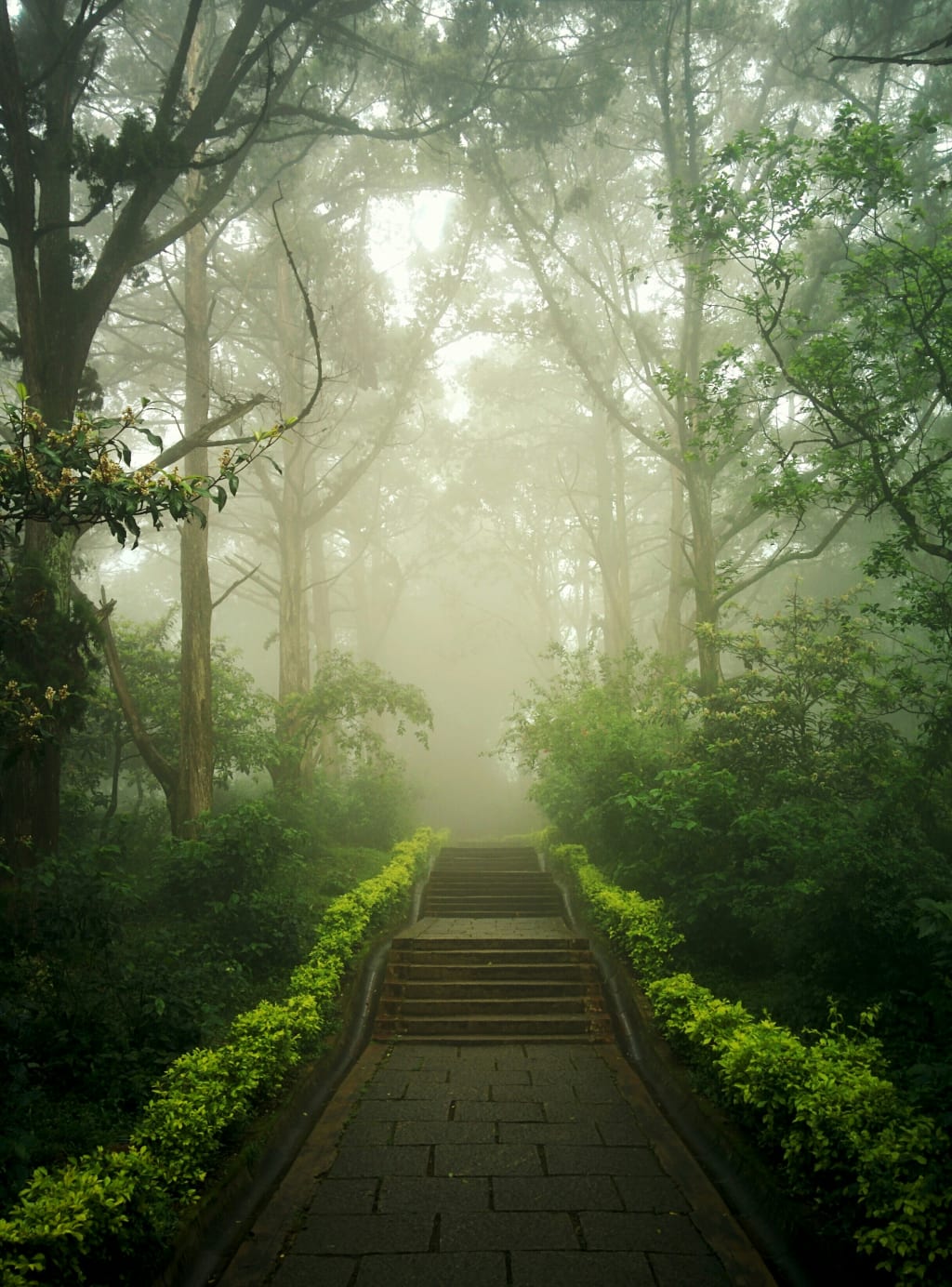
The mountain forest allowed only brief bursts of light to pass through the dense covering. Mindao gum trees, with bounteous leaves two palms wide, reached skyward, the legendary color-changing bark in mid-peel from rusted copper to bright emerald. Jutting and broken rock materialized out of the earth as if thrown by the hand of an ancient and angry god. The gray flecked stone split the light into an infinite array of stars hanging in the humidity. Dark holes in some of the larger outcroppings led to deeper worlds and different constellations.
Pai squinted, pressing drops of liquid salt out tight, puffy folds of skin. He found his voice. “How did I arrive here?” It immediately occurred to Pai that his first question was not: where am I? The dense forest felt familiar to him, though he knew he had never ventured this far… Was it north? He was scared, but not of the forest.
“It’s middle-meal time. They only feed us enough to keep us working. It’s best to eat even though dried elephant dung would taste better.” The thin boy looked around then went silent.
A parade of Jartas lumbered slowly forward with rock-full wagons. A lone, dark gray beast turned its tuskless head to Pailin and stared with a moist eye. He had never seen a Jarta before. And these, here in this forest, dragged their trunks on the ground, legs burdened by more than weight, and gray eyelids drooped over large gray eyes, sad and broken and searching. A man hit the animal with a long branch. A dark mass heavier than the elephant sat on the boy’s chest. With limited success, the boy’s body fought it off.
“Here,” the boy said, handing Pai a crudely carved bowl. “Follow in line.” The words landed on Pai as simply and dryly as they were spoken.
Pailin obeyed, still unsure of his place in this new world. Was this still the dream? he thought. Was there a dream at all? His head spun with faint fragments of the night before, of the storm, his mother on the porch, the wind and howling monkeys.
A fat, old man sloped a ladle full of a clear broth into Pailin’s bowl. The watery mixture would have hit the ground if not for a peculiar reflex in Pai’s arm. He rubbed his eyes and the gum trees, gray elephants and entrances to the mines came clearly into view as did the small children toiling from darkness. Were the stories true?
Pai winced someone struck his back with the same long stick that had struck the elephant. “Sit! Eat!” the man barked and raised the stick. Pai instinctively submitted.
“Randàn! See to the elephants!” another adult yelled. More voices. More ache.
The man with the stick sneered and went to the Jarta that had now fallen headfirst into the dirt, trunk splayed, single finger twitching for an act of kindness. That name echoed in Pai’s head. Randàn. And he would never forget that face. It was long and dark, appearing scratched by wind-blown sand. A fat nose, glued on upside down and pecked a dozen or more times by a bird’s sharp peak spayed mucus as he spoke. His right eye was missing, the socket sunken, skin ripped and then crudely sewn together and heartlessly sealed forever. Thin lips attempted to seal shut a mouth that roared more loudly than the takraw coaches during a losing match. The lips were losing the game as well.
Suddenly, Pai gasped, unable to inhale, lungs frozen. Violent muscle spasms expanded and contracted his rib bones, more pain. Purge pushed into his gut. The emptiness in his stomach roiled into an airy froth and a rancid scent bubbled up and escaped out his mouth and nose. Arms went numb and hands went cold. The boy’s thick legs grew in the earth, immobile. Hot energy rose up and stuck on his diaphragm, refusing to release. Understanding his circumstances, Pai dropped to the ground.
*****
Hands over his ears, Pai sat up amid a multitude of younglings, boney armed and weak-kneed, sagging skin the color of dry hakoni grass, dark eyes set in darker rings, and cracked hands covered in rock dust. He turned to the boy who had pulled him to his feet. “I’m Pai,” he whispered not knowing what to say, seeking a sign of benevolence or connection to this new world.
Those in charge shoved steaming rice, slabs of sliced meat resembling children’s fingers and fried taro root into their gaping, maotai-wet mouths, except Randàn, who elatedly worked the fallen elephant.
“Anurak,” the thin boy kicked back like a takraw ball.
Pailin fell into his thoughts. Images arose as he slurped the mealy insipid broth from the bowl, an attempt at boiled taro root. His mother had often prepared this dish with herbs and lemon and, of course, fully cooked as he knew raw taro could be poisonous. Pai wondered if the others knew. He gnawed at the taro liked an animal as his hunger supplanted safety as the primary instinct. He snipped off tuber bits with his teeth, swallowed softer pieces and spit out the raw. The ground was soft and deeply wet. There must have been a storm. It had been his birthday and there had been a storm. And mist. And men?
“Up!” Randàn beat the wounded elephant with the stick. The gray beast didn’t move. “Up you lazy bitch.” He struck again.
Pai stared at the overpowered elephant then realized he was alone in watching the grief of this animal displaying in front of him. Silence flooded his numb-cold mind while the children stared into their bowls and pawed at raw wood. Loneliness hurt. He started to go dark again. Pai was aware of the drifting off, the movement, but remaining surefooted in two places. As quickly as the power came, it was gone. Words tried to surface but jammed in his throat like too many boats squeezing through a river’s neck, bumping and turning and losing direction. So, he simply aped the other children. Then he felt a new river, warmer, like home.
The afternoon was warm and damp. Sweat beaded on the fine, adolescent hairs emerging on Pai’s upper lip. In the solitude, he remembered. The spiders had bitten him during the storm. He pulled up his pants leg. The marks were gone, his legs clean. Monkeys had howled, and from close by. He had eaten rice with duran fruit for his birthday. He had fallen off the porch and landed in a strange mist.
A burst of color broke his thoughts. For the first time, there were colors in his mind, like a field of freshly bloomed orchids waking in the morning’s dewy sun. Faces appeared, forlorn and beast-like, one morphing into the next until they became familiar. He saw his mother and father. Then there was a group of young faces, in school, listening. Somchai, their instructor, was mouthing words without sound, telling a tale to a rapt audience, and... Boom. Pai’s head exploded as the story slammed to its climax. He remembered. All of it. Clarity. Pai was a slave in the jade mines of Kujjala Forest. His world spun again.
**** *
“To work!”
Again, Pai’s ears woke first. This time, however, there was only one voice, the same voice that had ordered the ugly man to beat the elephant.
In silent unison the hordes of halflings stood. They quickly filed past bamboo baskets, let their dry bowls drop and disappeared into an abyss bleaker than their formless shadows
Pailin stood.
Anurak pressed on his back.
“No. No!” Pailin yelled through the lump in his throat. No one moved. He fell into the stream of small, ragged bodies with Anurak’s palm still guiding him. Over his shoulder, he could hear Randàn beating the poor Jarta. He slowly turned his head against his instince, forced by another hand, this one invisible. The poor animal lifted its trunk. Frustrated by the lack of agony, Randàn picked up a larger club and swung. The elephant howled, her trunk slamming silent in the dirt.
“NO!” Phailin spun and screamed in commiseration, and with a new voice. Randàn burned with a red heat, turning his face into a beaten eggplant. The elephant, its massive chest still heaving and tears dripping off its long eyelashes, raised and dropped her free front leg. The man stormed over to the young boy with faint freckles peppering his pudgy cheeks and an odd, single blue eye that seemed now to be glowing. He swung the club at his side as if building an energetic force with which to strike a fatal blow.
The other children, including Anurak, continued their march into the cave without care.
The club swung in a large arc as Randàn swaggered toward Pai, sputtering wet obscenities from a rancid face.
The forest floor darkened as a heavy black cloud blocked the sun.
Pai rubbed his burning left eye. He saw his mâe-mâe and phâa. He saw his grammy Raylai. He saw the poor Jarta, standing, now.
Suddenly a dark mass fell from the sky and landed on Pai’s left temple. A ripe pikifruit exploded.
**** *
“Is it true, phâa, that the water flows out the other side of the earth?” Pailin asked, massaging his left temple without reason.
Pai sat on the soft grass and watched the sun’s rays dance and sparkle on the rippling surface of Pôhkanaree Pond, an immense sky of deep, cold and very old waters that resembled, almost perfectly, the translucent blue-black night pearl. The sparkles fading and dying on the water reminded him of the fire-wands he waved at new year celebrations in Changmari as they burnt to ash. Pai stood up on strangely weak legs.
“What do you believe, Pai?” his father returned as he gently pushed a long, thin boat into the blue waters.
“All the other children say it is so.” As he spoke, a band of Gaju elephants emerged from the forest. Pai held a small, flat stone in his hand, turning it over and staring. It seemed to form part of his arm. His next breath stretched and filled his lungs with the clean wet scent of new life in the pond. Pudgy cheeks gave way to a grin.
“Come, step in,” his father said.
“They say even the best pearl divers can’t reach the bottom of the lagoon. And if you could hold your breath long enough, you would emerge in some far-off land with strange looking people.” Pailin wound-up and side-armed the smooth stone across the water, skipping it four, five and six times in ever shorter hops. On the seventh, the stone disappeared among the floating stars in the dark blue sky. Pai jumped into the boat, landing heavy and solid, and picked up an oar.
“And do you believe these children, the ones at school?”
“Yes. Or no. I don’t know.” Pailin scratched and shook his head. “They say a lot of things I don’t believe. Or think I shouldn’t believe.”
Pai’s father swiftly guided the boat through the openness of the pond, leaving a spreading-V of ripples in its dark wake. Birds flew quietly overhead.
“What do you see in the water?”
Pai hesitated with the request. His phâa and mâe-mâe swam in murky waters and often posed murkier queries of their son. This one felt murkiest. He pressed his mind to the floating islets adrift on the blue-black glass, an armada of wayfaring ships searching for a lost port. Pai remembered the stories from his childhood. The diminutive islands had broken free from mountain cliffs surrounding the lagoon, bobbling in the icy waters and passing their days in quiet reflection. Moss covered shrubs, acacias and buttercup trees covered the islands serving as nomadic sanctuaries for thousands of birds skipping from island to island as they made their way across the lake and on to places unknown.
It was a cool summer morning, and a heavy mist had covered the mountain lagoon like a thin blanket of lacey snow, slowly melting with the rising sun, sending swirls of spray heavenward. Now, only puffy clouds hovered over the blue waters, each billow taking a familiar shape: a giant geikko slithered; a buffalo mother coddled her cub; and baby elephants played in a misty mud.
Pailin’s father watched his son survey the world around him and smiled. “What do you see?” his asked again.
“Nothing. Just blackness.”
“That is something. Is it not?”
Frustration. “No, I see only blackness.” He looked harder but hardly looked at the water. Everything blurred, like trying to focus after waking up too early in the morning. He wiped his eyes with his silk sleeve. The sun threw halos, no pulses, down to the sky below. Dizziness fell over him. His left temple pulsed as well.
“The morning is long already and the sun high. We must see to our chores, Pai. Mother will be disappointed if we return with empty baskets.”
“Yes, phâa.”
Pailin’s father navigated to the leeward side of a nearby isle where white egrets flew overhead in a mirroring V-formation to the one that followed behind the boat. The pudgy boy and his father held out their lines. Sitting sidled on the sole bench in the center of the long canoe-like boat, the pair threw weighted silk threading across the water in harmonic undulations until the weights dropped and disappeared among the stars. It wasn’t long before Pai felt a slight tug on his line and started pulling.
On the far bank, a larger, darker elephant stood out among the white Gajus, heavy on its feet, staring with long, wet eyelashes. The gray creature lifted its trunk. Pai thought he saw a blue eye glare back at him as he rubbed his own. He recognized the elephant.
“Ah!” Pai screamed. A large school of flying fish shot out of the blue waters, some as far as thirty feet before diving back under, flitting wispy fins like wings, sparkling in the sun and rained water over the boy and his father.
“I would like to catch one of those!” exclaimed Pai.
“You cannot catch the fish that flies.”
“I bet you can, phâa.”
“I have never caught one, nor do I ever plan to catch one.”
“Why will you not catch the fish that flies? You catch all the other fish.”
The man sat still. “What do you see in the water?” he asked, smiling broadly while gently pulling his sagging silk line back into the boat in large loops.
“Nothing! I see nothing, like the time before. I don’t see anything in the water. It’s too dark.” Pai’s head felt as if he were trying to play takraw in a bowl bunflower honey.
The afternoon wore thin, and the sun was setting, casting long, eerie shadows from the floating islands like broken fingers scratching at the water’s surface. Pai’s father held an empty line and shook his head. The bone hook had been picked clean. He smiled. “Look again. Now what do you see in the water?” he repeated.
Exasperation. Pai stared without caring, making no attempt to focus or see. Was this resignation he was feeling or the heat of hate? Questions without answers. Over and over. Exhaustion. His neck gave up and his head dropped. His eyes tired with the blueness. Aching and throbbing. Pai wanted to gape blankly and parrot the same. Nothing. Even that felt too difficult a task. Expiration. Deep in the cold, dark water, tiny rings of light expanded like ripples from a stone dropped into a calm lake, growing larger, brighter. These rings did not originate from the sun above, but by something deeper below. The source hovered, neither sinking nor rising, but pulsating a yellowish glow in beats, like a heart, like his left temple, a thicker ring followed by a thinner, constant and relentless. The pairs of rings rose with the beating in his chest, matching the tempo and becoming enmeshed in his soul.
Pai’s body tingled, amassing a violent and troubling energy. He turned to his father, blank-eyed, and said, “I don’t see anything.”
His phâa smiled.
**** *
This time his ears weren’t involved. The voice came from inside Pai’s head. He heard the words in the darkness. He opened his eyes.
The tunnel was long, sloped and cooler as he descended in the line of stunted slaves. Torches lit the tight hall, dimmer and farther apart the further he followed. Wet dirt dried to stone and Pai quickly realized he was bare of feet. The cold touched him deeply from all points. The pathway narrowed, walls inching to his shoulders, rubbing, grinding, then scraping. In dying light, a small flame flickered at the far end of the tunnel. The scents of decay and sweat wafted from the recess, and Pai’s nostrils reacted irritably. One-by-one, children squatted, kneeled and crawled until they disappeared behind the pale light. Pai stopped and felt his weight, from the inside, as it moved and separated, somehow, from his body. Was he splitting? But his head screamed back. The calculus wasn’t difficult, the conclusion easily derived. Pom-Pai was too large to fit through the far hole.
A guard stared at him oddly, saying nothing. He appeared much older, closer to the fade than the adults outside the mine. The creases on his face, carved by time, sun and a life out of balance, reminded Pai of the beaten elephant.
Pai touched his left temple, dried blood flaked and fell in the darkness. His head tumbled as if flailing in a rushing river, unable to break free of the current, resigning to submission. Screams failed while powerful detached legs carried the boy closer to the ending. Something was wrong. Time had passed without his consent. Or had time stopped? His body felt foreign, thick and confused. He fell to his knees. Or was he pushed? The hall went black. Or did he pass out again? Bodies slid over wet skins; salt stung the scrapes on his hands. Chaos pushed into his chest with the force of a flying takraw ball. In his mind, he saw rotting corpses blocking his progress or escape. Coldness crushed his rib cage as a last breath left his lungs. This is how I die, the young boy played out in thought, here, confused, alone, a slave, and a single star. Gone were his mother’s embarrassed laughter, his father’s uncomfortable gaze and all that was before the storm. His body went numb save for the pulsations emanating from inside his left temple, behind his blue eye. Pai’s mouth gaped as if uttering a final, silent prayer.
Blue light flashed. Pai landed with a heavy thud and puff of dirt. He was in an immense space where groups of bodies huddled and hacked at walls with metal picks, creating a cacophony of clinking that penetrated the densest clouds in his head.
The room was well-lit. Anurak held one pick in his hand and presented a second to Pai. Tiny green stars sparkled from deep within the walls. Glowing. “How...” Pai lacked the strength to say more.
“You came in the night, like the rest of us.”
Confusion. Clanking. Clamor. Pai’s lips moved but his ears heard no sound.
“Emerald.”
“What?”
“The elephant. Outside. Her name is emerald.”
About the Creator
Jeffrey Scott
Writing is an adventure!
Keep reading
More stories from Jeffrey Scott and writers in Chapters and other communities.
Portals & Paths: The Nine Gems
Chapter 2: SEEDA Orange light rolled over the wet green hills east of Ayutaya as the morning’s first rays snuck through the final remnants of a storm limping after the night. The new sun struck the peak of the King’s Tower where Phra Ram diligently edited and reedited the plans for the Great Gathering as he had done for the previous three fulmoons. Sweeping layered roofs with gold gilding and upturned corners reflected the light into beams crisscrossing the palace compound. Outside the walls, morning mist covering Kandala’s capital city coalesced into warm dewdrops, and the inhabitants slowly emerged from their cool slumber to the heat of the Yellow Lands’ shores.
By Jeffrey Scott2 years ago in Chapters
The Guardian Chapter V
Alexander left his Coming of Age ceremony with Cronos and the elders with as many new questions as he had answers for his old questions. Cronos had confirmed his suspicions were correct. Not only was there a link between the Beast Masters and the inhabitants of the Citadel, but it was the Citadel's fault that the Beast Masters existed in the first place. Instead of banishing the law breakers which allowed them to wreak havoc on the rest of humanity, the Citadel elders should have stripped them of their powers before they became too strong. Now Alexander would need to battle the Beast Masters and the Jikininki. It would be difficult for him to forgive the Citadel Elders because their poor decisions led to the deaths of his parents and more than half the planet's human population.
By Mark Gagnon26 days ago in Chapters
A More Human Vocal
When we launched Vocal nearly a decade ago, the world was a very different place. LLMs did not exist, and stories were created one at a time by people sitting down to write, revise, and share something personal. Many of our assumptions about publishing, trust, and participation were built for a world where effort and output were inseparable.
By Justin @ Vocal7 days ago in Resources



Comments
There are no comments for this story
Be the first to respond and start the conversation.