

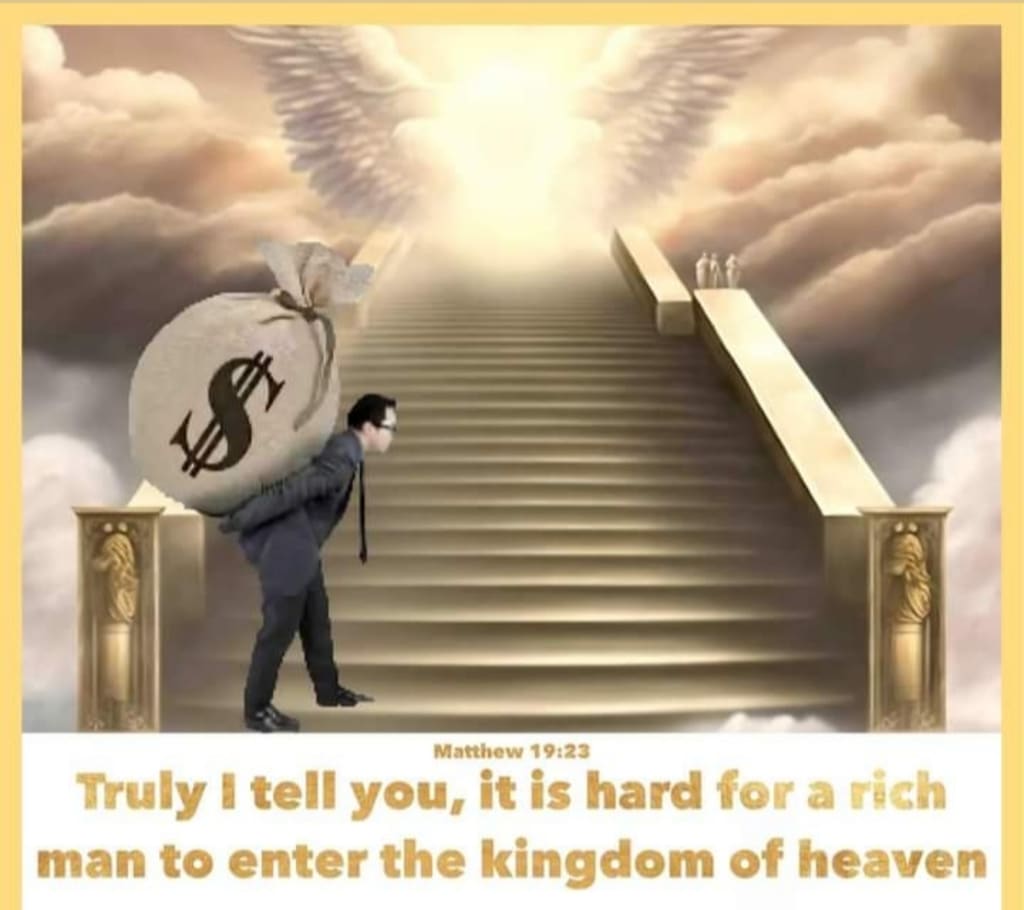
Matthew Chapter 19 of the New Testament is a significant chapter that covers several important teachings and events in the life of Jesus Christ. Here’s a summary that highlights the main points and themes of the chapter:
**1. Teachings on Divorce (Matthew 19:1-12):**
The chapter opens with Jesus leaving Galilee and traveling to the region of Judea, east of the Jordan River. As He begins to teach, Pharisees approach Him to test Him with a question about divorce: “Is it lawful for a man to divorce his wife for any reason?”
Jesus responds by referring to the creation narrative, emphasizing that marriage was instituted by God, who made humans male and female and said that a man should leave his father and mother and be joined to his wife, becoming one flesh. Jesus explains that what God has joined together should not be separated by humans.
The Pharisees question why Moses allowed for a certificate of divorce and the dismissal of a wife. Jesus explains that Moses permitted divorce because of the hardness of people’s hearts, but it was not so from the beginning. Jesus asserts that anyone who divorces his wife, except for sexual immorality, and marries another commits adultery.
The disciples respond to this teaching by suggesting that it might be better not to marry at all. Jesus acknowledges that not everyone can accept this teaching, but He explains that some are eunuchs because they were born that way, some were made eunuchs by others, and some have chosen to live as eunuchs for the sake of the kingdom of heaven. He concludes that only those who can accept this teaching should do so.
**2. Jesus Blesses Little Children (Matthew 19:13-15):**
Next, people bring little children to Jesus so that He might lay His hands on them and pray. The disciples rebuke them, but Jesus responds with displeasure and says, “Let the little children come to me and do not hinder them, for to such belongs the kingdom of heaven.” He lays His hands on them and blesses them before departing.
**3. The Rich Young Man (Matthew 19:16-30):**
A young man approaches Jesus and asks what good deed he must do to gain eternal life. Jesus tells him to keep the commandments. When the man asks which ones, Jesus lists several, including prohibitions against murder, adultery, theft, and false witness, and commands to honor father and mother and love one’s neighbor as oneself.
The young man claims he has kept all these commandments and asks what he still lacks. Jesus tells him that if he wants to be perfect, he should sell his possessions, give to the poor, and follow Him. The young man goes away sorrowful because he has great wealth. Jesus comments on the difficulty for a rich person to enter the kingdom of heaven, using the analogy of a camel passing through the eye of a needle to illustrate this challenge.
The disciples are astonished and ask who then can be saved. Jesus replies that with man this is impossible, but with God, all things are possible. Peter then remarks that they have left everything to follow Jesus and asks what they will have. Jesus promises that the twelve disciples will sit on twelve thrones, judging the twelve tribes of Israel. He concludes with a statement about the reversal of fortunes in the kingdom of heaven, noting that many who are first will be last, and many who are last will be first.
**Summary:**
Matthew 19 addresses key aspects of Jesus’ teaching on marriage and divorce, the importance of embracing the kingdom of heaven with childlike faith, and the challenge of wealth in relation to spiritual commitment. It underscores Jesus' commitment to upholding the sanctity of marriage, His openness to children, and His call to radical discipleship. The chapter highlights the contrasting values of the kingdom of heaven, where material wealth and social status are redefined, emphasizing humility, generosity, and unwavering trust in God.
About the Creator
Danny Prem kumar
A vision is our long-term goals and aspirations for the future in terms of its long-term growth and impact on this world. My mission defines what we do and what we stand for, while our vision speaks to our goals and ideals for the future.
Keep reading
More stories from Danny Prem kumar and writers in Chapters and other communities.
Psalm Chapter 84
Psalm 84 is a profound and evocative hymn of praise found in the Book of Psalms in the Bible. This chapter is attributed to the sons of Korah, who were known for their musical and liturgical contributions in the temple worship of ancient Israel. The psalm is often recognized for its deep longing for the presence of God and its celebration of the joy and blessings found in worshiping Him. Here is a detailed summary of Psalm 84:
By Danny Prem kumar2 years ago in Chapters
Valentine's Dates Over the Years
Colin grinned as Brooklyn slipped into the living room. “Is it all set?” he asked. The twenty-one year old grinned. She was in her last year of college and Colin knew that Lincoln was proud of her. Although she had been away at college, she’d eagerly helped Colin plan his surprise for Lincoln. “I’m so glad you’re finally doing this,” she said.
By Reb Kreyling18 days ago in Chapters
Albert Einstein: The Genius Who Changed the Universe
Albert Einstein (14 March 1879 – 18 April 1955) was a German-born theoretical physicist whose ideas transformed our understanding of the universe. Best known for the theory of relativity and his mass–energy equivalence formula E = mc², Einstein’s work laid the foundation for modern physics. He also made groundbreaking contributions to quantum theory, statistical mechanics, and cosmology. In 1921, he received the Nobel Prize in Physics for his explanation of the photoelectric effect, a discovery that would pave the way for quantum mechanics.
By Haroon Pasha4 days ago in Chapters




Comments
There are no comments for this story
Be the first to respond and start the conversation.