
King David Aghmashenebeli
The Builder of Georgia's Golden Age


Early Life and Ascension to the Throne
Born in 1073 into the Bagrationi dynasty, David became king at just 16 years old after his father, George II, abdicated during a time of crisis. Georgia was fragmented, facing invasions from the Seljuk Turks and internal dissent. David inherited a weakened kingdom but quickly proved to be a capable and determined leader.
Military Reforms and Victories
David recognized that a strong military was essential for the survival and growth of his kingdom. He implemented several groundbreaking reforms:
1. Creation of a Professional Army: David established the Mona-Spa, a professional military force composed of Georgian soldiers and recruited warriors from abroad, particularly Kipchak mercenaries.
2. Liberation Campaigns: He led a series of successful military campaigns to reclaim Georgian territories occupied by the Seljuk Empire.
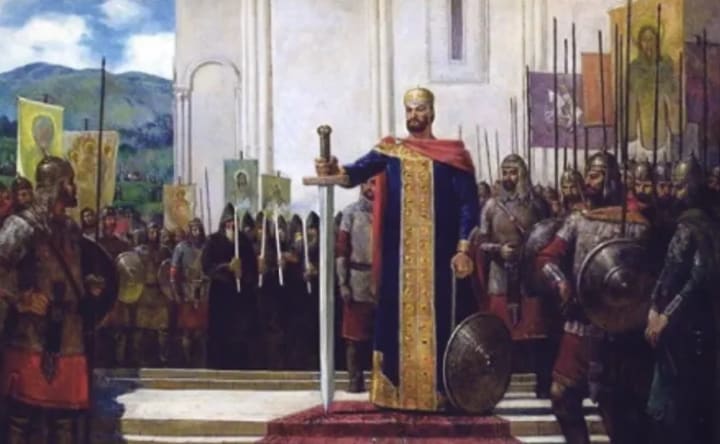
The crowning achievement of his military career was the Battle of Didgori in 1121. David’s forces decisively defeated a massive Seljuk army, securing Georgia’s independence and opening the path for expansion. This victory earned him the title Aghmashenebeli or “the Builder.”

Political and Administrative Reforms
David was not only a military leader but also an astute statesman. He implemented reforms that strengthened Georgia’s governance and unified its people:
1. Centralization of Power: David curbed the influence of regional feudal lords and established a strong, centralized monarchy.
2. Economic Development: He encouraged trade and improved agricultural production, fostering prosperity.
3. Religious Tolerance: David promoted unity by respecting the diverse religious communities within his kingdom, including Muslims, Armenians, and Jews.
Cultural Flourishing
Under David’s reign, Georgia experienced a cultural renaissance. He was a patron of the arts and education, fostering the growth of literature, architecture, and theology:
1. Construction of Monuments: David oversaw the construction of numerous churches and monasteries, including the Gelati Monastery, a UNESCO World Heritage Site. This monastery became a center of learning and spirituality, housing scholars and theologians.
2. Literary Achievements: His reign inspired a flowering of Georgian literature, with works emphasizing themes of national pride and religious devotion.
Religious Leadership
David was deeply religious and saw himself as a servant of God. He strengthened ties with the Georgian Orthodox Church and promoted its growth as a unifying institution. The Chronicle of Kartli, written during his time, describes him as a wise and devout leader who prioritized the spiritual well-being of his people.
Legacy and Impact
King David Aghmashenebeli’s contributions to Georgia’s history are unparalleled. By the time of his death in 1125, he had transformed Georgia from a fragmented state into a powerful and unified kingdom. His leadership laid the groundwork for the reign of his successors, including his granddaughter Queen Tamar, under whom Georgia’s Golden Age would reach its zenith.
David’s achievements continue to resonate in modern Georgia. His legacy is celebrated in literature, art, and public monuments, and his image is a symbol of national unity and pride.
King David Aghmashenebeli was a visionary ruler whose military prowess, political acumen, and cultural patronage elevated Georgia to its historical zenith. His reign remains a testament to the enduring spirit of the Georgian people and their ability to triumph against adversity. Today, David the Builder is not just a historical figure but a revered icon of Georgia’s past, embodying the ideals of courage, wisdom, and leadership.
About the Creator
Keep reading
More stories from Gus Woltmann and writers in Chapters and other communities.
The Essence of Chinese Culture
Chinese culture, one of the world’s oldest continuous civilizations, is a rich mosaic of traditions, philosophies, art, and customs that have evolved over millennia. Its profound influence extends beyond its borders, shaping the cultures of East Asia and inspiring the global community. With a history spanning over 5,000 years, Chinese culture is deeply rooted in harmony, respect for ancestors, and the pursuit of balance in life.
By Gus Woltmann4 months ago in Chapters
The Cave Part 6
If you have ever heard a tale about yourself that you cannot remember and doubtless think is made up, you will know how I felt when Tharkin related all that the eagle had seen of me before my memories were scattered. Of far distances and traveling companions that I did not recall, camping out under the stars and making our way to the mountains with deliberate purpose. The great bird had lost contact with my party once we entered the forests, and the seven other members were not seen again by him or his brethren since.
By Jamye Sharp22 days ago in Chapters
Cassian-13: Prologue
Cassian-13: Chapter Links (Follow the story easily here) Prologue “Why do I sense your hesitation?” Dr. Phillip Tenzen dabbed the sweat off his brow with the back of his right hand as he held the clipboard in his left. “Well, it’s just that he, uh, doesn’t fit the psychological profile of, uh…”
By Jean-François Lamothe2 days ago in Chapters




Comments