
H.H. Holmes: The Murderer Who Built a House of Horror
Inside the Mind of America’s First Serial Killer

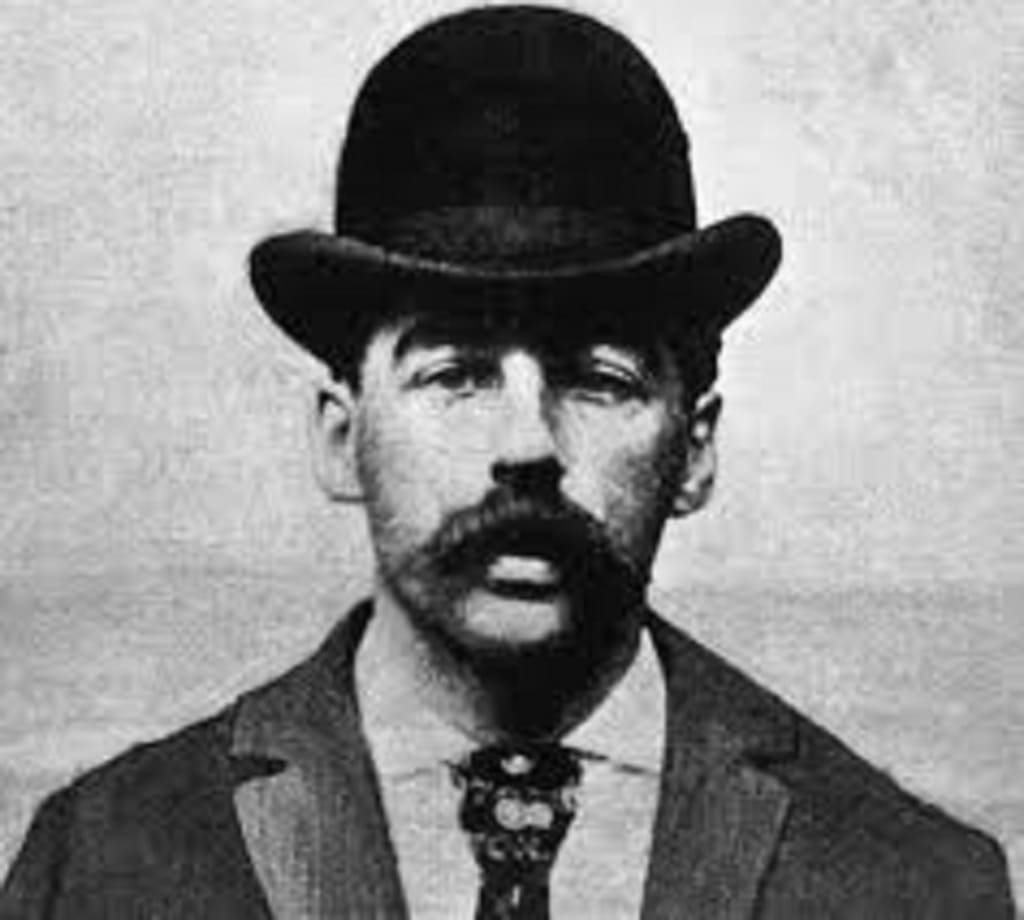
H.H. Holmes, born Herman Webster Mudgett, is considered one of the first modern serial killers. Operating during the late 19th century, Holmes used his charm, intelligence, and cunning to lure victims into his deadly trap. Holmes, who is famous for building the infamous "Murder Castle" in Chicago, is thought to have killed at least twenty people, though some estimates say it could have been much higher. This is the complete story of H.H. Holmes, from his childhood through his crimes, the infamous "Murder Castle," his capture, and one of America's most chilling killers' lasting legacy. Early Life: A Troubled Beginning
Herman Webster Mudgett was born on May 16, 1861, in Gilmanton, New Hampshire. Holmes, the son of a successful farmer, had a difficult childhood marked by his controlling and abusive father. Growing up, he was described as a bright and inquisitive child, but his behavior was often erratic and disturbing. Even at a young age, he showed a cold, calculating side and was known for bullying other children. Holmes attended Phillips Exeter Academy, a prestigious New England school, where he studied medicine. Afterward, he went on to the University of Michigan, where he received a medical degree in 1884. It was here that he began to exhibit the traits that would define his adult life—manipulation, deceit, and a lack of empathy for others.
The Beginning of His Criminal Career
Holmes moved to Chicago in the late 1880s after finishing his education, where he would open the infamous Murder Castle. However, before becoming a full-fledged killer, Holmes was involved in a series of smaller criminal activities. He used fake names and stolen identities to defraud people of money and commit fraud and embezzlement. Additionally, he was accused of grave robbery, in which he used the dead for his medical experiments. Holmes had also begun to become deeply obsessed with death and human anatomy by this point, which would later fuel his horrific crimes. He is believed to have been involved in several deaths during this period, though they were not definitively linked to him until later investigations.
Building the Murder Castle: A Place of Death
Holmes built what would later become known as the "Murder Castle" after purchasing a property in Chicago's Englewood neighborhood in 1889. The structure was designed with hidden passages, trapdoors, soundproof rooms, and secret stairways, making it an ideal location for someone intent on hiding their crimes. The building’s complex architecture was said to have been specifically constructed to disorient and trap victims.
The "castle" was a three-story hotel that Holmes opened in 1893, coinciding with the World’s Columbian Exposition in Chicago, which attracted thousands of visitors to the city. This presented Holmes with the perfect opportunity to use his establishment as a front for his killings. Many of his victims were young women, lured into the hotel under false pretenses, and he used a variety of methods to kill them.
The Murder Castle: A Horror in Plain Sight
Holmes' Murder Castle was like a house of horrors. It contained:
Soundproof rooms designed to keep victims’ screams from being heard.
Trapdoors that led to hidden chambers where bodies were disposed of.
Gas chambers where victims could be suffocated or asphyxiated.
Chambers for dissection where Holmes could perform gruesome experiments on his victims’ bodies.
It is said that Holmes used a secret basement to dissect and dispose of his victims' bodies. He even made money by selling body parts to medical schools in some instances. The structure itself became a nightmare maze, designed to confuse anyone who might attempt to escape.
The Victims: Who Were They?
Holmes’ victims were often young women who had been lured to his hotel under the guise of employment, marriage, or other false promises. He had many victims who were out-of-town visitors who had come to Chicago for the World’s Fair and stayed at his hotel, trusting the charming and well-spoken Holmes.
The total number of victims is unknown, but most experts agree that he killed at least 20 people during his rampage. Estimates range from 20 to 200. Holmes would often kill by suffocation or poison, though he also used physical torture and dissections on some victims. He was known to be a master manipulator, and many of his victims trusted him because he held a position of authority as a doctor.
The Capture of H.H. Holmes
Due to a combination of police investigations and Holmes' own growing recklessness, his crimes began to unravel in 1894. He was initially implicated in a life insurance scam when he murdered a business partner named Benjamin Pitezel and tried to collect a fraudulent life insurance claim. This eventually led to the involvement of authorities.
Holmes had attempted to use Pitezel's children to advance his criminal activities; however, while he was attempting to flee, a detective by the name of Frank Geyer located him and located the Pitezel family's remains, establishing a connection between them and Holmes. Geyer’s investigation led him to uncover Holmes’ murderous activities, and in 1895, Holmes was arrested in Boston.
During the investigation, Holmes confessed to the murders of 27 people, though the exact number remains uncertain. He was tried for the murder of Benjamin Pitezel, and in 1896, he was convicted and sentenced to death.
The Trial and Execution
Holmes' trial was sensational and garnered widespread media attention. He was found guilty of Pitezel’s murder and was sentenced to death by hanging. On May 7, 1896, he was executed at the Philadelphia County Prison. His final words were reportedly, "I am innocent, but I could not prove it."
After his death, it was revealed that Holmes had left behind a trail of chaos, death, and deception. His "Murder Castle" was partially demolished, though some parts of it still exist. The site where the castle once stood is now the location of a post office in Chicago.
Holmes's Legacy: The Dark History of the Murder Castle The background of H.H. Holmes has become part of American folklore and a symbol of the dark side of human nature. One of history's most notorious crime scenes, "Murder Castle" by him serves as a chilling reminder of the evil that can hide behind a charming facade. Holmes' legacy has inspired numerous books, documentaries, and films. He is often regarded as one of the first modern serial killers, predating others like Ted Bundy and John Wayne Gacy. The mystery surrounding his true number of victims continues to fascinate true crime enthusiasts and historians alike.
Was H.H. Holmes America's First Serial Killer?
While Holmes is often considered one of the first modern serial killers, there are other figures in history who might also fit the profile. Some argue that Holmes' methods were unique due to his combination of medical knowledge and psychological manipulation. He preyed on vulnerable people in a very calculated way, and his ability to escape detection for so long was a reflection of his intelligence and ability to blend into society.
It’s also important to note that Holmes’ crimes were committed during an era where criminal investigation methods were not as advanced as they are today. Holmes’ ability to manipulate the system, his charm, and the complexity of his “Murder Castle” made him difficult to apprehend.
Conclusion: A Legacy of Horror
H.H. Holmes’ story is one of calculated cruelty, manipulation, and murder. His Murder Castle remains one of the darkest and most disturbing crime scenes in American history. Despite the fact that his exact number of victims may never be known, his legacy as a cruel and calculated killer cannot be denied. He is remembered not just as a murderer, but as a man who used intelligence, charm, and cunning to manipulate the world around him, hiding his darkness behind the façade of a respectable doctor and businessman.
The case of Sherlock Holmes is still a chilling reminder of the horrors that can occur when a person is allowed to operate unchecked in society and the potential for evil to be concealed even beneath the most mundane surfaces.
About the Creator
Keep reading
More stories from Shahadat Hossain and writers in Chapters and other communities.
Jeffrey Dahmer: The Milwaukee Cannibal – A Full History of a Serial Killer
Jeffrey Dahmer is one of the most infamous serial killers in American history—his name synonymous with horror, depravity, and the darkest corners of the human psyche. Nicknamed "The Milwaukee Cannibal," his crimes shocked the world not only for their brutality but also for their disturbing psychological undertones. Between 1978 and 1991, Dahmer murdered 17 young men and boys, committing acts of necrophilia, dismemberment, and cannibalism.
By Shahadat Hossain11 months ago in Chapters
How Reading Affects the Brain
Reading is more than just a way to pass time or absorb information — it’s a workout for the brain that can shape how we think, feel, and understand the world. Scientists have long studied the effects of reading on the brain, and the findings reveal that this simple act can have profound neurological, emotional, and cognitive benefits. Here’s a closer look at how reading influences the brain.
By Gustavo Woltmanna day ago in Chapters




Comments
There are no comments for this story
Be the first to respond and start the conversation.