
From the Log of HMS Thunder (Ten)
A Shooting of the Guns


⸻
Scene: The South China Sea – The Dreadnought’s Opening Salvo
The pirate stronghold at Black Lotus Inlet had plagued British merchants for years. Junks swept out of the fog like ghosts, grappling hooks flashing through the air, crews armed with rusted muskets and curved boarding blades. Entire convoys had disappeared.
That morning, however, the sky over the inlet turned gray with coal-smoke as HMS Thunder Britain’s first uranium-salt–core dreadnought—rounded the headland.
The pirates jeered at first.
Ships that size were slow.
British captains were predictable.
Cannons spoke louder than flags.
So they fired.
A full broadside—thirty-odd iron cannonballs arcing through the sky like hailstones hurled by the gods.
They struck the dreadnought’s ironclad hull with ringing, metallic CLANGS that echoed across the entire harbor.
Some balls shattered.
Some flattened.
None penetrated.
The ship’s sides glowed only faintly where metal kissed metal.
A silence rolled across the pirate decks.
An entire way of war—gone in an instant.
Up in the gunnery tower, the pneumatic computation engine clacked and hissed. Brass pistons calculated distance, wind drift, bearing. Slide-rule co-processors rattled. Pressure gauges quivered as the uranium-salt boiler pulsed like a beating heart.
Steward watched from its telegraphic link in the Ministry, data streaming in parallel blocks. Not the roar of cannon, not the heroics—just vectors, impact angles, telemetry, probability curves.
Pattern recognized:
“Offensive capability of local forces: obsolete.
Response time: optimal.
Commence counter-action.”
On the deck, the Captain lifted a single hand.
“Fire.”
The dreadnought answered with a thunder that shook the mountains.
Massive shells screamed from her guns—white streaks of chemistry, mathematics, and industrial ambition.
When they hit the shore batteries, the earth itself seemed to recoil. Traditional wooden fortifications disintegrated. Pirate junks burst into flame. Men dove into the sea as shockwaves rolled over them like invisible fists.
In less than three minutes, the harbor was a smoking ruin.
Piracy at Black Lotus Inlet—an institution for generations—ceased to exist before the smoke even cleared.
Across Asia’s ports, rumors spread faster than ships could sail:
“The new British ship cannot be scratched.”
“Cannonballs bounce off it.”
“Its guns can erase a city block.”
And in London, Steward simply filed the data.
Systemic threat: neutralized.
Demonstration: successful.
Paradigm shift: confirmed.
⸻
Scene: Message on the Strait
Evening fog clung low over the strait as HMS Thunder made her approach toward the friendly port of Lisbon. The great ship moved with slow, deliberate majesty, her screws turning just enough to keep steerageway. The watch bill for harbor entry had been executed flawlessly: the Harbor Stations had been set for nearly thirty minutes. The Forward Duty Watch stood ready on the foc’sle, eyes sweeping the narrowing channel; the Aft Duty Watch mirrored them at the quarterdeck. On the bridge, the Officer of the Watch, Lieutenant Harland, kept one hand on the rail and the other on his binoculars, overseeing the Quartermaster’s slow adjustments to the helm.
The sun was a dying smear of orange behind the hills. A peaceful evening. A friendly port. Nothing unusual.
“One bell, Second Dog Watch. Harbor stations manned and ready.”
The Messenger of the Watch, a young, wiry seaman named Duff, burst up the ladder to the bridge wing, breathing hard but maintaining his formality. He snapped a salute, arm rigid, and held out a folded paper slip.
“Signal from the Radio Room, sir. Highest priority.”
Harland frowned—the radiomen never used runners unless something was wrong.
He unfolded the slip. Duff continued, voice uncertain:
“Origin unknown, sir… but it carries Admiralty cipher prefix Hawthorn One.”
Harland’s head snapped up.
Hawthorn One was a restricted codeword prefix used only for threats to crown vessels—never cargo inquiries, never diplomatic chatter, never routine harbor approach communications. Whoever sent this, whoever they were, had access to the most guarded signal protocols in the Empire.
Harland read the message.
Four lines.
No signature.
PLOT TO ATTACK HMS THUNDER.
COAL BARGE IDENTIFIED AS THREAT.
DO NOT ALLOW APPROACH.
ORIGIN CLASSIFIED.
A chill spread down Harland’s spine.
He folded the slip and turned to Duff.
“Messenger—fetch the Captain. Double quick.”
Duff saluted sharply and vanished down the ladder.
Harland tried to steady his breathing. Unknown origin. Proper prefix. He had read enough Admiralty cipher instructions to know that this could not be a prank or a mistake. Someone—somewhere—knew something.
Before he could think further, a shout erupted from the foc’sle.
“Bridge! Forward Watch reporting! Unknown coal barge dead ahead, crossing our bow at close range!”
Harland strode out to the bridge wing and raised his binoculars. The strait curved slightly ahead, and out of the mist emerged a low, broad-bellied coal barge. No lanterns hung from its mast. No men moved on its deck. It drifted sideways across Thunder’s designated approach lane.
A dangerous maneuver in a narrow strait at the best of times.
Harland’s voice was sharp:
“Quartermaster, reduce to bare steerage! Lookouts, keep your glass on that barge!”
“Aye, sir!”
From shore, the harbormaster’s station began signaling frantically with lamps:
ALTER COURSE! GIVE WAY!
YOU ARE IN A RESTRICTED CHANNEL!
The barge did not respond. It continued its slow, determined drift.
Bootsteps clamored up the ladder again. The sound preceded the Captain by half a second. As his cap cleared the coaming, the Quartermaster snapped his heels together as the Bosun’s Mate sang out:
“Thunder on the Bridge!”
Conversation ceased instantly. Every man came to attention until the Captain gave the curt nod:
“Carry on.”
“OOW, report.”
Harland handed him the slip. Ransome read it once, then lifted his binoculars.
The barge swayed in the swell, empty as a tomb.
The Captain’s voice hardened.
“Officer of the Watch—confirm that vessel is ignoring both our signals and the harbormaster’s.”
“Confirmed, sir.”
“Forward Duty Watch—any signs of crew?”
A shout came back through the speaking tube:
“None, sir! Deck appears deserted!”
Ransome lowered his glasses.
“Very well. Officer of the Deck—pass the command.”
Harland stepped to the voicepipe leading to the ship’s internal comms.
“Gunnery Control, Bridge.
Stand by.”
The line crackled.
“Gunnery Control here.”
Harland spoke clearly, deliberately:
“By order of the Captain: unidentified coal barge is now designated TARGET.
Gunners’ mates to stand ready with five-inch secondary battery.
Awaiting firing order.”
Below decks, gears clacked and boots hammered. The five-inch crew would be loading shells even now—one man fetching the charge, another the shell, the breechman checking the block, the trainer spinning the horizontal wheel to bring the gun onto the barge’s silhouette.
The Captain moved to stand behind the Quartermaster.
“Steady as she goes. Keep her centered.”
“Aye, sir.”
The barge grew closer—no change of speed, no attempt to turn away, no lanterns.
It wants to die, Harland thought.
The Captain gave his final order without hesitation:
“Officer of the Deck—signal Gunnery.”
Harland lifted the voicepipe again.
“Gunnery Control—Bridge.
Captain’s order: engage the target.”
A single reply came back, crisp:
“Aye, Bridge. Engaging.”
On the starboard side, Gun Two of the secondary battery erupted with a concussive blast.
The shell hit the barge amidships.
The world became fire.
The explosion was enormous—far beyond what coal dust should allow. A towering fireball tore the barge apart, sending a column of flame and smoke roaring skyward. The shockwave rippled across the harbor, rattling windows on the waterfront and slamming into Thunder like the blow of a giant’s fist.
Fragments of steel and timber rained into the sea.
Silence held the bridge for several seconds. Only the crackle of burning debris and the distant cries of startled gulls broke the stillness.
The XO stepped closer to the Captain, voice low.
“Sir… that barge would have crippled the ship. The message saved us.”
Captain Ransome did not look away from the drifting smoke.
“Yes,” he said quietly. “But I want to know who sent it.
And how they knew.”
He glanced at the folded slip in his hand.
It was unsigned. Marked “origin classified.”
Yet it had carried the perfect prefix.
Ransome spoke again, firm and cold:
“Officer of the Watch—log the incident.
And send a copy to the Admiralty with immediate priority.”
He paused.
“Someone out there is watching over us.
Or watching them.”
About the Creator
Mark Stigers
One year after my birth sputnik was launched, making me a space child. I did a hitch in the Navy as a electronics tech. I worked for Hughes Aircraft Company for quite a while. I currently live in the Saguaro forest in Tucson Arizona
Keep reading
More stories from Mark Stigers and writers in Chapters and other communities.
The Launch of the HMS Thunder (Nine)
⸻ Scene: The Launch of the First Dreadnought Portsmouth Naval Yard – Dawn The fog over the dockyards glowed faintly gold as the sun struggled through the mist. Flags cracked in the wind—Union Jacks strung from cranes, gantries, and the sharp prow of the newest pride of the British Empire. Thousands had gathered: nobles in furs, ministers in their stiff collars, naval officers polished to blinding shine. Reporters jostled for positions. Photographers prepared their plates.
By Mark Stigers 3 months ago in Chapters
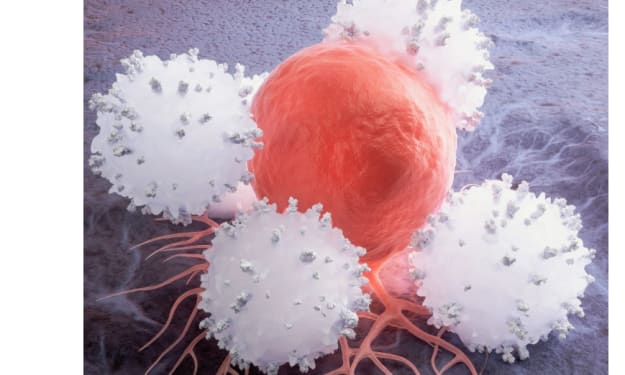
Coffee may eventually turn cancer treatments on and off.
Without thinking twice, the majority of us reach for coffee. Scientists are now transforming that well-known shock into something even more accurate: a switch that can regulate gene editing within living cells.
By Francis Dami2 days ago in Chapters
Pearl
1980 something. we all hung out at Pearl and you and i were nothing special, or so i thought. i mean we all danced, drenched in our own sweat, our own saline solution of fear, too many beers, shots, laughter, tears, fucks in the bathroom and i don't know when we began to be afraid. do you?
By ROCK aka Andrea Polla (Simmons)7 days ago in Fiction



Comments
There are no comments for this story
Be the first to respond and start the conversation.