
ChatGPT Replaced My MVP Team and App Sold for $320K
ChatGPT
Claude and ChatGPT as the Fastest MVP Developers
When a U.S. founder turned to Claude and ChatGPT, software delivery changed overnight. These language models handled tasks once requiring a team — drafting, testing, and iterating — and the result was a $320K app sale.
The story highlights how artificial intelligence can reshape the way startups approach building minimum viable products (MVPs). Instead of relying on expensive teams and long timelines, one founder demonstrated how fast and affordable development could become with AI.
ChatGPT — From Idea to Prototype
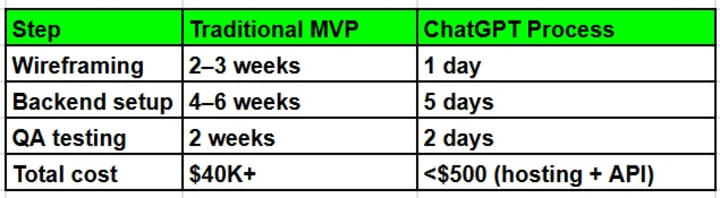
Ethan, a 31-year-old developer in San Diego, had an idea for a SaaS tool but no budget for a team. Hiring even a small MVP crew — designer, backend developer, and QA tester — would cost him at least $40K. For an independent founder with limited resources, that figure was daunting.
Instead of waiting for funding or searching for a co-founder, Ethan decided to see whether AI could take on the workload of an entire MVP team. His challenge was bold but clear: build a functioning SaaS app in just three weeks with minimal outside help.
The result was surprising even to him — not only did he finish the app in under 20 days, but he also managed to sell it in a micro-acquisition deal worth $320K.
ChatGPT as a Designer
The first hurdle was design. Ethan wasn’t trained in UI/UX, but he knew an unattractive or confusing interface could doom his app from the start. Instead of hiring a designer, he turned to ChatGPT.
Prompt he used:
"ChatGPT, creates a wireframe outline for a SaaS dashboard that helps freelancers track client invoices. Include navigation structure, core components, and color palette ideas."
ChatGPT produced wireframes, user experience suggestions, and even CSS snippets. While a designer might have needed two weeks to deliver a polished layout, Ethan had one ready in just a day. It wasn’t perfect, but it was functional and user-friendly enough to move forward.
ChatGPT as Backend Dev
The next obstacle was the backend. Traditionally, setting up an API, authentication, and payment processing would require weeks of coding and debugging. Ethan decided to see if ChatGPT could accelerate this process.
Prompt:
"ChatGPT, generates a Node.js + Express backend API with endpoints for user authentication, invoice creation, and Stripe payments. Add JWT authentication and error handling."
Not only did ChatGPT provide the necessary code, but it also explained the logic behind each section. Ethan could then refine the code, test it, and adjust quickly. What might have taken a backend developer four to six weeks, Ethan completed in five days.
ChatGPT for QA Testing
Testing often becomes the slowest part of the MVP cycle. Manual QA requires carefully checking edge cases, repeating scenarios, and logging bugs. Ethan again relied on ChatGPT.
Prompt:
"ChatGPT, create automated Jest tests for the invoice API, including edge cases (invalid user ID, empty payload, failed payment)."
The AI produced automated test cases that immediately flagged bugs before launch. This step alone saved Ethan weeks and gave him confidence in the product’s reliability.
From Prototype to Pitch
By the end of 19 days, Ethan had:
A functional SaaS app
A landing page with copy written by AI
Email outreach scripts for potential buyers
With his app and materials ready, he contacted investors. One conversation quickly led to an acquisition deal. In less than a month, he transformed an idea into a six-figure exit.
Before vs After AI
Going Beyond One AI Model
Although ChatGPT was his primary tool, Ethan soon realized that relying on just one model limited him. By incorporating other AI systems like Claude, Gemini, and Perplexity into his workflow, he could compare outputs and refine them into stronger results.
This multi-model approach worked like an informal “AI team,” where each tool had strengths: one might generate code, another polish copy, and another refine a pitch deck. Combining them meant Ethan didn’t just save time — he increased quality without additional expense.
This strategy became especially valuable when preparing investor-facing materials. Polished pitch decks, refined outreach emails, and smoother presentation notes gave Ethan an edge, ensuring that his product looked professional even without a traditional team behind it. He later experimented with a tool called Chatronix as part of his workflow.
Bonus Prompt for Founders
One of Ethan’s favorite techniques was using structured prompts that treated AI like a full development crew. For example:
"ChatGPT acts as a full MVP team. Generate wireframes, backend code, test cases, and a 14-day build schedule for a SaaS app that tracks freelancer invoices. Each output should include actionable steps and dependencies."
He often layered prompts across different models, asking one to generate, another to refine, and a third to check for gaps. This made the process feel less like working with a single assistant and more like managing a small team of experts.
Final Takeaway
Ethan’s story shows what’s possible when creativity meets emerging technology. He didn’t just build faster — he proved that AI can stand in for an MVP team during early validation. Instead of burning $40K on a prototype, he produced and sold a product for $320K in less than a month.
For founders and creators, the lesson is clear: with the right structure and prompts, anyone can ship, test, and even sell without waiting on a traditional team. AI may not replace human talent in every case, but as Ethan discovered, it can be enough to turn an idea into a business — faster and cheaper than ever before.
About the Creator
Keep reading
More stories from Zair Fateh Ali and writers in Chapters and other communities.
The Oasis reunion tour has finally arrived in North America. Was it worth the wait?
The Verdict: After 16 years of bitter feuds and broken promises, the Gallagher brothers' North American reunion shows prove that some things are worth the wait—even when Mother Nature tries to steal the spotlight.
By Zair Fateh Ali7 months ago in Futurism
The Cave Part 6
If you have ever heard a tale about yourself that you cannot remember and doubtless think is made up, you will know how I felt when Tharkin related all that the eagle had seen of me before my memories were scattered. Of far distances and traveling companions that I did not recall, camping out under the stars and making our way to the mountains with deliberate purpose. The great bird had lost contact with my party once we entered the forests, and the seven other members were not seen again by him or his brethren since.
By Jamye Sharp27 days ago in Chapters
The Conduit: Chapter I7
Chapter 17 Jonas and Anu were exhausted. They searched through the mountain structure from one end to the other as they looked for another way into the prison area. The two were getting ready to stop when Anu noticed something along the wall. She stopped Jonas and let out a sigh of frustration. Standing there, staring at the white smudge on the stone carved wall, she took a seat on the ground and started going through her bag.
By Jason Ray Morton 6 days ago in Chapters
TUS NUA - ch 53
TUS NUA – ch 53 New Beginnings – Mia and Midnight (*)(*)(*) Finola knew Ali’s brother-in-law needed to put his mind at rest. She fed her arm through his and led him outside. “We’ll sit here. If you like, I can put a block around us so our conversation will be private.”
By Margaret Brennan6 days ago in Fiction




Comments
There are no comments for this story
Be the first to respond and start the conversation.