
Bangladesh Election 2026: BNP Victory Signals New Era for Pakistan-Bangladesh Relations and Regional Power Shift
Can Bangladesh Balance Relations with Pakistan and India?

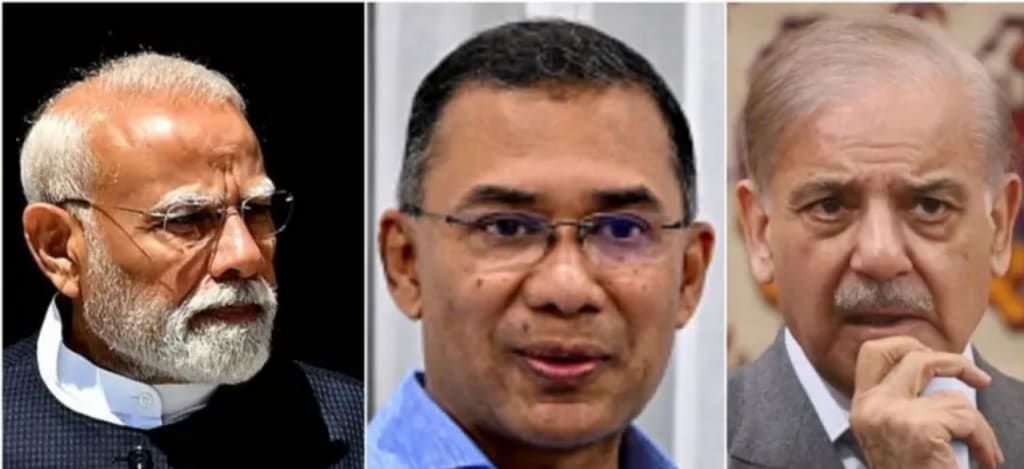
After the Bangladesh Nationalist Party (BNP) won Bangladesh’s general elections, the likely prime minister Tarique Rahman has been receiving congratulations from world leaders. Pakistan’s Prime Minister Shehbaz Sharif also expressed his desire to work with Bangladesh’s new leadership.
In a statement on X, Shehbaz Sharif said he congratulated Tarique Rahman on the BNP’s “resounding victory” in the parliamentary elections in Bangladesh.
He added that he looks forward to working with the new leadership of Bangladesh to further strengthen historic fraternal and multidimensional relations and to advance shared goals of development.
Bangladesh’s Awami League government under Sheikh Hasina was widely regarded as anti-Pakistan and pro-India. However, after Sheikh Hasina left for India following a popular uprising in August 2024, the situation changed completely.
The interim government in Bangladesh moved to improve relations with Pakistan. Trade ties between the two countries were enhanced, visa issuance was eased, and flight operations were restored.
The head of Bangladesh’s interim government, Muhammad Yunus, also met Prime Minister Shehbaz Sharif at various international forums.
Now, following the BNP’s victory, there is hope for further improvement in Pakistan–Bangladesh relations.
What significance do Bangladesh’s election results hold for Pakistan? How far will the new BNP government go in strengthening ties with Pakistan? Will there be a new regional alignment, and where will India stand in this situation? The BBC spoke to analysts who closely follow Bangladeshi politics about these issues.
Pakistan Should Be Concerned Only If Bangladesh Is Not Anti-India
Some experts say the BNP’s victory is a positive development for Pakistan. However, some observers argue that it will not be easy for the new Bangladeshi government to move forward by worsening relations with India.
International affairs analyst Dr. Hasan Askari Rizvi says that under Sheikh Hasina’s government, relations between Pakistan and Bangladesh were almost nonexistent. Now, however, a government is coming to power that wants good relations with Pakistan.
“In the past as well, whenever the BNP came to power, Khaleda Zia’s government maintained friendly relations with Pakistan. That process is likely to resume, and ties between the two countries will improve further.”
Dr. Rizvi added that Bangladesh and Pakistan can work together to promote stability and cooperation in South Asia.
Defense analyst Ikram Sehgal says that both the BNP and Jamaat-e-Islami are considered anti-India parties. Therefore, any party in Bangladesh that is anti-India will naturally be closer to Pakistan.
He added that Pakistan should be grateful that India’s diplomatic efforts against Pakistan often end up harming India itself.
However, Sehgal also cautioned that Pakistan should be concerned if the new government in Bangladesh strengthens its ties with India.
It is worth noting that when the Taliban came to power in Afghanistan in 2021, it was considered a positive development for Pakistan, and some Pakistani political leaders welcomed the Taliban government. However, over time, relations between the two countries cooled, and the Afghan Taliban established close ties with India.
Dr. Rizvi says no government in Bangladesh will damage its relations with India.
Bangladesh shares a long border with India, and India has significant influence in the Bay of Bengal. Therefore, Bangladesh’s new government will adopt a realistic foreign policy and maintain normal relations with India.
“No government in Bangladesh can afford to anger India or engage in conflict with it because there are geographical realities that Bangladesh cannot ignore.”
However, he believes the relationship will not be as warm or close as it was during Sheikh Hasina’s government.
A Possible Defense Pact?
Ikram Sehgal says that if Pakistan and Bangladesh want to strengthen their ties, they will need to adopt visa-free and tariff-free policies.
He also suggested that the two countries might even sign a defense agreement under which an attack on one would be considered an attack on both.
According to Sehgal, such an agreement could be similar to the strategic mutual defense agreement signed last year between Pakistan and Saudi Arabia, under which aggression against one country would be considered aggression against both.
He argues that India’s policies have caused grievances among its neighbors, which has brought Pakistan and Bangladesh closer in recent times.
Following the election results in Bangladesh, he sees the possibility of a new regional alignment involving Pakistan, Bangladesh, and China.
Good News for Pakistan
Professor Sanjay Bhardwaj of the Centre for International Studies at Jawaharlal Nehru University says that during BNP governments, Bangladesh maintained good relations with Pakistan.
“When the BNP was in power from 1991 to 1996 and again from 2001 to 2006, it had good ties with Pakistan.”
He noted that Pakistan strongly promotes Islamic ideology, while the BNP maintains a moderate stance in this regard. If the BNP were to form a coalition government with Jamaat-e-Islami, Islamic fundamentalism could be strengthened. Although this currently appears unlikely, it is still good news for Pakistan.
Khaleda Zia’s sympathetic stance toward Pakistan was not viewed favorably in India. If such a stance re-emerges, what impact would it have on India?
Bhardwaj said that between 2001 and 2006, Tarique Rahman oversaw BNP operations. During that period, he had a soft policy toward Pakistan while maintaining a working relationship with India, although Bangladesh–India coordination was not particularly strong.
He added that India advocates for a comprehensive society and democracy, whereas the BNP’s policies involve a significant role for the military and Islam as a central ideological element.
India has traditionally preferred a democratic, secular, and nationalist government in Bangladesh. However, that may not be the case now.
Challenges May Increase for India
Indian Prime Minister Narendra Modi called Tarique Rahman to congratulate him on the election victory.
In his statement after the call, Modi said he congratulated Tarique Rahman on the “resounding victory” in Bangladesh’s elections and reaffirmed a commitment to peace, development, and prosperity for the people of both countries.
Tarique Rahman also said he was pleased to speak with Narendra Modi.
After this exchange of cordial remarks, some experts believe that India’s recent efforts to improve relations with the BNP have yielded positive results.
Earlier this year, when Khaleda Zia passed away, India’s foreign minister visited Dhaka. Analysts saw this gesture as a clear signal of India’s intention to move future relations forward.
Sheikh Hasina’s son, Sajeeb Wazed, told the Indian Express that the interim government’s growing closeness with Pakistan should concern India. He said the Awami League government had kept India’s eastern border secure from terrorism, as Bangladesh had previously been used as a base for insurgency in India.
Professor Happymon Jacob of Shiv Nadar University wrote in the Hindustan Times that rapidly deteriorating India–Bangladesh relations pose various challenges.
He said the risk of infiltration along the 4,000-kilometer border between the two countries could increase.
According to him, Pakistan and China are benefiting from tensions between India and Bangladesh, and Pakistan’s activities in Bangladesh have increased.
India Will Prioritize Its National Interests
Many observers believe it is unrealistic to expect India to maintain a permanent relationship with any single political party in Bangladesh.
Former Indian diplomat Somen Roy said that in international relations, there are no permanent friends and no permanent enemies.
He said that India had a friendly government in Bangladesh under the Awami League, but now a new government is coming. National interest, however, is paramount, and India will prioritize its national interest above all.
“If India relies solely on the Awami League, then it will have no relations with anyone else. That would not be correct, and the Indian government will not do that.”
Roy added that India’s foreign policy is shaped by its strategic interests, and the same principle will apply to Bangladesh in the future.
Simply put, India will assess whether safeguarding its national interests requires friendship with parties other than the Awami League and it will not hesitate to pursue that path.
About the Creator
Keep reading
More stories from Real content and writers in Chapters and other communities.
Pakistan Launches PRSC-EO2 Satellite: SUPARCO Successfully Sends Second Indigenous Earth Observation Satellite into Orbit
Pakistan has announced another important milestone in its national space program by successfully sending its second indigenous Earth Observation Satellite into space.
By Real content2 days ago in Chapters
The Guardian Chapter V
Alexander left his Coming of Age ceremony with Cronos and the elders with as many new questions as he had answers for his old questions. Cronos had confirmed his suspicions were correct. Not only was there a link between the Beast Masters and the inhabitants of the Citadel, but it was the Citadel's fault that the Beast Masters existed in the first place. Instead of banishing the law breakers which allowed them to wreak havoc on the rest of humanity, the Citadel elders should have stripped them of their powers before they became too strong. Now Alexander would need to battle the Beast Masters and the Jikininki. It would be difficult for him to forgive the Citadel Elders because their poor decisions led to the deaths of his parents and more than half the planet's human population.
By Mark Gagnona day ago in Chapters
Valentine's Dates Over the Years
Lincoln had a sheepish smile on his face when he opened the door. “Hey, so I was going to call you,” he started. Colin’s gaze roamed down the other man’s body, taking in the sweatpants and t-shirt he was wearing. “I know I said casual, but the restaurant does prefer a bit more…”
By Reb Kreyling6 days ago in Chapters
Mismatch Challenge Winners
Blending genres isn’t about stacking elements side by side. It’s about what happens when two sets of expectations refuse to cooperate. The strongest entries in the Mismatch Challenge understood that tension and leaned into it. Rather than smoothing the edges, these stories let their chosen genres complicate one another, creating friction that carried through voice, structure, and consequence.
By Vocal Curation Team4 days ago in Resources




Comments
There are no comments for this story
Be the first to respond and start the conversation.