
Andrew Carnegie: From Immigrant to Steel Tycoon
How the Scottish-American Built a Fortune and a Global Legacy

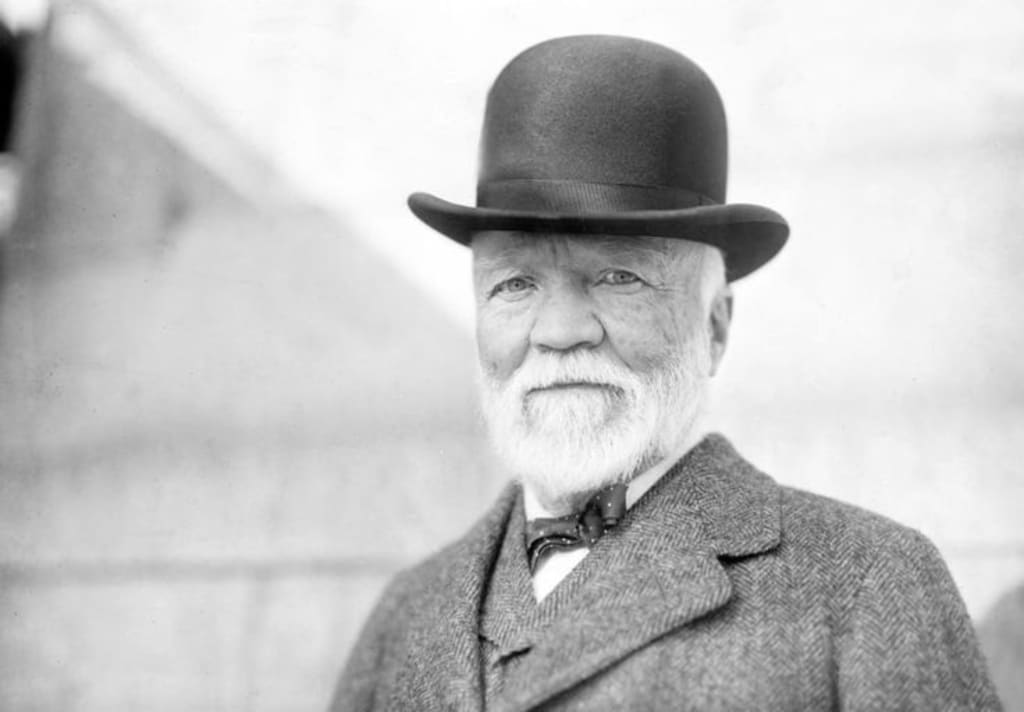
Andrew Carnegie was born on November 25, 1835, in Dunfermline, Scotland, a town that had once been wealthy but was declining by the mid-19th century. His father, William Carnegie, was a handloom weaver, a craft that was rapidly disappearing due to the rise of industrialized steam-powered looms. As a result, the family faced severe poverty, forcing Andrew’s mother, Margaret, to work long hours mending shoes and running a small grocery shop to make ends meet. These early experiences instilled in Carnegie a profound awareness of social inequality and a lifelong determination to rise above hardship. Witnessing the struggles of the working class inspired his later belief that wealth should be used to improve society.
🚢 Journey to America and Life in Pittsburgh
In 1848, when Carnegie was 12, his family immigrated to the United States in search of a better life. The journey was difficult: crowded bunks, minimal food, and a 50-day voyage across the Atlantic tested their endurance. Upon arriving in New York, the family traveled inland to Pittsburgh, Pennsylvania, a city that was rapidly industrializing but also suffering from pollution, poor housing, and unsafe working conditions. Andrew took his first jobs as a bobbin boy in a cotton factory, then as a messenger and telegraph operator. Even while working long hours, he educated himself by reading books and visiting a local library. His dedication, intelligence, and reliability caught the attention of railroad executive Thomas A. Scott, who hired him as a personal telegrapher and secretary. This mentorship exposed Carnegie to the inner workings of business and gave him the foundation for his later entrepreneurial success.
⚙️ Rise in Industry and the Steel Empire
Carnegie left the railroad industry to invest in iron and steel, seeing enormous potential in America’s growing infrastructure needs. He embraced the Bessemer process, a new technology that transformed pig iron into strong, cheap steel. By producing steel efficiently and controlling the supply chain—from raw materials to transportation—Carnegie vertically integrated his operations, dramatically reducing costs. By the late 19th century, Carnegie Steel dominated the U.S. steel market, producing more steel than all of Great Britain. His business acumen was matched by his ruthless efficiency, careful cost management, and strategic partnerships, which allowed him to build one of the largest industrial empires of his era.
💥 Labor Conflict and the Homestead Strike
Despite his rhetoric supporting workers’ rights, Carnegie’s factories often demanded long hours for low pay. In 1892, the Homestead Strike erupted at his Homestead steel plant when his manager, Henry Clay Frick, locked out workers and hired armed Pinkerton agents to break the strike. Several workers were killed in the conflict, leading to national outrage. The strike revealed a stark contrast between Carnegie’s public image as a philanthropic industrialist and the harsh realities of his business practices. While he delegated day-to-day management and claimed he was away during the strike, the event remained a stain on his reputation and highlighted the tensions of America’s Gilded Age between labor and industry.
💰 Becoming the Richest Man in the World
In 1901, Carnegie, then 65, sold his steel company to financier J. P. Morgan, who merged it into the newly formed U.S. Steel Corporation. The sale earned Carnegie approximately $250 million, making him the richest man in the world. This enormous fortune allowed him to retire from business and dedicate his life to philanthropy. Carnegie famously stated, “The man who dies rich dies disgraced,” believing that wealth should be used to benefit society rather than hoarded.
📚 Philanthropy and the Gospel of Wealth
Carnegie’s philanthropic vision transformed communities around the world. He funded over 2,500 public libraries across the United States, Britain, and other English-speaking countries. Beyond libraries, he donated to educational institutions, universities, and scientific research. Carnegie also authored The Gospel of Wealth, a seminal essay advocating that the rich should actively distribute their wealth to promote the welfare and progress of society. His philosophy emphasized empowering individuals through education, rather than providing temporary charity.
🕊️ Global Peace and Social Reform
Carnegie’s vision extended beyond the U.S. He funded initiatives promoting peace, including the construction of the Peace Palace at The Hague, which later became the seat of the International Court of Justice. He supported the education of Black Americans, notably funding the Tuskegee Institute under Booker T. Washington and helping establish the National Negro Business League. Carnegie also founded pension funds for his workers, promoting financial security. His philanthropic work reflected a broad concern for social progress, education, and global cooperation.
⚰️ Death and Lasting Legacy
Andrew Carnegie passed away on August 11, 1919, having given away nearly all of his fortune. His final $30 million was distributed to charities, foundations, and educational institutions. Carnegie was buried in Sleepy Hollow Cemetery in New York, leaving behind a legacy as both a powerful industrialist and a transformative philanthropist. Today, he is remembered for shaping the American steel industry and for using his wealth to improve access to education, culture, and social progress worldwide. His life remains a testament to ambition, vision, and the complex responsibilities of wealth.
💬 Comment to share your thoughts on Carnegie’s life
👍 Like & Share to spread knowledge
💡 Support us with a tip to help create more educational content
About the Creator
Haroon Pasha
📚 Learn history, literature & knowledge daily
👍 Like | 💬 Comment | 🔔 Subscribe
🔄 Share to support free education
💖 Tip us to help grow this page
Keep reading
More stories from Haroon Pasha and writers in Chapters and other communities.
William Shakespeare Biography: Life, Works, and Legacy of the Greatest English Playwright
Imagine a world without Romeo and Juliet, Hamlet, or Macbeth. No famous line “To be, or not to be”, no tragic lovers, no powerful kings falling from pride, and no timeless lessons about life and love. Hard to imagine, right? Yet all these treasures came from one man born in a quiet English town more than 400 years ago. William Shakespeare rose from ordinary beginnings to become the most influential writer in the history of literature. His words crossed borders, centuries, and cultures, speaking equally to kings and common people.
By Haroon Pashaa day ago in Chapters
The Cave Part 6
If you have ever heard a tale about yourself that you cannot remember and doubtless think is made up, you will know how I felt when Tharkin related all that the eagle had seen of me before my memories were scattered. Of far distances and traveling companions that I did not recall, camping out under the stars and making our way to the mountains with deliberate purpose. The great bird had lost contact with my party once we entered the forests, and the seven other members were not seen again by him or his brethren since.
By Jamye Sharp12 days ago in Chapters
Pakistan Bombs Afghanistan: Nangarhar and Paktika Airstrikes Kill Civilians, Taliban Condemns Attack
Provincial officials in eastern Afghanistan’s Nangarhar province told the BBC that a house belonging to a man named Shahabuddin was targeted in the Gardai Kach area of Behsud district, killing and injuring around 20 people, including women and children.
By Real content5 days ago in Chapters




Comments
There are no comments for this story
Be the first to respond and start the conversation.