
After 1938
The Changes and Impact


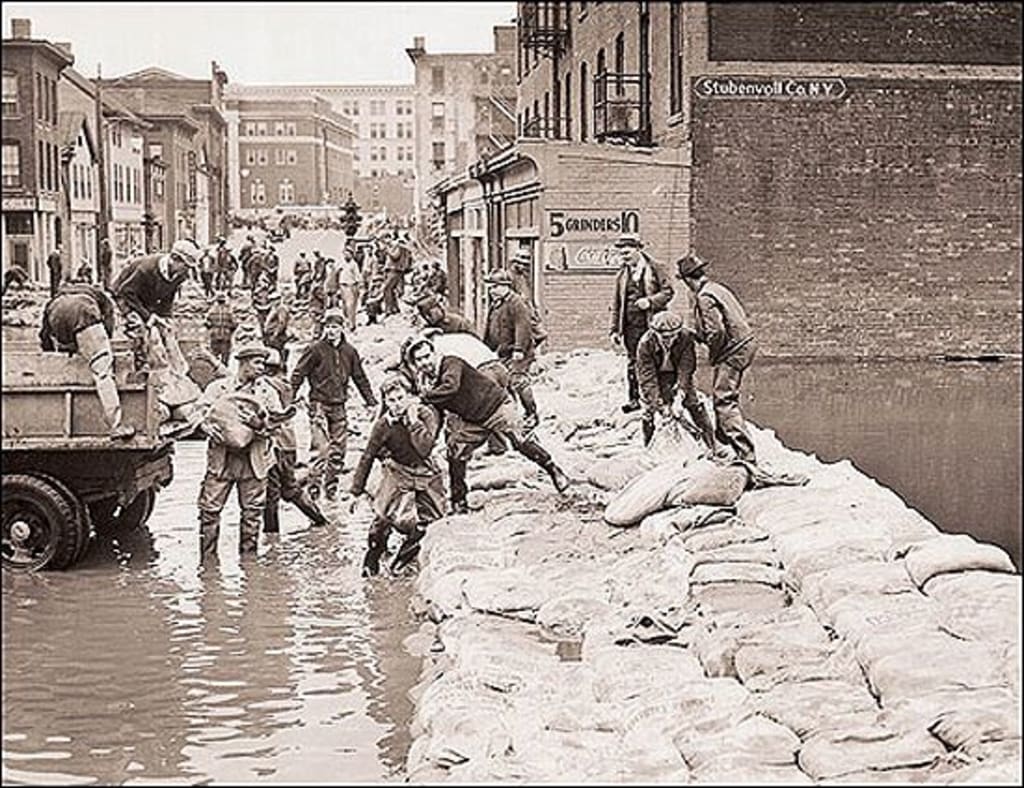
This story is a continuation of my previous story, The Black and White World of 1938. It will begin where I left off...on September 21, 1938.
It just so happened, on this very day...that there was a horrific and deadly hurricane which took the lives from an estimated four to eight hundred people throughout seven of New England's states. Not only leaving behind emotional duress and grief, but that storm would also take this entire geographical area countless years of recovery from the physical damage and financial toll of this devastation:
But in a small town in the Southern state of Louisiana on that same day, my family was also going through our own storm...the devastating murder of my grandfather and uncle. That tragedy has also taken decades of recovery.
My mother's mother found herself widowed at forty-five years of age.
Her oldest son, Larue, age 24, was away, working for the WPA project. (The The Works Progress Administration was an American New Deal agency, that employed millions of jobseekers to carry out public works projects, including the construction of public buildings and roads. It was set up on May 6, 1935, by presidential order, as a key part of the Second New Deal under Franklin Delano Roosevelt.)

Another son, Harry, was 21 and had just joined the CCC (Civilian Conservation Corps) and sent to California. The Infrastructure & Employment program was established 1933, also by President Roosevelt. It allowed single men between the ages of 18 and 25 to enlist in work programs to improve America's public lands, forests, and parks (and to provide jobs to boost the economy.)
The following is a flyer he sent home postmarked 3/4/1939:

Louise, her oldest daughter, was 19 and engaged to be married. "Aunt Sis," as I know her, got married in November 1938, only two months after her father and brother were killed. The couple lived in a duplex next door to her widowed mother and her fatherless children for awhile, though. (Uncle Bill, her husband, also served in the CCC.)

Jimmy, the youngest son, was still in high school. He would be 17 that December. Also at home were daughters, Lucile, age 14, and my mother, the youngest, Estelle, only 9 years old.
Young Larue and Harry were now the ones that were depended upon to be adults and provide all the money they could muster to their mother and their younger siblings.
Not only were these very meager times, but also a phase loomed that continually brought up anger and hurt which put any healing in the backseat. "The trial" had taken place and the man who murdered Gertrude Smith's husband and son was rightfully sentenced to life for two counts of capital murder in Louisiana's infamous Angola prison to face hard labor.
But that sentence, although the maximum he could get, could never replace the love that had been lost. And it could never take away the agony they felt because of the absence of their beloved. "Life went on" but it would never be the same...it just went on. And as it did, history unfolded itself.
"On Sept. 16, 1940, President Franklin D. Roosevelt signed into law the Selective Training and Service Act, which was another name for the draft. It required all men between the ages of 21 and 45 to register for the draft...It was the nation’s first peacetime draft." https://www.defense.gov/News/Feature-Stories/Story/Article/2140942/first-peacetime-draft-enacted-just-before-world-war-ii/
On October 16, 1940, Larue and Harry went together, as required, to the local parish (Louisiana's county) and registered in that draft. (Jimmy was still under 21 and throwing all his energy into in high school football. His class would become the State Champs that year.)
He would sign up for the Navy in July of 1941, the youngest son, but first of them to enlist. His ship would supply ammunition to other ships headed out during the Normandy invasion. He served in the Navy from 1941-1947 and then joined the Army from 1949-1952.
Jimmy's younger sisters, Lucile and Estelle also managed to shine after the 1938 tragedy. Lucile would graduate as valedictorian of her high school in May of 1943 while Estelle enjoyed being a beautiful cheerleader and working after school in the local pharmacy/malt shop throughout her high school years.
My grandmother would end up having a son in each branch of the service and I'm certain she stayed in prayer for their safe return. Her inner strength amazed me. And to add to her burden, her father, whom she had not shared a particularly warm relationship with, suffered a stroke. His wife, (my grandmother's stepmother,) then abandoned not only her debilitated husband to my recently widowed grandmother, but also left her own teenaged son and my grandmother's youngest blood brother for her to raise and care for.
December 7, 1941:
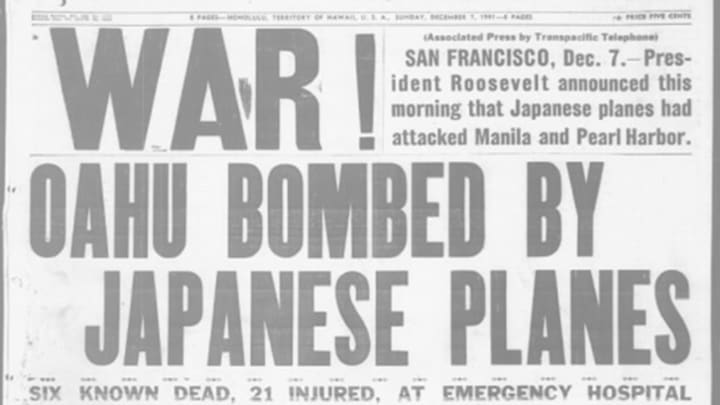
Larue's Army records show he served from 11/30/1942 through 2/14/1946. He was unable to fight in combat because years earlier, he had lost an eye somehow, and had a "glass" eye replaced to his right socket...but he served in the Military Police mostly in the San Antonio, Texas area.
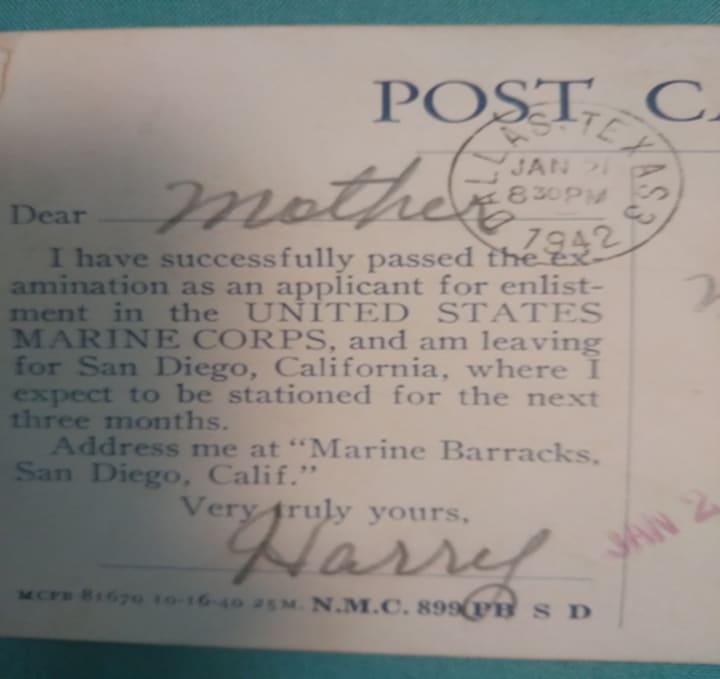
Harry was also drafted into the Army, but instead enlisted into the Marines. This postcard was mailed on January 2, 1942. His military service would take him to the Asian Pacific campaign, receiving a Purple Heart for being wounded in 1944 (while getting another wounded brother in arms to safety.) His duty was also ended in 1946, with the rank of Sergeant.
"When the United States declared war after the attack on Pearl Harbor, the United States government created a system of rationing, limiting the amount of certain goods that a person could purchase. Supplies such as gasoline, butter, sugar and canned milk were rationed because they needed to be diverted to the war effort.
Americans received their first ration cards in May 1942. The first card, War Ration Card Number One, became known as the “Sugar Book,” for one of the commodities Americans could purchase with their ration card. Other ration cards developed as the war progressed. Ration cards included stamps with drawings of airplanes, guns, tanks, aircraft, ears of wheat and fruit, which were used to purchase rationed items." https://www.nationalww2museum.org/war/articles/rationing-during-wwii


Larue would marry in 1943, Jimmy in 1944, and Harry in 1945. Lucile would marry only long enough for a brief honeymoon and then the groom had the union annulled. My mother, Estelle would marry in 1951.
Larue would go on to join the Mormon church, become a Mason and a Shriner. He would retire from years of service with the General Electric company in Shreveport, Louisiana and stay married to his wife, Opal, and raised her son. He mostly isolated himself and his new family from his family of origin because of his new-found beliefs, which included abstinence from alcohol and cigarettes.
Harry and Jean would settle in Shelbyville, Indiana where he worked as an auto mechanic. He had adopted Jean's six-month old daughter after they married. There was no doubt of their love for one another, but alcohol had taken its toll on them both. Harry would die at the young age of forty-seven from pancreatitis.
Louise, (also known as Sister, Sis, or Aunt Sis,) would marry Bill a total of three times, divorcing him twice. They had one daughter. She obtained her beautician's license, owned and ran a cafe, truck-farmed, and had chicken houses. That daughter would be the first in the family to obtain a college degree. They never lived anywhere else but remained in Arcadia, Louisiana.
Jimmy would marry four times in all, twice to the mother of his two children. He worked as a truck driver. They resided in San Antonio, Texas.

Lucile would become an executive secretary for a huge oil company in Houston, Texas. She never remarried, but chose to keep her mother in her care. As she got older, she gave up her favorite Scotch because of the implications it had and the anger it brought out in her.
My mother, Estelle, married three times...twice to my father. Alcohol played a huge part in our life, unfortunately. I wish there had been anti-depressants back in those days, rather than trying to drown her sorrows away from a bottle of cheap whiskey or cans and cans of Schlitz beer. My mother and her brood bounced between living in Louisiana and Texas after the final divorce. She married another man (who also loved to drink) at one point, but it lasted only a few months.
My grandmother never remarried. I can't even imagine how she carried on. All I ever knew her as was a very sweet and quiet, very private lady who loved her family. I do vividly remember when my Uncle Harry died in 1965, the wailing cry she had and the words that came out of her agony, "Please God, no more of my children. Let me go next."
Trauma is a word so flippantly and frequently tossed around in our culture today. But in reality, and according to the American Psychological Association, trauma is a grave ordeal, basically reserved for such as natural disasters, wars, murders, and rapes. https://www.apa.org/topics/trauma/
Looking at the concept of trauma's aftermath on my family, it's difficult to differentiate and determine the extent that the murders had from the behavioral patterns that my grandfather brought into play prior to his demise. (He also had been an alcoholic with another set of family from which he left behind when he married my grandmother.) But I'm pretty sure that the combination of both left a trail of heartbreak and bad patterns. Some people call this generational trauma. I have included three articles in the reference section that might shed some light, if you are interested. The aftermath of our storm is still being cleaned up.
~~~~~~~~~~~~~~~~~~~~~~~~~~~~~~~~~~~~~~~~~~~~~~~~~~~~
~~~~~~~~~~~~~~~~~~~~~~~~~~~~~~~~~~~~~~~~~~~~~~~~~~~~
References:
About the Creator
Shirley Belk
Mother, Nana, Sister, Cousin, & Aunt who recently retired. RN (Nursing Instructor) who loves to write stories to heal herself and reflect on all the silver linings she has been blessed with :)
Reader insights
Nice work
Very well written. Keep up the good work!
Top insights
Easy to read and follow
Well-structured & engaging content
Heartfelt and relatable
The story invoked strong personal emotions
Keep reading
More stories from Shirley Belk and writers in Chapters and other communities.
The Black & White World of 1938
I think we see the world from eighty-five years ago only in stark black and white. Old photos, old movies, old stories. And the rules and social mores were pretty much in black and white, too. The greys of culture then were hidden, attempting to blend in and disappear, even though there was some pushing still going on for the greys. But pretty much, in those days, as I see it, people didn't have too much time to rebel because they were too busy putting food on the table. After all, it was near the closing of a decades long Great Depression. So, it was indeed, a basic black and white existence. I try to hold onto all of what I have left of my family from that era in a few of those old photos, some stories, handwritten letters, and other scattered memorabilia. But the problem is, that the story from my family's 1938 life needed some factual answers and some color. I wanted to uncover the true story of their lives. I wanted to really get to know them. They deserved it and I needed to learn from them.
By Shirley Belk2 years ago in Chapters
The Guardian Chapter V
Alexander left his Coming of Age ceremony with Cronos and the elders with as many new questions as he had answers for his old questions. Cronos had confirmed his suspicions were correct. Not only was there a link between the Beast Masters and the inhabitants of the Citadel, but it was the Citadel's fault that the Beast Masters existed in the first place. Instead of banishing the law breakers which allowed them to wreak havoc on the rest of humanity, the Citadel elders should have stripped them of their powers before they became too strong. Now Alexander would need to battle the Beast Masters and the Jikininki. It would be difficult for him to forgive the Citadel Elders because their poor decisions led to the deaths of his parents and more than half the planet's human population.
By Mark Gagnon14 days ago in Chapters
Stop the AI from taking over Earth!
Not long after, Gazzer and I arrived back at Void. It seemed… different not mentioning how much HAVE CHANGED! The buildings, many were removed, the houses looked the same, the population… INCREASED MAGNIFICIENTLY! Oh boy, how much trouble would it be… as in, I WOULD HAVE TO HELP GAZZER THROUGH BUSTLING STREETS JUST TO GET TO SCHOOL! It’s trouble alright! But then, I saw it… AI robots on MY PLANET! I had to stop them. I took my VoidA2000 which turned into a car and drove to the area where the AIs were at.
By *+*+*~Teja~*+*+*7 days ago in Chapters



Comments (17)
Congratulations 🎉👏 Plz give me tips how article grow
A very compelling story! I will check out some of yours others that you've linked here. Thank you and congrats on TS!
A great piece of history
Good evening, my name is Samuel I'm a poet and journalist I would love to read some of your work, and build community would love if you could check some of my work out as well-!
Shirley, this continuation of your family's story after the heartbreaking events of 1938 is both intimate and illuminating.
ok i love this alot i follow your stories alot. btw can you check out my latest story
Wow! So much history... And Life does go on. Bittersweet, but a reason to appreciate that we were given the chance to live ourselves and learn what it's like to be a part of a family. This was very inspiring, Shirley and makes me wonder if I attempted something like this, how far back could I go. Hmmm. Thank you so much for sharing this and Congrats!
Back to say congratulations on your Top Story! 🎉💖🎊🎉💖🎊
Congrats on your richly deserved Top Story! I love the way you have organized this. I researched the 1920s not long ago, but I haven't delved much into the Great Depression and the 30s in general. I smiled when I saw Louise married Bill more than once, especially since I'm going through a breakup with someone I still love. I'm spreading myself around today, reading lots of stories by many different authors here on Vocal. But I'm saving this because I want to come back and read they Psychology Today links you provided. I'm saving this. ⚡💙 Bill⚡
Congrats on TS!!!
amazing
Congratulations on the very well-deserved top story!
Congrats!!!♥️♥️♥️♥️♥️♥️♥️
Yoour grandmother sounds like an extremely strong woman.
I had to read your part 1 again because I'd forgotten a lot of details. I'm glad they all managed to bounce back. But the alcoholism was really sad, hmmm
Weaving together the historical tragedy of the hurricane with the very personal story of loss in your family makes the story all the more moving.
Thank you for writing this Shirley. I like how you wrote this as a historical documentation. You did a concise and professional job with this. You family history is quite an interesting story. This was a great way for me to spend a few minutes in my day. I have always been very interested in things such as history, science, psychology. Bits and pieces of my main interest or touched on in this piece. Great work, Shirley!