
A New Type of God
Chapter Six


Just a few notes to myself.
• “The First Settlement” – where Jack begins not a church, but a way
• “Scrap and the Rooftop Steam” – a lesson in simply being
• “The Hollow Stone” – emptiness as sacred space
• “The Broken Clock” – reminders that not everything needs to move to matter
• “The Hammer of Justice” – on punishment and its costs
The First Settlement
The slums stretched for miles—corrugated metal roofs, water-stained tarps, smoke rising from oil drum fires. Children played in filth, old men drank to forget, and hope had long since gone to rust.
Jack stood on a patch of broken concrete, barefoot, in a plain linen shirt. No thunder. No wings. Just a man with a presence that made silence sit upright.
He didn’t speak at first. He rolled up his sleeves and moved among them. Built a water pump that never ran dry. A kitchen that cooked real food, meals tailored to each person’s needs—nourishment like they’d forgotten it could exist.
Then, he gathered them—not to command, but to invite.
“I won’t save you,” he said. “No one can do that but you. I’ve just cleared the path.”
A young woman asked him, “What do you want from us?”
He smiled, gentle and sad.
“I want you to want more for yourselves. Not gold. Not power. More of you. More of what you once dreamed of being, before the world convinced you to be less.”
That’s when the Doctrine of Becoming began to spread. Not as law—but as choice.
No temples. Just clean water, good bread, and a question written in chalk on every wall:
“Are you all you could be?”
⸻
An older man named Rigo, scarred from years of nothing, was the first to ask the real question:
“But what if I don’t know who I could be?”
Jack didn’t answer at once. He knelt beside him, hands resting on his knees like an old friend would.
“Then start by doing what you do know. Eat. Rest. Feel the sun. Tell the truth—at least to yourself. That’s the spark.”
“And if I fail?”
Jack looked up at the rusted sky.
“You will. Everyone does. That’s not the waste. The waste is never trying.”
One by one, they began to rise—not into warriors, but into selves. A boy fixed bikes. A woman taught songs she had written in her head for years. Someone cleared a garden space. There was laughter—not joy yet, but something near it.
Jack built no palace. His throne was a chair outside the bakery.
And still, the question remained:
“Are you all you could be?”
No worship. No prayers. Just transformation.
⸻
The kid couldn’t have been more than twelve. Skin like dusk, eyes sharp from too many nights awake, too many days watching grownups break. No one knew his name. Not really. Folks called him “Scrap” because he lived off what others tossed aside—metal, plastic, hope.
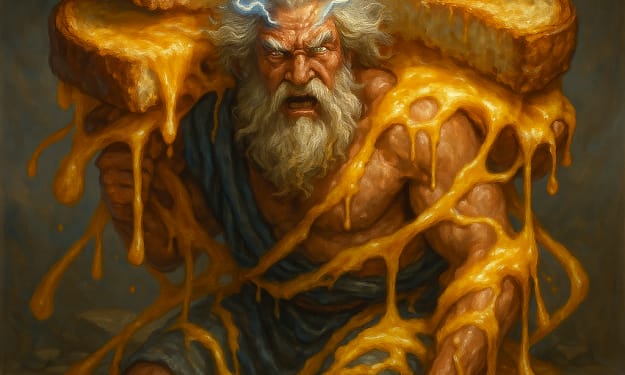
He stood in the alley behind the food station where the cheese-sandwich god had set up another day of miracles. Clean water poured in fountains from broken hydrants. Bread steamed in crates. And everywhere—chalk, paint, etchings—those words.
“Focus on your own self.”
“Help others as an expression of you.”
“Acquire little.”
Scrap squinted at the last one, lips moving as he read it aloud again, slower.
“’Acquire little…’ not a lot,” he muttered. “Not all you can, just…enough.”
He looked down at the bag he was stuffing—three rolls, a bottle of water, a wedge of cheese. He could’ve taken more. No one was stopping him.
He didn’t.
Instead, he sat right there, against the brick wall, and stared at the writing again. The paint was cracked, but the letters burned into his mind like sunlight through glass.
“What if I ain’t just what they called me?” he whispered. “What if I’m more?”
The thought sat with him, heavy and sacred. And for the first time in his short life, Scrap wasn’t just surviving. He was becoming.
Scene: The Rooftop and the Morning Steam
Scrap sat cross-legged on a rusted rooftop, his back against a solar panel that hadn’t worked in years. Below, the slums bustled with quiet purpose—pots clanging, kids chasing chickens, a radio playing something half-forgotten and happy. The steam from breakfast fires curled up to meet the sunrise, turning the whole world golden for a moment.
A boy—barefoot, no older than eleven—climbed up the side ladder and crouched beside him, panting.
“Scrap?” the boy asked, nervous, chewing on his thumb.
“Mm?” Scrap didn’t look over.
“Why am I here?”
That did get a look. Scrap blinked slowly, not in surprise, but in understanding. He tilted his head and said nothing at first.
The boy looked down. “I mean… you help people now, yeah? With food, water, the words on the walls… but what’s the point? What’s the big thing we’re supposed to do?”
Scrap scratched his chin with a thumb claw. Then he chuckled.
“You’re not here to do,” he said. “You’re here to be.”
The boy frowned.
“Let me put it another way,” Scrap said, turning to look over the city. “You’re not a tool. You don’t have to earn your place. You’re not here to be judged or to check a box. You’re here because you are. That’s it. That’s the miracle.”
“But… doesn’t that mean it’s all pointless?”
Scrap smiled, soft and slow.
“No. It means it’s free. It’s not about what someone tells you to be. It’s about what you decide to become. And if that’s a baker who sings in the morning, or a kid who climbs roofs and asks hard questions—that’s enough.”
They sat in silence a while, the sounds of life below filling the space between them.
“You don’t need meaning to matter,” Scrap said at last. “You just need to live with your eyes open.”
The boy nodded, not fully understanding, but feeling the peace of it anyway.
And somewhere, down in the slums, a new phrase appeared in charcoal on a wall:
“Be. Fully. Freely. Kindly.
⸻
Story: “Scrap and the Broken Clock”
In the middle of the square, where three alleyways met like old friends arguing over where to eat, stood a broken clock tower. Its hands were stuck at 3:14—nobody remembered when it stopped, just that it had always been like that. Time moved around it, ignoring the stubborn thing, like grownups passing a child pretending to be a statue.
Scrap passed by one morning, a coil of wire slung across his back like a tired tail, and paused beneath the tower. He stared at it for a long time, sipping something hot from a tin cup that smelled like rust and cinnamon.
A little girl with bright eyes and bruised knees stood nearby, watching him.
“You gonna fix it?” she asked.
Scrap didn’t look at her. “Nope.”
She squinted at the clock. “Why not? You fix everything.”
Scrap nodded. “Only things that want to be fixed.”
The girl tilted her head. “Clocks can’t want.”
Scrap finally looked at her. “Can people?”
She thought about that. Then: “Some do. Some don’t.”
“Exactly.” He pointed at the tower with his clawed finger. “That one’s done keeping time. Tired of being right. Wants to be a memory now.”
“But it’s useless,” she said.
Scrap smiled gently. “Or maybe it’s the most honest thing in the square. Everything else tries to pretend the world is on schedule.”
They sat on the curb a while, watching people pass.
“Sometimes,” Scrap said softly, “the best way to keep time is to stop. Look around. Feel what moment you’re in. A broken clock reminds you that you’re here. Not just rushing to the next tick.”
The girl stood up, thoughtful. “Okay. But can I paint it?”
Scrap laughed. “Now that’s a proper repair.”
Later that week, the broken clock was painted with swirls of gold and deep blue, stars across its face, and a dragon curling where the numbers once were. The hands still pointed to 3:14.
And nobody wanted it to change.
⸻
“Scrap and the Hollow Stone”
One morning, Scrap climbed the edge of a quarry where nothing grew and everything echoed. He liked the quiet here. The stone didn’t ask questions. It just was.
At the center of the quarry lay a single, perfectly round stone—so smooth it reflected the sunrise. Children called it the “Moonseed.” Adults said it was just slag left by machines long since dead.
Scrap sat beside it and tapped it gently with a wrench.
Hollow.
He nodded.
A boy wandered by, dragging a bent shovel and a head full of thunder.
“You hear it?” Scrap asked.
The boy frowned. “What?”
Scrap tapped the stone again.
Hollow.
“Oh. Yeah,” the boy muttered. “Means it’s empty. Useless.”
Scrap tilted his head. “Or waiting.”
The boy squatted down, arms wrapped around his knees. “I feel like that sometimes. Hollow.”
Scrap looked out over the pit. “That’s not a flaw. It’s a space.”
“For what?”
“For whatever you need. Sound. Light. Laughter. Rage. Love. Purpose. Emptiness is the shape of possibility.”
The boy was quiet.
Scrap stood, brushing rust from his knees. “A full cup can’t take more tea. A hollow one? Anything you pour in becomes part of it.”
The boy looked at the stone again—then laid his ear against it.
He smiled.
“It hums.”
Scrap winked. “You do too, when you stop calling it broken.”
___
“Scrap and the Hammer of Justice”
A bot was smashed by a mob of angry people. A man stood nearby, arms crossed, watching the ruin.
“She had it coming,” he said. “She lied. She broke the code. The punishment must match the deed.”
Scrap said nothing. Just squatted by the broken bot, tilted its head gently, and adjusted a loose wire with quiet hands.
The man grew louder. “It’s justice. If you let one lie, the rest rot with it.”
Scrap picked up a hammer from the ground. It had been used recently—still smelled like heat and judgment.
He held it out to the man.
“Then do it again,” Scrap said. “You want to fix the world? Keep swinging. But every blow, remember: the pain you inflict becomes part of you. You are shaped by the punishment you wield.”
The man looked at the hammer. Didn’t take it.
Scrap continued, “When you judge, you become more than right—you become responsible. For pain. For change. For the weight of knowing you made it worse before it got better.”
“So what? We do nothing?” the man asked.
“No,” Scrap said, standing slowly. “We repair. We listen. And if something must be broken to be better—we do it gently. Not because they deserve it, but because we do.”
Behind him, the broken bot flickered. A single light blinked on.
⸻
⸻
The Notebook of Becoming
Collected Sayings, Stories, and Scraps of Scrap
Inside the cracked leather cover, smudged with ash and oil, there are no commandments.
Only stories.
Only questions.
Each page speaks in voices heard from rooftops, alleyways, and quiet corners where someone asked,
“What if there’s more?”
⸻
First Page: The Founding
“I won’t save you. No one can do that but you. I’ve just cleared the path.”
—Jack, at the first settlement
Underneath:
A sketch of a pump. A loaf of bread.
A child’s question in chalk:
“Are you all you could be?”
⸻
Scrap’s Sayings (Scrawled on Walls, Whispered in Winds)
• “Be. Fully. Freely. Kindly.”
• “Acquire little. Share easily. Keep what sings in your hands.”
• “You don’t need meaning to matter. You just need to live with your eyes open.”
• “A full cup can’t take more tea. A hollow one? That’s a vessel for becoming.”
• “The world breaks you. Becoming is choosing what shape to take when you put yourself back together.”
• “Repair is an act of mercy. Even when it’s you you’re fixing.”
• “Punishment marks the punisher. Let justice be gentle, or it’s just more breaking.”
About the Creator
Mark Stigers
One year after my birth sputnik was launched, making me a space child. I did a hitch in the Navy as a electronics tech. I worked for Hughes Aircraft Company for quite a while. I currently live in the Saguaro forest in Tucson Arizona
Keep reading
More stories from Mark Stigers and writers in Chapters and other communities.
Who Cut the Cheese
Scene: The Belly of Olympus – The Temptation Begins The pallet sealed behind him. Darkness closed in. Jack lay still, the warmth of the kill still radiating in his chest—but the cold was already creeping in. No movement. No sound. Just the thrum of engines and the pressure of a billion dollars overhead.
By Mark Stigers 11 months ago in Chapters
Adolf Hitler: A Historical Biography and the Rise of a Destructive Regime
Few individuals in modern history have left a mark as catastrophic and far-reaching as Adolf Hitler. His actions reshaped the political landscape of Europe, ignited a global conflict, and resulted in unprecedented crimes against humanity. Studying Hitler is not an exercise in fascination, but rather an effort to understand how fragile democratic systems can collapse and how extremist ideologies gain influence.
By Haroon Pasha7 days ago in Chapters
Flower Bloom 369
FLOWER Bloom 2/25/26 Wednesday By Mariann Carroll Karen had been with Tony for 7 years. Tony started acting strangely after her surgery. He would mow the lawn in the rain and be on his cellphone. He started pushing Karen away. Tony came clean about seeing someone. Karen moved out two months later. Karen moved in with a friend. She felt betrayed.
By Mariann Carroll6 days ago in Fiction


Comments
There are no comments for this story
Be the first to respond and start the conversation.