
"Yellowface" by R.F. Kuang - Review
Kuang's psychological horror delves into the book industry

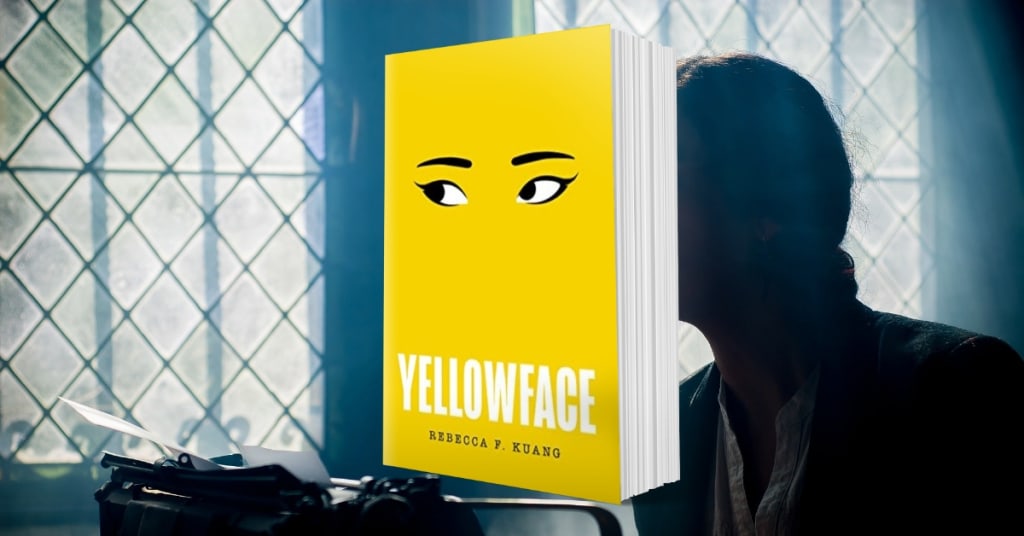
What’s the harm in a pseudonym? New York Times bestselling sensation Juniper Song is not who she says she is, she didn’t write the book she claims she wrote, and she is most certainly not Asian American—in this chilling and hilariously cutting novel from R. F. Kuang in the vein of White Ivy and The Other Black Girl.
Authors June Hayward and Athena Liu were supposed to be twin rising stars: same year at Yale, same debut year in publishing. But Athena’s a cross-genre literary darling, and June didn’t even get a paperback release. Nobody wants stories about basic white girls, June thinks.
So when June witnesses Athena’s death in a freak accident, she acts on impulse: she steals Athena’s just-finished masterpiece, an experimental novel about the unsung contributions of Chinese laborers to the British and French war efforts during World War I.
So what if June edits Athena’s novel and sends it to her agent as her own work? So what if she lets her new publisher rebrand her as Juniper Song—complete with an ambiguously ethnic author photo? Doesn’t this piece of history deserve to be told, whoever the teller? That’s what June claims, and the New York Times bestseller list seems to agree.
But June can’t get away from Athena’s shadow, and emerging evidence threatens to bring June’s (stolen) success down around her. As June races to protect her secret, she discovers exactly how far she will go to keep what she thinks she deserves.
With its totally immersive first-person voice, Yellowface takes on questions of diversity, racism, and cultural appropriation not only in the publishing industry but the persistent erasure of Asian-American voices and history by Western white society. R. F. Kuang’s novel is timely, razor-sharp, and eminently readable.
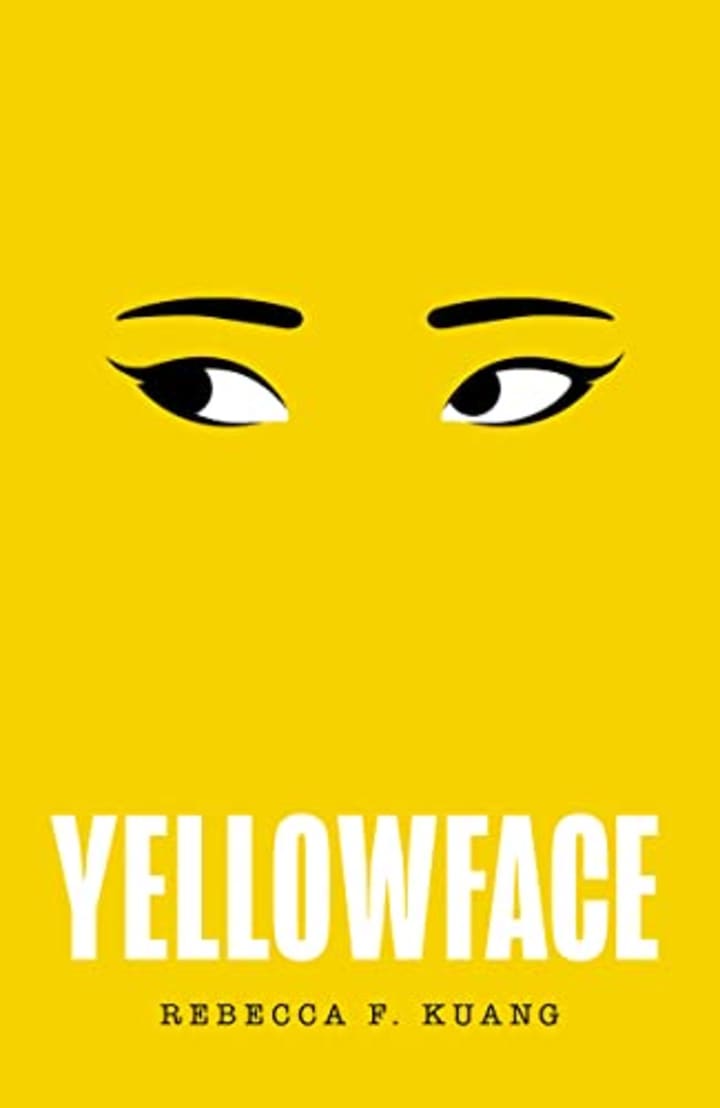
Rebecca F. Kuang sets up an intriguing premise and delivers on every level. I was hooked from the first sentence and devoured this story in over a week. With wry, satirical commentary on the publishing industry, the online book community, social media addiction, authorship, cancel culture, cultural appropriation and many other themes readers or authors can recognise in this book. Kuang tackles these themes with grit through one of the most egotistical and flawed characters I've read while still portraying the tragedy of what unfolds.
There's no hero in this story; actually, it's an ensemble of villains who want to profit from one deceased author's legacy and talent in one way or another, which makes this a compelling read. June has to be one of the most narristic protagonists I had ever read, which made her compelling in a tragic way. As her actions became more despicable and her excuses became weaker, you were anticipating how her lies would finally unravel.
This book raised a lot of interesting points about authorship and who should be able to write what story. In my opinion, as writers we should be able to write about whatever and whoever — as long as the context and themes are researched and accurately written on the page. Where June does a massive disservice — aside from the fact she plagiarised from a dead writer’s two storylines — was she took a concept of Chinese history of World War One and whitewashed it. The irony is she did her own research and still ignored historical facts. When this has severe backlash, she blames it on racism and even Athena’s own writing. The delusion of this character was infuriating realistic.
Yet, this book also accurately reflects what it feels like to be an author who’s had rejection after rejection or struggles to find their unique identity in their writing. As much as her actions were terrible, the tragedy of June was that she had nothing original to say or even write. Alas, it made sense that this sort of character could only put pen to paper with someone else’s words or ideas — despite the fact she could have written something original, if she had been vulnerable enough or authentic. She takes the cowardly approach, all throughout this novel.
Helen Laser effortlessly played June's narrative voice in the audiobook, she was perfect for this role. From the first sentence, Laser brought June to life and her performance was outstanding. I am seriously looking forward to her portrayal of Jessica Jones in the After Dark audiobook.
I was completely gripped by this story, I could not put it down. This book has the potential to be a stellar movie or limited series on Amazon Prime or Netflix — Florence Pugh as June and Katie Leung as Athena would be amazing in these roles — and it is definitely one of my favourite books of the year. Kuang is an author I will be reading more of and I cannot recommend this book enough!
My rating for Rebecca F. Kuang's Yellowface is ★★★★★.
About the Creator
Ted Ryan
Screenwriter, director, reviewer & author.
Ted Ryan: Storyteller Chronicles | T.J. Ryan: NA romance
Socials: @authortedryan | @tjryanwrites | @tjryanreviews
The Author Diaries #1: The Storyteller’s Curse — Exclusive Prologue Reveal
Author’s Note: Dear Readers, Thank you for being here — for reading, subscribing, and stepping back into the world of The Storyteller Chronicles. When I finished Book One, I truly thought the story was done. Silas was defeated. The grimoire was safe. Lauren had saved the day — in two worlds — and her family were reunited.
By Ted RyanExclusive • 7 months ago
My New Book is Finally Here
My poetry collection Beautiful and Brutal Things is done. It's actually done and finally published over 270 pages. Over a year of my life went into this book. More than a year, really. Long days at my computer, sometimes seven days a week because I couldn't stop even when I probably should have. Then two months of editing that felt harder than the writing itself. But it's finished, and I'm still standing, and the book is real.
By Tim Carmichael2 days ago in BookClub
7 Best Leadership Books In 2026
Leadership isn’t just a title—it’s a skill, a mindset, and a responsibility. Whether you’re leading a small team, running a company, or inspiring change in your community, strong leadership can define the trajectory of your success. But how do you cultivate the qualities that separate average leaders from truly transformative ones? One of the most effective ways is through reading. The right leadership books not only provide frameworks and strategies but also offer timeless wisdom drawn from real-world experience.
By Diana Meresc5 days ago in BookClub




Comments (1)
The novel sounds fascinating - covering many apt themes! A superb book review Ted.