
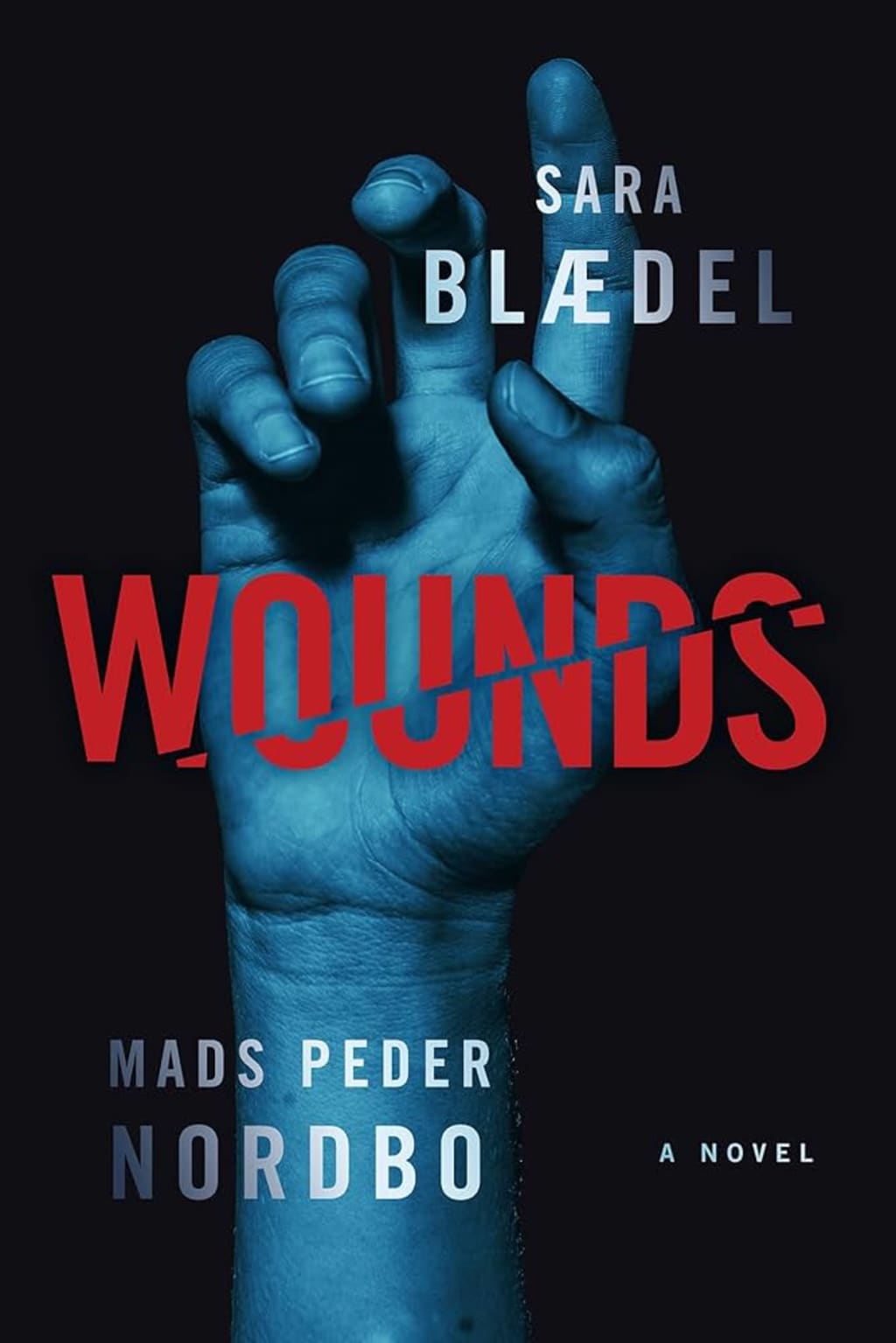
“WOUNDS” by Sara Blaedel & Mads Peder Nordbo
A chilling Nordic noir, Wounds blends animal rights, mirrored crimes, and moral dilemmas in a layered Scandinavian thriller.

Introduction
Few novels manage to merge chilling atmosphere, layered mystery, and deeply moral questions with the skill of Wounds by Sara Blaedel and Mads Peder Nordbo. This collaboration between two of Denmark’s most prominent crime writers delivers a dark, tension-filled journey into Odense’s underbelly. Through its carefully drawn detectives, unsettling antagonists, and dual narrative threads, the story explores not just crime but the boundaries of morality when human and animal suffering collide.
Book Title & Authors – State the book title and writing duo
Wounds is co-authored by Sara Blaedel, celebrated for her Louise Rick series, and Mads Peder Nordbo, best known for The Girl Without Skin. Together, they unite two powerful voices in Nordic noir. Their joint effort combines Blaedel’s intricate plotting and Nordbo’s haunting sense of atmosphere, creating a seamless narrative with compelling depth.
Genre & Setting – Scandinavian crime thriller set in Odense, Denmark
This work sits firmly within the Scandinavian crime thriller tradition, often referred to as Nordic noir. It's set in Odense, Denmark, Hans Christian Andersen’s hometown adds both irony and symbolic weight. A city known for fairytales becomes the stage for cruelty, revenge, and disturbing secrets. The cold, muted environment amplifies the darkness of the crimes, while the local cultural debates about animal rights provide a contemporary anchor.
Hook/Opening Statement
At its core, Wounds is a chilling exploration of mirrored mysteries, animal-rights conflicts, and the blurred lines between activism and violence. By blending visceral crime scenes with social commentary, the novel challenges readers to reconsider the price of justice when outrage mutates into cruelty.
Synopsis of the Story (without spoilers)
First Case – The Murder of Jørgen Andersen
The novel opens with the brutal murder of Jørgen Andersen. His violent death raises immediate questions, not least because he once had a restraining order against Monika le Fevre, a controversial taxidermist and animal exhibitor. What unsettles detectives further is the discovery of stitched-up wounds on his body strikingly reminiscent of an earlier unresolved crime. This gruesome echo binds the new case to a chilling past event.
Second Case – The Disappearance of Zenia Dybbøl
Parallel to the murder investigation runs a harrowing disappearance. Zenia Dybbøl, the daughter of Chief Constable Margrethe, vanishes in circumstances eerily similar to the earlier disappearance of Amalie Vedel. This duplication of tragedy suggests a patterned crime, amplifying the psychological stakes. Margrethe finds herself torn between personal anguish and the need to uphold professional duty.
Detective Dynamics
The cases fall under the scrutiny of DCI Liam Stark and Inspector Dea Torp, both of whom are skilled but uniquely different in their approach. They are reluctantly joined by Inspector Lene Erikson, whose competitiveness injects friction into the investigative team. The trio must put aside rivalries to piece together a mystery that seems to fold back upon itself.
Underlying Motif
Central to both cases is Monika le Fevre. Her provocative exhibition of preserved pets outraged animal lovers and activists alike, igniting debates that spilled over into threats and violence. Whether she is an instigator, victim, or both becomes one of the novel’s pivotal questions.
Character Analysis
Investigators
Liam Stark – Steady leadership
Liam Stark emerges as the grounding figure in the investigation. His calm, methodical approach contrasts with the emotional turmoil swirling around the case. Though not flashy, his steady leadership allows the investigation to stay focused despite competing egos and external pressures.
Dea Torp – The connecting force between cases
Dea Torp’s role is crucial, as she instinctively recognizes the threads connecting seemingly disparate crimes. Her perceptiveness and empathy balance Liam’s rationality. She often becomes the bridge not just between evidence, but also between strained colleagues.
Lene Erikson – Rival investigator, sharp but competitive
Inspector Erikson is depicted as sharp and incisive, though often undermined by her competitiveness. Her rivalry injects tension into the investigative dynamics, forcing the team to constantly weigh personal ambition against collaborative necessity.
Supporting Characters
Margrethe Dybbøl – Chief Constable torn between duty and motherhood
Margrethe’s character embodies the conflict between personal anguish and professional duty. As her daughter Zenia’s disappearance mirrors a prior case, her judgment risks being clouded. Her presence gives the novel its emotional weight, reminding readers that law enforcement officers are not immune to personal devastation.
Monika Le Fevre – Taxidermist at the center of controversy
Monika’s work turning pets into taxidermy displays creates both fascination and fury. She is simultaneously sympathetic and suspicious. The novel leaves readers questioning whether she is a provocateur trapped in circumstances beyond her control or an architect of violence hiding behind artistic expression.
Victims (Andersen, Hansen, Amalie, Zenia) – Threads connecting the mysteries
The victims are not faceless figures but integral threads that stitch the story together. Each crime or disappearance amplifies the mirrored motif, turning the narrative into a hall of reflections where past crimes echo into the present.
Themes & Motifs
Animal Rights vs. Human Violence
At the core is the unsettling question of how far activism should go. What begins as outrage against cruelty toward animals spirals into violent retaliation. The novel suggests that cruelty, whether directed at animals or humans, ultimately shares the same roots.
Mirroring Crimes
The repetition of murders and disappearances creates a motif of doubling. Each act mirrors another, suggesting patterns or deliberate mimicry. This recurring structure highlights the thin line between coincidence and design.
Family & Authority
Margrethe’s storyline epitomizes the clash between professional authority and personal loss. Can a leader enforce justice while her own family is entangled in the crimes? This motif explores the limits of objectivity when tragedy strikes close to home.
Justice & Revenge
The book asks whether revenge can masquerade as justice. Many characters, motivated by outrage, walk a precarious line between lawful justice and emotional retribution.
Writing Style & Structure
Tone – Dark, unsettling, morally complex
The prose is steeped in tension, with atmosphere dripping from every description. Odense is painted as a place where shadows cling to even ordinary corners.
Pacing – Intriguing buildup with detailed exposition; slower conclusion
The narrative builds with a steady layering of detail, keeping readers hooked as connections emerge. However, the conclusion takes its time, slowing into an extended wind-down that may divide readers.
Narrative Technique – Multiple perspectives weaving together
The story unfolds through multiple points of view. This technique allows the reader to see crimes from various angles, deepening both suspense and character understanding.
Comparisons – Similarities/differences with Dissolved (2023)
Compared to Dissolved, their 2023 collaboration, Wounds leans more heavily into moral ambiguity. Where Dissolved explored secrets beneath a drowned village, Wounds turns inward to human psychology and societal debates. Both share the same slow-burn, atmospheric style, but Wounds digs deeper into ethical dilemmas.
Strengths of the Book
- Strong investigative dynamics between Stark, Torp, and Erikson.
- Bold exploration of the overlap between animal abuse and human cruelty.
- Intricate, interwoven mysteries that sustain suspense.
- Emotional depth in Margrethe’s struggle, giving the story human gravity.
Weaknesses of the Book
- Some sections linger too long on exposition, slowing momentum.
- The drawn-out resolution may frustrate readers seeking a sharper conclusion.
- Graphic depictions of animal and human suffering could unsettle sensitive readers.
Reader Suitability
This novel is ideal for fans of Nordic noir who appreciate psychological depth alongside crime-solving. Readers who enjoy morally gray characters and layered mysteries will find much to admire. However, animal lovers may struggle with the disturbing imagery, and those preferring fast-paced thrillers may find the pacing deliberate. For readers who want to wrestle with ethical ambiguity while immersed in a bleak yet beautiful Scandinavian setting, this book is a compelling choice.
Conclusion & Final Verdict
Wounds is more than a crime novel it is a disturbing meditation on justice, morality, and the mirrors we face when cruelty crosses from animals to humans. By intertwining mirrored crimes, layered investigations, and deeply personal struggles, Sara Blaedel and Mads Peder Nordbo have crafted a thought-provoking addition to Scandinavian crime fiction. While its graphic depictions and slow conclusion may not suit every reader, those willing to confront unsettling truths will find a thriller that lingers long after the final page.
Final Verdict: A dark, emotionally charged thriller that unsettles, provokes, and challenges the very notion of justice.
About the Creator
Muhammah Hanzalah
Passionate about history and culture. Join me on Vocal Media for captivating insights into hidden historical gems and diverse cultural traditions. Let's explore the rich tapestry of our shared heritage and artistic expressions.
Keep reading
More stories from Muhammah Hanzalah and writers in BookClub and other communities.
The superstar tidying guru who transformed our homes: How Marie Kondo's 'Life-Changing Magic' cast its spell
For years, cluttered homes and overstuffed wardrobes have been a universal struggle. Enter Marie Kondo, the Japanese organizing consultant who revolutionized the way we perceive tidiness. With her best-selling book, The Life-Changing Magic of Tidying Up, and the immensely popular Netflix show Tidying Up with Marie Kondo, she has cast a spell on millions worldwide, turning decluttering into an art form and a path to self-improvement.
By Muhammah Hanzalahabout a year ago in BookClub
Rachel Reviews: Lakefront Wolves by Joseph Deegan
Meet Finn. He's an 18 year old kid who has potential. He's bright with great school scores and he's also an athlete, a footballer of some prowess. He has it all going for him, it would seem, and yet, he's determined to send what could be a well-planned, stable existence firmly off the rails. He drinks, he smokes, he takes drugs, he has violent tendencies and he's in danger of losing not only his mind but all that he holds dear.
By Rachel Deeming15 days ago in BookClub
7 Low Fantasy Books You Must Read In 2026
Low fantasy occupies a unique and fascinating space in literature. Unlike high fantasy—with its sprawling worlds, elaborate magic systems, and epic quests—low fantasy brings the supernatural into a world that feels remarkably like our own. The magic is subtle, often unsettling. The settings resemble real history or everyday life. And the stories focus deeply on human struggle, morality, and consequence.
By Diana Meresc6 days ago in BookClub



Comments
There are no comments for this story
Be the first to respond and start the conversation.