
Waiting For Godot
What on Earth is it all about?

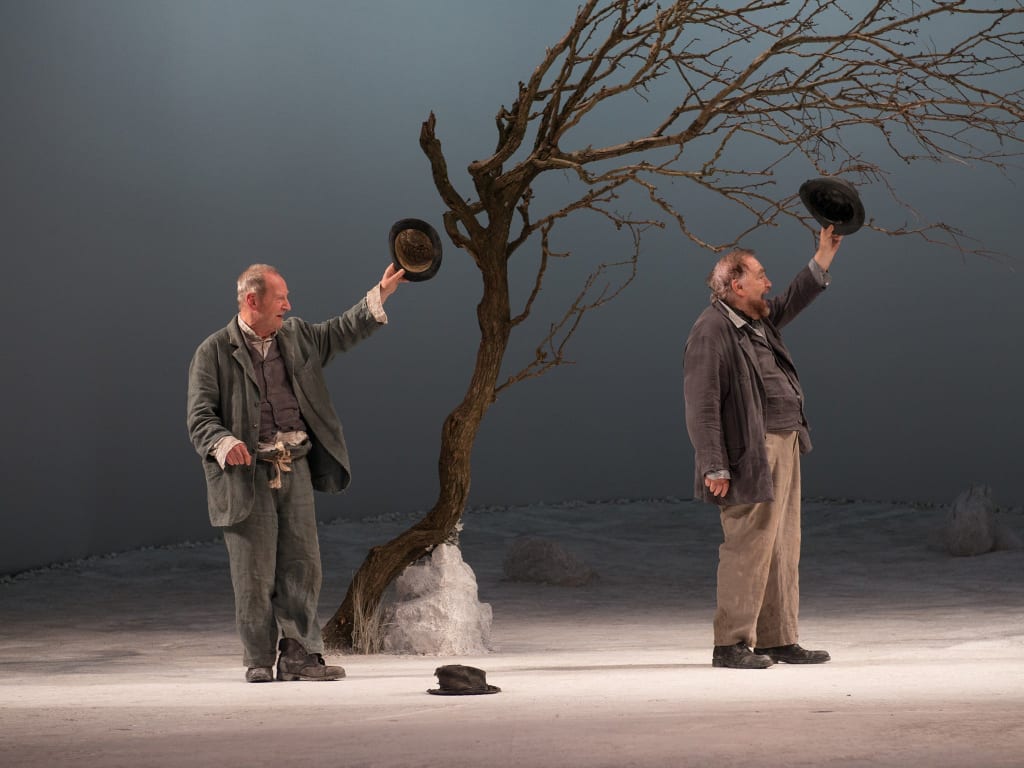
Samuel Beckett was born in Dublin, Ireland in 1906 and passed away in Paris thirty four years ago in 1989. He was awarded the Nobel Prize for Literature fifty four years ago in 1969.
The play that Beckett is most commonly associated with is 'Waiting for Godot,' originally published in French and titled 'En Attendant Godot'. Beckett once said that his reason for abandoning his native English and writing in French was to avoid any type of style he might fall into due to an over familarity with his native tongue.
Later the play was translated into English and found fame the world over, despite the fact that initially, the majority of people did not actually understand what the play was all about. Sir Peter Hall, The founder of the Royal Shakespeare Company took the play on in 1955, when apparently nobody else would touch it. In an early rehearsal, Sir Peter told the cast,"I haven't really the foggiest idea what some of it means ... But if we stop and discuss every line we'll never open."
One of the main stumbling blocks was the fact that Beckett capitulated mainstream theatrical convention in preference to something very experimental and avant-guard. So any sense of time and place was done away with, along with anything in terms of theatrical props and scene setting that might suggest a certain style.
There was a time when Beckett spent a great deal of time with that other Irish giant of literature, James Joyce, somewhat in awe of the man who he came to see almost as a muse.
"In 1945, Beckett returned to Dublin for a brief visit. During his stay, he had a revelation in his mother's room: his entire future direction in literature appeared to him. Beckett had felt that he would remain forever in the shadow of Joyce, certain to never beat him at his own game. His revelation prompted him to change direction and to acknowledge both his own stupidity and his interest in ignorance and impotence:
"I realized that Joyce had gone as far as one could in the direction of knowing more, [being] in control of one's material. He was always adding to it; you only have to look at his proofs to see that. I realized that my own way was in impoverishment, in lack of knowledge and in taking away, in subtracting rather than in adding."
Knowlson argues that "Beckett was rejecting the Joycean principle that knowing more was a way of creatively understanding the world and controlling it ... In the future, his work would focus on poverty, failure, exile, and loss – as he put it, on man as a 'non-knower' and as a 'non-can-er.' The revelation "has rightly been regarded as a pivotal moment in his entire career".
(Samuel Beckett, as related by James Knowlson in his biography, and Wikipedia.)
The above excerpts go a long way to explaining the creation of Waiting for Godot, not least of all the characters of Vladimir and Estragon, who it could be argued are the epitome of ignorance and impotence.
Another possible source of inspiration for Waiting for Godot and its characters and setting ('A country road, near a tree') lies in the historical context of the times. The play was written in 1948-49, in the immediate post-war years when the world was barely recuperating from a conflict that had torn almost the entire world apart.
World War Two had seen entire countries and major cities totally razed to the ground and millions of people killed, as combatants, or as innocent civilians. It was as close to a post-apocalyptic world as we could arrive at without suffering a nuclear war. And at the time, with the atomic bombing of Hiroshima and Nagasaki, in Japan, that nuclear scenario was far too uncomfortably close. Perhaps even more poignantly, the devastatingly destructive carpet bombing of Dresden in Germany had surely shown the world what the end might look like.
This goes a long way to explaining so many aspects of the play with its dystopian, post-apocalyptic scenario, its barely functioning characters (including Pozzo and Lucky, who is anything but lucky) and even its at times nonsensical dialogue. It is in fact, a world, a society, and personages, stripped bare of almost all signs of intelligent or educated civilization.
And in such a world, all four characters find themselves trying to make sense of it all, against all odds. In the case of Vladimir and Estragon they seem to be hopeful of some sort of salvation in the form of Godot, who they are waiting for, but who never appears.
As I have mentioned before in my previous article, Beckett claimed that Godot was not God, although he agrees that such a concept is implied. I would go a lot further than that and say that despite Beckett's insistence that Godot is not God, he most certainly is. How else do we explain so many Biblical references, such as the one alluding to the crucifixion of Jesus Christ?
The Bible says that two thieves were also set to be crucified at the same time as Jesus. One of them repented, the other didn't. One of them was saved, the other one was damned. And the mystery for Vladimir and Estragon is, that they are kept in the dark about whether or not Godot, or God, should he ever appear, will save or damn their souls forever. And that creates a conundrum of whether it is better to continue waiting or to give up all hope and leave.
And it is Beckett's contrariness that so often intrudes into the dramatic proceedings. For example, it has been justifiably claimed that Waiting for Godot is an existentialist play, belonging to the theatre of the absurd. Yet Beckett insists otherwise.
Likewise, Beckett once declared that the play would never be performed at a theatre in the round. Yet my very first view of the play was during Beckett's lifetime, in a production starring Max Wall and Trevor Peacock, at the Royal Exchange theatre in the round, in Manchester, United Kingdom, in 1979!
My view is that Beckett wanted to be as vague as possible, possibly in an attempt to be relevant to every man. I also believe that Beckett wanted to be evasive, to be open to question, to create ambiguity and a very high degree of uncertainty and confusion. Such themes suited the thrust of what Beckett was trying to achieve. However, still, he attempted to defy any sort of pigeon-holing.
Sir Peter Hall said at one point, it is a play about two old men having pointless conversations to kill time whilst they wait to die. And I for one cannot, hand on heart, gainsay that very apposite description. Having said that, it really is only one small part of what it is all about.
Another way of seeing the play is along the lines of that age-old precept that less is more. By stripping the whole edifice of human life bare, by taking away rather than adding, it has the effect of creating an abundance of riches in terms of meaning, far beyond the restrictive confines of any other type of conventional drama.
At the end of the play, Vladimir and Estragon contemplate suicide and struggle to come to any agreement, And when they finally do agree and say "Let's do it", they do not do it. Ambiguity, procrastination, and confusion, not to mention the hilarious antics of high tragic-comedy, reign supreme right to the very end of the play.
Jenny Farrel in Socialist Voice, December 2019, claims that Waiting for Godot is as relevant today as it ever was before. We are in grave danger of losing our humanity just as much in 2023 as we were in 1939 to 1945. I cannot but help agree. And if we are to be saved, then we had better start doing something to change the ways in which we live and treat the planet, before it's too late for each and every single one of us.
And if Waiting for Godot is about anything, it is about us losing our humanity. And the play offers us the audience an all too clear view of what that inhuman world would look like, and how the people in it would act. It is a world stripped bare of almost everything we believe in, our values, morals and ethics, our love for one another, our empathy and compassion, everything that we cherish and value, everything that gives meaning and definition to our otherwise tawdry, daily lives, and our hopes and dreams for the future. We have been warned.
About the Creator
Liam Ireland
I Am...whatever you make of me.
Reader insights
Outstanding
Excellent work. Looking forward to reading more!
Top insights
Easy to read and follow
Well-structured & engaging content
Expert insights and opinions
Arguments were carefully researched and presented
Eye opening
Niche topic & fresh perspectives
Masterful proofreading
Zero grammar & spelling mistakes
On-point and relevant
Writing reflected the title & theme
Keep reading
More stories from Liam Ireland and writers in BookClub and other communities.
It's All About Waiting, Or Is It?
Whilst there are many books that I have read, that were very enjoyable read, there are very few that have made a very deep and long-lasting impression upon me. Waiting for Godot is one of a handful of books that have not only made an impression, but have also changed the way I view life and the world that we live in.
By Liam Ireland3 years ago in BookClub
Rachel Reviews: Lakefront Wolves by Joseph Deegan
Meet Finn. He's an 18 year old kid who has potential. He's bright with great school scores and he's also an athlete, a footballer of some prowess. He has it all going for him, it would seem, and yet, he's determined to send what could be a well-planned, stable existence firmly off the rails. He drinks, he smokes, he takes drugs, he has violent tendencies and he's in danger of losing not only his mind but all that he holds dear.
By Rachel Deeming11 days ago in BookClub
Long Live The Book Club
Haruki Murakami once said, “If you only read the books that everyone else is reading, you can only think what everyone else is thinking.” He had a point, but perhaps he didn't count on the fact that many want to feel like they belong with others, and share something meaningful.
By Avocado Nunzella BSc (Psych) -- M.A.P 4 days ago in BookClub


Comments (1)
Very persuasive and convincing. The influence of Joyce is explained extremely well, and you argue eloquently for the play's historical relevance as a post-World War 2 text. Beckett fought with the French Resistance during that conflict, and some scholars have suggested he draws on lived experience in Godot - waiting in the middle of nowhere with an empty belly for a message that may never come does sum up the glamour of guerrilla warfare! I love that as well as considering the content, you chart the play's performance history from the RSC to the Strand (good old Trevor Peacock, what an actor and musician!). You really put across the point that Godot was something completely new and unexpected, which we tend to forget these days in a world replete with the imitators it spawned. All this, and in closing you also manage to look to the future, on which I quite agree that an eco-critical reading of Godot may well revitalize Beckett's mid-twentieth century masterpiece to teach the present generation some much-needed lessons. Splendid stuff!