
The Sacred Art of Commanding the Divine
Exploring Religious and Ceremonial Witchcraft

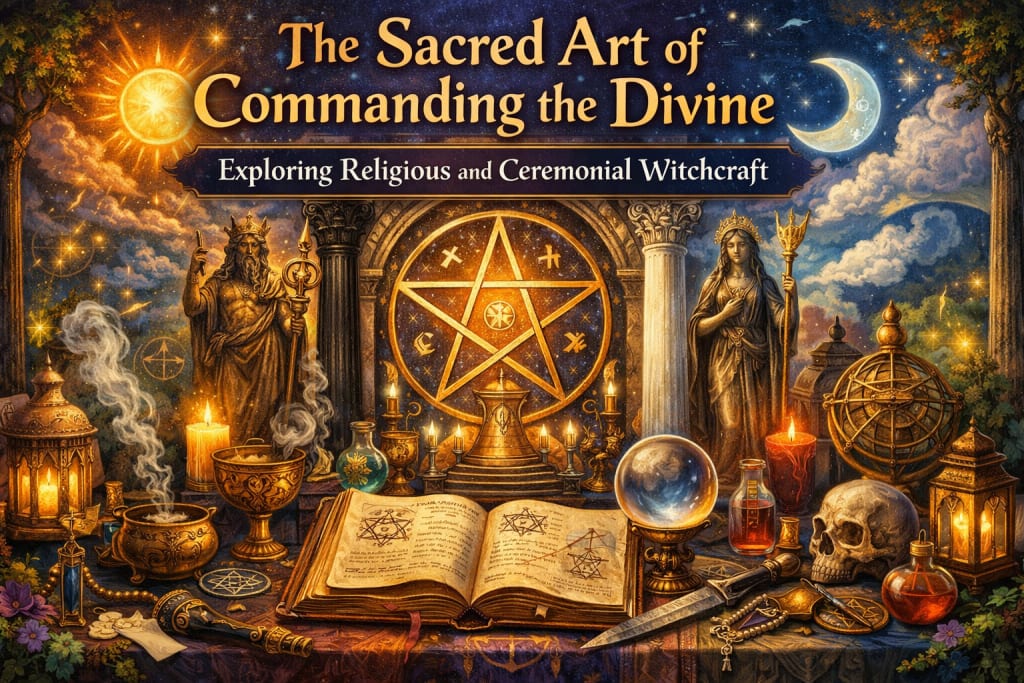
Thrones, Temples, and the Architecture of Sacred Power
Religious witches, frequently identified within historical records as ceremonial witches, occupy a layered and often misrepresented position within the spiritual development of Western and Near Eastern traditions. Ceremonial witchcraft arose from environments shaped by literacy, theology, philosophy, and institutional religion rather than exclusively from village survival practices or oral folk medicine. Temples, monastic scriptoria, royal courts, scholarly academies, and esoteric fraternities served as incubators for ritual systems that required formal education, linguistic precision, and theological fluency. Sacred alphabets, mathematical symbolism, planetary correspondences, angelic hierarchies, consecrated tools, and carefully calculated ritual timing formed a structured framework through which ceremonial practitioners attempted contact with divine or intermediary intelligences.
Historical evidence demonstrates that ceremonial witchcraft developed alongside established religious institutions rather than existing solely in opposition to them. Many ritual texts preserved within European and Near Eastern manuscript traditions reveal extensive reliance upon scriptural authority, liturgical structure, and theological interpretation. Hebrew divine names derived from Jewish mystical traditions appear prominently within medieval and Renaissance ritual manuals. Christian sacramental imagery influenced ritual purification practices, vestment design, and prayer structures. Islamic philosophical and astrological scholarship contributed mathematical models of celestial influence and metaphysical cosmology that circulated widely through translation movements in medieval Spain and the eastern Mediterranean. Neoplatonic philosophy supplied a metaphysical blueprint that described the universe as a descending chain of divine emanations linking transcendent unity with material reality. Hermetic writings reinforced concepts of cosmic sympathy, spiritual ascent, and sacred knowledge transmitted through ritual initiation.
Within ceremonial systems, ritual practice functioned as a disciplined spiritual vocation governed by ethical preparation, intellectual study, and devotional obligation. Preparatory requirements often included fasting, sexual abstinence, ritual bathing, confession of moral transgressions, and extended cycles of prayer. Sacred space construction relied upon geometric floor patterns, directional alignment, and consecrated inscriptions designed to reflect celestial order. Astrological calculations determined auspicious hours for ritual activity, based upon planetary rulerships believed to influence spiritual permeability between material and immaterial realms. Ritual language frequently incorporated Latin, Hebrew, Greek, or Arabic formulae preserved through generations of manuscript transmission, each syllable regarded as possessing vibrational and theological significance.
Ceremonial witchcraft preserved a worldview in which the cosmos operated through layered hierarchies populated by divine intelligences, angels, planetary spirits, and intermediary forces. Practitioners sought structured communication with these forces through prayer, invocations, hymns, and symbolic offerings rather than through chaotic or uncontrolled spiritual confrontation. Medieval and Renaissance grimoires often emphasized obedience to divine authority as a prerequisite for ritual success. Moral integrity, spiritual humility, and reverence for sacred law served as essential safeguards within these systems. Failure to maintain ritual purity was widely believed to produce spiritual imbalance or personal danger, reinforcing the perception of ceremonial witchcraft as a demanding spiritual discipline rather than casual experimentation.
Cultural misunderstanding surrounding ceremonial witchcraft developed through centuries of theological conflict, political consolidation, and social anxiety. Early Christian polemic literature frequently reframed independent ritual specialists as threats to ecclesiastical authority. Later witch trial literature merged folk superstition with elite ceremonial traditions, producing exaggerated portrayals of ritual practitioners as conspirators engaged in diabolical worship. Many accusations emerged from confessions extracted under judicial torture or from theological treatises written to reinforce institutional orthodoxy. Surviving ritual manuscripts, personal journals, and scholastic commentaries reveal a markedly different portrait rooted in devotion, scholarship, and structured spiritual aspiration.
The preservation of ceremonial witchcraft relied heavily upon manuscript culture, with texts copied, translated, and transmitted across linguistic and geographic boundaries for centuries. Jewish mystical writings influenced Christian magical theology through translation networks in medieval Spain and Italy. Arabic scientific and philosophical works entered European intellectual circles through scholarly centers in Toledo, Palermo, and Constantinople. Renaissance humanist scholars expanded access to classical Greek philosophical writings, reinforcing interest in Platonic cosmology and Hermetic spirituality. Secret societies and initiatory orders later adopted ceremonial frameworks, embedding ritual witchcraft within fraternal, mystical, and scholarly communities.
Ceremonial witchcraft reflects a persistent human attempt to engage divine structure through disciplined ritual, symbolic language, and theological contemplation. Historical practitioners pursued sacred knowledge through devotion, scholarship, and carefully regulated ceremonial practice designed to harmonize human consciousness with cosmic hierarchy. Surviving ritual traditions reveal spiritual systems shaped by reverence, intellectual rigor, and profound respect for divine mystery.
Sacred Order and the Theology of Structured Ritual
Religious and ceremonial witchcraft describes ritual traditions constructed upon theological doctrine, symbolic language, and disciplined spiritual methodology. Ceremonial witchcraft represents a system in which ritual activity follows established liturgical patterns designed to facilitate communication with divine or intermediary intelligences. The designation religious witch highlights the doctrinal and cosmological frameworks that anchor ceremonial practice within sacred traditions rather than outside institutional spirituality. Historical ceremonial systems functioned as extensions of religious devotion shaped by philosophical interpretation, scriptural symbolism, and metaphysical cosmology.
Ceremonial ritual systems operated through carefully codified structures intended to reflect perceived universal order. Ritual precision formed the foundation of ceremonial practice. Every gesture, spoken formula, spatial arrangement, and temporal calculation carried theological and symbolic significance. Sacred language served as a medium believed to harmonize human intention with divine vibration. Names associated with divine attributes or angelic hierarchies were treated as theological invocations representing sacred authority and cosmic identity rather than instruments of coercion. Many ritual manuals emphasized correct pronunciation, ritual purity, and contemplative preparation as essential conditions for spiritual alignment.
Consecrated ritual space represented a microcosmic reflection of divine architecture. Ritual circles, geometric diagrams, inscribed talismans, and directional alignments embodied symbolic models of celestial order. Circular boundaries frequently symbolized divine perfection, eternity, and cosmic unity. Sacred diagrams often incorporated geometric ratios associated with philosophical interpretations of harmony and proportion. Ritual tools such as wands, swords, chalices, pentacles, censers, and vestments served as symbolic representations of metaphysical forces. Materials selected for tool construction often corresponded with planetary or elemental associations drawn from classical cosmology and medieval natural philosophy.
Textual preservation formed a central pillar of ceremonial witchcraft. Ritual knowledge circulated through handwritten manuscripts, scholastic compilations, and carefully guarded initiatory texts transmitted across generations. Scriptural quotations, angelic hierarchies, planetary tables, and liturgical prayers appeared within many ceremonial manuscripts. Latin remained a dominant scholarly language throughout medieval and early Renaissance Europe, preserving liturgical and theological authority. Greek philosophical texts influenced metaphysical interpretations of divine emanation and cosmic hierarchy. Hebrew sacred names and mystical diagrams derived from Jewish esoteric traditions played a foundational role in many ritual systems. Arabic scientific and astrological treatises introduced advanced astronomical calculations, mathematical symbolism, and philosophical models that circulated through translation movements connecting the Islamic world with European intellectual centers.
Moral preparation and ethical discipline were regarded as essential safeguards within ceremonial practice. Ritual manuals frequently described purification requirements including fasting, ritual bathing, abstinence from sexual activity, confession of moral transgressions, and prolonged periods of contemplative prayer. Spiritual readiness was believed to influence ritual efficacy and personal safety. Ceremonial traditions emphasized the belief that divine intelligences responded to moral integrity and spiritual sincerity. Failure to maintain ethical discipline was often described as creating spiritual imbalance or attracting chaotic forces.
Cosmological literacy served as a defining feature of ceremonial witchcraft education. Practitioners studied astronomical cycles to determine auspicious planetary alignments believed to influence spiritual permeability. Mathematical principles were applied to sacred geometry, talismanic construction, and harmonic correspondences between sound, number, and celestial motion. Musical theory influenced the use of hymns, tonal chanting, and vibrational resonance within ritual environments. Philosophical systems derived from Platonic and Neoplatonic traditions presented the cosmos as a hierarchical chain of being linking transcendent divine unity with material manifestation. Hermetic philosophy reinforced concepts of spiritual ascent through knowledge, ritual purification, and symbolic transformation.
Ceremonial witchcraft demanded extensive intellectual training and access to scholarly resources rarely available outside monastic institutions, noble courts, or academic centers. Manuscript copying required linguistic fluency and theological education. Ritual diagrams required mathematical competence and artistic precision. Astronomical calculations required familiarity with planetary ephemerides and celestial tables. This intellectual rigor distinguished ceremonial witchcraft from localized folk practices that relied upon inherited oral tradition, regional herbal knowledge, and communal custom.
Ceremonial practitioners frequently viewed ritual activity as participation in a sacred dialogue between humanity and divine structure. Ritual language, symbolic gesture, and consecrated space functioned as theological expressions intended to harmonize earthly consciousness with celestial order. Surviving ceremonial traditions reveal a spiritual discipline grounded in scholarship, reverence, and structured ritual devotion shaped by centuries of cross cultural philosophical exchange.
Language of the Sacred Sciences and the Earliest Ritual Foundations
Religious and ceremonial witchcraft developed through a specialized vocabulary that described spiritual mechanics, cosmological structure, and ritual methodology. These terms emerged from temple liturgies, philosophical discourse, mystical theology, and manuscript traditions that preserved ritual knowledge across centuries. Each concept functioned as part of a larger spiritual grammar through which ceremonial practitioners interpreted divine order, spiritual hierarchy, and sacred participation within cosmic structure.
Theurgy
Theurgy represents one of the most philosophically significant elements within ceremonial religious practice. The term originates from Greek religious philosophy and translates as divine work. Classical theurgical traditions developed within late antiquity through Neoplatonic philosophical schools that described ritual activity as a pathway toward spiritual elevation and reunion with transcendent divine intelligence. Theurgical rites focused upon purification of consciousness, alignment with divine emanations, and participation in sacred hierarchies believed to descend from ultimate unity into material existence.
Theurgical practice relied upon hymns, sacred symbols, invocations of divine names, and ritual contemplation intended to elevate spiritual perception rather than manipulate physical events. Philosophers such as Iamblichus described ritual as a sacred technology capable of restoring harmony between human existence and divine structure. Theurgy emphasized moral discipline, devotional prayer, and ritual preparation as necessary steps toward spiritual transformation. This orientation distinguished theurgy from thaumaturgy, a separate category of ritual activity concerned with visible manifestations or practical material outcomes.
Grimoire
The grimoire functioned as a ceremonial manuscript containing structured ritual instructions, theological commentary, devotional prayers, sacred diagrams, planetary tables, and ethical guidelines. Many grimoires circulated within monastic scriptoria, scholarly courts, and esoteric initiatory circles where literacy and theological education were required for interpretation. Grimoires preserved ritual knowledge through handwritten transmission, with scribes often copying texts over multiple generations while adapting language and commentary to regional traditions.
Beyond technical instruction, grimoires frequently served as devotional literature. Ritual prayers often resembled formal liturgical petitions, invoking divine mercy, angelic guardianship, and spiritual purification. Seals and sigils within grimoires represented symbolic condensations of theological principles, celestial forces, or intermediary intelligences. The grimoire tradition reflects the intersection of scholarship, devotion, and ritual experimentation within ceremonial religious culture.
Sacred Names
Sacred names occupied a central position within ceremonial ritual language. Divine names derived from scriptural traditions, mystical interpretations, and linguistic numerology were believed to embody specific aspects of divine essence and creative authority. Hebrew divine names appeared prominently within medieval ceremonial traditions due to the sacred linguistic structure associated with Jewish mystical cosmology. Greek and Latin adaptations often preserved phonetic approximations intended to maintain spiritual resonance.
Within ceremonial theology, sacred names were treated as living expressions of divine presence rather than symbolic labels. Ritual recitation required careful pronunciation, spiritual focus, and ethical preparation. Manuscript traditions frequently emphasized that improper use of sacred names risked spiritual disorder. Sacred naming practices reflected theological belief in a universe sustained through divine speech, creative vibration, and sacred linguistic structure.
Consecration
Consecration represented the ritual transformation of ordinary materials, spaces, and physical bodies into sanctified instruments capable of participating in sacred activity. Consecration rites often incorporated fasting, ritual bathing, anointing with consecrated oils, incense purification, and extended cycles of prayer. Liturgical blessing formulae sanctified ritual tools, vestments, manuscripts, and ceremonial environments.
Consecration also functioned as spiritual preparation for ritual participants. Ceremonial manuals frequently described consecration as a process that refined intention, strengthened moral discipline, and aligned physical presence with sacred purpose. The process reinforced theological understanding that ritual instruments served as symbolic extensions of divine order rather than sources of independent power.
Circle
The ritual circle symbolized one of the most enduring visual representations within ceremonial religious practice. Circular geometry expressed theological concepts associated with unity, divine perfection, cyclical time, and cosmic wholeness. Sacred circles often incorporated inscribed divine names, geometric ratios, and directional markers aligned with cosmological symbolism.
Historical ritual diagrams reveal that circles frequently served as consecrated sacred space reflecting the structure of celestial harmony. The circle functioned as a boundary that separated ritual space from ordinary environment while symbolically representing participation within divine order. Geometric precision within circle construction reflected philosophical traditions that associated mathematical harmony with universal balance and sacred proportion.
Angelology
Angelology refers to the structured theological and philosophical study of spiritual intermediaries positioned between divine transcendence and material existence. Angelic hierarchies appear within Jewish mystical literature, early Christian theological writings, Islamic cosmological philosophy, and ceremonial ritual manuscripts. Angels were frequently understood as governors of planetary motion, guardians of natural forces, and administrators of moral order within the cosmos.
Ceremonial traditions often described angels as intelligences responsible for maintaining balance between celestial influence and earthly manifestation. Ritual invocation of angelic beings typically involved hymns, scriptural prayers, sacred seals, and ethical purification. Angelology reinforced the belief that spiritual communication required adherence to divine hierarchy and theological reverence.
Cosmic Correspondence
Cosmic correspondence describes the philosophical belief that the material world reflects patterns established within celestial and spiritual realms. This concept appeared within ancient Mesopotamian astronomy, Egyptian temple theology, Hellenistic astrology, and medieval Hermetic philosophy. Ritual timing frequently relied upon planetary hours, lunar phases, zodiacal transits, and seasonal alignments believed to influence spiritual permeability and energetic resonance.
Ceremonial practitioners studied celestial cycles as expressions of divine order manifested through mathematical precision and rhythmic harmony. Talismans, ritual hymns, and sacred diagrams often incorporated planetary symbolism intended to mirror cosmic patterns within ritual environments. Cosmic correspondence reinforced theological interpretation of the universe as an interconnected system governed by divine intelligence expressed through astronomical movement and natural rhythm.
Mesopotamian Origins and the Authority of Temple Ritual
The earliest foundations of ceremonial ritual practice emerged within the temple complexes of ancient Mesopotamia. Sumerian, Akkadian, Assyrian, and Babylonian religious cultures developed sophisticated ritual systems governed by priestly specialists trained in sacred writing, astronomy, and liturgical performance. Temple ritualists served as intermediaries responsible for maintaining harmony between human society and divine forces believed to regulate natural and cosmic stability.
Cuneiform tablets preserved extensive collections of incantations, hymns, purification rites, and ritual instructions addressing deities, protective spirits, and disruptive supernatural forces. Ritual specialists performed ceremonies designed to restore balance following illness, natural disaster, political instability, or perceived spiritual disturbance. Authority within these systems derived from divine mandate granted through temple initiation, scholarly training, and hereditary priestly lineage.
Incantation bowls discovered throughout Mesopotamian and later Near Eastern archaeological contexts reveal protective ritual practices inscribed with spiraling sacred texts intended to confine malevolent spiritual forces. Temple hymnals celebrated divine kingship, cosmic creation myths, and celestial governance administered through planetary deities. Astronomical observation served both scientific and theological functions, allowing priestly scholars to interpret celestial movement as expressions of divine communication.
Mesopotamian temple ritual established foundational principles that later influenced ceremonial religious traditions throughout the Mediterranean and Near Eastern worlds. Structured liturgy, sacred language, ritual purification, celestial timing, and hierarchical spiritual cosmology formed enduring elements within ceremonial witchcraft and religious ritual systems that continued to evolve across successive civilizations.
Maat and the Temple Sciences of Ancient Egypt
Ritual knowledge in ancient Egypt developed within a religious culture that regarded ceremonial precision as essential to the survival of cosmic and social order. Egyptian priesthoods cultivated one of the most sophisticated ritual systems of the ancient world, combining theological doctrine, astronomical observation, sacred architecture, musical liturgy, and symbolic language into a unified ceremonial science. Temple complexes operated as centers of spiritual administration where ritual specialists preserved harmony between divine forces, natural cycles, and human civilization.
Central to Egyptian ritual philosophy stood the concept of maat, a principle representing truth, balance, justice, and universal stability. Maat governed divine law, moral conduct, and the cyclical movement of the cosmos. Egyptian cosmology described existence as sustained through the continuous maintenance of maat against forces of chaos identified with the concept of isfet. Ritual activity served as a sacred obligation intended to reinforce cosmic equilibrium through prayer, offering, recitation, and symbolic reenactment of divine creation narratives.
Egyptian priesthoods underwent extensive education that included sacred writing, mathematical calculation, astronomical measurement, and liturgical performance. Temple priests memorized elaborate hymns and ritual formulae preserved within hieroglyphic and hieratic script traditions. Sacred texts were inscribed upon papyrus scrolls, temple walls, and funerary manuscripts that preserved ritual language believed to possess intrinsic spiritual potency. Egyptian theology regarded sacred writing as a manifestation of divine creative speech, with hieroglyphs considered visual embodiments of living spiritual forces rather than simple linguistic symbols.
The preservation and controlled use of divine names represented one of the most guarded elements of Egyptian ritual science. Names of deities embodied specific manifestations of divine authority and creative energy. Knowledge of hidden or secret names conferred spiritual access to divine presence within ritual contexts. Egyptian mythological literature illustrates the theological significance of sacred naming through narratives in which divine names function as keys to cosmic power and spiritual transformation. Ritual recitation of divine epithets formed an essential component of temple liturgy, funerary rites, and protective incantations.
Egyptian temple architecture reflected cosmological symbolism encoded through geometry, directional alignment, and proportional harmony. Temples were constructed as symbolic models of the universe, with architectural progression from outer courtyards toward inner sanctuaries representing movement from material existence toward divine mystery. Sanctuary chambers housed cult statues believed to serve as living vessels for divine presence during ritual activation. Daily temple rites included ceremonial washing, anointing, dressing, and nourishment of divine images, reinforcing theological belief that ritual service sustained cosmic vitality.
Astronomy played a vital role within Egyptian ceremonial tradition. Priest astronomers observed heliacal star risings, solar cycles, and lunar phases to determine ritual calendars and agricultural festivals. Celestial events were interpreted as manifestations of divine communication that guided ceremonial timing. Stellar alignments influenced temple orientation, with certain sanctuaries positioned to align with solar solstices or significant star systems associated with divine mythology. Egyptian cosmology described the afterlife journey of the soul as a celestial ascent guided by stellar navigation, reinforcing the relationship between ritual knowledge and cosmic geography.
Music and sacred sound functioned as essential components of Egyptian ritual performance. Temple musicians utilized harps, flutes, sistrums, and vocal chant to create vibrational environments believed to attract divine attention and purify ritual space. Hymns preserved within temple inscriptions demonstrate intricate poetic structure, theological symbolism, and rhythmic repetition designed to induce spiritual resonance. Sound was regarded as an extension of divine creative force, reflecting theological concepts that associated speech and vibration with the formation of existence.
Funerary ritual science further demonstrates Egyptian mastery of ceremonial complexity. Mortuary texts such as protective incantations, transformation hymns, and navigational spells guided spiritual transition through the afterlife. Ritual embalming processes incorporated symbolic gestures, sacred oils, and liturgical recitations intended to preserve physical form while preparing spiritual identity for cosmic rebirth. Burial chambers were decorated with cosmological diagrams, divine guardians, and ritual instructions that mirrored temple liturgical structure, illustrating continuity between earthly ceremony and spiritual transformation.
The Egyptian ritual specialist functioned as a ceremonial technician responsible for maintaining the delicate balance between divine order and material existence. Training emphasized moral discipline, ritual accuracy, and theological comprehension. Temple service required adherence to purification cycles, dietary regulations, and ceremonial abstinence designed to preserve spiritual integrity. Egyptian priesthoods believed that improper ritual performance threatened cosmic stability, reinforcing the sacred responsibility associated with ceremonial expertise.
Egyptian ritual science established enduring influences upon later Mediterranean and Near Eastern ceremonial traditions. Concepts of sacred naming, temple cosmology, ritual purification, symbolic geometry, and celestial alignment circulated through cultural exchange networks connecting Egypt with Hellenistic philosophical communities, Hermetic theological traditions, and later ceremonial manuscript culture. The legacy of Egyptian temple ritual demonstrates a civilization in which spiritual knowledge, scientific observation, and ceremonial devotion operated as integrated expressions of cosmic participation.
The Ladder of Light: Neoplatonic Theurgy and Ritual Ascent
Greek philosophical traditions of late antiquity provided one of the most influential intellectual foundations for religious and ceremonial witchcraft. Within the philosophical movement known as Neoplatonism, ritual activity received systematic theological justification as a sacred pathway toward reunion with divine origin. Neoplatonic cosmology described existence as a descending chain of emanations flowing from an ultimate and ineffable source often identified as the One. From this transcendent unity emerged successive layers of divine intellect, spiritual intelligences, celestial forces, and material reality. Human existence occupied a position within this cosmic hierarchy that allowed spiritual return through disciplined contemplation and sacred ritual action.
Philosophers associated with Neoplatonic schools regarded ritual symbolism as a language through which divine realities revealed hidden structure. Theurgical practice developed as a method of spiritual elevation grounded in the belief that sacred symbols functioned as material reflections of divine signatures. Ritual objects, geometric diagrams, hymns, and invocations were interpreted as embodiments of celestial principles that resonated with higher levels of existence. Theurgical rites were designed to activate spiritual memory believed to reside within the soul, allowing gradual ascent toward divine union through purification and contemplative illumination.
The philosophical contributions of Iamblichus transformed earlier Platonic emphasis on intellectual contemplation by asserting the necessity of ritual participation for spiritual ascent. Iamblichus described divine reality as exceeding the limitations of rational thought, requiring symbolic and ceremonial engagement to bridge the distance between humanity and transcendent intelligence. Ritual practice, within this framework, functioned as a sacred science governed by divine laws rather than human invention. Sacred symbols, according to Iamblichus, carried intrinsic spiritual power because divine forces had imprinted cosmic meaning into material forms. Theurgical ceremonies sought alignment with divine order through repetition of sacred gestures, recitation of hymns, and invocation of intermediary spiritual intelligences.
Neoplatonic cosmology described the soul as a fragment of divine intellect temporarily immersed within material embodiment. Ritual purification aimed to remove spiritual impurities accumulated through physical existence and emotional distraction. Preparatory disciplines often included fasting, moral self examination, prayer recitation, and philosophical meditation. These practices were intended to refine perception and restore spiritual receptivity to divine influence. Ritual ascent was understood as a gradual process rather than an instantaneous transformation, reflecting the hierarchical structure of the Neoplatonic universe.
Theurgical practice also incorporated complex symbolic correspondences linking celestial forces with material elements. Planets, stars, musical harmonies, numerical ratios, and sacred geometry were believed to express interconnected layers of divine manifestation. Ritual hymns composed in honor of planetary intelligences often followed mathematical harmonic structures derived from Pythagorean musical theory. Geometric diagrams used within ceremonial contexts reflected philosophical interpretations of cosmic proportion and spiritual symmetry. These symbolic systems reinforced belief in a universe governed by mathematical order and divine intelligence expressed through rhythmic and structural harmony.
Neoplatonic philosophy emphasized reverence for intermediary spiritual beings described as daemons, angels, or intelligences responsible for maintaining cosmic balance. These entities were not viewed as chaotic spirits but as administrators of divine law operating within hierarchical chains of command. Ritual invocation sought cooperation with such intelligences through hymns, offerings, and consecrated symbolic language. Theurgical texts often described these intermediaries as guides assisting spiritual ascent and transmitting divine illumination to ritual practitioners.
Religious and ceremonial witchcraft absorbed Neoplatonic theurgical principles through transmission across Hellenistic religious communities, late antique mystery traditions, and medieval manuscript culture. The emphasis upon purification, hierarchical cosmology, sacred symbolism, and devotional ritual preparation became foundational elements within later ceremonial traditions. Theurgical philosophy reinforced the theological perspective that ritual practice represented spiritual participation in divine order rather than an attempt to dominate or manipulate supernatural forces.
Neoplatonic theurgy also influenced early Christian mystical theology and later Hermetic philosophical traditions. Concepts of spiritual ascent through symbolic ritual, angelic hierarchy, and contemplative purification appear within mystical writings preserved throughout medieval monastic scholarship. Renaissance intellectual movements revived Neoplatonic philosophy through translation of Greek manuscripts, reintroducing theurgical concepts into European ceremonial ritual traditions. This philosophical revival contributed to the preservation of ritual systems that merged theological devotion with symbolic ceremonial structure.
Greek theurgical philosophy established a spiritual model in which ritual action, philosophical contemplation, and moral discipline operated as interconnected pathways toward divine reunion. The legacy of Neoplatonic theurgy endures within ceremonial religious traditions that continue to emphasize sacred symbolism, spiritual purification, and reverence for cosmic hierarchy as essential elements of ritual practice.
Chariots of Fire and the Sanctity of the Divine Name
Jewish mystical tradition preserved one of the most profound ritual and visionary systems within Near Eastern religious history. Early mystical literature known as Merkavah mysticism developed during late antiquity through scriptural interpretation, temple memory, and visionary theology centered upon ascent into celestial realms. The term Merkavah, meaning chariot, derives from prophetic descriptions of divine throne visions associated with the Hebrew prophet Ezekiel. These visions inspired generations of mystical scholars who sought spiritual comprehension of divine sovereignty through disciplined ritual preparation and sacred linguistic knowledge.
Merkavah texts describe structured visionary journeys through layered heavenly palaces often referred to as hekhalot. These celestial sanctuaries formed symbolic representations of divine proximity, with each successive chamber representing increasing degrees of spiritual illumination and theological comprehension. Passage through these heavenly realms required rigorous spiritual preparation governed by ritual purity, moral discipline, and precise recitation of sacred formulae. Visionary ascent was understood as an act of reverence toward divine kingship rather than a demonstration of individual authority or spiritual conquest.
Ritual purity held central importance within Merkavah traditions. Mystical aspirants followed detailed preparatory regimens that included fasting, ritual immersion in living water, abstinence from bodily excess, and prolonged periods of prayer recitation. Purification was believed to refine spiritual perception and create receptivity to divine presence. Ancient Jewish ritual law already emphasized purification through immersion practices associated with temple worship, and Merkavah mysticism extended these principles into visionary spirituality. Purity was regarded not merely as physical cleanliness but as alignment with covenantal holiness and obedience to divine commandment.
Sacred language formed the core technology of Merkavah mystical practice. Hebrew scriptural language was regarded as a divine medium through which creation itself had been spoken into existence. Mystical scholars interpreted Hebrew letters as carriers of creative energy and theological symbolism. Combinations of divine names, angelic titles, and scriptural phrases functioned as protective invocations and keys to celestial passage. Ritual recitation required precise vocalization, numerical meditation, and contemplative concentration. Linguistic permutations known as letter transpositions and numerical equivalences were studied as pathways toward hidden layers of divine meaning.
Merkavah literature describes celestial guardians positioned at the thresholds of heavenly palaces. These guardians were frequently depicted as angelic gatekeepers who tested ritual purity and theological knowledge. Successful passage required mastery of sacred names, liturgical hymns, and ritual passwords preserved within mystical manuscripts. These symbolic encounters represented spiritual trials designed to ensure that visionary ascent remained rooted in humility and covenantal obedience. Authority within Merkavah spirituality derived from devotion to divine law and faithful participation in communal religious tradition rather than from individual spiritual ambition.
Theological emphasis upon covenantal relationship distinguished Jewish mystical ritual from many surrounding religious systems. The covenant between the divine and the people of Israel formed the spiritual framework through which mystical experience was interpreted. Visionary ascent was regarded as participation in divine revelation rather than acquisition of personal power. Mystical literature frequently warned against arrogance, spiritual pride, and unauthorized ritual experimentation. Sacred knowledge was believed to require ethical responsibility and communal accountability.
Merkavah hymns preserved within mystical manuscripts demonstrate elaborate poetic structure and theological symbolism. These hymns describe celestial choirs, fiery angelic beings, and throne room liturgies that echo temple worship traditions. The imagery reflects memory of ancient Jerusalem temple ritual combined with visionary expansion into cosmic liturgy. Mystical ascent was often described as joining angelic worship through sacred recitation, reinforcing continuity between earthly religious observance and heavenly praise.
Angelic hierarchy played a significant role within Merkavah cosmology. Mystical texts describe layered orders of angelic beings associated with divine attributes, cosmic governance, and celestial guardianship. Angelic names and functions were preserved within ritual manuscripts alongside detailed descriptions of throne room architecture, celestial fire symbolism, and divine radiance. These hierarchies reflected theological belief in structured divine administration extending from transcendent unity into visible creation.
Merkavah mystical traditions influenced later developments within Jewish esotericism, including early Kabbalistic cosmology and sacred linguistic philosophy. The emphasis upon divine names, letter symbolism, ritual purity, and visionary ascent continued to shape Jewish mystical literature throughout medieval scholarship. Sacred language traditions eventually contributed to ceremonial ritual systems within Christian and Hermetic manuscript culture through translation movements and scholarly exchange across Mediterranean intellectual centers.
Jewish mystical spirituality preserved a ceremonial worldview in which language, ritual preparation, and covenantal devotion formed pathways toward divine encounter. Merkavah literature reflects a religious culture that regarded visionary experience as sacred participation in heavenly liturgy governed by moral discipline and theological reverence. The enduring legacy of these traditions continues to influence ceremonial ritual systems that emphasize sacred naming, spiritual purification, and hierarchical cosmology as foundations of religious mystical practice.
The Sefirot and the Architecture of Divine Harmony
Medieval Kabbalistic thought represents one of the most intricate and philosophically sophisticated developments within Jewish mystical tradition. Central to this system is the cosmology of sefirot, ten emanations through which the infinite divine essence manifests into the created world. Each sefirah embodies a distinct attribute of divine activity, ranging from mercy and compassion to judgment and discipline, forming an interdependent structure that balances spiritual and material realms. Ritual practice within this framework sought to harmonize these emanations, repairing imbalances believed to result from human misalignment with divine law and maintaining the cosmic equilibrium of creation.
Kabbalistic ritual systems employed Hebrew letters as foundational building blocks of divine expression. Each letter was considered a vessel of creative energy, intrinsically linked to the sefirot and the structure of reality. Numerical symbolism, known as gematria, allowed practitioners to discern hidden correspondences between words, sacred names, and cosmological principles. Through careful study and application of these permutations, ceremonial ritual could harmonize human action with divine will. Ritual diagrams, letter combinations, and numerical sequences served not merely as symbolic tools but as practical instruments for aligning the material and spiritual spheres.
Ethical conduct functioned as the foundation for ritual efficacy within Kabbalistic practice. The use of divine names, central to ceremonial work, was regulated according to moral discipline, spiritual preparation, and communal responsibility. Names were not considered magical charms for personal gain but living conduits of divine presence. Improper recitation, careless handling of sacred texts, or disregard for ritual purity was believed to introduce disorder, potentially fracturing the subtle balance between human behavior and cosmic structure. The religious witch, in this context, served as a guardian of harmony, channeling sacred knowledge in service of divine repair rather than exercising dominion over spiritual forces.
Kabbalistic practice also emphasized contemplative ascent through the sefirotic structure. Each ritual action was designed to refine perception, cultivate ethical awareness, and bring consciousness into alignment with divine intelligence. Ritual meditations often involved visualization of the sefirot, chanting sacred names, and structured reflection on the moral qualities associated with each emanation. These practices reinforced the understanding of ceremonial work as both intellectual and spiritual discipline, integrating mystical knowledge with ethical behavior.
The ceremonial systems of Kabbalah reflect a profound understanding of the interconnectedness of all creation. Cosmic correspondence, numerical harmony, and the interplay of divine emanations provided a framework in which ritual action could repair spiritual rupture, elevate consciousness, and maintain the alignment of human existence with divine purpose. Sacred texts preserved instructions for precise recitation, letter permutations, and meditative practice, illustrating the meticulous attention required for effective engagement with the spiritual order.
Kabbalistic ritual, with its emphasis on emanation, sacred language, and moral responsibility, shaped later ceremonial practices within Jewish mystical circles and influenced broader esoteric traditions. Its focus on ethical application of divine knowledge distinguished ceremonial engagement from superstition or opportunistic manipulation. The religious witch operating within this framework was recognized as a custodian of spiritual integrity, ensuring that ritual activity contributed to the restoration of balance within the cosmos and the ethical ordering of human action.
Through the architecture of the sefirot, the structured use of sacred names, and careful attention to ethical and spiritual preparation, Kabbalistic ceremonial practice demonstrates an enduring model of mystical devotion. Ritual was conceived as a disciplined partnership with divine intelligence, an exercise in restoring harmony and understanding the profound interconnectedness of all levels of reality. The work of the religious witch within this system embodies the integration of scholarship, moral responsibility, and spiritual engagement as a living expression of sacred cosmology.
Sacred Devotion and the Architecture of Christian Ritual
Medieval Christian ceremonial traditions developed within monastic, cathedral, and scholastic contexts, preserving ritual knowledge under the disciplined framework of prayer, liturgy, and sacred observance. Ritual activity functioned as a structured participation in divine order, integrating scriptural recitation, celestial timing, and consecrated objects into practices designed to maintain spiritual harmony, seek divine insight, and provide protection for individuals and communities. These traditions combined devotional intensity with theological sophistication, producing ceremonial systems that emphasized moral discipline, hierarchical cosmology, and sacred language.
Monastic Magic and Prayer
Within monasteries, ritual knowledge was transmitted and safeguarded under the sacred language of liturgical recitation. Psalms served as primary instruments of ritual, functioning as both prayer and incantation capable of invoking divine presence, protection, and healing. The rhythm, repetition, and linguistic precision of psalmody reinforced spiritual focus, aligning monastic consciousness with cosmic and ecclesiastical order. Sacred relics and consecrated objects acted as talismans, embodying divine authority and serving as focal points for devotion. The monastic calendar regulated the timing of ritual, coordinating prayer cycles with celestial events, feast days, and liturgical observances, reflecting the belief that earthly ritual could mirror divine order.
Ritual discipline required extensive training and personal preparation. Monastic practitioners followed strict codes of conduct, including fasting, daily recitation, extended periods of meditation, and ritual purification. These practices were designed to cultivate spiritual receptivity and ensure ethical alignment with divine intention. Ceremonial precision reinforced the understanding that liturgical action was not symbolic alone but participated in the actual maintenance of spiritual and cosmic balance.
The Clerical Magician
Many medieval ceremonial texts attributed ritual authority to ordained clergy. Grimoires such as the Key of Solomon present detailed instructions for ritual preparation, emphasizing moral rectitude, confession of transgressions, and prolonged spiritual discipline. Ritual manuals underscored the necessity of aligning human intention with divine will, portraying ceremonial practitioners as intermediaries rather than manipulators of supernatural forces.
The clerical magician was expected to possess theological literacy, scriptural knowledge, and mastery of sacred language. Tools and inscriptions used within ritual functioned as extensions of ecclesiastical authority, combining visual, linguistic, and symbolic elements to achieve spiritual efficacy. Ritual diagrams often incorporated geometric patterns, planetary correspondences, and inscriptions of divine and angelic names, reflecting a belief in cosmic correspondence and hierarchical order.
Angelic Mediation
Christian ceremonial systems emphasized angelic intermediaries as primary agents within ritual practice. Angels were understood as conduits of divine knowledge, healing, and protection, maintaining alignment between earthly action and celestial governance. Invocation and praise of angelic intelligences formed a significant component of ceremonial ritual, reinforcing hierarchical cosmology and structured participation in divine law.
Accusations of demonic activity or heresy often misrepresented the intentions and practices of ceremonial practitioners. Many historical accounts conflated theological debate, political anxiety, and social tension with ritual practice, producing exaggerated perceptions of clerical magical activity. Surviving ritual manuals and monastic writings reveal a consistent emphasis upon moral discipline, devotion, and ethical participation rather than coercive manipulation of supernatural forces.
Integration of Liturgy, Cosmology, and Moral Discipline
Christian ceremonial traditions demonstrate a consistent interplay between liturgy, celestial observation, and ethical preparation. Ritual timing frequently corresponded with planetary positions, feast days, or seasonal cycles, reflecting a belief in cosmic correspondence. Sacred language, including Psalms, angelic names, and scriptural quotations, functioned as active conduits of spiritual power, emphasizing the inseparability of knowledge, ethical conduct, and ritual action.
These ceremonial systems exemplify a worldview in which spiritual authority, moral responsibility, and ritual precision operate as interconnected elements of religious practice. The clerical magician and monastic ritualist alike were understood as custodians of sacred knowledge, ensuring that ritual activity reinforced divine order, protected human communities, and facilitated spiritual elevation. Christian ceremonial traditions preserved a legacy in which devotion, scholarship, and ritual expertise formed an integrated approach to spiritual engagement, emphasizing alignment with divine will over personal ambition or opportunistic manipulation.
The Geometry of the Divine: Letters, Numbers, and Cosmic Harmony
Islamic esoteric traditions cultivated sophisticated systems of mystical knowledge in which letters, numbers, and celestial patterns were regarded as integral expressions of divine order. The study of Ilm al-Huruf, or the science of letters, formed a central component of these practices. Each letter of the Arabic alphabet was understood to carry intrinsic spiritual significance, representing aspects of cosmic forces, metaphysical principles, and divine attributes. Letters were not merely linguistic tools but living instruments through which human action could resonate with universal harmony. Ritual recitation of letter combinations, sacred names, and symbolic phrases aimed to align temporal existence with the underlying order of creation.
The philosophical and theological foundation of Ilm al-Huruf emphasized the correspondence between microcosm and macrocosm. Letters were seen as building blocks of reality, reflecting divine intelligence manifesting through the structure of the world. Combinations of letters were carefully studied for their numerical value, vibrational resonance, and symbolic significance. Mystical practitioners employed these structures in prayer, meditation, and ceremonial recitation to cultivate spiritual attunement and cosmic alignment. The ethical framework of ritual was considered inseparable from technical execution, as improper or careless engagement with sacred letters was believed to disrupt harmony rather than facilitate spiritual ascent.
Astrological Precision and Celestial Correspondence
Islamic esoteric practice integrated astronomical observation and astrological calculation into ritual methodology. Scholars preserved, refined, and transmitted detailed knowledge of planetary motion, lunar cycles, and stellar configuration. Celestial patterns informed the timing, structure, and symbolic content of ritual activity, creating a precise relationship between earthly action and cosmic rhythm. Planetary hours, lunar phases, and zodiacal correspondences guided ritual operations, reflecting the belief that the heavens expressed divine governance over both spiritual and material realms.
Mathematical precision was central to ritual design. Geometric construction, proportional measurement, and calculation of planetary alignments ensured that ceremonial action mirrored cosmological order. Sacred diagrams often incorporated circles, stars, and polygonal forms, representing both celestial structure and the hierarchical manifestation of divine intelligence. Ritual tools, inscriptions, and spatial orientation were calibrated according to these correspondences, reinforcing the theological principle that material form could channel spiritual influence when properly aligned with cosmic law.
Ethical intention served as the cornerstone of Islamic esoteric ritual practice. Ritual recitation, mathematical calculation, and ceremonial construction were meaningful only when undertaken with moral rectitude, spiritual focus, and adherence to divine guidance. Human action was understood as participating in a divinely ordered universe rather than imposing control over it. The practitioner functioned as a custodian of sacred harmony, ensuring that ritual engagement contributed to balance, healing, and spiritual elevation rather than disruption or misuse of cosmic forces.
Islamic esoteric traditions transmitted this combined mastery of sacred letters, numerical symbolism, and celestial observation through manuscript culture, scholarly networks, and initiatory teaching. Ritual manuals, commentaries, and mystical treatises preserved complex instructions for the precise recitation of letters, construction of diagrams, and timing of ceremonial action. These texts reveal an intellectual rigor, spiritual discipline, and devotion to cosmic order that characterized ceremonial practice within Islamic mystical culture.
The integration of Ilm al-Huruf, sacred mathematics, and astrological knowledge produced a ceremonial system in which ritual action functioned as both contemplative practice and alignment with divine intelligence. Letters, numbers, and planetary correspondences were woven into a cohesive symbolic language capable of guiding spiritual perception and harmonizing creation. Ethical observance and moral intention ensured that ritual activity reflected reverence for cosmic balance, forming the foundation of Islamic ceremonial mysticism.
Bridges of Knowledge: Islamic Esotericism and European Ceremonial Tradition
The transmission of Islamic esoteric knowledge into Europe profoundly shaped the development of Western ceremonial systems. Centers of learning in medieval Spain and Sicily facilitated the translation of Arabic philosophical, mathematical, and mystical texts into Latin, introducing European scholars to advanced concepts in algebra, geometry, astronomy, and astrology. These intellectual currents provided a foundation for the integration of precise calculation, symbolic correspondences, and cosmological awareness into ceremonial ritual. European ritual manuals increasingly reflected the fusion of rigorous mathematical structure with sacred language and moral discipline, creating frameworks in which ritual action mirrored cosmic order.
The influence of Islamic esotericism extended beyond technical knowledge. Astronomical tables, planetary correspondences, and numerical symbolism were adapted into European ceremonial practices to regulate ritual timing, talismanic construction, and sacred geometry. Ethical intention remained central to legitimacy, emphasizing that ritual efficacy depended upon alignment with divine order rather than manipulation of spiritual forces. The integration of these techniques formed a bridge connecting Mediterranean, Near Eastern, and European mystical traditions, producing a cross-cultural continuity in ceremonial practice.
Renaissance Revival and Hermetic Synthesis
The Renaissance represented a period of intellectual revitalization in which European scholars sought to recover ancient wisdom preserved in Greek, Egyptian, and Near Eastern sources. Hermetic texts, rediscovered and translated during this era, emphasized the unity of divine intelligence, the interconnectedness of all creation, and the potential for human ascent through disciplined study and ritual action. These writings provided a philosophical framework for ceremonial practice that integrated cosmology, ethics, and spiritual symbolism. Hermetic philosophy reinforced the notion that ritual work functioned as an intellectual and devotional pursuit rather than a tool for superstition or arbitrary influence.
Marsilio Ficino and Planetary Devotion
Marsilio Ficino, a central figure in Renaissance humanism, developed sophisticated systems of planetary devotion that exemplified the synthesis of classical philosophy, astrology, and ritual practice. Planetary hours, musical harmonics, and liturgical recitation were combined to structure devotional exercises in accordance with celestial influence. Ficino emphasized the philosophical and ethical dimensions of ritual, portraying celestial devotion as a method of aligning human consciousness with universal harmony. Music and planetary symbolism were employed not as magical shortcuts but as instruments to refine perception, cultivate spiritual discipline, and facilitate moral contemplation within a cosmically ordered universe.
Ficino’s integration of astrology and prayer reflected a broader Renaissance aspiration to harmonize intellectual rigor, theological understanding, and spiritual practice. Ritual timing corresponded to planetary cycles, reinforcing the principle that human action should resonate with the order of creation. Ethical conduct and moral purity were prerequisites for effective participation, ensuring that ceremonial engagement remained an exercise in philosophical spirituality rather than opportunistic manipulation of cosmic forces.
John Dee and Angelic Communication
John Dee represents one of the most well-documented figures embodying the role of the religious ceremonial witch in Renaissance Europe. His work combined Biblical scholarship, mathematics, ritual observation, and angelic invocation, demonstrating the integration of intellectual study with ceremonial devotion. Dee meticulously recorded communications in angelic language, observing strict protocols of prayer, fasting, and moral preparation to safeguard ritual integrity. Angelic correspondence was treated as sacred revelation rather than personal acquisition of power, reinforcing the theological and ethical framework central to religious ceremonial practice.
Dee’s system exemplified a comprehensive approach in which ritual, scholarly study, and moral discipline operated as interdependent elements. Mathematical knowledge informed talismanic construction and ritual geometry, while astrology structured the timing of angelic invocation. Sacred language functioned as a living medium through which human action could participate in divine order. Dee’s work illustrates the continuity of ceremonial tradition across centuries, connecting medieval, Islamic, Hermetic, and Renaissance intellectual currents into a cohesive system of ritual devotion and spiritual elevation.
The transmission of knowledge from Islamic, Hermetic, and classical sources into European ceremonial practice demonstrates the enduring interplay between scholarship, ethical discipline, and ritual precision. Renaissance ceremonial systems combined intellectual rigor, symbolic complexity, and devotional integrity to produce practices in which human action, celestial order, and divine intelligence converged within a structured spiritual framework. The legacy of these traditions preserves a vision of ceremonial witchcraft grounded in moral responsibility, scholarly mastery, and alignment with cosmic harmony.
Sacred Instruments and the Language of Symbols
Ceremonial religious practice relied upon a carefully codified set of tools and symbols, each serving as a conduit between the human and the divine. These instruments were not mere props but active elements within ritual, embodying metaphysical principles, cosmological correspondences, and ethical intention. Their form, orientation, and use reflected centuries of theological development, philosophical reflection, and mystical insight, creating a symbolic language through which ritual practitioners could engage with spiritual intelligences.
The Altar
The altar functioned as the central axis of ritual space, representing the intersection between heaven and earth. Its placement within the ritual environment reflected cosmological and directional principles, often aligned according to cardinal points, celestial cycles, or symbolic associations with sacred geography. Altars served as a locus for offerings, invocations, and consecrated objects, providing a fixed center around which the symbolic architecture of the ritual unfolded. Materials, inscriptions, and consecration practices imbued the altar with sacred authority, reinforcing the theological principle that human ritual could participate in divine order.
The Wand
The wand symbolized intentionality, will, and the focused channeling of spiritual authority. In ceremonial context, the wand was a tool for directing attention, invoking intelligences, or tracing sacred symbols. Its purpose was not to dominate or coerce spiritual forces but to harmonize human action with divine law. Ritual manuals emphasized careful construction, consecration, and ethical preparation, reflecting the understanding that proper alignment of intention, moral discipline, and symbolic action ensured spiritual efficacy. The wand functioned as a bridge between intellectual comprehension of cosmic law and practical ceremonial execution.
The Cup
The cup represented receptivity, grace, and the transformative potential of divine interaction. Ritual liquids, including wine, water, or consecrated oils, served as sacramental elements within ceremonial practice. The cup functioned as a vessel not only for material substance but also for symbolic meditation upon divine flow, spiritual nourishment, and the cyclical movement of cosmic energies. Its presence within ritual emphasized the necessity of receptivity alongside action, teaching that effective ceremonial work required openness, attentiveness, and ethical intention.
The Pentacle
The pentacle embodies principles of order, proportion, and divine design. Its geometric structure encodes the relationships between elements, celestial forces, and philosophical concepts of harmony. Historical use of the pentacle emphasized its role as a symbolic map of the cosmos, a focal point for ritual contemplation, and a tool for structuring ceremonial space. Misinterpretations of the symbol as inherently magical or malevolent reflect later cultural distortions rather than its original theological and philosophical significance. Within ritual practice, the pentacle functioned as an instrument of alignment, contemplation, and mediation between the earthly and the divine.
Integration of Tools and Symbolism
In ceremonial systems, tools and symbols operated as a cohesive ensemble rather than in isolation. The altar provided the spatial and spiritual center; the wand directed attention and intention; the cup mediated receptivity and grace; and the pentacle represented cosmic order and philosophical alignment. Together, these instruments created a symbolic architecture that allowed ritual action to mirror cosmic structure, reinforce moral and spiritual discipline, and facilitate alignment with divine intelligence. Their proper use required ethical awareness, scholarly understanding, and careful ritual preparation, emphasizing that ceremonial practice was a disciplined, morally grounded, and spiritually participatory art.
The enduring legacy of ritual tools and symbols within religious ceremonial practice demonstrates a sophisticated understanding of the interplay between physical representation, metaphysical principle, and spiritual intention. Each instrument functions as a living symbol, guiding the practitioner in ethical engagement, ritual precision, and attunement to the cosmic order, reflecting centuries of philosophical thought, mystical experience, and theological reflection.
Guardians of the Sacred: Ethics and Moral Discipline in Religious Witchcraft
Religious and ceremonial witchcraft is inseparable from a framework of rigorous ethical discipline. Ritual knowledge, sacred language, and cosmological insight are regarded not as tools for personal gain but as responsibilities entrusted to the morally prepared practitioner. Textual traditions repeatedly emphasize virtues such as humility, chastity, devotion, charity, and unwavering commitment to prayer, viewing these qualities as essential for sustaining spiritual integrity and maintaining alignment with cosmic order. Power divorced from virtue was believed to destabilize both the practitioner and the wider spiritual ecosystem, potentially resulting in disruption of divine balance or spiritual collapse.
Ethical preparation functioned as both internal cultivation and external observance. Humility required recognition of human limitation and subordination to divine authority. Chastity was often extended beyond physical conduct to encompass mental and spiritual focus, reinforcing the discipline necessary for sustained ceremonial work. Charity and moral responsibility extended the effects of ritual beyond the individual, ensuring that ceremonial practice contributed to the wellbeing of communities rather than personal ambition. Prayer, meditation, and liturgical recitation formed the backbone of ethical and spiritual reinforcement, shaping consciousness in harmony with sacred principles.
Ceremonial systems frequently codified prohibitions as a central feature of ethical instruction. Warnings against coercion of spiritual intelligences, arrogance in practice, and unchecked curiosity without moral preparation are recurrent across manuscript traditions. Ritual manuals often framed such transgressions as threats to spiritual stability rather than merely procedural errors. Ethical infractions were understood to compromise the efficacy of ritual, attract spiritual disturbance, or introduce unintended consequences into human and cosmic affairs. Knowledge of sacred symbols, divine names, and mystical correspondences was consistently treated as a privilege contingent upon disciplined practice, moral awareness, and responsible intention.
Moral discipline also extended to the timing and administration of ritual work. Observance of fasting, periods of contemplative study, and alignment with sacred cycles reinforced ethical preparation. Ritual proficiency was inseparable from spiritual maturity; ceremonial texts frequently caution that mastery without virtue produces not authority but vulnerability. The ethical framework within religious witchcraft transformed ritual from a technical exercise into an integrated spiritual path, in which wisdom, conduct, and devotion were inseparable.
The ethical principles embedded within ceremonial practice served as a stabilizing force across centuries of mystical tradition. By framing knowledge as responsibility rather than entitlement, these systems ensured that practitioners approached ritual with reverence, care, and moral awareness. The religious witch was conceived as a guardian of balance, a disciplined participant in the cosmic order, and a custodian of sacred responsibility, demonstrating that true spiritual authority emerges not from power alone but from the union of knowledge, practice, and ethical virtue.
Shadows and Resilience: Persecution and Misrepresentation
Religious and ceremonial witchcraft has historically endured both misrepresentation and persecution, shaped by complex intersections of politics, religion, and social anxiety. Witch trials disproportionately targeted folk practitioners whose work involved healing, divination, or local ritual practice, yet educated ceremonial ritualists were not immune. Political instability, religious reform, and widespread fear of social disorder created conditions in which accusations of witchcraft could be weaponized against scholars, clergy, or ritual practitioners. Ceremonial systems, often associated with literacy, sacred texts, and esoteric knowledge, were particularly vulnerable to suspicion in climates of uncertainty.
The conflation of ceremonial ritual with diabolism arose primarily from propaganda rather than theological critique. Inquisitorial manuals frequently ignored historical and theological sources, producing sensationalized narratives that depicted ritual practitioners as heretical, demonic, or malevolent. Misinterpretations amplified fear and obscured the ethical, devotional, and scholarly dimensions of ceremonial practice. The careful study, moral discipline, and theological alignment central to religious witchcraft were recast in popular imagination as malevolent or subversive, erasing the context of devotion and cosmic harmony embedded in ritual work.
Modern Survival and Revival
Despite centuries of misrepresentation, ceremonial traditions persisted in fragmentary manuscripts, monastic libraries, and oral transmission. Nineteenth-century revival movements sought to reconstruct these systems with renewed attention to symbolic rigor, ethical discipline, and scholarly engagement. Esoteric orders emphasized structured initiation, moral instruction, ritual precision, and alignment with cosmic and spiritual principles. Practices were framed as disciplined study and participation in sacred tradition rather than opportunistic or manipulative magic. Revivalist movements preserved continuity with historical ceremonial systems while adapting ritual frameworks to contemporary intellectual and cultural contexts.
Academic Reassessment
Modern scholarship has provided significant corrective insight into historical perceptions of ceremonial witchcraft. Careful study of primary manuscripts, liturgical texts, and ritual diagrams demonstrates devotional intent, theological alignment, and moral discipline at the core of practice. Misconceptions arising from trial records, polemical tracts, and popular culture have been clarified through contextual examination. Ritual manuals and esoteric texts reveal structured, scholarly, and ethical frameworks rather than rebellion, coercion, or demonic engagement. Contemporary analysis underscores that ceremonial practice functioned as a disciplined spiritual path, emphasizing alignment with divine order, ethical responsibility, and participatory devotion to cosmic balance.
The history of persecution and misrepresentation illustrates both the vulnerability and resilience of ceremonial religious traditions. Misunderstanding and fear temporarily obscured the theological and moral integrity of ritual systems, yet dedicated study, revivalist engagement, and scholarly reassessment have preserved their intellectual and spiritual legacy. Religious ceremonial practice endures as a testament to the integration of moral discipline, ethical responsibility, and rigorous scholarship in the pursuit of spiritual alignment and cosmic harmony.
Living Tradition: Contemporary Religious and Ceremonial Witchcraft
Contemporary practice of religious and ceremonial witchcraft represents both continuity and adaptation, blending historical ritual systems with individualized spiritual devotion. Practitioners maintain reverence for structured ceremonial frameworks while incorporating insights drawn from historical texts, mystical philosophy, and scholarly research. Ritual action continues to emphasize alignment with cosmic order, ethical discipline, and moral responsibility, preserving the principles that have guided ceremonial systems across centuries.
Modern ceremonial practice often involves meticulous study of sacred texts, ritual diagrams, angelic hierarchies, planetary correspondences, and cosmological symbolism. Practitioners examine historical manuscripts to reconstruct authentic liturgical structures, understand the ethical context of ritual, and ensure alignment with the spiritual logic of traditional ceremonial systems. This research-oriented approach maintains the intellectual rigor that characterized earlier practitioners, ensuring that modern ritual work is grounded in scholarly understanding as well as devotional intent.
Ethical grounding remains a cornerstone of contemporary ceremonial practice. Ritual preparation continues to include moral reflection, meditation, fasting, and contemplative exercises designed to refine perception and cultivate humility, discipline, and spiritual receptivity. Sacred language, symbolic tools, and ritual spaces are treated with reverence, emphasizing that ceremonial efficacy depends upon integrity, intention, and alignment with higher principles rather than arbitrary manipulation or personal ambition.
Contemporary practitioners also demonstrate flexibility and inclusivity in ritual expression. While historical forms of ceremonial witchcraft provide the structural foundation, modern practice often integrates cross-cultural insights, philosophical reflection, and personal spiritual experience. Tools such as the altar, wand, cup, and pentacle retain their symbolic and cosmological significance, while ritual timing, invocations, and contemplative exercises may be adapted to accommodate modern contexts. This approach preserves the integrity of ceremonial tradition while allowing living practice to evolve with new knowledge and insight.
Community and mentorship remain significant in contemporary ceremonial practice. Study groups, esoteric orders, and educational workshops provide avenues for transmitting historical knowledge, ethical frameworks, and ritual technique. Collective study and shared ritual reinforce the ethical and scholarly dimensions of practice, fostering an environment in which ceremonial work is approached as a disciplined spiritual path rather than a performance of personal power.
The persistence of research, ethical discipline, and devotion within contemporary ceremonial witchcraft underscores the resilience of these traditions. Modern practitioners function as custodians of a living heritage, honoring the intellectual, moral, and spiritual rigor of historical systems while sustaining their relevance for contemporary spiritual exploration. Religious ceremonial practice continues to exemplify a structured path toward alignment with cosmic order, moral refinement, and sacred knowledge, preserving centuries of ritual sophistication within a modern spiritual framework.
Architects of Sacred Ritual Thought
Religious and ceremonial witchcraft developed through the intellectual and spiritual labor of philosophers, mystics, scholars, and legendary archetypes whose writings and ritual systems shaped the theological and cosmological foundations of sacred practice. Contributions from multiple cultural and religious environments formed an intricate network of ritual philosophy, metaphysical symbolism, and ethical discipline. Each figure or tradition strengthened ceremonial frameworks through scholarship, devotion, and visionary theology rather than theatrical mysticism or sensational display.
Iamblichus and Theurgical Ascent
Iamblichus of Chalcis, a Neoplatonic philosopher of the third and fourth centuries, established a decisive philosophical defense of ritual as a sacred science. Neoplatonic schools prior to Iamblichus emphasized intellectual contemplation as the primary path toward divine union. Iamblichus introduced theurgical ritual as a necessary complement to philosophical reasoning, arguing that divine realities transcend purely rational comprehension.
Theurgical doctrine presented sacred symbols, invocations, and ritual actions as vessels carrying divine signatures. Ritual objects, sacred geometry, and liturgical recitations were understood as reflections of cosmic principles embedded within creation. Spiritual ascent required purification, disciplined study, and participation in ritual sequences that mirrored celestial order. Iamblichan theology deeply influenced later ceremonial systems by framing ritual as a cooperative dialogue between humanity and divine intelligences.
Marsilio Ficino and Planetary Devotion
Marsilio Ficino, a Renaissance scholar and translator, revived Platonic and Hermetic philosophy during fifteenth century Florence. Ficino translated foundational philosophical texts that reshaped European mystical theology and ceremonial spirituality. Ficinian ritual systems combined planetary astrology, sacred music, prayer, and devotional meditation into a structured spiritual discipline.
Planetary devotion within Ficinian philosophy involved harmonizing human consciousness with celestial rhythms. Musical modes, aromatic substances, gemstones, and liturgical chants were carefully selected according to planetary correspondences. Ficino described celestial bodies as channels of divine influence rather than autonomous powers. Ritual activity served as spiritual attunement designed to elevate moral and intellectual awareness through alignment with cosmic harmony.
Solomon as Archetype of Sacred Authority
King Solomon occupies a central symbolic role within ceremonial witchcraft literature. Biblical tradition portrays Solomon as a monarch endowed with divine wisdom and authority over spiritual forces through covenantal favor. Later ritual texts attributed complex ceremonial systems to Solomonic authorship, presenting Solomon as a model of disciplined rulership, sacred scholarship, and ritual mastery.
Solomonic literature emphasized moral preparation, ritual purification, fasting, prayer, and adherence to divine law as prerequisites for spiritual authority. Sacred seals, invocations, and ritual diagrams associated with Solomonic traditions functioned as symbolic expressions of divine governance rather than instruments of coercive domination. The Solomonic archetype reinforced the concept that spiritual authority arises through wisdom, discipline, and covenantal alignment with sacred order.
Jewish Kabbalists of Medieval Iberia
Jewish mystical scholars working within medieval Iberian communities developed complex cosmological systems that deeply influenced ceremonial ritual theory. Kabbalistic teachings articulated a dynamic model of divine emanation through the sefirot, a network of spiritual attributes linking divine transcendence with material existence.
Kabbalistic ritual activity emphasized restoration of cosmic harmony through prayer, meditation upon sacred Hebrew letters, numerical symbolism, and contemplative recitation of divine names. Linguistic mysticism within Kabbalah presented Hebrew as a sacred language through which creative power manifests. Ethical conduct, humility, and communal responsibility were considered essential safeguards within Kabbalistic practice, reinforcing ceremonial witchcraft as a moral and devotional discipline.
Islamic Esoteric Scholars and Mathematical Cosmology
Islamic intellectual traditions preserved and expanded ceremonial and mystical sciences through rigorous scholarship in mathematics, astronomy, medicine, and linguistic mysticism. Scholars working within Islamic esoteric traditions explored relationships between numerical patterns, sacred letters, and cosmic forces. Ilm al huruf, the science of letters, examined phonetic vibration, numerical equivalence, and metaphysical symbolism embedded within Arabic script.
Islamic astrological scholarship refined planetary calculation, astronomical observation, and calendrical precision, providing ceremonial systems with highly sophisticated timing methodologies. Spiritual legitimacy within Islamic esotericism required moral discipline, spiritual purification, and adherence to divine unity. Ritual recitation, contemplative repetition of sacred phrases, and meditative study formed central devotional practices that shaped later ceremonial traditions across Mediterranean and European intellectual circles.
John Dee and Angelic Scholarship
John Dee, a sixteenth century mathematician, astronomer, and scholar of sacred languages, embodied the integration of scientific inquiry with ceremonial spirituality. Dee approached ritual practice through biblical scholarship, mathematical symbolism, and devotional prayer. Collaborative spiritual sessions conducted with a scrying partner produced detailed records of visionary communications presented as angelic instruction.
Angelic language systems documented by Dee introduced complex alphabets, ritual diagrams, and liturgical sequences designed to facilitate spiritual revelation. Dee maintained a strong emphasis on prayer, confession, fasting, and moral preparation as prerequisites for ritual engagement. Mathematical and astronomical knowledge shaped Dee’s ceremonial worldview, reinforcing the belief that divine order manifests through measurable cosmic structure.
Heinrich Cornelius Agrippa and Occult Philosophy
Heinrich Cornelius Agrippa synthesized medieval magical traditions, Renaissance humanism, Kabbalistic mysticism, and Hermetic cosmology into a comprehensive philosophical framework. Agrippa’s writings organized ceremonial knowledge into interconnected categories including natural philosophy, celestial influence, and divine theology.
Agrippan philosophy presented ritual practice as a sacred science requiring mastery of correspondences linking minerals, plants, animals, celestial bodies, sacred languages, and angelic hierarchies. Agrippa emphasized ethical responsibility and spiritual purification, warning that misuse of sacred knowledge invites spiritual disorder. Systematic classification of ritual correspondences influenced later ceremonial systems by providing a structured intellectual map connecting earthly phenomena with divine emanation.
Collective Legacy of Sacred Scholarship
The combined influence of these philosophers, mystics, scholars, and archetypal figures established ceremonial witchcraft as a disciplined spiritual tradition grounded in theology, cosmology, and moral responsibility. Ritual precision, linguistic mysticism, mathematical symbolism, and philosophical contemplation formed a unified framework through which ceremonial practitioners pursued sacred knowledge. Intellectual rigor and devotional reverence defined ceremonial witchcraft as a path of spiritual alignment shaped by centuries of scholarly and mystical innovation.
Recommended Reading: #commissionearned
Centuries of Western ceremonial practice converge within this extensive anthology that gathers scholarship, ritual theory, and historical analysis into a single reference work. Contributions examine Hermetic philosophy, Solomonic magical literature, Renaissance occult revival, and Golden Dawn initiatory systems. Sacred correspondences, angelic hierarchies, ritual tools, and initiatory symbolism receive careful historical and theological context. Manuscript traditions and classical grimoires are examined through academic and experiential lenses, providing strong grounding in the evolution of structured ritual magick. Exploration of sacred geometry, cosmological order, and ritual purification reinforces ceremonial magick as a disciplined spiritual path rooted in theology and philosophy. The diversity of scholarly voices reflects the multilayered nature of religious ceremonial traditions across Europe and the Mediterranean. Historical continuity between ancient ritual sciences and modern ceremonial systems becomes clearly visible through the collected research and commentary. This work strengthens understanding of ceremonial witchcraft as a structured religious and intellectual tradition shaped by centuries of sacred scholarship.
The Ritual Magick Manual: High Magick, Ceremonial Magick, and Pagan Rituals by Didi Clarke
Modern ceremonial ritual receives practical and philosophical examination through detailed instruction in altar construction, ritual timing, sacred tools, and invocation structure. Clarke presents ceremonial magick as an organized spiritual discipline that requires preparation, symbolic literacy, and ethical reflection. Planetary correspondences and cosmological alignment are explained as integral components of ritual efficacy. Integration of Pagan ritual frameworks demonstrates how ceremonial traditions continue to evolve while preserving sacred symbolism inherited from ancient and medieval sources. Ritual responsibility and spiritual maturity remain central themes throughout the manual, reflecting long standing ceremonial teachings concerning moral discipline. Educational clarity allows ceremonial magick to be understood as both devotional practice and metaphysical study. Connections between historical ritual science and modern ceremonial expression are presented through structured exercises and ritual guidance. The text illustrates the survival and transformation of ceremonial witchcraft within contemporary religious spirituality.
European grimoire traditions serve as the historical backbone for this instructional examination of ceremonial ritual and spell construction. Silva introduces classical magical manuscripts that preserve invocations, sacred names, ritual circles, and protective symbolism central to ceremonial magick. Examination of ritual tools, consecration rites, and ceremonial preparation reveals the structured nature of grimoire based ritual practice. Wiccan ceremonial elements appear alongside historical material, demonstrating adaptation of classical symbolism within modern Pagan spirituality. Ritual work is framed within ethical preparation and reverence for magical lineage, echoing longstanding ceremonial teachings. Historical overview and practical guidance combine to demonstrate how sacred ritual systems maintain continuity across cultural and generational boundaries. Instructional material highlights relationships between folk magic, ceremonial witchcraft, and modern religious ritual traditions. The work reinforces ceremonial magick as a living system that blends historical structure with evolving devotional expression.
Keeping Her Keys: An Introduction to Hekate's Modern Witchcraft Second Edition by Cyndi Brannen
Devotional practice centered on Hekate unfolds through ritual study, mythology, and spiritual transformation rooted in ancient Mediterranean religious traditions. Historical exploration examines Hekate as guardian of thresholds, guide of souls, and protector of sacred boundaries within Greek spiritual practice. Brannen presents structured devotional rites involving meditation, offerings, sacred journaling, and initiatory symbolism that parallel ancient theurgical preparation. Ritual devotion emphasizes purification, contemplation, and ethical responsibility as pathways toward sacred relationship. Integration of mythological scholarship and spiritual mentorship demonstrates how deity centered ceremonial practice continues within modern religious witchcraft. Psychological and spiritual transformation receives equal emphasis alongside ritual structure, reflecting the initiatory nature of ceremonial devotion. Historical goddess veneration is woven into contemporary spiritual discipline, illustrating continuity between ancient ritual theology and modern sacred practice. The text exemplifies how ceremonial witchcraft survives through devotional religious experience grounded in sacred relationship and ritual reverence.
The Book of Smokeless Fire by S. Ben Qayin
Initiatory ceremonial philosophy emerges through dense exploration of spirit hierarchies, sacred alphabets, and ritual authority rooted in Western occult and Middle Eastern mystical symbolism. Qayin constructs ceremonial systems that draw from classical grimoire traditions, presenting ritual work as transformative spiritual initiation. Symbolism of sacred fire serves as central theological motif representing purification, divine illumination, and spiritual sovereignty. Ritual seals, invocations, and sacred linguistic structures are presented as vehicles for metaphysical alignment and spiritual ascent. Emphasis on discipline, purification, and ethical responsibility mirrors traditional ceremonial warnings found throughout historical magical manuscripts. Literary style intentionally reflects classical grimoire language, preserving ritual solemnity and initiatory atmosphere. Complex cosmology presented within the work highlights ceremonial witchcraft as a path requiring intellectual and spiritual preparation. The text deepens understanding of ceremonial ritual as an initiatory religious journey grounded in sacred symbolism and theological depth.
Voodoo and African Traditional Religion by Lilith Dorsey
African Traditional Religions and Vodou ceremonial systems receive detailed cultural, historical, and theological examination through exploration of ritual cosmology, ancestral reverence, and priestly initiation. Dorsey traces preservation of African ritual science through displacement, colonization, and cultural adaptation across Caribbean and American environments. Sacred songs, ritual objects, ceremonial offerings, and spirit mediation demonstrate highly structured religious systems that parallel ceremonial magick traditions found in European esotericism. Community responsibility and ancestral devotion serve as the moral and spiritual foundation of ritual practice. Examination of spirit hierarchies and ceremonial timing reveals complex cosmological literacy embedded within African diasporic spirituality. Cultural analysis corrects common misunderstandings by presenting Vodou as sophisticated religious ceremony grounded in sacred lineage. Ritual structure within African Traditional Religions illustrates universal ceremonial principles that appear across global sacred traditions. The work expands understanding of religious witchcraft by revealing ceremonial ritual as a worldwide spiritual phenomenon shaped by cultural identity and ancestral continuity.
Beyond Myth and Spectacle: Understanding Ceremonial Witchcraft
Public imagination often portrays ceremonial witchcraft as dramatic spectacle filled with instant transformation, theatrical incantations, or effortless displays of supernatural authority. Historical and theological reality presents a very different image rooted in discipline, education, and spiritual responsibility. Ceremonial systems developed as structured religious and philosophical traditions that require extended preparation, intellectual study, and ethical refinement. Ritual success was historically linked to personal transformation rather than immediate material gain. Mastery of ceremonial systems often required years of manuscript study, linguistic training, and contemplative practice before participation in advanced ritual work became acceptable.
Speed and convenience remain among the most persistent misunderstandings surrounding ceremonial witchcraft. Classical grimoires and ritual manuals consistently emphasize extended preparation periods involving fasting, prayer, meditation, and ritual purification. Sacred names, planetary timing, and symbolic tools function within carefully constructed cosmological frameworks that cannot be reduced to quick or casual performance. Many ceremonial traditions required practitioners to observe strict behavioral codes, dietary restrictions, and devotional schedules lasting weeks or months before ritual engagement. Spiritual authority was understood as a gradual development shaped by moral discipline and theological understanding rather than spontaneous acquisition of power.
Entertainment driven portrayals have contributed to the erosion of public understanding regarding ceremonial ritual. Popular culture often substitutes symbolic depth with visual spectacle, presenting ritual elements as theatrical devices rather than sacred technologies. Ritual circles, sacred alphabets, and ceremonial tools historically served as representations of cosmic harmony, divine order, and spiritual protection. Sacred invocations were approached with reverence and caution, reflecting belief that ritual language carried theological significance and metaphysical consequence. Historical ceremonial literature repeatedly warns against ritual undertaken without preparation or moral integrity, reinforcing the view that ceremonial witchcraft operates as a sacred vocation rather than recreational activity.
Another widespread misconception frames religious witches as adversaries of organized religion. Historical evidence demonstrates that ceremonial witchcraft frequently developed within religious environments including Jewish mysticism, Christian monastic scholarship, Islamic esoteric study, and Hermetic philosophical theology. Ritual specialists often identified as devout adherents of established religious traditions while exploring mystical dimensions of spiritual experience. Sacred scripture, liturgical prayer, and theological doctrine formed the foundation of many ceremonial systems. Ritual practice was frequently viewed as an extension of religious devotion designed to deepen understanding of divine structure and cosmic order.
The assumption that ceremonial witchcraft promotes rebellion against divine authority fails to reflect historical ceremonial philosophy. Many ritual systems emphasize obedience to divine law, respect for spiritual hierarchies, and reverence for sacred tradition. Angelic invocation, contemplative prayer, and scriptural meditation appear repeatedly throughout ceremonial manuscripts as central spiritual activities. Ceremonial practitioners were often instructed to approach ritual with humility and spiritual accountability, reflecting a worldview in which sacred knowledge required moral maturity and theological grounding.
Misinterpretation has also arisen from historical periods of political and religious tension during which ceremonial ritual became associated with heresy or diabolism. Inquisitorial writings and polemical literature frequently misrepresented ceremonial traditions by conflating mystical scholarship with subversive religious behavior. Surviving ritual manuscripts, devotional texts, and philosophical treatises reveal a tradition grounded in prayer, sacred symbolism, and spiritual ascent rather than rebellion or sacrilege. Careful examination of ceremonial literature reveals consistent emphasis on purification, devotion, and alignment with divine harmony.
Ceremonial witchcraft remains one of the most intellectually demanding and spiritually rigorous ritual traditions within global esoteric history. Complex cosmological models, linguistic symbolism, astronomical calculation, and philosophical theology form the foundation of ceremonial systems. Ritual participation requires patience, perseverance, and scholarly dedication sustained across years of study. Sacred ritual is approached as a lifelong spiritual discipline shaped by reverence for divine order, ethical responsibility, and pursuit of sacred knowledge.
Guardianship of Sacred Knowledge and Responsible Study
Religious and ceremonial witchcraft stands as one of the most intricate spiritual traditions within global esoteric history, shaped by centuries of scholarship, devotional ritual, and theological reflection. Ceremonial systems developed through temple liturgies, monastic scholarship, mystical philosophy, and manuscript transmission that preserved sacred ritual knowledge across generations. Ritual texts, symbolic diagrams, sacred alphabets, and cosmological correspondences function as components of a sacred language designed to reflect divine structure within the material world. Engagement with ceremonial tradition requires intellectual patience and moral discipline equal to ritual precision. Sacred ritual systems were historically treated as spiritual sciences requiring lifelong dedication rather than casual spiritual experimentation.
Historical ceremonial literature consistently emphasizes the importance of direct engagement with original texts and scholarly commentary. Primary manuscripts, historical translations, and academic research preserve ritual context, theological nuance, and symbolic complexity that cannot be fully conveyed through abbreviated summaries or simplified interpretations. Public libraries, university collections, and digital manuscript archives provide valuable access to historical material that allows deeper exploration of ceremonial philosophy and ritual tradition. Many public institutions offer interlibrary loan programs and research databases that provide entry into rare and historically significant ceremonial writings. Time spent examining original material cultivates critical thinking and historical awareness essential for responsible engagement with ceremonial systems.
Independent research strengthens understanding of ceremonial witchcraft by encouraging evaluation of historical context, linguistic symbolism, and theological intent. Ceremonial traditions developed across Jewish, Christian, Islamic, Hermetic, and classical philosophical environments, each contributing distinct ritual and cosmological perspectives. Careful comparative reading allows recognition of shared ceremonial principles while preserving cultural and religious authenticity. Scholarly research also reveals historical debates, theological interpretations, and evolving ritual structures that shaped ceremonial practice across centuries. Intellectual curiosity supported by disciplined research protects sacred traditions from distortion and oversimplification.
Modern access to digital information presents both opportunity and risk. Free online resources can introduce historical material and scholarly discussion, yet digital content varies widely in accuracy, translation quality, and historical reliability. Unverified ritual instructions, incomplete translations, and anonymous commentary frequently circulate without scholarly review or historical context. Ritual literature removed from theological and cultural framework may lead to misunderstanding of ceremonial symbolism and ethical requirements. Careful evaluation of authorship, historical citation, and academic credibility remains essential when consulting digital resources. Cross referencing information through reputable publications, educational institutions, and established research libraries strengthens accuracy and safeguards ceremonial knowledge.
Respect for ceremonial tradition requires recognition of ritual as sacred religious and philosophical heritage rather than entertainment or novelty. Historical ceremonial practitioners approached ritual knowledge with humility, spiritual preparation, and reverence for divine authority. Ritual engagement was often preceded by ethical reflection, contemplative prayer, fasting, and study intended to cultivate moral and intellectual readiness. Ceremonial manuscripts frequently caution against spiritual ambition without discipline, reinforcing the belief that sacred knowledge carries responsibility equal to spiritual privilege. Ritual tradition historically rewarded patience, scholarship, and ethical conduct while discouraging impulsive or curiosity driven experimentation.
Ceremonial witchcraft remains a living testament to humanity’s enduring pursuit of divine understanding through structured ritual, sacred language, and philosophical inquiry. Preservation of this lineage depends upon careful study, historical respect, and thoughtful engagement with authentic sources. Libraries, archives, and academic scholarship continue to serve as guardians of ceremonial knowledge, offering pathways toward deeper comprehension of ritual philosophy and sacred symbolism. Meaningful exploration of ceremonial witchcraft grows through dedication to learning, respect for tradition, and commitment to intellectual and spiritual integrity.
About the Creator
Marcus Hedare
Hello, I am Marcus Hedare, host of The Metaphysical Emporium, a YouTube channel that talks about metaphysical, occult and esoteric topics.
https://linktr.ee/metaphysicalemporium
Keep reading
More stories from Marcus Hedare and writers in BookClub and other communities.
Ida Craddock
The Crime of Speaking Clearly Certain historical figures disappear through intentional removal rather than neglect. Ida C. Craddock encountered sustained opposition after challenging powerful cultural institutions. Educational work produced by Craddock confronted sexual ignorance promoted as moral discipline, questioned religious leadership separated from lived human experience, and exposed legal systems willing to criminalize sexual education. Cultural resistance intensified during the late nineteenth and early twentieth centuries, an era defined by rigid public morality and aggressive censorship.
By Marcus Hedare7 days ago in BookClub
Rachel Reviews: Lunch Tales: Teagan by Lucille Guarino
Well, I did enjoy this! Sometimes, all you need is just great storytelling and this is what Lucille Guarino delivers here. There's no big message to this book; it's just about folks and families, living their lives and coping with everything that's being thrown at them and finding their way. But when it's done well, like it is here, then you have characters to whom you can relate, tension which leaves you rooting for a better outcome, attraction which has your heart racing and an urge, as a reader, to see the characters happy with the people with whom they belong.
By Rachel Deeming6 days ago in BookClub
7 Great Books You'll Love Every Time You Read Them
There are certain books that transcend time, leaving an indelible mark on every reader who opens their pages. These are not just stories; they are experiences, lessons, and companions that reward repeated readings. Whether it’s the depth of the characters, the brilliance of the prose, or the universality of the themes, some books invite us back again and again, revealing new insights each time.
By Diana Meresc3 days ago in BookClub
Super Bowl LX Recap: A Team Called Hawks
Sixty. The Super Bowl turned 60! Still amazes me that this was the sixtieth Super Bowl played in NFL history. It seems like yesterday that I watched Super Bowl XXVII, the first SB I ever watched. The QB who won Super Bowl XXVII has since called a few SBs, and will call next year's game, but that's another story. Super Bowl LX took place at Levi's Stadium in Santa Clara, California, the home stadium of the San Francisco 49ers. However, it was one of their division foes who represented the NFC, as the Seattle Seahawks faced off against the New England Patriots.
By Clyde E. Dawkins4 days ago in Unbalanced



Comments
There are no comments for this story
Be the first to respond and start the conversation.