
The Power of Geography
From Deserts to Oceans to Outer Space How Physical Landscapes Shape Global Power.

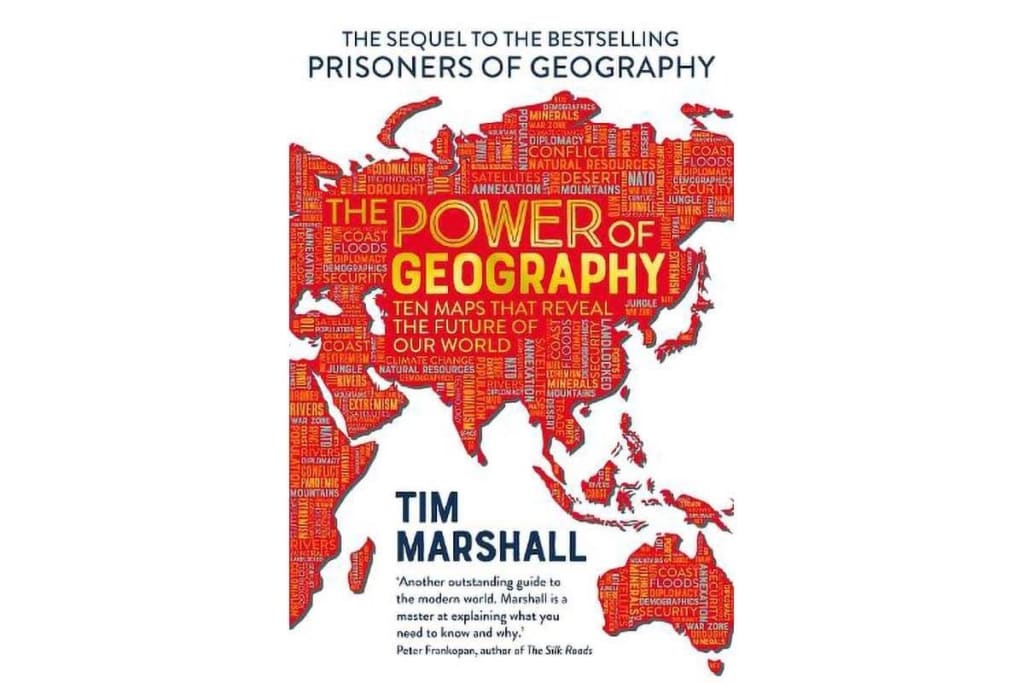
The Power of Geography by Tim Marshall
Ten Maps That Reveal the Future of Our World by Tim Marshall is a compelling continuation of his earlier geopolitical work, Prisoners of Geography. Published in 2021, this book offers a masterful exploration of how geography despite the rapid advance of globalization, technology, and diplomacy continues to shape the destiny of nations. With the rigor of a seasoned journalist and the clarity of a skilled storyteller, Marshall provides a detailed, region-by-region analysis of ten critical locations that are set to shape the world’s political and economic future.
The strength of this book lies in its structured approach. Each chapter is devoted to a specific country or region, exploring its physical geography, historical context, political landscape, and future prospects. Marshall doesn’t just offer dry cartographic facts; instead, he weaves geography into the larger narrative of national identity, conflict, and ambition.
1. Australia
Marshall opens with Australia, often viewed as isolated but increasingly central in the geopolitical tug-of-war between China and the West. Its strategic location in the Indo-Pacific, vast resources, and alliances with Western powers position it as a pivotal player in the coming decades. Yet it must also balance a strong economic relationship with China against growing security concerns.
2. Iran
Iran’s geography has long rendered it a formidable regional power. Surrounded by mountain ranges and deserts, it has been historically insulated yet fiercely independent. Marshall explains how Iran’s terrain contributes to its resilience and its influence across the Middle East, from Iraq to Syria and Lebanon. The chapter underscores Iran’s challenges and ambitions in a region marked by volatility.
3. Saudi Arabia
In discussing Saudi Arabia, Marshall explores the kingdom’s geographical centrality in the Arab world, its dependence on oil wealth, and its attempts at modernization under Vision 2030. The desert terrain, tribal structure, and control over Islamic holy sites give it influence but also constrain it as it seeks to reinvent itself in a post-oil world.
4. The United Kingdom
Post-Brexit Britain is examined through the lens of its island geography. Marshall analyzes how historical naval dominance, the legacy of empire, and shifting global alliances influence Britain’s future. He discusses Scotland’s potential independence, the fragility of the union, and the country’s evolving global role outside the EU.
5. Greece
Greece’s geography places it at a crossroad between East and West. This chapter explores its historical ties to Europe and Asia, its turbulent relationship with Turkey, and its role in the migration crisis. Marshall shows how geography both burdens and benefits Greece, making it a key but often underappreciated actor in regional affairs.
6. Turkey
Turkey’s strategic position bridging Europe and Asia has always given it geopolitical weight. Marshall delves into its ambitions under President Erdogan, its complex identity as a secular state with deep Islamic roots, and its control over crucial waterways like the Bosporus. The chapter portrays Turkey as a nation at a crossroads both geographically and ideologically.
7. The Sahel
The Sahel region, stretching across Africa below the Sahara Desert, is marked by environmental degradation, poverty, and fragile states. Marshall illustrates how its geography fosters instability but also highlights international efforts to stabilize and develop the region. It is one of the most pressing humanitarian and security concerns of our time.
8. Ethiopia
Marshall examines Ethiopia’s mountainous terrain, its role as a historic African empire, and its water disputes with neighboring countries over the Nile River. The country’s internal divisions and border tensions with Eritrea and Sudan are discussed, showing how its geography complicates both unity and regional peace.
9. Spain
Spain’s geographic and cultural diversity creates both opportunity and fragmentation. Marshall discusses Catalonia’s independence movement, immigration challenges, and Spain’s role within the EU. The country’s position between Europe and North Africa places it at the center of several major issues, including energy, migration, and trade.
10. Space
In a bold and forward-looking final chapter, Marshall explores outer space as the “next frontier” of geopolitics. He examines satellite technology, military applications, and the growing ambitions of nations like the United States, China, and Russia. Geography, Marshall argues, is no longer limited to Earth alone.
Conclusion
Tim Marshall’s The Power of Geography is a vital and timely work that transcends conventional political analysis. It is both accessible and richly informative, suitable for readers ranging from students to diplomats. Through vivid examples and incisive commentary, Marshall demonstrates that geography remains a powerful force shaping economies, guiding foreign policy, and influencing the course of history.
This book is not merely a sequel but an essential companion to understanding today’s world. In a rapidly changing global order, The Power of Geography is a reminder that the terrain beneath our feet still matters and always will.
About the Creator
Syed Haider Mehmood
I live through stories—crafting reviews, self-written tales, poetry, and reflections on novels and life. Rooted deeply in my love for reading and writing, I transform thoughts and emotions into words that truly resonate with readers.
Keep reading
More stories from Syed Haider Mehmood and writers in BookClub and other communities.
Orientalism
Edward W. Said’s Orientalism (1978) is a landmark work that fundamentally reshaped the fields of literary theory, history, political science, and cultural studies. Deeply researched and powerfully argued, the book critiques the Western world’s long-standing tradition of depicting the “Orient” broadly defined as the Middle East, Asia, and North Africa through a lens of exoticism, inferiority, and otherness. Far from being a neutral academic pursuit, Said argues, Orientalism has functioned as a system of knowledge production intimately linked to colonial domination and cultural imperialism.
By Syed Haider Mehmood8 months ago in BookClub
Rachel Reviews: Lakefront Wolves by Joseph Deegan
Meet Finn. He's an 18 year old kid who has potential. He's bright with great school scores and he's also an athlete, a footballer of some prowess. He has it all going for him, it would seem, and yet, he's determined to send what could be a well-planned, stable existence firmly off the rails. He drinks, he smokes, he takes drugs, he has violent tendencies and he's in danger of losing not only his mind but all that he holds dear.
By Rachel Deeming14 days ago in BookClub
7 Best Books That Will Change The Way You Think About Money
Money shapes our lives in more ways than we often realize. Yet, many of us approach it with outdated beliefs, habits, or misconceptions that can hinder financial growth, wealth-building, and even personal fulfillment. The right books don’t just teach you how to manage money—they transform your mindset, influence your decisions, and help you cultivate long-term financial resilience.
By Diana Meresc6 days ago in BookClub


Comments
There are no comments for this story
Be the first to respond and start the conversation.