
The Next Conversation by Jefferson Fisher
Book Review

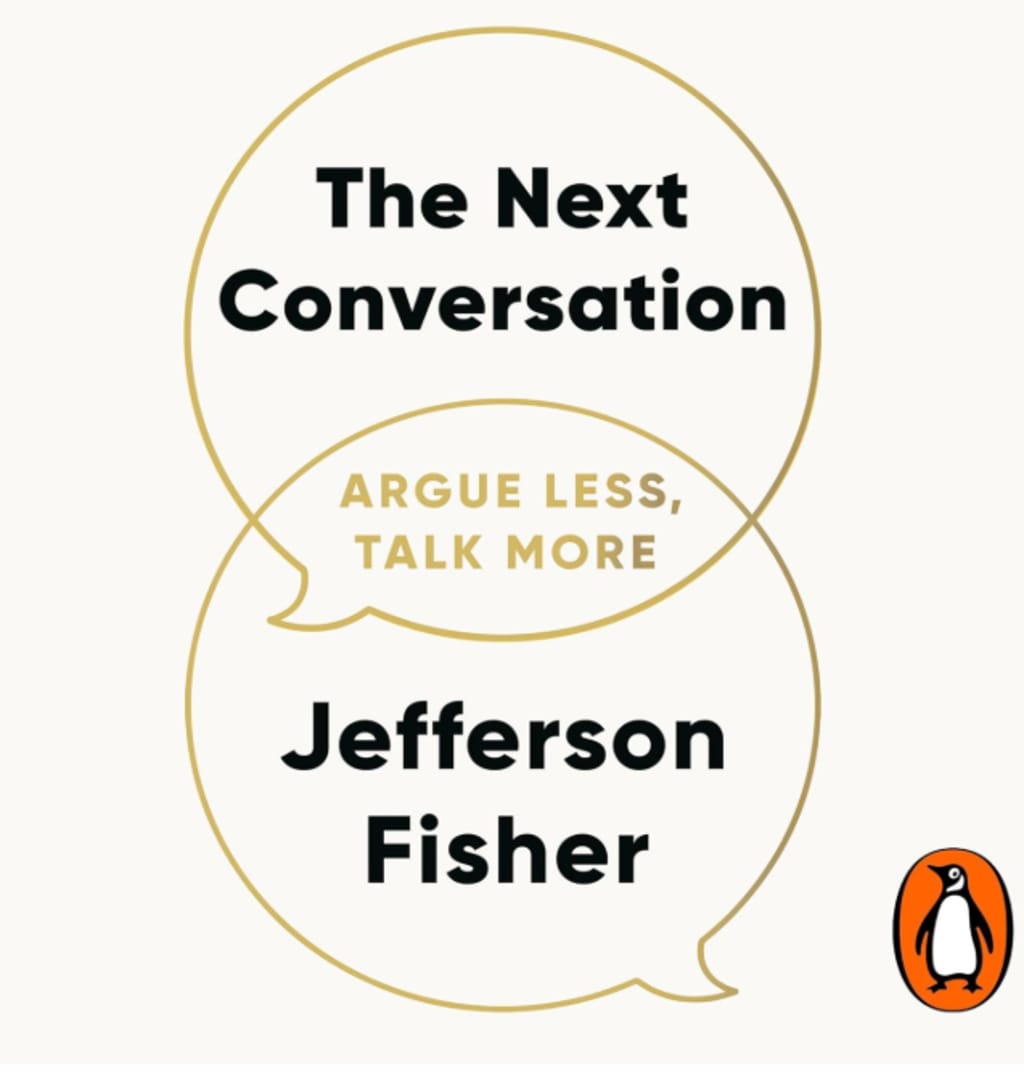
Why This Book Stuck With Me
Some books give you advice. Others provide you with clarity. The Next Conversation by Jefferson Fisher presents itself as a book of second nature. The learning experience went beyond teaching talk methods and beyond while encouraging me to use conversation as a relationship-building instrument rather than a control mechanism.
The publication presents information that exceeds basic clinical "good communication" instructions. As he drives from the front seat of his truck Fisher develops his thoughts instead of using a therapist's counselling chair. The reader experiences a sincere and genuine tone in his voice. As a professional trial lawyer he serves as a main occupation yet his true identity stands as something different—a professional communicator. The author reveals methods in his new book to transition from competitive discussions toward meaningful dialogues.
I discovered the necessity of reading this book only as I approached the middle of chapter one when I reconsidered a verbal exchange during the previous day. Readers who experience regret regarding their verbal communication will find great value in this book.
What It’s About (Spoiler-Free)
Fisher presents a deceptively basic instruction that showing up powerfully matters more than giving up on controversy.
Two parts comprise the structure of the book.
● Fisher introduces readers in Part I to rethink conflict through controlled reactions to find the person's past arguments in the first part.
● The practical portion starts here in Part II. Fisher presents readers with three distinct guidelines which lead to better dialogue between people.
1. Say it with control.
2. Say it with confidence.
3. Say it to connect.
The approach offers practical yet personal recommendations for changing arguments through manageable methods such as turning silence into an instrument while also cutting down the number of useless apologies and asking "What message do I wish to convey?" before speaking.
These aren't scripts or gimmicks. Both their knowledge and approach come from real-life practice and compassionate delivery.
Big Themes You’ll Keep Coming Back To
1. Connection > Winning
The process of winning and arguing typically leads to sacrificing essential elements like trust together with respect and potentially the connection completely disappears.
Instead of demonstrating a point, Fisher presents a different approach to understanding the person next to you. Trying to build real connections replaces the need to control conversations and every interaction transforms because of this shift.
2. Regulate Yourself First
Fisher teaches profound emotional pacing methods which help people control their voice, posture and reactions whenever arguments become intense.
He broke the tension of a contested deposition by casually inquiring about the witness's most significant difficulty during the current year. It completely shifts the conversation. That moment stuck with me.
3. Use Your Values as a Compass
According to Fisher, we should use our core values—honesty and kindness as well as empathy—as guidance to take control of any interaction. When you ground challenging talks in your desired character traits instead of specific words you want to deliver then you will generate true effects.
● His values?
● The opportunity for kindness exists therefore I make use of it.
● I want people to understand who I am even though my name remains
unmentioned.
● I will serve as a lighthouse instead of becoming a bridge.
4. A single dialogue will transform everything
Each interaction with a family member, coworker or friend represents the chance for substantial change to occur. That’s not cheesy. That’s hopeful.
Start your free Audible trial and listen to The Next Conversation
What It Felt Like Reading This
Reading The Next Conversation didn’t feel like studying. It felt like exhaling.
There’s a calm to Fisher’s writing. I found myself dog-earing pages, underlining quotes, and texting friends mid-chapter saying, “This is so good.”
The line that hit me? “The person you see isn’t the person you’re talking to.” That one alone shifted how I approach tough talks.
Real Stuff I’ve Already Used
● I ask, “What do I want them to know?” before any emotionally loaded talk.
● I’ve stopped over-apologizing for things that don’t need an apology.
● I use silence instead of rushing to explain myself.
● I focus on how I want to show up—calm, clear, kind—rather than “winning.”
These aren’t radical moves. But they’ve helped me show up as the version of myself I like.
Where This Book Really Shines
● Super readable. Conversational, kind, and never preachy.
● Grounded in real stories. The information in this book comes from legal settings along with household settings and the TikTok platform.
● Emotionally smart. The book will help you recognize yourself in its content while stimulating a drive to improve.
● Practical. Real tools, real phrases, real results.
What Might Not Work for Some
● Not academic. It’s not packed with studies. It’s packed with experience.
● More stories than stats. The content lacks bullet points together with diagrams making it inappropriate for this text.
● A little repetition. I found it helpful. Others might not.
Who This Book Is For
Pretty much anyone. But especially:
● Couples who want to argue less and listen more
● Parents raising emotionally aware kids
● Managers navigating tough feedback
● Anyone feeling misread, misunderstood, or unheard.
Click here to view buying options of The Next Generation
Want to Listen Instead?
Prefer audio? The Next Conversation is also on Audible—and it’s read by the author himself.
Start your free Audible trial and listen to The Next Conversation
You get one free audiobook with your 30-day trial. Cancel anytime. But honestly? You might want to keep going.
If You Liked This, You’ll Also Like…
● Nonviolent Communication by Marshall Rosenberg
● Set Boundaries, Find Peace by Nedra Glover Tawwab
● Crucial Conversations by Patterson, Grenny & co.
Each one expands on what Jefferson Fisher starts—clear, confident, kind communication.
Final Thoughts
A communication book from the beginning would not have led me to consider my argument methods as well as my offering of support to others—but this book accomplished both things.
● You need not deliver perfection in your statements. Just say it with care.
● The need for perfection does not exist in this scenario. Just try again.
● Accept the following interaction as the one to transform everything.
Affiliate Disclaimer
Some links in this post are affiliate links, including Amazon and Audible. I may earn a small commission—at no extra cost to you—if you purchase through them. Thanks for supporting thoughtful content!
About the Creator
Sid Coulton
I have discovered a love for writing blogs, creating stories and writing articles. My book reviews do contain affiliate links as i am an Amazon Associate.
Keep reading
More stories from Sid Coulton and writers in BookClub and other communities.
The Anxious Generation
Summary Jonathan Haidt’s The Anxious Generation is an evidence-backed analysis that defines “The Great Rewiring” of childhood yet serves as a vital and enlightening exploration of modern childhood development and its mental health effects on young people, especially members of Gen Z.
By Sid Coulton10 months ago in BookClub
Rachel Reviews: The Spiral Archive by Pieter Hendrik
It's difficult for me to know where to start with a review of this book as it was, for me, an entirely unique experience and one that I'll probably never have again. I don't want that to be interpreted as unenjoyable but it has left me scratching my head a little and ruminating on its content, its themes and its characters.
By Rachel Deeming8 days ago in BookClub
There Is Only One True Unreliable Narrator...
The unreliable narrator: A new trend in the literary fiction world, usually also falling under the category of unlikeable narrator and plotless fiction. I think, in many ways, the tiktok-afication of this term has pulled it away from what it actually means and is often used as a synonym for an unlikeable narrator.
By The Austen Shelf3 days ago in BookClub



Comments
There are no comments for this story
Be the first to respond and start the conversation.