

Imagine books so costly that only the wealthy could own them. This was reality for most of history. Books were hard to make, so only scholars had them. A German goldsmith changed this. Johannes Gutenberg invented the printing press. This machine made books available to everyone.
Writing existed long before books. Ancient people wrote on stone, trees, metal, and bones. Clay tablets were an early writing tool. They were popular in the ancient Near East. People wrote on them with reeds. Tablets could be reused after soaking in water. Baked tablets lasted longer.
Egyptians used papyrus, an early paper. Papyrus came from the papyrus plant. It was rolled into scrolls, like early books. The Egyptian Book of the Dead was written on papyrus. Israelites used parchment scrolls made from animal skin. Scrolls were common until the codex.
The codex was like a modern book. It was a stack of bound sheets. Julius Caesar may have invented it. Christians used codices widely. By the 4th century, codices replaced scrolls in the West. Codices saved space and were easy to handle. They made reading easier.
Modern books resemble codices. Paper and printing presses are the main differences. China invented paper over 2,000 years ago. Early paper was made from mulberry bark. The bark was pounded, mixed with water, and dried. Later, hemp and fishing nets were added.
China kept papermaking secret. In 751 AD, Arabs captured Chinese papermakers. The Islamic world learned to make paper. Paper mills spread across the Middle East by the 8th century. By the 13th century, paper reached Europe through Baghdad. Paper replaced other writing materials.
Gutenberg's printing press was crucial. Before printing, books were copied by hand. This made them rare and expensive. Scribes copied books. Calligraphers made fine books. Illuminators added pictures. Correctors checked the work. Copying took a long time.
Universities in Europe increased the demand for books. A faster printing method was needed. China used wood block printing. This method started before 220 AD. Carved wood blocks were inked and pressed on paper. The Diamond Sutra is an early printed book from 868 AD.
Movable type printing also started in China. Separate character blocks formed words. Neither method reached Europe until paper became common. Gutenberg's press revolutionized printing in 1440. He created a movable type press.
Gutenberg made metal letters from a lead alloy. This worked well for printing and is still used. He used oil-based ink that stuck to metal. The press used a screw and handle to press paper onto the inked type. Two people could print 3,600 pages a day, compared to 40 by hand.
By the late 15th century, presses existed in over 200 European cities. Books became cheaper and more available. Mass communication began. Ideas spread freely. Knowledge was no longer controlled. People could question authority.
Printing presses have improved, but the method remains similar. Modern books use offset printing. This method uses cylinders and aluminum plates. Lasers create the image. Ink is transferred to paper through a rubber cylinder. Digital printing is used for small print runs.
Bookmaking has changed with technology. The book's look has stayed mostly the same since the codex. E-books are different. They need no paper or printing. They are easily shared online and are cheap. Yet, many prefer physical books. Holding a book feels special.
About the Creator
Keep reading
More stories from Mostafa Al Aklouk and writers in BookClub and other communities.
How to
Asking a question others fear to ask benefits everyone. If you're brave enough to ask, you'll likely find 80% of people share your curiosity. Asking once means you'll never need to ask again. Stop doing things that hold you back. Think about what you can change. Some bad habits are hard to break, but others are worth fighting.
By Mostafa Al Aklouk10 months ago in Lifehack
Book Review: Atmosphere by Taylor Jenkins Reid
I flipped the book over in my hands in the centre of the small airport book shop. Although I had heard promising reviews of Atmosphere by Taylor Jenkins Reid, I hesitated. The synopsis didn’t compel me - I wasn’t much of a space girly. In high school it made me cringe when my peers would talk about the stars.
By sleepy draftsa day ago in BookClub
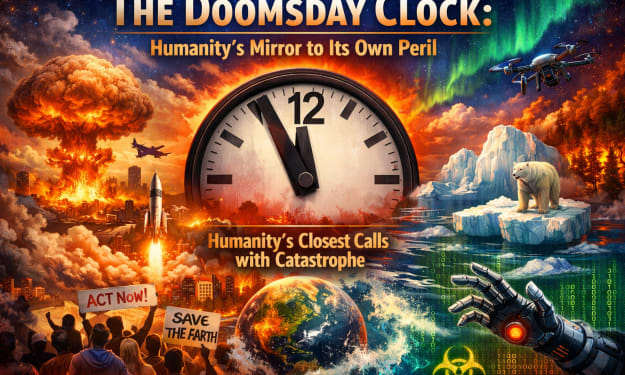
The Doomsday Clock: Humanity’s Mirror to Its Own Peril
A Clock at the Edge of History The Doomsday Clock stands as one of the most enduring symbols ever created to translate abstract danger into a form the human mind can grasp. A single clock face, stark and deliberate, conveys the accumulated weight of scientific knowledge, political tension, environmental strain, and technological acceleration. This image has escaped the boundaries of academic journals and policy circles to become part of global cultural consciousness. The clock functions not as decoration, nor as prophecy, but as a warning system rendered in metaphor.
By Marcus Hedare7 days ago in BookClub
The Devil's Triangle
The sails ruffled in the breeze as we cruised along. The Sea Breeze was a mid-size catamaran that sailed out of Royal Naval Dockyard in Bermuda. We had booked this trip weeks in advance and were now looking at our Captain, Spike and two boat hands. Paddy and Wilson seemed like nice guys, joking around with the passengers and telling us some stories about Bermuda that only locals would know. Their island accents sounded almost British but they were pleasant to listen to.
By Barbara Gode Wilesa day ago in Fiction



Comments
There are no comments for this story
Be the first to respond and start the conversation.