
The Hermetic Order of the Golden Dawn
Ritual, Symbolism, and the Legacy of Modern Magic

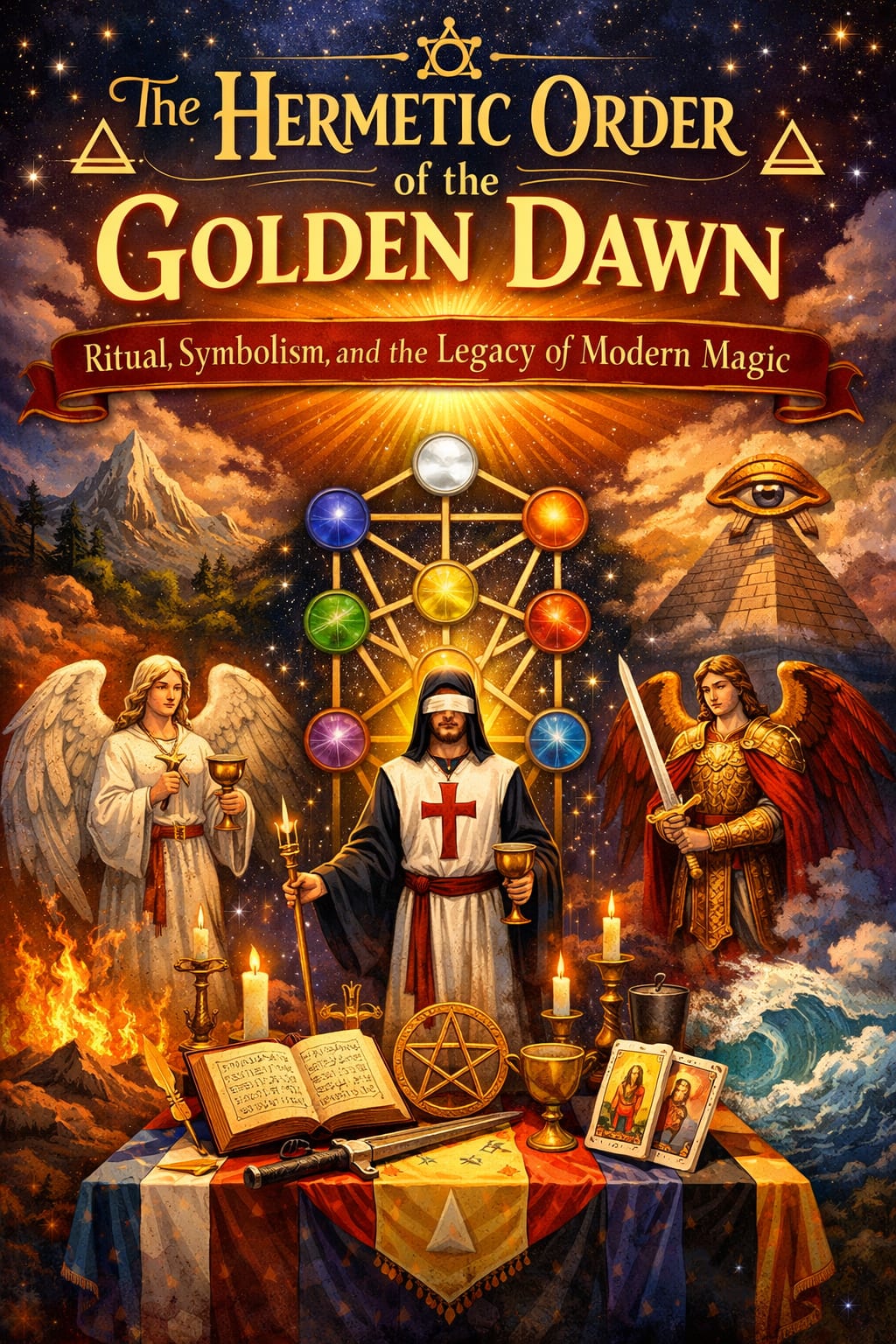
The Architecture of Esoteric Revival
Late Victorian Britain stood at a crossroads of intellectual confidence and spiritual unease. Industrial expansion transformed cities into engines of production. Telegraph networks compressed global communication into moments. Advances in geology, biology, and comparative religion challenged long accepted theological frameworks. Charles Darwin’s evolutionary theory altered public discourse on creation and human origin, while advances in archaeology uncovered material evidence of civilizations long buried beneath desert sands and ruined temples.
Public fascination with ancient Egypt intensified following excavations and museum exhibitions throughout the nineteenth century. Hieroglyphic translations revealed complex religious cosmologies filled with divine hierarchies, funerary rites, and symbolic theology. Classical Hermetic texts, rediscovered and translated during earlier centuries, gained renewed attention among scholars and esoteric circles. Renaissance magical philosophy, Kabbalistic speculation, Rosicrucian manifestos, and medieval grimoires circulated among collectors, antiquarians, and spiritual experimenters seeking hidden systems of universal wisdom.
Urban salons and private drawing rooms hosted séances, trance lectures, and demonstrations of mediumship. Organizations such as the Theosophical Society and various Masonic bodies attracted members drawn to symbolic initiation and spiritual hierarchy. Freemasonry, with elaborate ritual drama and allegorical teaching, offered a framework that suggested knowledge could be transmitted through staged ceremonial progression. Many intellectuals and artists began searching for a synthesis between scientific progress and mystical experience.
Within such a fertile cultural environment, a small consortium of British occult scholars and Freemasons established the Hermetic Order of the Golden Dawn in 1888. Founders included William Wynn Westcott, Samuel Liddell MacGregor Mathers, and William Robert Woodman, all men connected through fraternal networks, antiquarian research, and interest in ceremonial magic. Foundational authority for the Order drew from a collection of manuscripts known as the Cipher Manuscripts, documents written in encoded text that outlined a structured magical curriculum, elemental symbolism, and initiatory framework.
The Golden Dawn distinguished itself through methodical organization. Initiation progressed through graded levels modeled partly upon Masonic degree systems yet expanded through intricate correspondences linking astrology, alchemy, Kabbalah, Enochian angelic language, geomancy, and tarot symbolism. Rituals incorporated carefully choreographed movement, invocations, color symbolism, sacred geometry, and Hebrew divine names arranged within ceremonial space. Instructional documents preserved practical exercises such as visualization, astral projection, talismanic construction, and meditation upon symbolic diagrams known as tattva emblems.
Systematic integration of diverse esoteric traditions marked a defining achievement of the Golden Dawn. Medieval magical grimoires often presented fragmented ritual instructions. Renaissance occult philosophy attempted intellectual synthesis but lacked standardized initiatory training. The Golden Dawn assembled disparate strands into a unified ceremonial and educational framework designed to cultivate both intellectual comprehension and experiential transformation. Such organization allowed magical practice to function as a disciplined spiritual curriculum rather than a loose collection of mystical experiments.
Membership attracted poets, actors, physicians, artists, and scholars whose creative output later shaped twentieth century literature, visual art, and occult revival movements. Detailed ritual scripts and symbolic charts produced within temple lodges later influenced modern tarot deck design, contemporary ceremonial magic orders, and psychological interpretations of archetypal imagery. Surviving instructional papers continue circulating among esoteric practitioners and historians as primary documentation of structured Western magical training during the late nineteenth century.
The Hermetic Order of the Golden Dawn emerged during an era when scientific discovery expanded material understanding while spiritual inquiry sought new symbolic languages capable of expressing metaphysical experience. Formalized ritual, layered symbolism, and graded initiation transformed scattered occult traditions into an enduring intellectual and spiritual system that continues to influence Western esoteric study.
Hermeticism
Hermeticism represents a philosophical and mystical current inspired by texts attributed to Hermes Trismegistus, a syncretic figure combining elements of the Greek god Hermes and the Egyptian deity Thoth. Core Hermetic writings, particularly the Corpus Hermeticum and the Asclepius, emerged in Hellenistic Egypt between the first and third centuries of the Common Era. Hermetic philosophy emphasizes divine unity, correspondence between macrocosm and microcosm, and spiritual regeneration through knowledge known as gnosis. Renaissance scholars such as Marsilio Ficino translated Hermetic texts into Latin, encouraging widespread circulation among European intellectual circles. Nineteenth century occult revival movements adopted Hermetic cosmology as a bridge linking classical philosophy, alchemical symbolism, astrology, and metaphysical ascent. Golden Dawn doctrine relied heavily upon Hermetic principles as a theoretical framework supporting ritual structure and symbolic interpretation.
Kabbalah
Kabbalah developed within Jewish mystical scholarship during medieval Europe and the Near East. Foundational texts include the Sefer Yetzirah and the Zohar, both exploring divine emanation, sacred language, and cosmic structure. Kabbalistic thought describes divine manifestation through a sequence of emanations representing stages of creation and spiritual refinement. Golden Dawn scholars adapted Kabbalistic teachings into a Hermeticized framework influenced by Christian mysticism and Renaissance occult philosophy. Hebrew divine names, angelic hierarchies, and numerological correspondences became integrated into ceremonial magic, providing a symbolic language connecting spiritual forces with ritual practice.
Tree of Life
The Tree of Life serves as the central diagrammatic representation of Kabbalistic cosmology. The diagram consists of ten Sephiroth, representing stages of divine emanation, arranged along three vertical pillars connected by twenty two pathways. Each Sephirah corresponds with spiritual attributes, planetary symbolism, and states of consciousness. Golden Dawn teachings expanded the Tree of Life into a comprehensive map linking astrology, tarot symbolism, alchemical transformation, and ceremonial ritual. Initiatory progression through Golden Dawn grades corresponded with symbolic ascent through the Sephiroth, reflecting gradual spiritual refinement and intellectual comprehension.
Cipher Manuscripts
The Cipher Manuscripts comprise a series of encoded documents discovered during the late nineteenth century and translated into plain text by William Wynn Westcott. Manuscripts contained outlines for ritual initiation, symbolic correspondences, and organizational structure for a magical fraternity. Content included elemental symbolism, temple layout instructions, and hierarchical degree systems. Historical debate continues regarding manuscript authorship, with theories suggesting German Rosicrucian origin or composition by British occultists. Regardless of origin, manuscripts provided structural blueprints that enabled formation of the Golden Dawn and established ceremonial frameworks still studied within modern esoteric scholarship.
R.R. et A.C.
R.R. et A.C., abbreviated from Rosae Rubeae et Aureae Crucis, translates as Red Rose and Golden Cross. The designation refers to the Second Order within Golden Dawn hierarchy. Advancement into the Second Order required completion of outer grade initiations and demonstration of symbolic and theoretical mastery. Instruction within R.R. et A.C. emphasized practical ceremonial magic, astral projection, talismanic construction, and advanced invocation techniques. Ritual work conducted within the Second Order aimed at direct spiritual experience and transformation rather than purely intellectual study. Surviving instructional papers associated with R.R. et A.C. influenced twentieth century magical societies and ceremonial lodges across Europe and North America.
Banishing Ritual of the Pentagram
The Banishing Ritual of the Pentagram functions as a foundational ceremonial exercise within Golden Dawn practice. Ritual performance involves visualization of pentagram symbols at cardinal directions, invocation of archangelic guardians, and vibrational recitation of sacred divine names derived from Hebrew tradition. Purpose includes purification of ritual space, stabilization of psychological focus, and establishment of symbolic protective boundaries. Continued usage among modern ceremonial magicians demonstrates lasting influence of Golden Dawn ritual methodology.
Secret Chiefs
Secret Chiefs represent alleged spiritual authorities believed to operate beyond physical perception. Golden Dawn tradition described such figures as advanced adepts communicating through visionary or astral contact. Historical documentation suggests Samuel Liddell MacGregor Mathers claimed correspondence with such entities, presenting guidance as justification for ritual innovations and doctrinal development. Concept of hidden initiatory guardians reflects earlier Rosicrucian and Theosophical traditions that proposed invisible hierarchies directing spiritual evolution. Debate concerning literal or symbolic interpretation of Secret Chiefs remains prominent within academic and esoteric analysis.
Encoded Foundations and the Birth of a Magical Fraternity
The Hermetic Order of the Golden Dawn formally entered public existence in London during 1888, emerging from networks of Freemasonry, Rosicrucian scholarship, antiquarian research, and Victorian occult revival culture. Three central architects shaped early organizational structure, doctrinal development, and ceremonial expansion.
William Wynn Westcott (1848 to 1925)
Westcott served as a London coroner, Freemason, and prominent member of several esoteric fraternities. Scholarly interests included comparative religion, alchemy, and mystical philosophy. Westcott claimed discovery of a collection of encoded ritual manuscripts during the mid 1880s. Documents, later designated as the Cipher Manuscripts, contained material written in a substitution cipher using a modified Trithemian system. Decoded text revealed skeletal outlines of initiatory ceremonies structured around elemental symbolism, geometric temple arrangement, Hebrew divine names, and Kabbalistic correspondences.
Cipher content did not provide complete ritual scripts. Material instead offered schematic frameworks requiring expansion, interpretation, and ceremonial elaboration. Westcott asserted correspondence with a German Rosicrucian adept identified as Fraulein Anna Sprengel. Letters allegedly granted authorization for establishment of an English temple operating under continental esoteric lineage. Surviving documentation supporting existence of Sprengel remains absent from archival evidence.
Historical investigation conducted by Ellic Howe during twentieth century scholarship raised significant questions concerning authenticity of Sprengel correspondence. Howe examined handwriting samples, paper composition, and timeline inconsistencies, proposing potential fabrication designed to provide continental legitimacy and hierarchical authority. Regardless of disputed origin, the Cipher Manuscripts supplied structural scaffolding for ceremonial curriculum later expanded into a comprehensive magical training system.
William Robert Woodman (1828 to 1891)
Woodman contributed administrative stability, scholarly prestige, and fraternal legitimacy. Medical training combined with extensive involvement in Rosicrucian scholarship enhanced organizational credibility among Victorian intellectual circles. Woodman held senior leadership position within the Societas Rosicruciana in Anglia, a Masonic affiliated society devoted to Christian mysticism, alchemical philosophy, and Rosicrucian symbolism. Membership in Societas Rosicruciana required Master Mason status, creating a selective intellectual environment that nurtured esoteric study through graded initiation and symbolic instruction. Woodman facilitated administrative structure and reinforced connections between Rosicrucian tradition and emerging Golden Dawn ceremonial hierarchy.
Samuel Liddell MacGregor Mathers (1854 to 1918)
Mathers demonstrated exceptional influence upon doctrinal and ritual development. Linguistic fluency in French supported translation of European grimoires and occult manuscripts, including texts attributed to Renaissance ceremonial magic and medieval magical tradition. Mathers expanded cipher outlines into elaborate ritual performances incorporating symbolic color scales, temple regalia, weapon symbolism, angelic invocations, and detailed grade ceremonies. Mathers also introduced Enochian magical components derived from sixteenth century angelic records attributed to John Dee and Edward Kelley. Instructional documents produced under Mathers’ supervision later formed core curriculum studied within twentieth century ceremonial magical orders.
Organizational development culminated with establishment of the first functioning temple, Isis-Urania Temple, founded in London during 1888. Temple design reflected Egyptian symbolic aesthetics combined with Kabbalistic spatial correspondences and ritual geometry. Initiatory ceremonies conducted within Isis Urania introduced candidates to structured progression through elemental grades associated with earth, air, water, and fire symbolism.
Expansion followed rapidly. Additional temples appeared in Bradford, Weston super Mare, Edinburgh, and Paris. Geographic growth reflected increasing interest among intellectuals, artists, physicians, and literary figures drawn toward systematic magical instruction and symbolic initiation. Each temple maintained standardized ritual curriculum derived from cipher frameworks and Mathers’ ceremonial expansions, preserving doctrinal cohesion across multiple lodges.
The Cipher Manuscripts remain among the most debated artifacts in Western esoteric history. Questions surrounding authorship, continental lineage, and symbolic authenticity continue generating scholarly analysis. Regardless of disputed provenance, manuscript content provided structural architecture for a disciplined magical order that reshaped ceremonial practice, tarot symbolism, and Hermetic philosophy across Europe and North America during the late nineteenth and early twentieth centuries.
Ladder of Ascent: The Initiatory Architecture of the Golden Dawn
The Hermetic Order of the Golden Dawn developed a rigorously organized initiatory framework designed to guide spiritual and intellectual development through symbolic progression. Graded advancement reflected a synthesis of Rosicrucian initiation, Masonic ceremonial structure, Renaissance Hermetic philosophy, and Kabbalistic cosmology. Each grade represented both academic mastery and ritual transformation, linking ceremonial performance with metaphysical ascent mapped upon the Kabbalistic Tree of Life.
The Outer Order
The Outer Order functioned as foundational training designed to introduce symbolic literacy, esoteric scholarship, and elemental ritual practice. Initiatory degrees followed a numerical formula pairing a zero or ascending number with a Sephirotic reference derived from Kabbalistic tradition.
Grades included:
- Neophyte 0=0
- Zelator 1=10
- Theoricus 2=9
- Practicus 3=8
- Philosophus 4=7
Numerical structure corresponded directly to Sephirotic placement upon the Tree of Life. Zelator grade instruction focused upon Malkuth, representing manifestation, material existence, and elemental earth symbolism. Theoricus studies corresponded with Yesod, associated with lunar symbolism, dream consciousness, and astral imagery. Practicus instruction aligned with Hod, representing intellectual analysis, language, and symbolic interpretation. Philosophus grade corresponded with Netzach, emphasizing emotional discipline, artistic symbolism, and ritual devotion.
Outer Order curriculum incorporated extensive theoretical and practical instruction. Students memorized the Hebrew alphabet, including numerical values and phonetic correspondences essential for ceremonial invocation. Kabbalistic tables organized symbolic relationships between divine names, angelic hierarchies, planetary forces, and elemental qualities. Tarot symbolism received systematic classification, linking each card to astrological, alchemical, and Kabbalistic correspondences. Instruction included planetary astrology, alchemical transformation theory, elemental invocation methods, and meditation techniques based upon visualized geometric symbols known as tattva emblems.
Initiation ceremonies functioned as dramatic ritual theatre designed to produce psychological and spiritual transformation. Ceremonies included symbolic blindfolding, guided circumambulation within temple space, recitation of sacred formulae, and staged allegories of death and rebirth. Ritual language, lighting, color symbolism, and temple geometry combined to create immersive initiatory experiences designed to imprint symbolic meaning upon memory and subconscious perception.
The Second Order: R.R. et A.C.
Advancement into R.R. et A.C., abbreviated from Rosae Rubeae et Aureae Crucis, required completion of Outer Order studies alongside demonstrated ritual proficiency and symbolic comprehension. The Second Order served as advanced training focused upon operational ceremonial magic rather than theoretical study.
Instruction expanded into Enochian magical systems derived from angelic records documented by John Dee and Edward Kelley during the late sixteenth century. Enochian practice involved complex angelic alphabets, magical tablets representing cosmic elemental forces, and ceremonial skrying performed through crystal or symbolic vision surfaces.
Second Order instruction emphasized talismanic construction using engraved symbols, planetary metals, astrological timing, and consecration rituals. Planetary invocation ceremonies aimed to establish controlled interaction with symbolic intelligences associated with classical planetary spheres. Visualization techniques became increasingly complex, requiring detailed mental construction of symbolic temples, astral landscapes, and ritual implements. Skrying exercises encouraged controlled visionary exploration designed to produce direct symbolic communication and experiential spiritual insight. Ritual magic operations incorporated elaborate invocations, protective ceremonial boundaries, and hierarchical spiritual symbolism.
Historical documentation demonstrates that R.R. et A.C. served as the operational core of Golden Dawn magical practice. Surviving instructional papers reveal highly structured magical experimentation combining psychological discipline with symbolic cosmology.
The Third Order
Golden Dawn tradition described a Third Order composed of spiritual adepts identified as Secret Chiefs. Documentation portrayed such figures as advanced initiates operating beyond physical incarnation while guiding doctrinal evolution through visionary or symbolic communication. Claims regarding direct contact frequently appeared within correspondence attributed to Samuel Liddell MacGregor Mathers during organizational leadership conflicts.
Historical research has produced no verifiable evidence supporting physical existence of a Third Order hierarchy. Many academic scholars interpret Secret Chiefs as allegorical representations of inner spiritual authority, higher consciousness, or archetypal initiatory guardians drawn from earlier Rosicrucian and Theosophical traditions. Symbolic interpretation aligns with esoteric pedagogical methods that frame spiritual progress as dialogue between conscious intellect and transcendent symbolic wisdom.
The graded initiatory system of the Golden Dawn established one of the most comprehensive ceremonial training structures within Western esotericism. Integration of academic study, ritual performance, symbolic meditation, and hierarchical advancement created a disciplined curriculum capable of preserving esoteric knowledge while facilitating experiential transformation through staged initiatory ascent.
Ceremonial Drama and the Symbolic Language of Initiation
Ritual practice within the Hermetic Order of the Golden Dawn operated as structured ceremonial theatre designed to produce spiritual and psychological transformation through symbolic enactment. Golden Dawn temple ceremonies followed strict choreography combining spatial movement, sacred language, color symbolism, musical cadence, and ritual gesture. Ritual structure reflected Renaissance magical theory proposing that symbolic performance could reshape consciousness and align human awareness with cosmic order.
The Neophyte Ceremony
The Neophyte initiation functioned as formal entrance into Golden Dawn ceremonial training. Candidates entered temple chambers blindfolded, representing spiritual ignorance and separation from esoteric knowledge. Temple officers assumed ritual roles representing elemental guardians and symbolic hierarchies derived from Hermetic and Kabbalistic cosmology. Movement around the ritual chamber followed circumambulatory patterns aligned with cardinal directions, reinforcing symbolic association between spatial orientation and elemental forces of earth, air, water, and fire.
Ceremonial questioning examined symbolic readiness and intellectual preparation. Removal of the blindfold marked ritual awakening, representing transition from darkness into symbolic illumination. Temple implements, colored banners, incense fragrance, and vocal intonation created multisensory ceremonial environments designed to imprint symbolic meaning upon memory and emotional perception. Each successive grade initiation developed allegorical narratives portraying spiritual ascent, ethical refinement, and philosophical comprehension mapped onto cosmic symbolism derived from Kabbalistic doctrine.
The Lesser Banishing Ritual of the Pentagram
The Lesser Banishing Ritual of the Pentagram became one of the most enduring ceremonial exercises associated with Golden Dawn practice. Ritual sequence begins with the Qabalistic Cross, a gesture aligning physical body with Kabbalistic cosmology through visualization of divine light extending across vertical and horizontal axes of spiritual space.
Ritual procedure continues through drawing pentagram figures in the four cardinal directions using ritual gesture or ceremonial dagger symbolism. Practitioners vibrate sacred Hebrew divine names associated with elemental purification and protective invocation. The sequence culminates with visualization and invocation of four archangelic guardians positioned at directional boundaries. Ritual objectives include purification of ceremonial space, stabilization of mental focus, development of visualization discipline, and establishment of symbolic psychological boundaries. Continued use across modern ceremonial magic demonstrates structural durability and practical effectiveness.
The Middle Pillar Exercise
The Middle Pillar exercise emerged during later Golden Dawn tradition and gained broad recognition through writings and teaching of Israel Regardie. The exercise centers upon visualization of descending divine radiance moving through central Sephirotic spheres of the Tree of Life. Practitioners imagine luminous energy flowing sequentially through Kether, Tiphareth, Yesod, and Malkuth, forming an energetic column linking transcendent spiritual consciousness with physical embodiment.
Psychological integration forms primary objective of the Middle Pillar exercise. Visualization encourages harmonization of emotional, intellectual, and physical awareness through symbolic alignment with Kabbalistic cosmology. Many twentieth century occult practitioners and depth psychology scholars recognized parallels between Middle Pillar visualization and emerging theories of subconscious integration and archetypal imagery.
Enochian Tablets
Golden Dawn ceremonial training incorporated color coded elemental tablets derived from angelic records attributed to sixteenth century occult investigations conducted by John Dee and Edward Kelley. Enochian tablets contained symbolic grids of letters arranged into complex hierarchies representing elemental forces and angelic intelligences. Ritual application involved skrying practices conducted through crystal surfaces, polished mirrors, or visualized symbolic gateways.
Enochian ceremonial work required extensive memorization of angelic names, geometric patterns, and ritual invocations. Practitioners recorded visionary experiences within magical diaries, forming an early experimental approach to systematic mystical exploration. Enochian symbolism introduced elaborate cosmological maps representing elemental interaction across spiritual and material dimensions.
Precision defined Golden Dawn ceremonial methodology. Ritual symbolism functioned as structured language designed to communicate metaphysical principles through embodied experience rather than abstract philosophical discourse.
The Symbolic Matrix of Esoteric Cosmology
The Tree of Life
The Tree of Life formed the central symbolic framework organizing Golden Dawn doctrine and ritual progression. The diagram consists of ten Sephiroth representing stages of divine manifestation arranged across three vertical pillars symbolizing balance between severity, mercy, and equilibrium.
Traditional Sephirotic attributions include:
- Kether, Crown
- Chokmah, Wisdom
- Binah, Understanding
- Chesed, Mercy
- Geburah, Severity
- Tiphareth, Beauty
- Netzach, Victory
- Hod, Splendor
- Yesod, Foundation
- Malkuth, Kingdom
Each Sephirah corresponded with planetary symbolism, color scales, ritual incense formulations, tarot trumps, Hebrew letter associations, angelic hierarchies, and ceremonial implements. Golden Dawn grade advancement mirrored symbolic ascent through Sephirotic spheres, presenting spiritual development as progressive alignment with divine emanation.
Tarot Integration
Golden Dawn symbolism profoundly influenced modern tarot structure through collaboration between Arthur Edward Waite and Pamela Colman Smith during early twentieth century publication of an illustrated tarot deck released in 1909. Waite, a Golden Dawn initiate and esoteric scholar, developed symbolic interpretations grounded in Kabbalistic correspondences and Hermetic philosophy. Smith translated symbolic instructions into narrative imagery depicting human figures, landscapes, and elemental symbolism within Minor Arcana cards.
Golden Dawn teachings linked tarot suits with elemental forces, astrological influences, and Sephirotic placement upon the Tree of Life. Illustrated Minor Arcana scenes introduced narrative symbolism enabling intuitive interpretation alongside traditional divinatory methods. Modern tarot practice throughout Western occult culture continues to reflect Golden Dawn symbolic structure and interpretive philosophy.
Golden Dawn ceremonial architecture fused dramatic ritual performance with intellectual symbolism, creating a multidimensional system designed to transform perception, deepen spiritual comprehension, and establish lasting influence upon Western esoteric tradition.
Architects, Visionaries, and Controversial Reformers
Development of the Hermetic Order of the Golden Dawn depended upon a network of scholars, artists, ritual innovators, and ideological reformers whose personalities shaped ceremonial structure, internal politics, and cultural influence. Leadership within the Order combined academic research, artistic experimentation, and charismatic authority, producing both creative expansion and organizational instability.
Samuel Liddell MacGregor Mathers
Mathers served as primary architect of Golden Dawn ceremonial structure and magical curriculum. Scholarly work included translation and adaptation of several influential Renaissance and medieval grimoires. Among notable publications appear editions of the The Key of Solomon and The Book of the Sacred Magic of Abramelin. Both texts contributed ritual frameworks involving talismanic construction, angelic invocation, and ceremonial purification.
Mathers expanded cipher manuscript outlines into complex ritual dramas incorporating color symbolism, temple regalia, weapon symbolism, and angelic hierarchies. Instructional manuscripts attributed to Mathers introduced Enochian magical systems derived from sixteenth century angelic records associated with John Dee and Edward Kelley. Claims of communication with Secret Chiefs appeared within private correspondence and doctrinal instruction, presenting Mathers as intermediary between physical initiatory lodges and transcendent spiritual authorities.
Relocation to Paris during the 1890s shifted administrative control away from London temples. Leadership style gradually developed strong hierarchical centralization. Increasing reliance upon personal authority and alleged spiritual mandates contributed to internal conflict and eventual organizational fragmentation during the closing years of the nineteenth century.
William Wynn Westcott
Westcott functioned as administrative founder and structural organizer during early Golden Dawn development. Professional career as coroner combined with extensive involvement in Rosicrucian and Masonic scholarship allowed establishment of intellectual legitimacy within Victorian fraternal culture. Westcott supervised early lodge organization, membership recruitment, and preservation of ritual manuscripts derived from Cipher Manuscript material.
Public exposure of occult involvement during 1897 created professional risk within governmental service. Institutional pressure associated with public office prompted resignation from active Golden Dawn leadership. Departure significantly altered organizational balance, allowing increased ritual authority to consolidate under Mathers’ direction.
Florence Farr
Florence Farr represented one of the most influential female leaders within Golden Dawn history. Professional reputation as stage actress intersected with scholarly interest in symbolism, voice vibration, and ritual performance. Leadership of London temple operations following Westcott resignation introduced ceremonial refinement emphasizing vocal intonation, rhythmic invocation, and symbolic Egyptian aesthetics.
Farr maintained strong connections with emerging feminist intellectual movements and artistic circles associated with fin de siècle cultural experimentation. Development of ritual performance techniques focused upon sonic resonance, symbolic gesture, and dramatic staging expanded Golden Dawn ceremonial practice into theatrical and psychological dimensions rarely explored within earlier fraternal societies.
W. B. Yeats
Membership of Yeats beginning in 1890 contributed literary prestige and symbolic experimentation within Golden Dawn cultural influence. Yeats integrated Hermetic and Kabbalistic symbolism into poetic structure, mythological narrative, and philosophical speculation. Esoteric symbolism influenced major literary works including The Second Coming and A Vision, both exploring cyclical cosmology, archetypal imagery, and metaphysical transformation.
Participation within Golden Dawn ceremonial initiation reinforced Yeats’ interest in symbolic language as a method of artistic expression and spiritual exploration. Integration of ritual symbolism into literary composition influenced development of modernist poetic imagery and mystical philosophical literature during early twentieth century cultural movements.
Aleister Crowley
Crowley entered Golden Dawn membership during 1898 and demonstrated rapid advancement through initiatory grades. Advancement into Second Order membership generated internal controversy, particularly among London temple leadership. Conflicts involving ritual authority, doctrinal interpretation, and administrative legitimacy escalated into organizational crisis during 1900.
Following separation from Golden Dawn authority structures, Crowley established philosophical and magical system known as Thelema. Thelemic doctrine introduced new ritual texts, symbolic mythology, and spiritual philosophy emphasizing individual spiritual will as central metaphysical principle. Crowley’s later publications, magical experiments, and public persona established enduring influence upon twentieth century occult revival and ceremonial magic practice.
Israel Regardie
Regardie entered twentieth century occult history as secretary and student within Crowley’s magical circle during the 1920s. Scholarly preservation of Golden Dawn ceremonial knowledge occurred through publication of the multi volume work The Golden Dawn between 1937 and 1940. Publication included ritual scripts, symbolic correspondences, instructional diagrams, and initiatory documentation previously restricted to lodge membership.
Regardie’s editorial effort preserved extensive Golden Dawn ritual corpus during a period when many original lodges had dissolved or fragmented. Modern ceremonial magical organizations, esoteric scholars, and historical researchers continue to rely upon Regardie’s publications as primary documentation of Golden Dawn ceremonial structure and symbolic system.
Golden Dawn leadership reflected a convergence of scholarship, artistic experimentation, ritual innovation, and ideological conflict. Contributions from founders, performers, poets, reformers, and archivists collectively shaped one of the most influential esoteric traditions within modern Western spiritual and intellectual history.
Fracture Within the Temple: Authority, Legitimacy, and Organizational Collapse
Stability within the Hermetic Order of the Golden Dawn depended upon cooperation between administrative leadership, ritual authority, and initiatory hierarchy. Following the withdrawal of founding organizer William Wynn Westcott during 1897, internal balance shifted dramatically. Removal of Westcott eliminated a moderating administrative presence that had previously balanced ceremonial innovation with fraternal governance. Remaining leadership increasingly concentrated under Samuel Liddell MacGregor Mathers, whose authority rested upon ritual authorship, manuscript control, and alleged communication with transcendent initiatory overseers known as Secret Chiefs.
Mathers asserted exclusive spiritual mandate derived from claimed correspondence with these hidden adepts. Such claims elevated ritual authority beyond democratic lodge governance, positioning Mathers as intermediary between human initiates and invisible spiritual hierarchy. London based members increasingly questioned historical verification of Secret Chief correspondence as well as administrative centralization conducted from Mathers’ residence in Paris. Concerns also developed regarding restricted access to advanced ritual manuscripts and accusations involving unauthorized transmission of initiatory material.
Organizational tension intensified through disputes over manuscript authenticity, hierarchical legitimacy, and ritual authorization. Correspondence between London members and Mathers revealed growing mistrust regarding doctrinal revisions and personal authority. Leadership division eventually transformed philosophical disagreement into institutional confrontation.
Crisis reached public ceremonial expression during 1900 at the Isis-Urania Temple, original London temple and intellectual center of early Golden Dawn activity. Aleister Crowley, recently advanced into Second Order membership through authorization issued by Mathers, traveled to London acting as representative of Paris leadership. Crowley attempted formal assertion of authority intended to reinforce Mathers’ spiritual and administrative supremacy. London temple officers rejected such authority, citing procedural irregularities and disputed initiatory legitimacy. Confrontation escalated into public ceremonial conflict involving ritual regalia, competing warrants of authority, and institutional expulsion.
Following confrontation, organizational unity dissolved rapidly. Multiple successor bodies emerged, each claiming preservation of authentic Golden Dawn tradition while modifying doctrinal emphasis and ritual curriculum.
The faction known as Alpha et Omega remained under leadership of Mathers. Alpha et Omega attempted continuation of original ceremonial structure while incorporating additional symbolic material, expanded Enochian ritual work, and revised initiatory sequences. Paris served as primary administrative center for Alpha et Omega temples.
Another significant successor organization developed under the title Stella Matutina. Stella Matutina leadership emphasized collaborative lodge governance and gradual ritual adaptation while maintaining foundational Golden Dawn symbolism. Several British temples adopted Stella Matutina affiliation, preserving Outer Order and Second Order ceremonial progression with modified instructional texts.
Independent temples also appeared, operating without centralized leadership while maintaining Golden Dawn ritual structure and symbolic correspondences. Such decentralization allowed regional experimentation with ceremonial practice, contributing to diversity within twentieth century Western ceremonial magic traditions.
The schism of 1900 marked irreversible fragmentation of unified Golden Dawn authority. Despite organizational collapse, ritual manuscripts, symbolic correspondences, and initiatory frameworks continued circulating among successor societies and individual practitioners. Fragmentation paradoxically accelerated dissemination of Golden Dawn ceremonial knowledge, allowing ritual and symbolic systems to influence emerging magical orders, literary symbolism, and modern esoteric philosophy across Europe and North America.
Shadows Within the Order: Debate, Doubt, and Cultural Tension
Intellectual innovation and ceremonial experimentation within the Hermetic Order of the Golden Dawn generated significant admiration among esoteric scholars and cultural figures. Simultaneously, internal disagreement and external criticism produced enduring controversies involving historical authenticity, spiritual authority, personal conduct, and institutional inclusivity. Examination of such disputes reveals complex intersections between Victorian intellectual culture, mystical experimentation, and evolving social values.
Authenticity of the Cipher Manuscripts
The Cipher Manuscripts served as structural blueprint for Golden Dawn initiatory curriculum and ceremonial organization. Questions regarding authorship and historical origin surfaced shortly after establishment of temple lodges. Manuscripts consisted of encoded ritual outlines written in substitution cipher, later translated into ceremonial framework by William Wynn Westcott.
Scholarly investigation during twentieth century occult historiography identified inconsistencies in manuscript provenance. Linguistic analysis suggested composition influenced by nineteenth century esoteric scholarship rather than earlier continental Rosicrucian tradition. Some researchers proposed collaborative authorship among British occult circles connected with Masonic and Rosicrucian societies. Absence of independent archival documentation verifying manuscript transmission from European Rosicrucian organizations continues fueling academic debate. Regardless of disputed origin, manuscript content shaped ceremonial structure and symbolic correspondences central to Golden Dawn ritual tradition.
Existence of Anna Sprengel
Westcott described correspondence with Anna Sprengel as authorization for establishment of an English temple aligned with continental Rosicrucian lineage. Letters allegedly originated from Germany and conferred initiatory legitimacy upon Golden Dawn founders. No independent historical records confirm existence of Sprengel as documented Rosicrucian authority. Archival searches conducted by later historians, including Ellic Howe, failed to locate verifiable evidence supporting Sprengel biography or membership within established European esoteric societies.
Scholarly interpretation often views Sprengel narrative as symbolic or administrative construction designed to provide lineage continuity within fraternal occult tradition. Victorian esoteric organizations frequently emphasized transmission of authority through secret continental masters, reflecting Romantic fascination with hidden initiatory orders and ancient mystical lineages.
Legitimacy of Secret Chiefs
Golden Dawn doctrinal structure described advanced spiritual adepts known as Secret Chiefs who allegedly guided ritual development through visionary communication. Samuel Liddell MacGregor Mathers frequently asserted personal correspondence with such spiritual authorities. Claims reinforced Mathers’ ritual leadership and doctrinal authority, particularly following departure of Westcott from administrative leadership.
Contemporary members expressed skepticism regarding empirical verification of Secret Chief communication. Later academic interpretation frequently describes Secret Chiefs as symbolic representation of transcendent spiritual consciousness, archetypal initiatory guardians, or internalized mystical authority. Debate surrounding literal or allegorical interpretation continues within both scholarly and esoteric communities, reflecting broader tension between mystical experience and historical documentation.
Conduct and Magical Practices of Aleister Crowley
Membership of Crowley introduced both ritual innovation and public controversy. Rapid advancement through initiatory grades generated suspicion among established members. Personal experimentation with ceremonial magic, mystical sexuality, and radical spiritual philosophy later associated with Thelema attracted both fascination and condemnation within Edwardian and early twentieth century public discourse.
Crowley’s ceremonial writings and magical diaries documented extensive ritual experimentation involving Enochian invocation, astral exploration, and symbolic mythological creation. Victorian moral standards, combined with sensationalist press coverage, contributed to public accusations of moral impropriety, fraud, and psychological instability. Modern academic scholarship frequently reevaluates Crowley as complex cultural figure whose contributions influenced twentieth century occult revival, modern magical literature, and countercultural spiritual movements.
Public Accusations of Fraud or Delusion
Victorian and Edwardian press occasionally portrayed Golden Dawn ceremonial activity as theatrical deception or psychological eccentricity. Public exposure of secret ritual societies often generated sensational journalism emphasizing mysterious symbolism, ritual costumes, and alleged supernatural claims. Skeptical academic commentators occasionally dismissed ceremonial magic as imaginative performance lacking empirical verification.
Despite criticism, Golden Dawn ceremonial documentation reveals sophisticated symbolic pedagogy combining philosophy, psychology, mythology, and ritual drama. Modern historical analysis frequently interprets ceremonial practice as early exploration of symbolic psychology, experiential spirituality, and mythological consciousness rather than literal supernatural performance.
Gender Inclusion and Institutional Equality
Golden Dawn membership policy represented significant departure from many contemporary fraternal societies that restricted initiatory participation to male members. From inception during 1888, Golden Dawn lodges admitted female initiates as full ceremonial participants with equal access to ritual advancement and instructional manuscripts. Such policy reflected influence of progressive intellectual movements and artistic communities active within late Victorian cultural life.
Leadership contributions from figures such as Florence Farr demonstrated institutional commitment to female participation within ritual leadership, symbolic scholarship, and ceremonial innovation. Gender inclusivity within Golden Dawn distinguished the Order from many Masonic and Rosicrucian organizations that maintained strict gender exclusivity throughout nineteenth century fraternal culture.
Controversies surrounding manuscript authenticity, spiritual authority, personal conduct, and institutional structure reveal Golden Dawn history as dynamic intersection between scholarly curiosity, mystical aspiration, social reform, and human complexity. Examination of such debates enriches historical understanding of Western esoteric revival and cultural transformation during the closing decades of the nineteenth century.
Echoes Beyond the Temple: Enduring Influence Across Spiritual and Cultural Landscapes
Teachings and symbolic frameworks developed within the Hermetic Order of the Golden Dawn extended far beyond the lifespan of original temple lodges. Ritual structure, symbolic correspondences, and initiatory methodology shaped twentieth century occult revival, psychological theory, literary symbolism, and global spiritual practice. Dissemination occurred through former initiates, successor organizations, and published ritual manuscripts that introduced Golden Dawn symbolism to audiences across Europe and North America.
Modern Occultism and Successor Traditions
Organizational models developed within the Golden Dawn provided structural templates for numerous twentieth century esoteric societies. The Ordo Templi Orientis adopted graded initiatory hierarchy, ceremonial symbolism, and ritual progression influenced by Golden Dawn methodology. Although philosophical doctrine within Ordo Templi Orientis later incorporated Thelemic theology and sexual magical symbolism, ceremonial architecture preserved clear lineage connections to Golden Dawn ritual frameworks.
The Builders of the Adytum emerged during the early twentieth century under leadership of Paul Foster Case, a former initiate connected to Golden Dawn successor traditions. Builders of the Adytum emphasized tarot symbolism, Kabbalistic meditation, and structured esoteric education delivered through correspondence lessons. Curriculum structure, symbolic correspondences, and initiatory philosophy reflected direct adaptation of Golden Dawn instructional models. Numerous additional ceremonial magical societies adopted similar grade systems, ritual symbolism, and symbolic meditation techniques derived from Golden Dawn ceremonial practice.
Psychological Symbolism and Depth Analysis
Twentieth century psychological scholarship increasingly recognized symbolic and mythological imagery as expressions of unconscious cognition. Swiss psychiatrist Carl Jung demonstrated sustained interest in alchemical symbolism, archetypal imagery, and mythological transformation narratives that parallel symbolic frameworks developed within Golden Dawn ritual doctrine.
Jungian analytical psychology interpreted alchemical transformation as metaphorical representation of psychological individuation, a developmental process involving integration of conscious and unconscious identity structures. Symbolic cosmology of the Kabbalistic Tree of Life shares structural resonance with Jungian archetypal mapping of psychic development, with Sephirotic ascent reflecting stages of psychological integration and symbolic wholeness. Jung frequently examined Hermetic and alchemical manuscripts preserved within Renaissance magical tradition, establishing intellectual bridges between esoteric symbolism and emerging psychological theory.
Literary Symbolism and Esoteric Fiction
Golden Dawn symbolism profoundly influenced literary modernism and occult fiction during the late nineteenth and early twentieth centuries. Ritual symbolism, mythological cosmology, and Hermetic philosophy provided creative inspiration for W. B. Yeats, whose poetic mythology incorporated cyclical cosmology, visionary symbolism, and metaphysical allegory rooted in initiatory experience. Esoteric philosophical framework explored within A Vision integrated astrological symbolism, historical cycles, and mystical psychology derived from Golden Dawn symbolic tradition.
Occult novelist and ceremonial practitioner Dion Fortune further expanded Golden Dawn metaphysics through fictional narratives exploring magical training, astral symbolism, and psychological mysticism. Literary works such as The Mystical Qabalah and esoteric novels presented symbolic cosmology and ritual philosophy in accessible narrative form, influencing both occult practitioners and popular spiritual readership. Fantasy literature emerging during twentieth century cultural development frequently incorporated magical hierarchies, symbolic initiation, and mythological cosmology reflecting Golden Dawn ceremonial archetypes.
Popular Spiritual Practice and Global Tarot Tradition
Modern tarot interpretation throughout global spiritual communities demonstrates direct inheritance from Golden Dawn symbolic correspondences. Integration of astrological attribution, elemental classification, and Kabbalistic mapping within tarot structure emerged through Golden Dawn instructional manuscripts and ceremonial curriculum. Collaboration between Arthur Edward Waite and Pamela Colman Smith during early twentieth century publication of illustrated tarot decks translated Golden Dawn symbolism into visual narrative imagery accessible to broader audiences.
Contemporary tarot practice across Europe, North America, and global spiritual communities continues employing symbolic associations between tarot imagery, planetary symbolism, elemental philosophy, and psychological interpretation rooted in Golden Dawn doctrine. Educational systems, meditation practices, and divinatory traditions frequently rely upon symbolic frameworks first systematically organized within Golden Dawn ritual scholarship.
Golden Dawn influence persists as foundational architecture supporting modern ceremonial magic, symbolic psychology, mystical literature, and contemporary spiritual practice. Ritual symbolism developed within Victorian temple lodges continues shaping imaginative, intellectual, and spiritual exploration across diverse cultural and scholarly communities.
From Fragmentation to Endurance: Survival of the Golden Dawn Tradition
By the 1910s, original lodges of the Hermetic Order of the Golden Dawn experienced significant weakening. Internal schisms, disputes over leadership, and geographic dispersion contributed to decline of centralized authority. Administrative cohesion eroded as successor organizations operated independently, modifying ritual structure and instructional material to suit local membership and interpretive priorities. Institutional decline coincided with broader social and cultural shifts, including World War I, changing intellectual climates, and increasing scrutiny of esoteric societies within Victorian and Edwardian society.
Samuel Liddell MacGregor Mathers died in 1918 during the global influenza pandemic. His passing removed the final figure claiming direct communication with the Secret Chiefs and responsible for maintaining centralized ritual authority. Despite dissolution of original temples and departure of prominent initiates, ritual manuscripts, grade curricula, and symbolic correspondence remained intact. Copies preserved by former members, including detailed instructions for Outer Order, R.R. et A.C., and Enochian ritual practice, ensured survival of Golden Dawn ceremonial system.
Preservation of manuscripts reached a wider audience through Israel Regardie, whose publication The Golden Dawn between 1937 and 1940 systematically documented ritual structure, ceremonial instructions, and symbolic correspondences. Regardie's editorial work transformed private initiatory material into public scholarly resource while maintaining fidelity to original ritual architecture. Texts included detailed accounts of grade rituals, symbolism of the Tree of Life, tarot correspondences, Enochian exercises, and ceremonial performance methodology, providing both historical record and practical guidance for modern practitioners.
Twentieth century revival of Western esoteric practice drew heavily upon preserved Golden Dawn material. Ceremonial magic traditions incorporated graded initiation, elemental invocation, and symbolic meditation derived directly from Golden Dawn framework. Wiccan ritual structure, developed in mid-twentieth century by figures such as Gerald Gardner and Doreen Valiente, integrated Golden Dawn-inspired ceremonial choreography, seasonal ritual alignment, and symbolic invocation techniques. Modern tarot interpretation, divination practice, and symbolic meditation continued to reflect Golden Dawn correspondences between suits, elements, Sephiroth, and planetary forces.
Golden Dawn legacy persists through academic study, ritual practice, and artistic inspiration. Manuscript preservation, public dissemination, and integration into successive magical systems ensured survival beyond the lifespan of original lodges. Influence manifests across diverse domains including ceremonial magic, neopagan ritual, psychological symbolism, and literary expression, demonstrating resilience of structured esoteric pedagogy and symbolic methodology well into the twenty-first century.
Recommended Readings: #commissionearned
Publication of this extensive volume preserves ritual documents, instructional lectures, symbolic diagrams, and ceremonial procedures associated with Hermetic Order training systems. Israel Regardie gathered surviving temple manuscripts during early twentieth century occult revival movements and arranged material into structured instructional sections. John Michael Greer expanded commentary through historical interpretation, practical insight, and contextual academic framing. Detailed explanations examine elemental grade ceremonies, Enochian angelic workings, and Qabalistic correspondences linking ritual symbolism to Western esoteric cosmology. Extensive appendices contain temple layouts, magical tools, and initiatory progression frameworks. Material demonstrates direct influence upon twentieth century ceremonial magic traditions, including reconstruction movements and modern magical lodge development. Researchers examining esoteric lineage development gain access to primary source instructional content preserved from nineteenth century initiatory culture. Study of ritual structure and symbolic layering strengthens understanding of structured magical training traditions and initiatory psychology.
The Essential Golden Dawn: An Introduction to High Magic by Chic Cicero and Sandra Tabatha Cicero
Comprehensive introductory framework presents Golden Dawn magical philosophy through accessible language while maintaining scholarly accuracy. Historical background explores lodge formation, grade hierarchy, and ceremonial symbolism connected to Hermetic philosophy, Rosicrucian tradition, and Renaissance magical thought. Step by step explanations outline ritual preparation, meditation discipline, visualization techniques, and magical record keeping practices. Symbolic systems such as Tree of Life correspondences, elemental associations, and planetary influences receive clear instructional treatment. Practical exercises provide structured training foundations without requiring formal lodge membership. Discussions of ethical magical practice and spiritual development present balanced perspective concerning ceremonial discipline and personal transformation. Educational narrative supports readers pursuing academic interest or practical magical exploration through historically grounded methodology. Instructional clarity highlights enduring relevance of Golden Dawn ritual frameworks within contemporary esoteric practice.
Structured curriculum offers systematic initiatory pathway designed for independent practitioners and organized magical groups. Progressive lesson plans follow traditional grade structure beginning with Neophyte initiation symbolism and advancing toward adept level ceremonial practices. Detailed ritual scripts, meditation sequences, and symbolic study exercises replicate lodge training environment within personal study format. Instructional chapters emphasize disciplined magical journaling, astral visualization development, and elemental purification techniques central to traditional ceremonial advancement. Ritual equipment construction guidance and temple arrangement instructions support experiential magical training grounded in historical precedent. Explanatory commentary clarifies symbolic meaning behind ritual gestures, sacred geometry arrangements, and invocation formulae. Curriculum structure mirrors nineteenth century initiatory pedagogy while adapting instructional format for modern solitary study conditions. Study of systematic training progression illuminates structured ceremonial development models preserved within Western esoteric tradition.
The Golden Dawn Companion by R. A. Gilbert
Reference encyclopedia compiles historical data, member biographies, temple locations, manuscript sources, and organizational development timelines associated with Golden Dawn lodges. Archival research examines correspondence records, membership rolls, and private diaries documenting internal lodge culture and factional divisions. Historical reconstruction traces expansion from initial London temple foundation toward international lodge establishment during late nineteenth century occult revival period. Biographical entries introduce prominent initiates including poets, mystics, and scholarly occultists participating within ceremonial training structures. Detailed cross referencing assists academic researchers investigating interconnected esoteric networks influencing modern magical tradition development. Documentation clarifies lineage transmission following lodge fragmentation and successor order formation. Scholarly methodology emphasizes historical verification through primary document analysis and archival preservation efforts. Resource value supports historical investigation into Western occult institutional development and intellectual cultural history.
Esotericism and the Academy: Rejected Knowledge in Western Culture by Wouter J. Hanegraaff
Scholarly examination analyzes Western academic resistance toward esoteric intellectual traditions including Hermeticism, alchemy, ceremonial magic, and occult philosophy. Historical analysis traces intellectual marginalization beginning with Enlightenment rationalism and scientific institutional development. Academic framework explores classification of esoteric knowledge within cultural history, religious studies, and philosophical discourse. Case studies examine influence of occult revival organizations within broader Western intellectual culture, including transmission of symbolic systems and mystical philosophical models. Methodological approach integrates historiography, cultural anthropology, and religious studies research traditions. Comparative analysis demonstrates continuing scholarly reassessment of esoteric traditions within modern academic institutions. Interpretive discussions reveal cultural dynamics surrounding secrecy, initiatory knowledge transmission, and intellectual boundary formation. Academic perspective strengthens contextual understanding of Golden Dawn influence within broader Western philosophical and religious cultural evolution.
The Hermetic Order of the Golden Dawn: Magic Arts and the Occult Revival by Felix Taylor
Historical narrative explores development of Golden Dawn ceremonial tradition within Victorian era occult renaissance and broader European esoteric revival movements. Cultural analysis examines interaction between spiritualism, Rosicrucian philosophy, Theosophical currents, and Renaissance magical revival influences shaping lodge ceremonial framework. Examination of ritual art, symbolic architecture, and magical tool craftsmanship demonstrates aesthetic dimension of ceremonial practice. Narrative highlights intellectual climate encouraging mystical exploration during late nineteenth century British cultural transformation. Examination of membership demographics reveals intersection between artistic communities, literary circles, and occult study societies. Archival material analysis documents internal organizational conflict contributing to eventual lodge fragmentation and ideological divergence. Cultural history perspective reveals ceremonial magic as artistic, philosophical, and spiritual expression within Victorian society. Historical interpretation enriches understanding of Golden Dawn legacy across modern esoteric revival traditions.
Architects of Modern Western Esoteric Tradition
Hermetic Order of the Golden Dawn emerged during late nineteenth century as a rare intellectual and ceremonial achievement that organized centuries of mystical experimentation into a structured educational system. Earlier Western esoteric traditions often existed as fragmented manuscripts, private correspondences, or loosely organized philosophical movements. Golden Dawn leadership constructed a carefully layered initiatory curriculum that transformed scattered mystical practices into progressive stages of symbolic and spiritual development. Instruction combined ritual performance, theoretical study, meditation discipline, and symbolic analysis into unified ceremonial training.
Medieval grimoires provided ritual formulae, angelic conjuration frameworks, and protective ceremonial techniques that contributed foundational magical mechanics. Renaissance Hermetic philosophy introduced cosmological models linking humanity, planetary forces, and divine intelligence through symbolic correspondence. Jewish Kabbalah supplied the Tree of Life as a complex diagram organizing spiritual ascent, psychological transformation, and metaphysical structure. Rosicrucian symbolism contributed allegorical language centered on spiritual rebirth, sacred secrecy, and philosophical illumination. Masonic ceremonial traditions influenced lodge structure, initiation staging, hierarchical degree progression, and fraternal ritual choreography. Golden Dawn synthesis created an educational system capable of transmitting mystical knowledge through experiential learning rather than theoretical speculation alone.
Organizational discipline distinguished Golden Dawn operations from numerous short lived occult societies that flourished during Victorian spiritual revival. Carefully documented rituals, instructional lectures, symbolic diagrams, and magical record keeping created standardized training procedures across temple locations. Written curriculum materials allowed knowledge preservation beyond individual leadership lifespans. Systematic ceremonial design ensured each initiatory grade introduced symbolic lessons that prepared candidates for increasingly complex metaphysical concepts. Structured progression reinforced psychological transformation through repeated ritual participation and symbolic meditation practices.
Golden Dawn influence extended far beyond original temple membership. Twentieth century ceremonial magic traditions, modern tarot interpretive systems, and contemporary ritual witchcraft movements reflect structural elements derived from Golden Dawn ceremonial architecture. Standardized elemental correspondences, planetary attributions, and symbolic color scales remain widely adopted across Western esoteric practice. Lodge training models also influenced development of solitary magical study systems that preserved initiatory symbolism outside fraternal temple environments.
Historical importance also rests within preservation of Western mystical intellectual heritage during a period dominated by industrial modernization and scientific materialism. Golden Dawn curriculum presented ceremonial magic as disciplined philosophical study rather than theatrical superstition. Intellectual synthesis demonstrated compatibility between symbolic ritual and psychological transformation theory. Surviving manuscripts continue to provide researchers with detailed insight into nineteenth century esoteric pedagogy and ritual performance structure.
Golden Dawn legacy represents a turning point within Western mystical tradition where ancient philosophical currents converged into organized ceremonial instruction capable of influencing multiple generations of esoteric practitioners and scholars. Structured symbolism, initiatory psychology, and ritual precision established a lasting foundation that continues shaping modern interpretations of ceremonial magic, mystical philosophy, and symbolic spiritual development.
Pathways for Independent Exploration and Responsible Research
Hermetic Order of the Golden Dawn occupies a pivotal position within the historical evolution of Western esoteric practice. Late nineteenth century ceremonial curriculum introduced structured ritual design, symbolic correspondence systems, and progressive initiatory instruction that reshaped mystical study across Europe and North America. Golden Dawn teachings provide valuable insight into the fusion of Renaissance Hermeticism, Jewish Kabbalistic metaphysics, Rosicrucian allegory, and Masonic ceremonial structure. Careful academic and historical examination reveals a sophisticated educational framework grounded in symbolism, ritual psychology, and philosophical synthesis.
Serious scholarship benefits from engagement with primary source materials preserved through early twentieth century publications. Editorial compilations prepared by Israel Regardie provide extensive ritual texts, lecture papers, and instructional diagrams that document internal ceremonial structure. Historical analysis produced by occult historian Ellic Howe offers contextual investigation into organizational development, membership conflicts, and cultural environment surrounding Golden Dawn emergence. Literary exploration of mystical symbolism within W. B. Yeats writings demonstrates integration of initiatory philosophy into poetic and visionary expression. Comparative examination of Hermetic, Kabbalistic, and Rosicrucian source literature expands comprehension of symbolic frameworks utilized within Golden Dawn ritual curriculum.
Public libraries represent essential gateways for reliable academic research and historical investigation. University library systems, regional research libraries, and interlibrary loan networks provide access to rare occult scholarship, historical monographs, and peer reviewed academic publications often unavailable through commercial retailers. Reference librarians frequently assist with archival navigation, bibliographic research strategies, and verification of scholarly editions. Library collections frequently contain critical commentary, annotated translations, and historical analysis that support accurate interpretation of esoteric primary sources.
Digital research environments offer valuable accessibility yet require disciplined evaluation of credibility and historical accuracy. Numerous online repositories contain incomplete manuscripts, altered ritual instructions, and speculative interpretations lacking scholarly verification. Anonymous authorship, missing citations, and unverified translations present substantial risks for historical distortion and misinterpretation. Academic databases, digitized university archives, and established scholarly publishing platforms provide more dependable electronic research alternatives. Cross referencing between print scholarship and digital archives strengthens research reliability and historical accuracy.
Long term understanding of Golden Dawn philosophy develops through patient reading, symbolic analysis, and comparative study across multiple esoteric traditions. Ritual texts function most effectively when approached alongside historical context, philosophical commentary, and symbolic reference systems. Dedicated research encourages intellectual independence and fosters deeper appreciation of ceremonial symbolism, initiatory allegory, and mystical metaphysics preserved within Golden Dawn tradition.
Scholarly exploration of Golden Dawn history and teachings continues to reward disciplined study, critical analysis, and responsible source evaluation. Public academic resources, verified historical scholarship, and cautious digital research practices support meaningful engagement with one of Western esotericism’s most influential ceremonial traditions.
About the Creator
Marcus Hedare
Hello, I am Marcus Hedare, host of The Metaphysical Emporium, a YouTube channel that talks about metaphysical, occult and esoteric topics.
https://linktr.ee/metaphysicalemporium
Keep reading
More stories from Marcus Hedare and writers in BookClub and other communities.
Charles Godfrey Leland and Modern Witchcraft
Charles Godfrey Leland in an Age of Cultural Recovery Charles Godfrey Leland stands among the most versatile intellectual figures of the nineteenth century. Work as a literary humorist, investigative journalist, linguist, folklorist, educator, and interpreter of esoteric tradition unfolded across several decades marked by intense cultural transition. Birth in Philadelphia in 1824 placed Leland within a republic still negotiating identity through literature, historical memory, and regional tradition. Education at Princeton University and later study in Europe exposed Leland to philology, continental folklore studies, and Romantic era scholarship emphasizing vernacular culture as a repository of ancestral knowledge.
By Marcus Hedare3 days ago in BookClub
Book Review: Atmosphere by Taylor Jenkins Reid
I flipped the book over in my hands in the centre of the small airport book shop. Although I had heard promising reviews of Atmosphere by Taylor Jenkins Reid, I hesitated. The synopsis didn’t compel me - I wasn’t much of a space girly. In high school it made me cringe when my peers would talk about the stars.
By sleepy drafts12 days ago in BookClub
7 Fall Books You Must Read In 2026
Autumn is more than a season—it’s a mood. As the air turns crisp and golden leaves gather at our feet, we instinctively crave stories that mirror the richness and introspection of fall. But with thousands of titles competing for our attention, which ones truly capture the essence of autumn?
By Diana Merescabout 21 hours ago in BookClub
When True Love Never Questions Your Soul
“And she’s going to learn that this life will hit you, hard, in the face, wait for you to get back up, just so it can kick you in the stomach but getting the wind knocked out of you is the only way to remind your lungs how much they like the taste of air.” — Sarah Kay’s Poem — If I Should Have a Daughter
By Chantal Christie Weiss7 days ago in Humans



Comments
There are no comments for this story
Be the first to respond and start the conversation.