
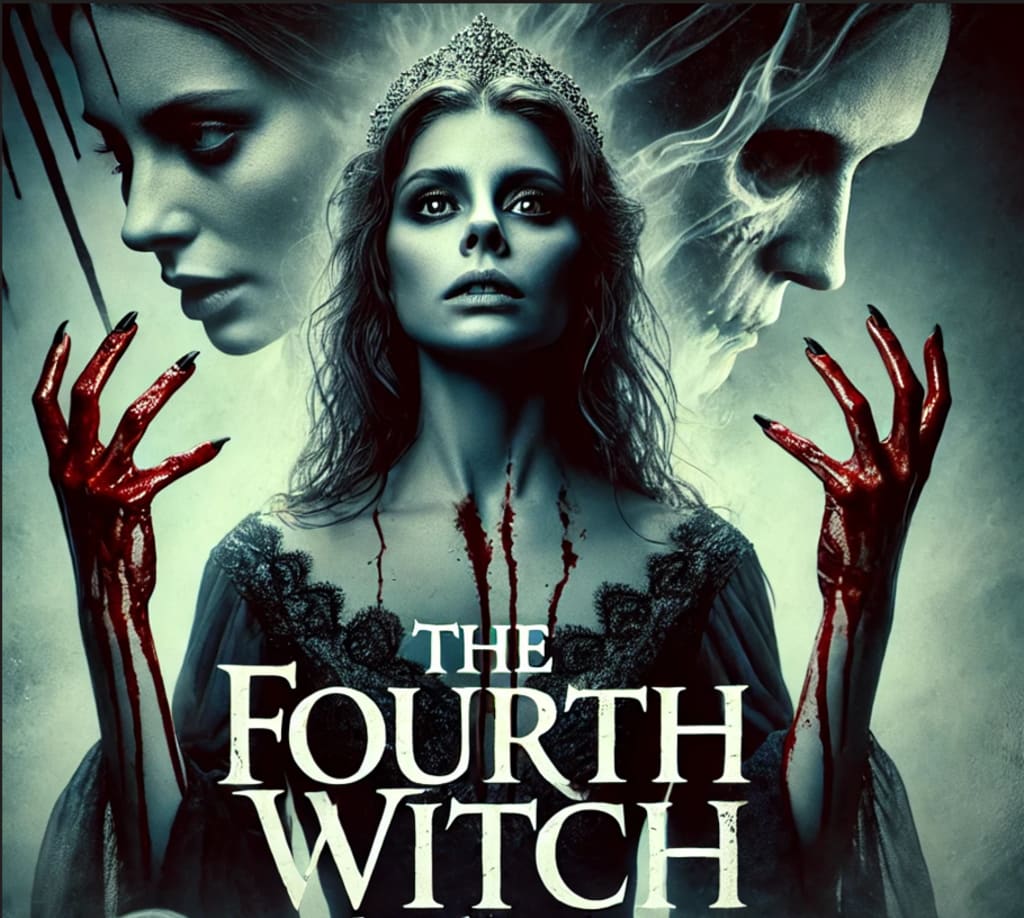
THE FOURTH WITCH
The Untold Tale of Lady Macbeth

PROLOGUE
A Whisper in the Wind
In the moorland’s biting chill, beneath skies heavy with storm clouds, three shadowy figures gather around a bubbling cauldron. Their chant slices through the air like a blade: “Fair is foul, and foul is fair.” They speak of destiny, destruction, and ambition — forces that will shape the fate of a man named Macbeth.
But as the witches spin their web of prophecy, another presence stirs in the shadows. She is unseen, unnamed, yet deeply entwined with their chaos. This figure, both mortal and otherworldly, will become the witches’ silent partner in their dance of doom.
This book explores Lady Macbeth as an enigmatic force who transcends the bounds of humanity, drawing parallels between her and the witches to uncover a deeper understanding of her character. The story begins not with a prophecy on a stormy heath, but with a letter carried by a weary messenger, bringing news of fate to a woman who has been waiting her entire life to wield power.
The Spark of Ambition
Lady Macbeth was not a woman prone to idleness. Her mind was a ceaseless storm of calculation and observation, a trait she had honed in the silent shadows of her husband’s ascent. Macbeth was a soldier, a man of action, but he lacked her sharpness of thought, her hunger for the crown. When the messenger arrived with the letter from Macbeth, her heart beat faster, not with joy, but with a sudden, fiery determination.
They met me in the day of success; and I have learned by the perfectest report, they have more in them than mortal knowledge.
These were her husband’s words, written with a soldier’s awe at the supernatural. But where Macbeth saw wonder, Lady Macbeth saw an opportunity. She read the letter again, her lips moving silently over the words. The witches had prophesied Macbeth’s kingship, and he, in his naivety, had shared the news with her, trusting her to guide him.
Shakespeare gives us little insight into Lady Macbeth’s life before the events of the play, leaving much to imagination. Was she the daughter of a nobleman, raised in the shadow of power? Or perhaps her ambitions were born of deprivation, a desire to escape a life of insignificance.
Some interpretations, such as those of actress Glenda Jackson, suggest that Lady Macbeth is a woman forged by the limitations of her time. "She is not inherently evil," Jackson once said in an interview. "She is a woman who sees the cage society has placed her in and decides to break free, no matter the cost."
The letter becomes the match that ignites the fire within her. Unlike Macbeth, who hesitates and grapples with his conscience, Lady Macbeth does not question the prophecy. She does not wonder if it will come true; she begins to plan how to make it so.
As she folds the parchment, her mind is already racing. She knows her husband well — too well. His letter speaks of ambition, but also of doubt.
Thou wouldst be great, yet do I fear thy nature; it is too full o’ th' milk of human kindness.
She sees her role clearly: to harden Macbeth’s resolve, to strip away his hesitations, and to guide him toward the throne.
In the solitude of her chamber, Lady Macbeth speaks the words that will define her transformation:
Come, you spirits that tend on mortal thoughts, unsex me here,
And fill me from the crown to the toe top-full
Of direst cruelty
This invocation is no mere soliloquy; it is a ritual. Her language mirrors the witches’ chants, rhythmic and commanding, as if she is calling upon the same dark forces that whispered to them on the heath.
Literary scholar Janet Adelman writes in Suffocating Mothers that Lady Macbeth’s invocation marks her attempt to escape the constraints of her gender and humanity. “She seeks not just to become more ruthless, but to transcend the very nature of what it means to be human,” Adelman observes.
This moment solidifies her role as an agent of transformation. She does not merely plot Duncan’s murder; she becomes a conduit for the ambition that will consume both her and her husband.
The Serpent Underneath
The air in Inverness Castle feels thick with foreboding. Lady Macbeth stands at the window, staring into the night. She has sent word to her husband, instructing him to come home quickly. "Hie thee hither," she had written, "that I may pour my spirits in thine ear."
When Macbeth arrives, he is weary from the journey and burdened by the weight of the witches’ prophecy. But Lady Macbeth meets him with the determination of a general preparing for battle.
Lady Macbeth’s greatest weapon is her words. She understands her husband’s nature — his bravery on the battlefield does not translate into the ruthlessness required to claim the throne. She attacks his hesitations with precision, questioning his manhood and his courage.
When you durst do it, then you were a man.
These words are not just a challenge; they are a command. Lady Macbeth speaks as if she is channeling the witches themselves, pushing Macbeth toward the inevitable. Her language, filled with metaphors of strength and serpents, mirrors the witches’ cryptic speech, reinforcing her alignment with their influence.
As they discuss the details of Duncan’s murder, Lady Macbeth takes control of the situation. She orchestrates every aspect of the plan, from drugging the guards to planting the daggers. Her precision is chilling, her resolve unshaken.
But beneath her confidence lies a flicker of vulnerability. When Macbeth hesitates, she lashes out with anger, but her desperation is evident. “Screw your courage to the sticking-place,” she urges him, knowing that his doubt could unravel everything.
Many actors and scholars have noted the complexity of Lady Macbeth’s character in this moment. Judi Dench, whose portrayal of Lady Macbeth is legendary, once remarked,
She is not a monster; she is a woman who believes in her husband and is willing to sacrifice everything for his success.
Dench’s interpretation highlights the tension between Lady Macbeth’s ambition and her humanity. She is not inherently evil but becomes consumed by the forces she has unleashed.
As the night deepens, Lady Macbeth’s confidence does not waver, but the atmosphere grows heavier. The castle seems to hold its breath, as if the walls themselves know what is about to happen.
When Macbeth returns from Duncan’s chamber, blood on his hands and horror in his eyes, Lady Macbeth takes charge once more. She dismisses his fears with cold practicality, but the weight of the deed begins to seep into her as well. “These deeds must not be thought,” she tells him, but her words carry the weight of her own unspoken guilt.
The Phantom at the Feast
The great hall of Inverness Castle glowed with the brilliance of a hundred torches. Shadows danced on the stone walls, flickering like restless spirits. Nobles from across Scotland filled the room, their voices weaving together in a chorus of laughter and conversation. Goblets clinked, and the scent of roasted meats mingled with the faint aroma of wax and fire.
It was meant to be a night of celebration, a testament to the strength and unity of Scotland under its new king. At the head of the table, King Macbeth sat with regal poise, his crown gleaming under the torchlight. Beside him, Queen Lady Macbeth radiated elegance and composure, her gown a cascade of rich crimson silk. To the onlooker, they were the picture of power.
But Lady Macbeth felt the fragility of the moment, like the tension of a bowstring drawn too tight. Beneath the grandeur and gaiety, something dark and uncontrollable was brewing. The feast began with grand speeches and hearty toasts. Macbeth rose to his feet, his voice booming as he welcomed his guests. “My noble friends,” he said, lifting his goblet, “we drink tonight to the prosperity of our realm!” The room erupted in cheers, but Lady Macbeth watched her husband closely.
His words were strong, his gestures confident, but she noticed the small tremor in his hand as he raised his goblet. His gaze flicked repeatedly toward an empty chair at the edge of the table, his jaw tightening each time.
Her heart sank. She had seen these signs before — the faraway look in his eyes, the tension in his shoulders. Banquo’s murder had left him restless, speaking in fragments and pacing the halls late into the night.
She had hoped that tonight’s feast would steady him, remind him of the fruits of their ambition. But now, as she watched him falter, she felt the creeping realization that Banquo’s death had not silenced the unease.
The first course was served, and the lords and ladies’ dove into their meals with relish. For a moment, the hall seemed alive with joy. Laughter rose in waves, the sound mingling with the clatter of silverware. Lady Macbeth allowed herself a brief smile, though it felt like a mask slipping into place.
Then, as Macbeth rose to propose a toast, the air shifted.
“Which of you have done this?” he demanded, his voice trembling with fury. His goblet clattered to the table, and he pointed a shaking finger toward the empty chair.
The room fell silent. Every eye turned toward the king, their expressions a mixture of confusion and unease.
Lady Macbeth froze. Her mind raced, piecing together what was happening. She had not seen him like this before, but she understood at once: Macbeth was seeing something that no one else could.
Summoning every ounce of control, Lady Macbeth rose to her feet.
“My lord is often like this,” she said, her voice smooth and steady.
“The fit is momentary. Pray you, keep seat.” Her words rippled through the room, a calming force against the rising tide of tension.
But beneath her composed exterior, she felt panic clawing at her chest. She moved to her husband’s side, her hand firm on his arm. “You shame yourself,” she hissed, her voice low but cutting.
Macbeth turned to her, his face pale and glistening with sweat. “Look there!” he whispered hoarsely, his eyes wide with terror. “Do you not see him?”
Lady Macbeth followed his gaze to the empty chair. There was nothing there, only the flickering shadows cast by the torches. But to Macbeth, it was Banquo, seated among the living, his ghostly form a silent accusation.
“Never shake thy gory locks at me!” Macbeth shouted, his voice breaking. His words sent a chill through the room. The nobles exchanged uneasy glances, their murmurs rising in a tide of speculation.
Lady Macbeth acted swiftly. “Friends,” she said, her voice rising above the murmurs, “think of this as nothing more than a strange infirmity. The king has been afflicted with such visions all his life.”
She guided Macbeth away from the table, her hand gripping his arm tightly. “Compose yourself,” she whispered fiercely, her tone edged with desperation. “They are watching.”
But Macbeth was beyond her reach. He staggered back toward the chair, his voice rising in frantic bursts. “Thy bones are marrowless, thy blood is cold,” he said, his words tumbling over one another. “Thou hast no speculation in those eyes!”
The feast dissolved into chaos. Some guests quietly slipped away, their expressions troubled. Others lingered in the corners of the hall, whispering among themselves. Lady Macbeth watched it all unfold, her mind a storm of frustration and fear.
When the hall was empty, she turned on Macbeth and said sharply –
You have displaced the mirth,
Broke the good meeting, with most admired disorder.
Macbeth, shaken, met her gaze. “It will have blood, they say; blood will have blood,” he muttered, his words heavy with dread. “Stones have been known to move, and trees to speak.”
Lady Macbeth's frustration flared. “Enough of this madness!” she snapped. But as she spoke, she felt a strange sense of unease. His words, cryptic and fragmented, reminded her of the witches. Their riddles, their paradoxes, their ability to unmoor reality itself.
That night, the distance between them grew more pronounced. Macbeth paced the chamber, muttering to himself about visions and prophecies. Lady Macbeth sat in silence, her mind churning with doubts she dared not voice.
The man she had once guided with such ease now seemed beyond her influence. His obsession with the witches' words, his fixation on Banquo's lineage, had consumed him entirely.
She thought of the witches then, their laughter ringing in her ears like a distant echo. They had planted the seeds of ambition, but it was she who had watered them, tended them, and now watched as they grew into something monstrous.
The banquet marked a turning point. Where once Lady Macbeth had been the driving force, the architect of their rise, she now felt herself slipping into the background. Macbeth no longer sought her counsel, no longer relied on her strength.
As she lay awake that night, the events of the evening played over in her mind. The ghostly presence at the feast, the empty chair, the blood that seemed to haunt Macbeth's every thought. She began to feel the weight of it all pressing down on her, a heaviness that no crown could lift.
The flickering torchlight in the hall, the ghostly whispers in Macbeth's voice, the trembling in her own hands — it all felt like a prelude to something darker. Lady Macbeth had always prided herself on her clarity, her ability to see the path forward even in the face of uncertainty. But now, the path seemed to twist and blur, leading only into shadow.
As dawn broke over Inverness, the once-celebratory hall lay empty, its torches extinguished. Lady Macbeth stood at the window, staring out at the horizon. She could feel the threads of their ambition unraveling, their carefully constructed world beginning to collapse.
In the silence of that morning, she whispered to herself words she had never dared to speak before: What have we done?
Nightmares in the Dark
The nights in Inverness grew longer as winter settled over the land. The castle, once a symbol of power and authority, now felt oppressive. The weight of what they had done hung in the air like an unbearable fog, creeping into the very stones of the walls, the winding corridors, and the hearts of its inhabitants. The blood that had been shed had not only stained their hands but had also marred the soul of the castle, and with it, the lives of its rulers.
Lady Macbeth no longer slept.
She lay in her bed, staring at the shadows on the ceiling. The fire in the hearth had long died, and the moonlight cast eerie, distorted figures across the walls. Her eyes were wide, unable to close, her heart racing with a frantic energy she could not control. The silence of the night only amplified the gnawing voice in her head, urging her to remember, to repent, but no solace came. Her thoughts spiraled, endlessly turning, never finding peace.
At times, she heard whispers—soft, faint, almost imperceptible. Her rational mind told her it was the wind or the murmur of servants in the halls. Yet, deep within her, she feared that these voices were not of this world. They were the echoes of the dead—the ghostly reminders of the life she had stolen, of the crown she had seized through blood.
The guilt gnawed at her, hollowing her out from the inside, leaving her restless and broken. It was no longer a mere passing unease; it was a constant presence, an unwelcome companion that followed her into every room, into every moment of silence. It was not just the weight of her actions, but the growing knowledge that she could not escape them—that the consequences of their crime would follow her forever.
She rose often in the middle of the night, as though driven by some unseen force. Her mind, though wide awake, could not stop her body from moving, pacing the halls of the castle in silence. It was during one of these restless wanderings that the servants first saw her.
They found her standing near the grand staircase, her hands moving in an eerie, rhythmic motion. She was scrubbing something invisible, her fingers twisting and turning, as though trying to erase some stain that would never come clean. Her eyes, though wide open, seemed lost—distant, unseeing, staring into some abyss that no one else could perceive. Her lips moved, but the words that escaped were not words of this world.
Out, damned spot,
Out, I say!
The servants froze, terror taking hold of them. They had always whispered behind her back—about her ambition, her cruelty, the iron grip with which she had controlled her husband. But now, in the dead of night, she was no longer the Lady Macbeth they had known. Now, she was a woman undone by her own guilt, a woman who seemed to be unraveling, piece by piece, before their very eyes.
Some servants whispered that the castle had become cursed, that the blood spilled in Duncan’s murder had summoned vengeful spirits. Others spoke of Lady Macbeth herself, of the possibility that she had been overtaken by something darker, something beyond human comprehension. They saw the madness in her eyes, the feverish gestures, the obsessive repetition of words that made no sense. But none of them dared to approach her, for fear that whatever haunted her might soon haunt them as well.
The sleepwalking became a nightly occurrence. It was not just an innocent wander through the halls but a full immersion into some dark world that existed between sleep and wakefulness, between life and death. Lady Macbeth’s body moved, but her mind was trapped in a distant past. Her hands were perpetually scrubbing, scrubbing at nothing—her frantic gestures were a manifestation of the guilt she could not escape.
"Out, damned spot," she muttered again and again, as if she could somehow wash away the blood she had shed. But no matter how hard she scrubbed, the stain remained.
Her fixation intensified, turning frantic. Gone was the composed queen, replaced by a shattered soul. Her mind had turned into a prison, with walls closing in each night.
It was during one of these episodes that Macbeth found her.
Macbeth's ambition had morphed into madness. His rise to the throne was tainted by the murder of Duncan. The castle, once a symbol of power, now felt like a tomb, haunted by the ghosts of his victims.
When Macbeth encountered his wife, she stood by the hearth, her hands in a peculiar motion. Her eyes were fixed on something unseen, her lips quivering as she spoke softly.
Look not so pale, my lord,
These hands are as clean as yours.
Macbeth felt a shiver run down his spine. These words, familiar yet different, revealed a deeper, darker fear. Her eyes betrayed a madness that had consumed her, leaving him to fear losing her forever.
You have no reason to be afraid, my lord,
We have done what must be done. There is no turning back.
Macbeth saw a transformation in her, a shift from a human to something supernatural. Her fixation on the bloodstains echoed the witches' prophecies, hinting at a dark transformation. Was she now a witch, consumed by the very forces she had once sought?
Lady Macbeth's words, though disjointed, echoed with a haunting familiarity.
Who would have thought the old man to have had so much blood in him?
These words were more than a statement; they were a confession of the horror they had unleashed. Her madness was not just personal but a transformation into something darker. Some scholars believe she became a spectral presence, caught between the mortal and supernatural realms. As critic A.C. Bradley notes, "The sleepwalking scene represents the final unraveling of a woman who has been driven mad by her own ruthless ambition."
The forces that drove her to murder now consumed her. Shakespeare's witches had whispered dark promises to Macbeth, but Lady Macbeth now seemed to embody those forces. Her ambition had led her to become a vessel for darkness.
She becomes, in the end, a ghost, a shadow of her former self, caught in the grip of guilt and madness.
The transformation in Macbeth was subtle yet undeniable. Though shaken by madness, he was consumed by paranoia and a thirst for power. In Lady Macbeth's eyes, a depth of torment was evident, something he could no longer ignore. She was more than just his wife, urging him to murder; she was a symbol of the psychological and supernatural forces that shaped their tragic fate.
The echoes of their crime, the blood they spilled, had seeped into their souls. The ghosts of their victims haunted them, never to be escaped. Theatre actor Ian McKellen noted,
The tragedy of Macbeth lies in the inability to escape the consequences of our choices. Even power, gained through bloodshed, cannot bring peace.
Lady Macbeth's peace was now an impossibility. Guilt consumed her, not just for her actions but for realizing the forces she had embraced turned against her. She had become the very darkness she once sought to control, the fourth witch in their twisted tale.
In the dead of night, Inverness's corridors whispered of a woman undone. She was caught between worlds, lost to the darkness she once sought to master.
The Hollow Crown
Lady Macbeth was once a woman of unparalleled ambition, a force in the halls of power. Her strength lay in her intellect and her ability to see the path forward, even when others faltered. When Macbeth wavered, she steeled his resolve, pushing him toward the throne they both desired. But now, as winter gripped the land, Lady Macbeth felt herself slipping into a fog. Each step felt heavier, her mind clouded by thoughts not her own.
The clarity she once prized had dissolved, leaving her lost in Inverness's halls like a ghost. The weight of their actions, the murders, the deceit, and the rise to power, pressed down on her like an iron shackle. The silence was unbearable. The throne, once coveted, now felt like a prison. Her husband, Macbeth, had become a shadow of the man she married. Their partnership had crumbled; he no longer sought her counsel or confided in her.
In the early days of their reign, the castle was alive with their dreams and schemes. They were unstoppable, two halves of a whole, bound by ambition and the belief in their greatness. They whispered their plans in the dead of night, strategizing and comforting each other when doubt crept in. But now, silence stretched between them like an unbridgeable chasm. She no longer saw the man she helped crown king; instead, she saw a man consumed by paranoia and terror.
Macbeth had become obsessed with the witches, those dark, cryptic figures who foretold his rise. He could no longer differentiate between prophecy and reality, between what was foretold and what he could control. The witches' promises of immortality and invulnerability had driven him further into madness. Lady Macbeth had once dismissed their prophecies as tricks, but now she feared Macbeth was falling under their spell, chasing after ghosts and illusions that were tearing apart their marriage.
The witches spoke of Macbeth's future, his rise and fall. But Lady Macbeth's soul was also at risk. She had entered a dangerous pact, where her identity and sense of self were fragmenting. As she watched Macbeth withdraw into himself, consumed by thoughts of legacy and control, she realized how far they had both fallen. Their ambitions, meant to elevate them, now felt hollow. The crown's weight was unbearable.
Death had cast a shadow over the castle, like an ever-looming storm cloud. The murders started with Duncan's blood staining the floor. Banquo was slain, his ghost haunting Macbeth's every step. Then, Macduff's family was brutally taken, their lives lost to preserve a fragile throne.
Macbeth's brutality seemed to embolden him, but Lady Macbeth was undone by it. Each death, each act of violence, chipped away at the woman she once was. She became a spectator to her own demise, powerless to stop the unraveling of their empire.
She felt trapped within the castle, as if it was closing in on her. The corridors, once filled with determination, now echoed with silence. The whispers of blood, murder, and guilt followed her everywhere, with no escape or solace.
On a night when the castle's weight was unbearable, Lady Macbeth found herself at the parapet. The cold stone pressed against her feet as she gazed into the blackness below. The castle was a place of shadows, where past and present collided.
She had believed power would free her, that the crown would give her control. But now, the night stretched out before her like an endless abyss. She saw only the hollow promise of her ambition.
For a moment, she wondered if stepping forward would be easier. Would it be better to end it all, to escape her torment and guilt? But as she stood there, something inside her shifted. She turned away from the edge, retreating into the shadows, her steps slow and deliberate.
Yet, even as she pulled back, Lady Macbeth knew she was no longer the same. The guilt consumed her, festering like a wound that would never heal. She could not escape the consequences of her actions. The crown, once a symbol of power, now felt like a curse.
The transformation was subtle but undeniable. She was slipping away from humanity, becoming something darker. In her isolation, her descent into madness mirrored the witches who had prophesied Macbeth's fate. The line between Lady Macbeth and the supernatural was blurring.
As the days passed, the air around her thickened with malevolent energy. The walls whispered to her, and shadows moved of their own accord. She felt unseen eyes watching her every step. Lady Macbeth was becoming a part of the castle, haunted by its history.
What troubled her most was the realization she was no longer in control. Not of the castle, not of Macbeth, and not of herself. This loss of control was the most haunting aspect of her transformation.
She had crossed an invisible line, marking a point of no return. The whispers of witches echoed in her mind; their words indistinct yet ominous. These riddles, once nonsensical, now seemed to hold profound meaning, as if crafted for her alone. They were designed to unravel her sanity, leaving her questioning her own transformation.
Was she becoming like them? The thought sent shivers down her spine. Had she succumbed to the same dark forces she once sought to control? The fourth witch, a figure from Macbeth's past, now seemed a haunting reflection of her own destiny. The line between sanity and madness blurred, leaving her to ponder her own fate.
Shakespeare’s witches had always been agents of chaos, creatures who thrived on manipulation and destruction. In Macbeth, they were the instigators, the ones who set the events in motion. But as Lady Macbeth stood alone in the castle’s depths, she began to understand that she, too, had become a part of that chaos. She had once been the mastermind behind the murder of Duncan, the one who had urged Macbeth to act. But now, she was losing herself to the very darkness she had embraced.
The witches had once foretold Macbeth’s fate, but Lady Macbeth now realized that she, too, had a fate to meet—a fate she had set in motion, a fate that was entwined with the very forces that had once been her tools. Her descent was inevitable, and as she gazed into the abyss, she understood that there was no escape from the path she had chosen.
Her transformation had begun, and with it came the slow realization that she had become something far darker than she had ever imagined. She was no longer just a queen. She was no longer just the ambitious woman who had shaped Macbeth’s rise to power. She was becoming something more—a figure caught between the mortal and supernatural realms, a woman whose mind had become as fractured and unpredictable as the witches themselves.
As the darkness closed in around her, Lady Macbeth could feel the invisible threads that connected her to the witches pulling her in. She had long ago crossed the threshold into madness, and now there was no turning back. Her transformation into the fourth witch was well underway, and with it, the castle of Inverness would become her prison, her tomb, and the stage for her final unraveling.
The Final Descent
The day Lady Macbeth died was enveloped in an eerie silence, as if the castle itself was mourning. Inverness, once a symbol of ambition and power, had transformed into a tomb. The air was heavy with decay, and the servants moved with a spectral quietness, avoiding the queen's chambers.
Macbeth, in the great hall, was consumed by the impending battle. His hands were slick with sweat as he sharpened his sword, his mind racing with strategy and paranoia. The witches' prophecies haunted him, their words echoing in his mind like ghosts. Yet, it was not the battle outside that weighed on his heart but the news of Lady Macbeth's passing.
A servant entered, his posture a testament to the reverence usually reserved for funerals. His voice trembled as he delivered the news.
“My lord,” the servant said, his head bowed low, “the queen… is dead.”
The room's temperature dropped, as if the castle itself had sighed in sorrow. Macbeth's reaction, though, was one of cold indifference. He turned away, his gaze fixed on something beyond Inverness, something more real than his wife's death. His words were a mere whisper, devoid of emotion:
She should have died hereafter.
These words hung in the air, devoid of emotion. There was no mourning, no sense of loss in Macbeth's voice. It was as if he had already buried his love for Lady Macbeth, recognizing her death as a final step in their tragic downfall.
While Macbeth appeared unmoved, those who had witnessed Lady Macbeth's final days knew a different truth. Her last days were marked by profound isolation, a stark contrast to her once forceful presence. The servants, once her confidantes, now whispered among themselves, fearful of her.
Lady Macbeth spent her final hours staring at the tapestries, her mind consumed by regret and guilt. The tapestries, once symbols of power, now mocked her. The figures woven into their fibers seemed distant, removed from the woman she had become. The opulence she once coveted now felt hollow, the crown a shackle she could no longer bear.
In isolation, Lady Macbeth's mind frayed, unraveling in terrifying and haunting ways. Her nights, once filled with dreams of greatness, became endless cycles of sleeplessness. She wandered the castle halls, her steps hesitant and erratic, as if searching for something unattainable. Her hands wrung involuntarily, a gesture that had become as essential as breathing. It was as if she sought to wash away the blood, to cleanse herself of the crimes she could never atone for.
“Out, damned spot!” she would cry, her voice fractured with desperation. The bloodstains on her hands were too much to bear, too much to ever escape. The phrase, once a cry of ambition, now echoed in her mind as a haunting reminder of her guilt. The “spot” had become a symbol of her unremovable guilt, a stain that haunted her.
Her transformation was gradual, imperceptible to those around her. Once a woman who seized power with skill, she now was consumed by her own darkness. The ambition that once propelled her forward now devoured her, gnawing at her mind and soul.
Literary scholars often view Lady Macbeth as a tragic figure, undone by her own ambition. Marjorie Garber notes, “Lady Macbeth, like Macbeth himself, is not simply a victim of fate but a victim of her own unacknowledged guilt and remorse.” Her guilt over Duncan's murder drives her to madness. She is trapped in a cycle of self-loathing, unable to escape the consequences of her actions.
Film directors have also explored Lady Macbeth's psychological decline. Roman Polanski's 1971 adaptation of Macbeth highlights her suffocating ambition. Polanski juxtaposes her isolation with Macbeth's paranoia, capturing her as a woman lost to her own fate. Her death is shown with simple understatement, as if her life was a mere prelude to her tragic end.
In her final hours, whispers about Lady Macbeth grew louder. Some said she took her own life, unable to bear her guilt. Others whispered darker tales, suggesting the spirits she invoked had turned against her. It was said she was found wandering, her eyes wide with fear, her lips murmuring incoherent prayers.
The truth of her death remains elusive. Whether by her own hand or supernatural forces, it hardly mattered. What mattered was that Lady Macbeth, once the queen of ambition, was consumed by the very forces she sought to control.
Shakespeare's Macbeth explores themes of fate, power, and the supernatural. The witches guide Macbeth toward his downfall. Yet, Lady Macbeth undergoes the most profound transformation. She becomes a part of the supernatural forces she once sought to manipulate. In her final moments, she is a shadow of her former self, lost in guilt and darkness.
Some critics argue that Lady Macbeth's demise marks the peak of her metamorphosis from an active participant to a supernatural entity. Feminist theorist Elaine Showalter posits, “Lady Macbeth's sleepwalking scene is a direct manifestation of her internal turmoil, but it also speaks to her transformation into a spectral, almost witch-like figure.”
Her final descent into darkness signifies a transcendence beyond human bounds, with her mind shattered and her soul lost in the very shadows she had invoked. The woman who urged Macbeth to claim the throne has now become an integral part of the supernatural forces she once sought to command. She is no longer the ambitious queen but a specter haunted by the spirits of her own creation.
Upon hearing of Lady Macbeth's demise, Macbeth's response mirrors the detachment that characterized their relationship in recent times. Her death is merely another step towards his downfall. Yet, for Lady Macbeth, her demise was not a quiet surrender but a terrifying silence, a woman consumed by the very forces she had endeavored to dominate.
The Fourth Witch
Lady Macbeth was never destined for love. From her first appearance, she commanded attention, not through grace or charm, but with an icy, almost terrifying resolve. Her ambition was singular: to see her husband crowned king and, through him, to claim power for herself. She was the mastermind behind the play's tragic unfolding, every whispered word and calculated gesture a step towards the throne. Her ambition was a fire that would consume everything in its path, including her own soul.
Initially, empathy is hard to find. Lady Macbeth's character is defined by manipulation and unwavering determination. She rejects the feminine weakness society imposes, willing to sacrifice her conscience and humanity for her ambitions. She drives Macbeth's ascent to the throne, not as a passive accomplice but as the dark, unseen force propelling him towards murder. Her encouragement to him, “screw your courage to the sticking-place,” elicits our disdain, as she is the architect of a crime too heinous to ignore.
Yet, as the play progresses, our perception of her shifts subtly. The hatred and revulsion we initially feel towards her begin to curdle into sympathy or sorrow. Lady Macbeth is more than a villain; she is a complex, human figure, driven by desires, flaws, and regrets. Her transformation is not just a descent into madness but the tragic unraveling of a soul torn between ambition and guilt, between her dreams of power and the crushing reality she has created.
In the aftermath of Duncan's murder, Lady Macbeth should have felt triumphant, yet her victory is empty. It is in the quiet hours, when the castle's silence is broken, that we witness the erosion of her strength. Her ambition, once a driving force, now torments her from within. Guilt poisons her veins. When she looks into Macbeth's eyes, she sees a stranger, a man lost to madness like herself. Her sleepwalking and frantic gestures reveal the true tragedy of her character.
It is not just the literal stain of Duncan’s murder that she cannot wash away, but the stain of her own soul—her ambition, her complicity, her guilt. She thought she could control it all. She thought she could wield power without consequence. But now, in the darkness of her mind, she is tormented by the realization that she has become something she cannot control. She is no longer a woman of iron will, but one who is unraveling, torn apart by the very forces she sought to master.
Here, in her madness, Lady Macbeth becomes something more than a mere woman. She becomes the fourth witch. But not in the traditional sense of those who revel in the supernatural, who cackle in the shadows and conjure spells. No, she is not like them, for she was never a witch to begin with. She is a woman—flawed, imperfect—who, in her quest for power, called upon the darkness and became entangled in it. She is the embodiment of the human soul’s vulnerability to ambition, a woman whose desires spiraled into madness. She may not have stood beside the witches in the woods, casting incantations, but she was, in every sense, their equal. She summoned the forces that guided Macbeth, just as they had foretold his rise and fall. And in the end, it is those same forces that consume her.
In Lady Macbeth’s tragic arc, there is no malice or cunning; there is only a human longing for more—more power, more freedom, more control. She sought to transcend the limitations of her sex, to be free from the constraints of a world that told her she was inferior. And in her desire to become something greater, she became something other—something that cannot be fully understood or embraced. She did not become a witch by choice, but by the relentless pursuit of her own desires, which ultimately bound her in ways she never could have predicted.
As she slips into the final moments of her life, the audience no longer sees her as the manipulative, power-hungry villain who once dominated the stage. Now, we see only a broken woman, a shell of her former self, consumed by her own guilt and sorrow. Her transformation into the fourth witch is not a dramatic moment of supernatural power; it is a quiet, tragic metamorphosis, a slow unraveling of a woman who was undone by her own ambition. She is the witch who never meant to be one, the woman who sought to transcend her humanity and lost herself in the process.
The sympathy that emerges for Lady Macbeth is not born out of pity, but from the stark realization that her fall was inevitable. She is not a mere villain, but a victim of her own desires. Her tragic flaw was not simply her ambition, but the human need to be more than what she was allowed to be. In her quest for power, she lost her soul, and it is this loss that elicits our deepest sorrow. She wanted to be free, but she was trapped by the very forces she sought to control.
And so, when she dies—whether by her own hand or by the cruelty of fate—there is no satisfaction, no sense of justice. Only sorrow. Lady Macbeth was not just a woman who lost her mind; she was a woman who lost herself. She became the fourth witch not because she sought the supernatural, but because she could not escape the consequences of her own humanity. She reached too far, too fast, and was consumed by the very ambition that had driven her.
In the end, it is not Macbeth’s story we remember, but hers. It is Lady Macbeth who steals the show, whose tragic arc resonates far beyond the scope of the play. It is her ambition, her guilt, her fall from grace that lingers long after the stage is empty. She is the fourth witch, but she is so much more. She is the woman who sought the stars, only to be swallowed by the very darkness she had unleashed.
Her legacy is not one of power, but of fragility—of a woman who reached too high and fell too far. She is a tragic figure, not because she was evil, but because she was human. And in her humanity, she became a warning to us all: that the price of unchecked ambition is the destruction of the self.
And so, as the final curtain falls, Lady Macbeth’s shadow lingers long after the lights have dimmed, like a whisper that refuses to fade. She was the fourth witch, yes, but in the deepest, most heartbreaking part of her, she was just a woman—a woman who dared to dream beyond her time, who sought a power she was never meant to hold. Her ambition was her strength, yes, but it was also her undoing. The world she built around herself—strong, unyielding—crumbled in an instant, leaving only a hollow shell behind. She did not fall from grace; she was devoured by it. And as we watch her fade into the darkness, we are left with a devastating truth: her tragedy was not that she wanted more, but that she lost herself in the wanting. Her ambition, once so fierce, became her chains, binding her to a fate she could never escape. In the end, she is not remembered as a villain, but as a broken, tragic soul who reached too far to see her husband succeed, who touched the stars, only to fall into the abyss of her own making. We mourn not just the loss of a queen, but the loss of a woman who, in seeking power, lost everything—her love, her mind, her very self. And in that loss, her story becomes our own—forever a reminder that the cost of ambition can sometimes be everything we hold dear.
EPILOGUE
The Echoes of Her Soul
The tale of Lady Macbeth, though steeped in blood and sorrow, is one that refuses to fade into the forgotten corners of time. Her story lingers in the air like the faintest whisper of a forgotten song, ever-present, even in silence. The world may have moved on, the throne may have passed into other hands, and the castle walls may have crumbled, but the shadows of her spirit remain—unseen, yet never absent.
She was, after all, a woman of profound paradox—a soul that both burned with ambition and trembled in the dark, a heart that both yearned for power and recoiled in the face of its consequences. Her journey was not simply the tragedy of a queen who sought too much; it was the universal journey of every human who has ever reached for something beyond their grasp, only to find that what they held was not what they imagined. Lady Macbeth’s downfall was not the inevitable collapse of evil; it was the rupture of a dream. A dream that began with pure hope and ended in nothing but ash.
But as her story continues to echo through the annals of literature, something quietly shifts in the retelling of her tale. We no longer see her as merely the villain, the puppet master behind Macbeth’s rise and fall. No, in the silent spaces between the words, in the pause before the final curtain falls, we begin to see her as something more—something achingly human. She becomes, in a sense, the quiet tragedy of us all.
For to understand Lady Macbeth is to confront the dark corner of the human heart where ambition dances with despair, where greatness is both the most beautiful and most devastating of dreams. It is here, in the chasm between desire and its fulfillment, that Lady Macbeth's legacy unfolds not as a warning against evil, but as a solemn reflection on the nature of our own longings and the price they exact.
Her transformation, so gradual yet so inevitable, is not marked by the spectacular feats of magic or supernatural machinations that some would expect from a witch. No, her metamorphosis is far more profound, more insidious. It is the quiet crumbling of a soul, worn thin by the relentless weight of ambition. She was not born of the witches’ cauldron, nor did she invoke dark spirits for the sheer thrill of power. She did so out of a profound, almost desperate, need to transcend—to escape the limits of her world, her role, her identity. She wanted to become something greater than the sum of her parts, something untouchable, something immortal.
And in her reach for eternity, she became something else altogether: a shadow of herself. A specter not only of the power she sought but of the dreams that consumed her, leaving her nothing but an empty vessel. It is this tragic emptiness that makes Lady Macbeth more than a mere villain; she is a symbol of the human condition, of how the pursuit of greatness can turn into a slow, grinding undoing.
In the years following her death, as the world continued its march forward, there was no forgetting her. Scholars, playwrights, and poets—the creators of worlds—continued to probe the recesses of her mind. The words "Out, damned spot" would become as familiar as any prayer, recited by generations who sought to understand the madness of a woman who had dreamed too much. In this repeated telling of her tale, Lady Macbeth’s tragedy grew ever more poignant. She was no longer just a footnote in a bloody play; she became a metaphor for something deeper, more universal: the relentless pursuit of an ideal, no matter the cost.
And in the quiet rooms of literary salons and theaters, where the air hummed with the voices of those who study and perform, a new understanding of her began to take shape. Here, Lady Macbeth was no longer just the iron-willed queen who manipulated her husband into murder. She was a symbol of the ambition that lives within each of us. Her madness was not an act of pure evil—it was the unraveling of a woman who had dared to believe in her own power, who had allowed herself to be consumed by a desire so vast it left nothing in its wake but the hollow emptiness of the void she had created.
Her legacy, as it evolved over time, became a reflection of the fragile beauty in human desire, in the yearning to transcend, to become more than we are. Lady Macbeth did not seek to destroy the world; she sought to conquer it—to rise above the limitations of her gender, her station, and her time. And in that very quest for transcendence, she was undone.
In the quiet, unspoken moments of her final days, Lady Macbeth's mind, once so sharp and calculating, became a labyrinth of regret, a place where her past actions tangled with the unbearable weight of her guilt. She was no longer the ruthless, calculating woman who had once stood unflinching before her husband, urging him toward murder. She was a broken figure, wandering the halls of her own mind, searching for a way to undo what had been done, to cleanse herself of the sins that clung to her skin. But it was too late. The blood had already stained her soul.
Her death, like the final scene of a play, is a soft, inevitable end. Some may say it was her hand that brought her down, others might whisper that the spirits she had once summoned came to claim her at last. But in truth, Lady Macbeth's death was not brought about by any external force—it was the culmination of everything she had built within herself. It was the breaking of a soul that had reached too far and too fast, only to find that the cost was greater than she could bear.
And yet, in the wake of her passing, something beautiful emerged. For it was not the power that defined her legacy, nor the ruthlessness of her ambition. It was the fragility she left behind—the fragile human heart, broken under the weight of its own desire. In the end, Lady Macbeth was not just a tragic figure who lost herself in the pursuit of power. She was a woman who dreamed too wildly, loved too deeply, and paid the ultimate price for her own humanity. Her story, then, is not just a tragedy; it is a profound meditation on the nature of ambition, the perils of desire, and the quiet, eternal ache that comes with seeking more than we are meant to have.
In her madness, in her decline, in her final moments, Lady Macbeth reminds us all of the delicate balance we must maintain between reaching for the stars and grounding ourselves in the earth. And in that reminder, her story becomes not one of mere downfall, but a resonant, aching reflection of who we are, and who we could become if we, too, reach too far.
Her shadow lingers—forever part of the world she left behind—whispering to us across the ages. Lady Macbeth was not just the fourth witch. When we look at the bigger picture, she was something much more powerful, much more tragic. She was a woman. And in that, her story is, perhaps, the most poignant tragedy ever told.
About the Creator
Subhayan Datta Choudhury
✨ Weaver of words, seeker of truth, and a Shakespearean soul. I craft stories that ignite the mind, stir the heart, and linger long after the last word. Step in—where every tale is an experience. 📖✨
Keep reading
More stories from writers in BookClub and other communities.
Rachel Reviews: The Spiral Archive by Pieter Hendrik
It's difficult for me to know where to start with a review of this book as it was, for me, an entirely unique experience and one that I'll probably never have again. I don't want that to be interpreted as unenjoyable but it has left me scratching my head a little and ruminating on its content, its themes and its characters.
By Rachel Deeming7 days ago in BookClub
This Book Made Me Afraid of My Own Thoughts
I didn’t expect Intercept to stress me out as much as it did. I picked it up thinking it would be a fun, fast sci-fi thriller, something intense but easy to digest. And it is fast, yes—but it’s also the kind of book that quietly messes with your nerves. I noticed halfway through that I kept pausing, not because I was bored, but because my brain needed a second to breathe.
By Rosalina Jane5 days ago in BookClub


Comments
There are no comments for this story
Be the first to respond and start the conversation.