
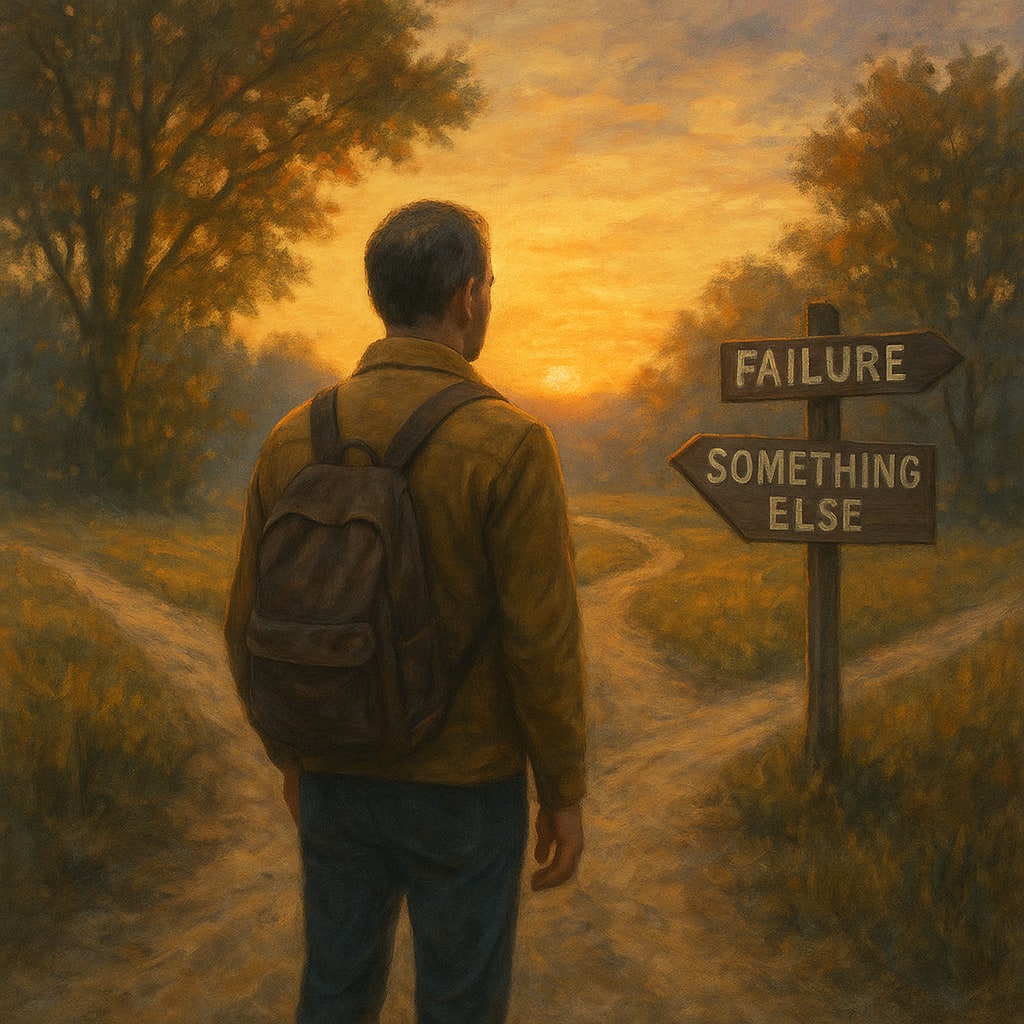
The Crossroads at Forty: Success, Failure, or Something Else?
Letting Go of Pressure and Choosing a Life That Fits

Introduction: The Quiet Storm
At forty, life doesn’t shout—it whispers. Gone are the explosive dreams of your twenties and the feverish ambition of your thirties. What remains is a quiet storm—of questions, of doubts, of possibilities. Some look at forty with pride: a thriving career, a growing family, a sense of control. Others look around and feel lost: unfinished goals, missed opportunities, and the nagging sense that they should have “arrived” by now.
But here’s the truth: No one really “arrives.” And if they do, it rarely looks like what they expected. The age of forty isn’t a finish line—it’s a mirror. It reflects back what you’ve built, but more importantly, what you believe about success, identity, and fulfillment.
In this essay, we explore the terrain of midlife careers—how success and failure aren’t always what they seem, and how calm or anxiety at forty is often a choice rooted in perspective rather than circumstance.
Chapter 1: The Illusion of Arrival
From a young age, we’re fed a linear story: study hard, get a good job, climb the ladder, and success will follow. By forty, you’re supposed to have “made it”—a respectable title, a decent salary, a house perhaps, maybe even a family. But reality rarely fits the brochure.
David, 42, was once a rising star in his advertising agency. But after years of 80-hour workweeks, he woke up one morning and realized he hated everything about his life—his job, his industry, his routine. “I was successful on paper,” he recalls, “but I felt like I was suffocating.”
On the flip side, Maria, 41, left her corporate job at 35 to start a bakery. The first few years were brutal. She almost gave up twice. Today, her business is modest but thriving, and she’s never been happier.
These stories reveal a crucial truth: success isn’t always up, and failure isn’t always down. The deeper question is, what are you measuring?
Chapter 2: The Metrics That Matter
At forty, most people experience a values shift. What once mattered—titles, cars, status—starts to fade. What rises in importance? Health, time, relationships, meaning.
The problem is, society still measures success externally. Social media parades highlight reels: someone’s new promotion, someone’s beach house, someone’s perfect family photo. It’s easy to compare and feel behind.
But ask yourself:
• Are you still growing?
• Do you feel aligned with your values?
• Are you excited about something, even if it's small?
If the answer is yes to even one of these, you’re doing better than you think.
The people who feel truly at peace at forty are not necessarily the ones with the biggest salaries—they’re the ones who’ve redefined success on their own terms.
Chapter 3: The Fear of Reinvention
For those who feel stuck at forty, the scariest idea isn’t that they’ve failed. It’s that they might need to start over. And that feels terrifying.
Why?
Because reinvention threatens identity. “If I’m not a lawyer, who am I?” “If I leave this job, what if I never find another one?” “Aren’t I too old to change paths?”
But here’s the truth no one tells you in your twenties: reinvention is not weakness—it’s maturity. It takes courage to say, “This no longer fits me, and I choose differently.”
And reinvention isn’t always a dramatic career change. Sometimes, it’s internal:
• Learning to set boundaries.
• Finding joy in small things.
• Letting go of the need to prove.
There’s a quiet power in saying, “I choose peace over prestige.”
Chapter 4: The Anxiety Trap
Of course, not everyone at forty feels calm. In fact, many feel like time is running out.
• “I only have twenty years before retirement.”
• “I’m behind my peers.”
• “I wasted my best years.”
This thinking creates a cycle of panic. You apply for jobs out of desperation. You start businesses you don’t really care about. You hustle, but it’s hollow.
How do you escape?
First, realize that anxiety is often rooted in comparison and fear—not truth. Then, take a breath and ask: What’s the smallest step I can take toward clarity?
At forty, you don’t need all the answers. You need a direction. Clarity comes from doing, not just thinking.
Chapter 5: The Power of Pause
One of the greatest superpowers at forty is permission. You can finally give yourself permission to:
• Pause without guilt.
• Rest without shame.
• Say no without apology.
You’ve earned it.
Yet, many people still chase like they’re 25, thinking rest is laziness. But growth isn’t always active. Sometimes, it's in the pause where your best insights emerge.
When you stop running from one goal to the next, you can ask: What do I want now?
Not what your younger self wanted. Not what others expect. What you want, now.
Chapter 6: Stories of Quiet Triumph
Let’s meet a few more people:
Jin, 40, left his job in finance to become a high school math teacher. His salary dropped by half, but his joy tripled.
Nina, 43, stayed in her career but finally asked for flexibility. She now works four days a week, spending Fridays painting and hiking.
Omar, 44, lost everything during a divorce and had to rebuild from scratch. Today, he runs a support group for men dealing with midlife transitions—and says it’s the most meaningful work he’s ever done.
These are not stories of Instagram-worthy “success.” But they are deeply human. And they are real victories.
Chapter 7: Midlife Myths to Unlearn
At this stage, unlearning is just as powerful as learning. Here are a few myths worth letting go:
1. "It’s too late to change."
Reality: You still have decades ahead. People start new paths in their 50s, 60s, even 70s.
2. "I missed my chance."
Reality: Every moment holds new opportunities. Your past prepared you for what's next.
3. "I should be further ahead by now."
Reality: Progress isn’t linear. Life has seasons, not a straight line.
4. "Everyone else has it figured out."
Reality: Most people are winging it. They just hide it better.
Chapter 8: Building a Life That Fits
Instead of chasing a "dream life," build one that fits. Like a well-tailored suit, your life should match your values, energy, and desires.
Consider:
• What energizes you?
• What drains you?
• What relationships uplift you?
• What routines bring peace?
Then, design your life accordingly. Make micro-adjustments. Change doesn’t have to be seismic. Even small shifts—leaving work an hour earlier, saying no to one extra obligation—can reclaim joy.
Chapter 9: Anchoring in Purpose
Purpose isn’t always grand. It doesn’t have to be a movement or mission. Sometimes, it’s simply being there for your kids, helping one person, or creating something beautiful.
Ask:
• What breaks your heart?
• What brings you to life?
• Where do your skills meet the world's needs?
Finding your purpose at forty isn’t about revolution—it’s about refinement.
Chapter 10: The Road Ahead
So, what now?
If you’re forty and thriving, honor that. Don’t let the world make you feel guilty for your contentment.
If you’re forty and flailing, breathe. You are not broken. You are becoming. Forty isn’t the end of your story—it’s the start of a new chapter.
At forty, you may not have all the answers. But you have something better:
• Wisdom from failure.
• Humility from experience.
• Freedom to choose again.
Wherever you are, choose with intention. Because this isn’t a crisis.
It’s an invitation.
To recalibrate. To reconnect. To redefine.
And above all, to trust that it’s never too late to build a life that is true, kind, and fully yours.
About the Creator
Rachel Reviews: Lakefront Wolves by Joseph Deegan
Meet Finn. He's an 18 year old kid who has potential. He's bright with great school scores and he's also an athlete, a footballer of some prowess. He has it all going for him, it would seem, and yet, he's determined to send what could be a well-planned, stable existence firmly off the rails. He drinks, he smokes, he takes drugs, he has violent tendencies and he's in danger of losing not only his mind but all that he holds dear.
By Rachel Deeming15 days ago in BookClub
7 Amazing Books to Read When You're Feeling Lazy
We all have those moments when life feels slow, energy is low, and the idea of tackling dense, heavy books feels impossible. Yet, even on our laziest days, reading can still be one of the most rewarding ways to spend time. The trick lies in choosing the right books—stories that are engaging without being exhausting, inspiring without being overwhelming, and comforting without feeling trivial.
By Diana Meresc6 days ago in BookClub




Comments (1)
At forty, I’ve come to realize that life isn’t always a straight path, but rather a series of crossroads and new opportunities we can choose from. Success or failure isn’t the end, but part of the journey of learning and growing. Sometimes, peace and confidence come from knowing what you truly want and embracing change. No matter where you are in life, I believe it’s never too late to make a new choice and build a life that truly matters.