
The Counter-Intuitive Path to Happiness: Why Mark Manson Says You Need to Care Less, Not More
How embracing failure, accepting mediocrity, and choosing better problems can lead to a more fulfilling life

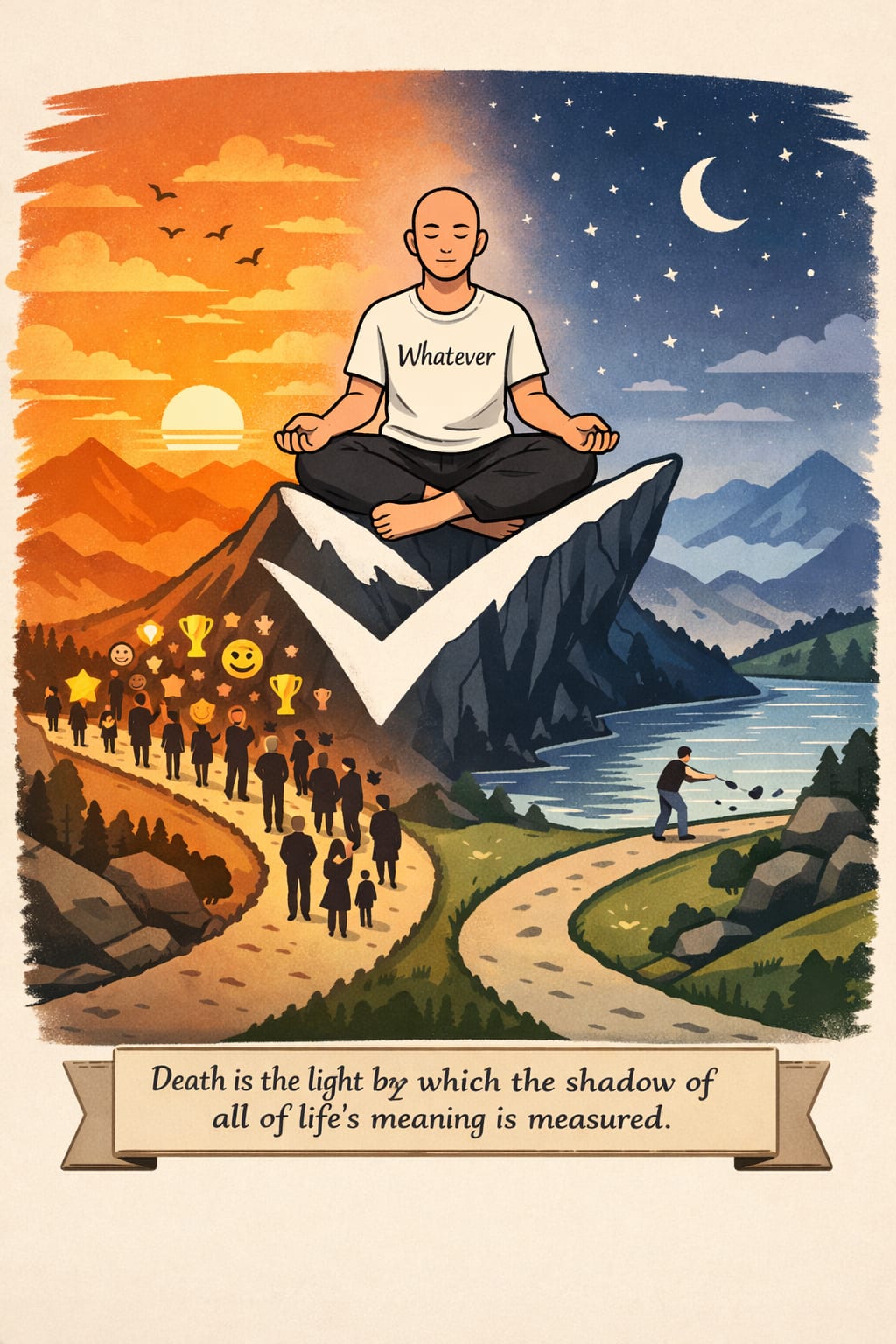
In a world saturated with self-help gurus preaching the gospel of positive thinking, relentless ambition, and the pursuit of endless happiness, Mark Manson's bestselling phenomenon The Subtle Art of Not Giving a F*ck arrives like a bucket of cold water to the face. Since its publication in 2016, the book has spent over 300 weeks on bestseller lists and sold more than 20 million copies. Its success lies not in offering easy answers, but in delivering a brutally honest truth: the key to a good life isn't caring about more things—it's caring about fewer things and caring about the right things well.
The Feedback Loop from Hell
Manson opens his manifesto with a paradox that challenges conventional wisdom: "The desire for more positive experience is itself a negative experience. And, paradoxically, the acceptance of one's negative experience is itself a positive experience." This observation, which he calls the "backwards law," forms the foundation of his entire philosophy.
Modern culture has created what Manson terms the "feedback loop from hell"—an endless cycle where trying to feel happy all the time actually makes us more anxious and miserable. The problem, he argues, is that we've been sold a lie. For decades, self-help books have told us that positive thinking is the key to a rich, fulfilling life. Manson's response characteristically cuts through the noise: "Fuck positivity. Let's be honest, shit is fucked, and we have to live with it."
This isn't pessimism for its own sake. Rather, Manson argues that our psychological problems stem from what he calls the "exceptionalism bias"—the belief that we should be special, that we deserve constant happiness, and that anything less represents failure. "The rare people who do become truly exceptional at something do so not because they believe they're exceptional," he writes. "On the contrary, they become amazing because they're obsessed with improvement. And that obsession with improvement stems from an unerring belief that they are, in fact, not that great at all."
You Are Not Special (And That's Liberating)
One of the book's most provocative chapters carries the title "You Are Not Special"—a direct assault on the participation-trophy mentality that has supposedly infected modern society. Manson pulls no punches: "Not everybody can be extraordinary; there are winners and losers in society, and some of it is not fair or your fault."
Yet this seemingly harsh message carries an unexpected gift: freedom. When we release the burden of having to be extraordinary, we can finally focus on what actually matters. "Once you accept the premise that a life is worthwhile only if it is truly notable and great, then you basically accept the fact that most of the human population (including yourself) sucks and is worthless," Manson observes. "And this mindset can quickly turn dangerous, to both yourself and others."
The alternative isn't settling for mediocrity—it's finding meaning in the ordinary, in the process rather than the outcome. Manson introduces the concept of the "Disappointment Panda"—a fictional character who delivers uncomfortable truths—to illustrate this point. The panda's wisdom? "Don't hope for a life without problems. There's no such thing. Instead, hope for a life full of good problems."
Choose Your Struggle
Perhaps the most powerful reframing in Manson's arsenal is his question about suffering. Instead of asking what you want to enjoy, he suggests a more revealing inquiry: "What pain do you want in your life? What are you willing to struggle for?"
This question cuts to the heart of who we are because, as Manson argues, "Who you are is defined by what you're willing to struggle for." Everything worthwhile comes with inherent sacrifice. The dream job brings stress. The perfect relationship requires difficult conversations. The house you love demands constant maintenance. "Happiness comes from solving problems," Manson writes. "The secret sauce is in the solving of the problems, not in not having problems in the first place."
This perspective transforms how we approach goals. When we fall in love only with the result—the promotion, the relationship, the achievement—we set ourselves up for disappointment. "I wanted the reward and not the struggle. I wanted the result and not the process. I was in love with not the fight but only the victory. And life doesn't work that way."
The Responsibility/Fault Fallacy
One of Manson's most nuanced insights concerns the difference between responsibility and fault. Many people avoid taking responsibility for their problems because they confuse responsibility with blame. "We are responsible for experiences that aren't our fault all the time," he points out. "This is part of life."
Taking responsibility—even for things that aren't your fault—is the ultimate power move. "The more we choose to accept responsibility in our lives, the more power we will exercise over our lives. Accepting responsibility for our problems is thus the first step to solving them." This isn't about blaming yourself for everything bad that happens. It's about recognizing that regardless of who caused a problem, you're the only one who can solve it.
Manson illustrates this with the story of his friend who was in a relationship with a verbally abusive woman. The friend's breakthrough came not when he blamed her for the abuse—which was indeed her fault—but when he took responsibility for his choice to stay. That realization gave him the power to leave.
Good Values vs. Shitty Values
At its core, The Subtle Art of Not Giving a F*ck is a book about values. Manson argues that our psychological well-being depends not on eliminating problems but on having better problems—and better problems come from better values.
He defines good values as those that are 1) reality-based, 2) socially constructive, and 3) immediate and controllable. Bad values, conversely, are superstitious, socially destructive, and outside our control.
Popularity, for instance, makes a terrible value because it depends entirely on others. Pleasure is equally problematic: "Pleasure is a false god. Research shows that people who focus their energy on superficial pleasures end up more anxious, more emotionally unstable, and more depressed."
Better values might include honesty, creativity, generosity, or discipline—qualities that are within our control and contribute to both our own growth and the well-being of others. "Self-improvement is really about prioritizing better values and choosing better things to give a fuck about," Manson concludes. "Because when you give better fucks, you get better problems. And when you get better problems, you get a better life."
Death: The Ultimate Motivator
The book's final chapter carries a simple title: "And Then You Die." It's a fitting conclusion to a philosophy built on confronting uncomfortable truths. Manson reminds us that mortality isn't just an ending—it's what gives life meaning.
"Death is the light by which the shadow of all of life's meaning is measured," he writes. The awareness that our time is limited forces us to prioritize, to distinguish between what deserves our fucks and what doesn't. "You are going to die someday. Everyone you know is going to die soon. And in your short life you only have a certain amount of fucks to give."
Rather than depressing us, this realization can be liberating. When we accept our limitations—including the ultimate limitation of death—we're freed from the tyranny of infinite possibility. We can commit fully to what matters, not because it will make us immortal, but because it makes us alive right now.
The Subtle Art, Distilled
What makes Manson's book resonate so deeply is its rejection of easy answers. He doesn't promise that reading it will make you happy. He doesn't offer a seven-step plan to success. Instead, he offers something more valuable: permission to be flawed, to struggle, to fail, and to find meaning in all of it.
The "subtle art" he describes isn't about not caring at all—it's about caring deeply about the right things and refusing to waste your limited fucks on everything else. "Not giving a fuck does not mean being indifferent; it means being comfortable with being different."
In a culture that constantly demands more attention, more emotion, and more investment in things that don't ultimately matter, that's a message worth giving a fuck about.
About the Creator
Rachid Zidine
French teacher in Morocco, BA in French Literature | Essays on language, society, culture, philosophy & anthropology.
Keep reading
More stories from Rachid Zidine and writers in BookClub and other communities.
The Invisible Government
By any conventional definition, governments rule nations. They levy taxes, pass laws, regulate markets, and enforce environmental protections. Yet in the 21st century, multinational corporations often exert influence that rivals—and sometimes eclipses—that of elected officials. Through lobbying networks, aggressive tax strategies, global labor arbitrage, and environmental maneuvering, the world's largest companies have become powerful architects of the global order.
By Rachid Zidine4 days ago in Journal
Book Review: Atmosphere by Taylor Jenkins Reid
I flipped the book over in my hands in the centre of the small airport book shop. Although I had heard promising reviews of Atmosphere by Taylor Jenkins Reid, I hesitated. The synopsis didn’t compel me - I wasn’t much of a space girly. In high school it made me cringe when my peers would talk about the stars.
By sleepy drafts21 days ago in BookClub
Unofficial Challenge: What would you do if you were rich?
I love the kind of work I get to do in my career, but as I job search and browse apartments again due to another understaffed and unsustainable work environment that I did not intend to get into, my daydreams of better days consistently lean into the same question: What would I do if I didn't have to worry about my basic needs being met?
By Kay Husnick6 days ago in Writers




Comments
There are no comments for this story
Be the first to respond and start the conversation.