
The Article of "Little Red Riding Hood"
"Exploring the Deeper Lessons Behind the Girl in the Red Cloak"

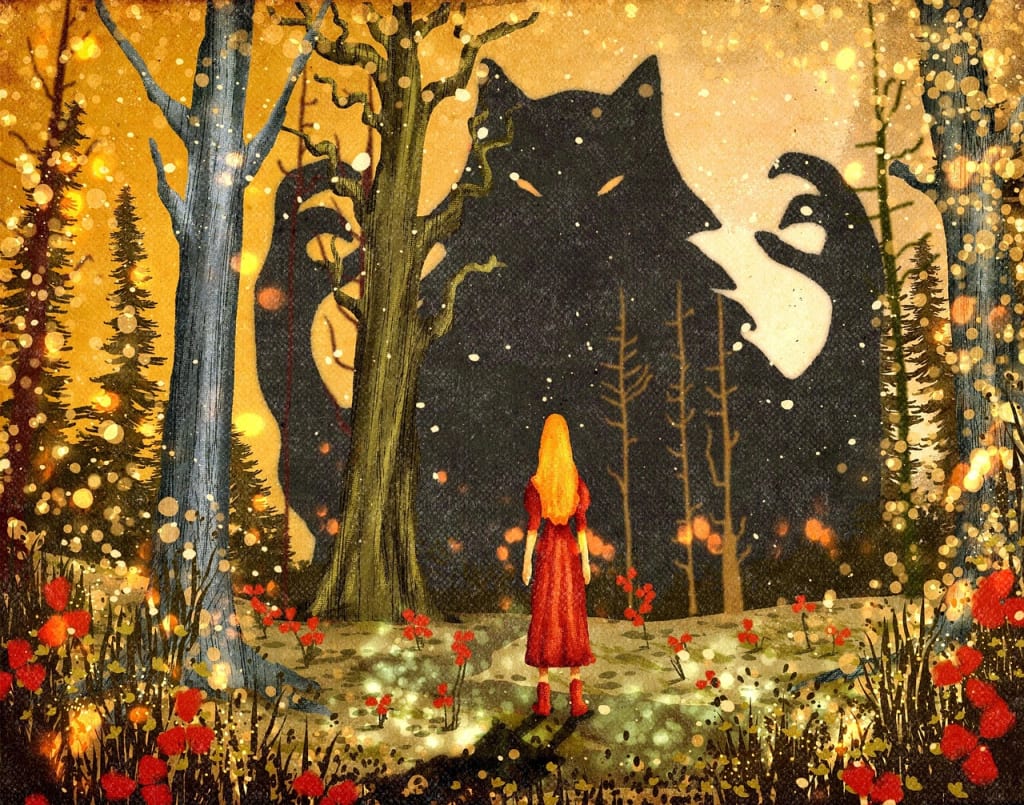
Little Red Riding Hood was a sweet young girl who lived in a peaceful village at the edge of a vast forest. Everyone knew her as Little Red Riding Hood. She was given this name because she always wore the bright red hooded cloak that her grandmother had made for her. One day, her mother packed a basket filled with bread, butter, and sweet cakes for her to deliver to her ailing grandmother, who lived alone in a cottage deep in the woods. “Stay on the path, don't talk to strangers, and go straight to Grandmother's house,” her mother reminded her before she left. The sun shone through the trees as Little Red Riding Hood made her way through the forest, and birds sang in the sky above. She intended to follow her mother's instructions, but her curiosity got the better of her. She was captivated by the forest's beauty. It wasn’t long before she encountered a sly and cunning wolf. The wolf gently asked the girl where she was going after noticing that she was alone and in danger. Forgetting her mother’s warning, Little Red Riding Hood innocently replied that she was on her way to visit her sick grandmother.
The wolf, ever the schemer, hatched a devious plan. He tricked the girl into wandering off the path to pick wildflowers for her grandmother, while he rushed ahead to the cottage. He deceived the elderly woman there into opening the door, swallowing her whole right away. He climbed into bed to wait for the girl to arrive, disguised by her cap and nightgown. When Little Red Riding Hood finally got there, she found the room dim and the door slightly open. She was puzzled by her “grandmother’s” strange appearance — her large eyes, big ears, and unusually sharp teeth. With each question—“Grandmothe“r, what big eyes you” have!”—the wolf responded cunningly, “The better to see you with, my dear,” until at last he leapt from the bed and swallowed her too.
Fortunately, a nearby huntsman, who had grown concerned about the quietness of the cottage, burst in just in time. He saw the sleeping wolf and, guessing what had happened, cut open its belly with his knife, freeing both the grandmother and Little Red Riding Hood unharmed. They filled the wolf’s belly with heavy stones, and when the wolf awoke, he collapsed under the weight and died.
From that day on, Little Red Riding Hood learned to never stray from the path and to always listen to her mother’s advice.
Symbolism and Themes
Little Red Riding Hood is more than just a tale of a girl and a wolf — it is a story rich in symbolism and moral lessons. In the story, the hue of her cloak, red, serves as a warning sign and frequently represents both passion and danger. The path she is told to follow represents safety, structure, and obedience — values often emphasized in traditional society, especially for young children.
The transformation from innocence to experience is symbolized by the mysterious and awe-inspiring forest. The wolf represents the predatory nature of the world, especially the threat of strangers who may not be what they seem. The story is interpreted as a cautionary tale about the risks that young girls face when they go out on their own. This tale has evolved across cultures and centuries, with some versions far darker than others. There was no rescue in some early versions; the wolf simply ate the girl. The huntsman only appears to save the day in later versions, such as the Brothers Grimm adaptation, providing a more reassuring moral conclusion for young readers. Why It Survives The reason Little Red Riding Hood remains relevant today is because of its universal themes. It speaks to the vulnerability of innocence in the face of cunning and malice. It highlights the importance of awareness, obedience to wise guidance, and the dangers of naivety. In a modern context, it serves as a metaphor for the challenges of growing up and learning to navigate a world that is not always safe or honest.
In addition, the story's adaptability guarantees its place in literature and popular culture. It has inspired countless adaptations — from animated cartoons and children’s books to darker reinterpretations in films and novels. Each retelling reflects the values and concerns of its time, but the core story remains compelling.
Conclusion
In addition to its gripping plot and memorable characters, Little Red Riding Hood endures due to its deeper messages. It is a tale that reminds us all — whether child or adult — of the importance of caution, the danger of deception, and the power of courage and quick thinking. As long as stories are told, the little girl in the red hood will walk the forest path in our imaginations, a symbol of both vulnerability and strength.
About the Creator
Keep reading
More stories from emon Islam and writers in BookClub and other communities.
"The Importance of Birds: Nature’s Most Beautiful Messengers"
Every morning, before the world fully wakes, there’s a chorus that begins outside my window. It starts quietly—one chirp, then another—and soon becomes a full orchestra of wings, whistles, and warbles. That’s when I remember how lucky we are to share this planet with birds.
By emon Islam10 months ago in BookClub
Rachel Reviews: Lakefront Wolves by Joseph Deegan
Meet Finn. He's an 18 year old kid who has potential. He's bright with great school scores and he's also an athlete, a footballer of some prowess. He has it all going for him, it would seem, and yet, he's determined to send what could be a well-planned, stable existence firmly off the rails. He drinks, he smokes, he takes drugs, he has violent tendencies and he's in danger of losing not only his mind but all that he holds dear.
By Rachel Deeming15 days ago in BookClub
7 Books With Brilliant Ideas You'll Be Thinking About All Year
The most powerful books do more than tell stories or deliver information—they plant brilliant ideas that reshape how we see the world, our work, our relationships, and even ourselves. These are the books that spark conversations, inspire action, and linger in our minds long after we close them.
By Diana Meresc7 days ago in BookClub
A Transparent Look at Vocal Challenges and Top Stories
Almost three years ago, we shared a resource article that served as a place for people to suggest new challenge prompts. We thought it would be a good idea to refresh that thread, and take the opportunity to answer a few common questions about top stories, how challenges are judged and how submissions are reviewed.
By Vocal Curation Team4 days ago in Resources


Comments
There are no comments for this story
Be the first to respond and start the conversation.