
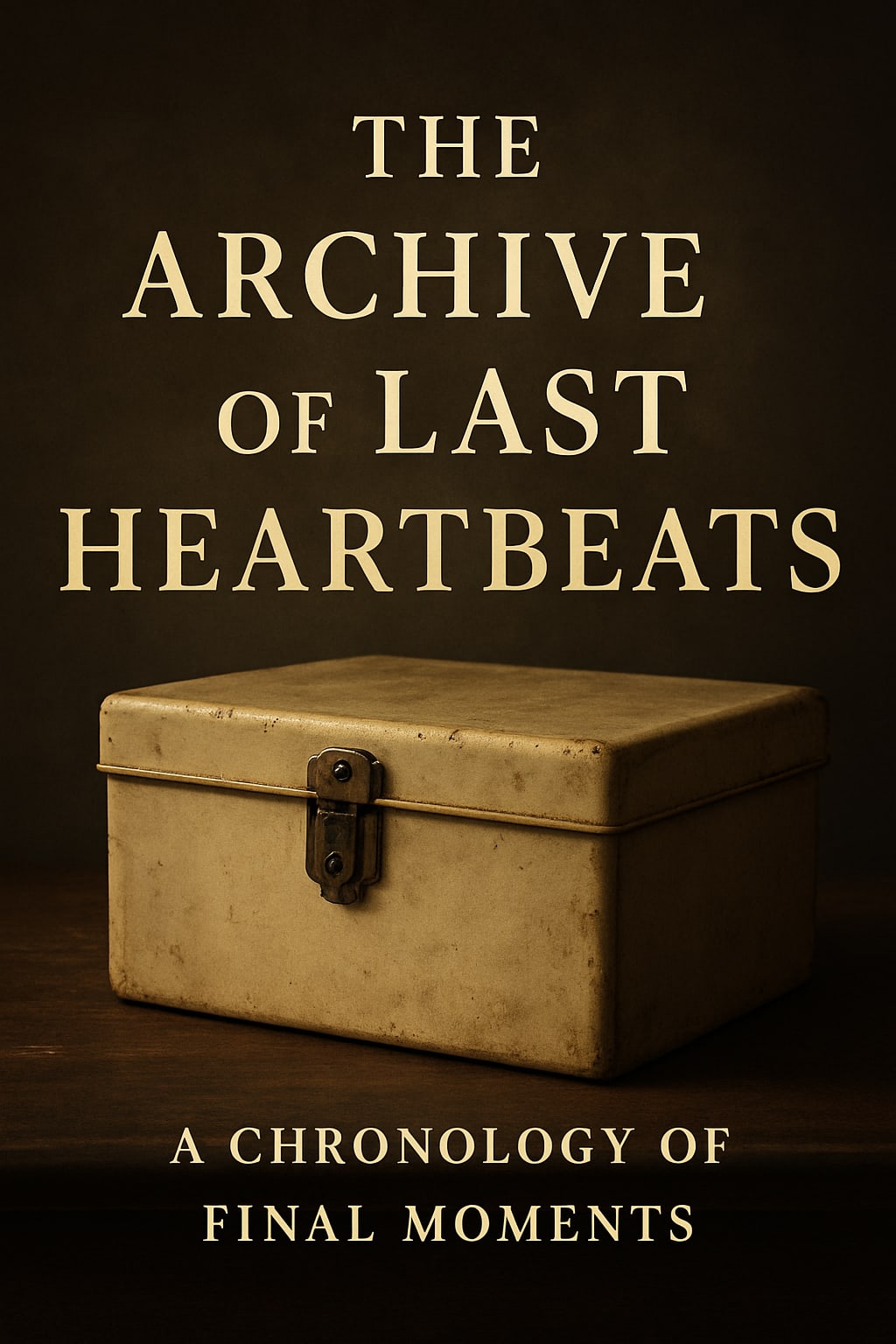
THE ARCHIVE OF LAST HEARTBEATS
A Chronology of Final Moments

THE QUIET KEEPERS
The Archive was nothing like the world imagined it.
To the public, the Archive of Last Heartbeats was little more than a poetic name—one of those solemn institutions tucked behind a government ministry, spoken of only when necessary. Newspapers mentioned it rarely, and when they did, they used phrases like “ethical custodianship,” “end-of-life biometric preservation,” or “the Department of Terminal Records.”
To the archivists who worked inside it, the truth was far simpler and infinitely heavier:
They collected the last measurable emotional signature of every human being who died.
Not their thoughts.
Not their memories.
Not their life stories.
Just a heartbeat.
The final one.
At the exact moment the electrical activity of the heart ceased, the Archive’s network—linked to every hospital, hospice, battlefield medic unit, prison infirmary, and emergency drone in the country—captured the final 0.8 seconds of the heart’s electrical pattern.
And it recorded something else, too.
The emotional sum of a life.
It was not mystical, not magical, not supernatural.
It was neuroscience.
Over decades of research, scientists had discovered that the human heart responded exquisitely to emotional states. Joy, terror, regret, and resolve—each left measurable signatures in the last pulses of life. With advanced sensors, pattern recognition, and bioelectrical translation, those signatures could be converted into waveforms.
They called them Echoes.
Each Echo was kept inside a small, transparent capsule about the size of a thumb. Inside, a suspended filament glowed faintly with the captured electrical pattern. When activated, it emitted a faint sound—barely audible unless amplified.
Only archivists had access to them.
Only archivists were trained to interpret the Echoes.
And only archivists knew that some heartbeats…
sang.
THE LISTENER
The archivist’s name was Elias Renn.
He had worked at the Archive for seventeen years. He was tall, quiet, slightly stooped from decades of meticulous work, and carried an air of gentle detachment. People who met him described him as polite but unreachable, like a man living half an inch behind his own eyes.
His job was simple:
Receive Echo capsules.
Log them.
Store them.
Never activate them.
The Archive’s first rule was etched above the entrance to the vault:
THE DEAD ARE TO BE PRESERVED, NOT EXPERIENCED.
Elias agreed with the rule in theory. He had seen what listening could do to people. An untrained mind, exposed to the distilled emotion of a stranger’s final moment, could be overwhelmed. Some Echoes pulsed with terror. Others with grief so deep it was almost physical. Others—rarer—glowed with something like peace, or gratitude, or fierce love.
Still… the rule had not always stopped him.
The first time Elias listened, he had been twenty-seven and new to the job. A capsule had arrived with an unusual pattern—stable, rhythmic, and warm. Something about it called to him. Against protocol, he had activated it.
What he heard did not sound like a heartbeat.
It sounded like a humming lullaby.
A grandmother dying in her sleep, surrounded by family she loved more than life.
Elias listened once, then never again.
Or so he told himself.
In truth, the Echoes whispered to him every day. Each faint flicker of a capsule held a universe of feeling, compacted into a violent, beautiful instant.
He longed to understand them.
But longing was not the purpose.
The purpose was indexing.
So he worked.
Diligently.
Quietly.
Compartmentalizing everything—his curiosity, his sadness, his growing conviction that no system should hold this much humanity in silence.
He worked so well, in fact, that the archive director rarely checked on him. His colleagues assumed he preferred solitude. And in a sense, he did.
But solitude has a way of magnifying the things one tries to suppress.
THE DISRUPTION
The day everything changed began like any other.
A shipment of Echo capsules arrived from the Northern Trauma Center—twelve from cardiac arrest cases, three from hospice deaths, and one from an industrial accident.
Elias signed the transfer log.
The courier left.
The outer doors sealed with a hiss.
He began sorting the capsules by type.
Then he saw the anomaly.
A capsule pulsing rapidly—far faster than the typical post-mortem stabilization rate. Its filament flickered with an unstable oscillation, like a heartbeat that refused to accept its own ending.
Elias frowned and checked the metadata.
Identification code: E-19-2048-Ψ
Origin: Battlefield Unit Delta
Age: 29
Cause of Death: Shrapnel impact, thoracic cavity
Echo Class: Unstable Category 5
Elias’s breath tightened.
Category 5 Echoes were rare. They were marked by extreme emotional surges—rage, terror, ecstasy, or complex combinations. They were never allowed to be activated. Most archivists went their entire careers without handling one.
Elias held the capsule gently, feeling its tiny vibration.
It startled him.
Echoes did not vibrate.
He re-read the file: “Subject’s neural activity persisted 0.2 seconds past cardiac cessation.”
Impossible.
The heart stops, and the brain follows. That was the rule.
Except… not always.
Elias lifted the capsule toward the light.
The filament inside glowed red—deep, intense, like something burning from within.
The Echo seemed almost… alive.
And faintly, beneath the hum of the Archive’s ventilation system, Elias thought he heard something.
A sound so faint it could have been imagined:
A syllable without words.
A note without pitch.
A heartbeat without a body.
For the first time in years, Elias felt afraid.
And then, strangely, he felt something else.
Connection.
The same sensation he had felt seventeen years earlier when he activated that grandmother’s Echo.
He placed the capsule into the temporary indexing bay.
He tried to focus on work.
But the anomaly throbbed in his peripheral vision.
Unsteady.
Unquiet.
Unresolved.
Hours passed. Other archivists left the building. The vault lights dimmed to night mode. The security system hummed.
Elias stood alone in the archive chamber, surrounded by millions of silent capsules.
Again, the anomaly pulsed.
Again, he felt it pulling at him—not violently, but insistently. Like a story begging to be heard.
He tried to walk away.
His feet did not move.
He tried to follow protocol.
His mind would not comply.
Something inside him trembled, then finally broke open—a truth he had buried for nearly two decades:
He did not work here to preserve silence.
He worked here because he could hear what others could not.
He was a listener.
A true one.
And the Archive, for all its rules, had been created by people who never understood the Echoes. They preserved the data, but they did not understand its meaning.
Elias did.
Slowly, as if performing a forbidden ritual, he lifted the capsule from the indexing bay and carried it to the center of the room.
His hand shook.
His breath caught.
His heart pounded.
He whispered, “Just once. I need to know.”
He pressed the activation panel.
The chamber lights dimmed.
The sound emerged.
THE FIRST HEARTBEAT
It was not music.
It was not a voice.
It was not language.
It was a surge.
A sudden, overwhelming rush of emotion so powerful that Elias staggered backward. His vision blurred. His knees nearly gave way.
The Echo filled the room with a raw, vibrating frequency—deep, resonant, pulsing with life violently interrupted.
Then it shifted.
The vibrations condensed.
The sound tightened.
A rhythmic pattern emerged.
A drumbeat.
A breath.
A gasp.
A strangled whisper of defiance.
Elias clutched the rail beside him, eyes watering.
This was no quiet death.
No peaceful passing.
No gentle last breath
This was a soldier’s final heartbeat.
Fierce.
Wounded.
Refusing to surrender.
Soaked in the memory of comrades left behind.
Holding onto love for someone waiting at home.
And threaded through it all—a single, piercing emotion that nearly broke Elias’s chest:
Unfinished purpose.
Elias steadied himself.
The Echo pulsed louder.
The soldier had died trying to accomplish something—something he never got the chance to complete. And the emotional signature of that unresolved mission had imprinted itself onto the final heartbeat.
Elias tried to deactivate the capsule.
The tablet denied the command.
He tried again.
Denied.
The Echo intensified.
The chamber walls began to reverberate as though struck by invisible waves.
And then something impossible happened:
Other capsules…
began to flicker.
One after another.
Row by row.
Shelf by shelf.
The Archive awakened.
THE AWAKENING
The flickering began like a ripple across still water—subtle at first, almost gentle. Then it grew.
The capsules nearest to the activated Echo began to tremble faintly, their filaments glowing and dimming in irregular rhythms. Elias watched, stunned, as the disturbance spread outward in expanding rings. Thousands of Echoes—silent for decades—responded as if stirred from a long sleep.
The room vibrated.
Elias’s breath hitched.
This was not part of any known protocol.
Echoes were isolated. Sealed. Mutually inert.
They were not supposed to interact.
He looked down at the activated anomaly in his hand.
“What are you…?” he whispered.
The capsule throbbed with a fierce, steady rhythm—as if the soldier’s final heartbeat were echoing through the entire Archive.
The vibrations intensified.
Elias stumbled backward as the soundscape around him changed. Layer by layer, faint tones rose from every direction—low hums, soft chimes, quivering oscillations that sounded almost like voices trapped beneath water.
Not language.
Not thought.
But emotion.
Billions of emotions.
It no longer felt like one heartbeat.
It felt like a million.
The Echoes of the dead—each containing the final emotional imprint of a life—were resonating with the anomaly’s violent, unresolved passion.
The Archive was becoming a symphony.
And Elias was standing in the center of the first movement.
THE FIRST INTERFERENCE
The automatic lights flared to full brightness—an emergency response triggered by internal vibration anomalies.
Elias shielded his eyes.
A sharp alarm chimed from the security hub outside the vault.
A red warning band appeared across the room’s wall display:
BIOELECTRICAL INTERFERENCE DETECTED.
ECHO CONTAINMENT PROTOCOL INITIATED.
Elias’s pulse spiked.
Containment protocol meant the system believed there was a bioelectric cascade—exactly the type of event the Archive was designed to prevent. If left unchecked, the system would automatically neutralize the Echoes.
Neutralization was irreversible.
Thousands—millions—of final heartbeats would be erased.
Elias forced himself to breathe.
He had opened the capsule.
He had triggered the chain reaction.
And now, if he didn’t act, the Archive would purge its entire collection.
He bolted for the central console.
“Override containment!” he shouted at the system.
The screen pulsed a soft blue as it processed the request.
OVERRIDE REQUIRES DIRECTOR AUTHORIZATION.
Elias cursed under his breath.
He didn’t have authority.
The director lived two hours away.
And security lockdown would seal the vault in less than 90 seconds.
He needed another way.
He looked back at the anomaly capsule. It still pulsed in his hand—furiously, defiantly, spreading its emotional signature across the vault like a call to arms.
The soldier had died with unfinished purpose.
That purpose had found Elias.
He sprinted to the auxiliary control panel and opened the manual circuit board. Rows of switches and breakers lined the metallic interior, each labeled with codes only archivists understood.
He scanned the labels, fingers trembling.
ECHO-TO-ECHO INTERFACE NODE
VAULT HARMONIC REGULATOR
BIOPSYCHIC RESONANCE DAMPER
There—
HARMONIC ISOLATION GRID
If he could isolate the anomaly’s waveform, the chain reaction would stop.
He grabbed the breaker’s handle—
Then froze.
The room around him pulsed.
Not violently.
Not dangerously.
Rhythmically.
Harmoniously.
And something clicked inside Elias’s mind—an understanding so sudden he gasped.
The Echoes weren’t destabilizing.
They were synchronizing.
The soldier’s Echo wasn’t harming the vault.
It was awakening it.
The Archive had never been designed for passive storage. That wasn’t what the founder wrote in the original mission. Elias had read the sealed documents years ago—documents people had forgotten, ignored, or dismissed as idealistic nonsense.
The Archive was built to preserve humanity’s emotional truth.
Not in silence.
In resonance.
Elias let go of the breaker and stepped back.
The symphony grew clearer.
Layer upon layer of final emotions bloomed into the air—fear interwoven with courage, joy braided into sorrow, regret folding into gratitude. Echoes collided, merged, harmonized, broke apart, reformed.
It was beautiful.
Terrible.
Honest.
Every heartbeat told a story.
Every Echo sang a life.
Elias pressed his hand to the glass of a nearby shelf, feeling the hum reverberate through his bones.
“I hear you,” he whispered. “All of you.”
THE LISTENER RETURNS
The first voice was not a voice.
More like a vibration.
Come back.
Not finished.
Hear.
Elias staggered. The emotional wave hit him like a physical force.
The soldier’s Echo—still clutched in his hand—burned hot.
The resonance peaked.
His vision warped.
And suddenly he was no longer in the vault.
He was standing in a rain-soaked street. Smoke filled the air. Sirens wailed. People ran past him, shouting. And in the middle of the chaos stood a soldier—helmet dented, uniform torn, one hand clutching his side.
The soldier turned.
Elias looked into the man’s eyes.
Eyes filled with desperation.
Determination.
And overwhelming sorrow.
“You have to finish it,” the soldier said—not with sound, but with emotional imprint translated into perception. “Please.”
Elias opened his mouth, but before he could speak, the scene collapsed like ash in the wind.
He was back in the vault.
On his knees.
Panting.
The glowing anomaly flickered in his hand.
The Echo had projected a memory.
Not a hallucination.
Not imagination.
A fragment of the soldier’s final moment.
Elias forced himself to stand.
“What do you need me to finish?” he whispered.
The capsule pulsed twice.
Elias understood.
He needed to listen to more.
Not one Echo.
Many.
Because no Echo existed alone.
Every human life intersected with others—family, lovers, enemies, strangers. Emotion was relational. Heartbeats were connected by stories, even if those stories were scattered across millions of people.
If the archive was resonating…
It was because something bigger was trying to be understood.
And Elias—
the only true Listener in the building—
was the only person capable of deciphering it.
He stepped forward, surrounded by the glow of a million lives.
“Then show me,” he said.
“I’m listening.
THE SYMPHONY OF FINAL MOMENTS
The Archive responded like a conductor raising an unseen baton.
Echoes intensified.
Some split into sharp, staccato pulses—fear, shock, sudden endings.
Others bloomed into warm, sustained vibrations—love, acceptance, peace.
Still others trembled with complex patterns—regret braided with relief, anger tinged with hope, longing mixed with forgiveness.
Elias approached a capsule on the nearest shelf and touched it gently.
Instantly, a soft sound spilled outward.
A hum.
A melody of gentle resignation.
He saw a vision of an elderly man lying in a hospital bed, holding his daughter’s hand. The man whispered a final apology he had waited thirty years to give.
Elias moved to the next.
A flicker.
A drumbeat.
A young boxer collapsing in the ring—his heartbeat pulsing with triumph even as his body failed him. He died believing he had made his father proud.
Next.
A rapid sequence of beats—shaky, terrified.
A teenager in a submerged car.
Clawing at the window.
Thinking of her little brother.
Next.
A slow, wavering throb.
A woman on a porch, watching the sunset one last time, remembering her husband’s laugh.
Elias cried.
He laughed.
He trembled.
Each Echo filled him with a story—but none was complete on its own.
Together, though…
Together, they formed a tapestry.
Patterns began to emerge:
Shared pains repeated across lives.
Shared joys echoed in identical rhythms.
Shared regrets crescendoed at the same emotional frequencies.
The Archive did not just hold individual heartbeats.
It held a portrait of humanity.
And the anomaly—the soldier’s furious, unfinished Echo—was the catalyst forcing the portrait into view.
Elias wiped his eyes.
If these Echoes were trying to say something…
It was not to one man.
It was to the world.
He looked again at the activated anomaly.
“What are you trying to tell me?” he whispered.
And suddenly—
He understood.
The Archive wasn’t malfunctioning.
It was communicating.
The dead were not crying out in fear.
They were asking for something.
They were asking to be heard.
THE WARNING
The resonance reached its peak.
Elias stood in the center of the vault, surrounded by trembling capsules that glowed like a million tiny lanterns. The air itself felt charged—thick with meaning, heavy with emotion.
The anomaly—still thumping in his palm—began to slow.
Not weaken—focus.
The soldier’s Echo was narrowing its signal, directing it toward a specific set of capsules across the room.
Elias followed the pull.
He moved through rows of memories until he stopped at a shelf labeled:
CIVILIAN CASUALTIES – REGION 7
COLLECTION YEARS: 2044–2048
He recognized the location code. Region 7 was the conflict zone where the soldier had died.
The filaments inside the capsules here flickered in perfect unison.
These weren’t random heartbeats.
They were connected.
Elias picked up one capsule at random and touched the activation pad.
A child’s heartbeat filled the air—light, fragile, frightened.
Emotion surged around him—confusion, pain, a final thought reaching desperately for a mother who wasn’t there.
Elias swallowed hard.
He activated the next.
A woman—breath ragged, heartbeat thready—thinking of the husband she left behind in a refugee center.
Next.
An old man—furious, desperate, clinging to a final act of defiance.
Next.
A medic—calm, resigned, asking himself whether the people he saved would survive without him.
Each Echo built upon the last.
Each emotion reinforced a pattern.
It wasn’t merely a tragedy.
It wasn’t randomness.
It was a consequence.
The soldier’s Echo pulsed harder, almost painfully.
Elias dropped to one knee, clutching his chest as a realization struck him with brutal clarity:
These people had died because of the policy decisions made far from their homes.
Someone had ordered operations that cost these lives.
Someone had known the risks.
The soldier’s Echo wasn’t just grief or rage.
It was guilt.
Unfinished purpose meant something deeper:
He had died trying to expose the truth.
He had been carrying evidence—emotional, factual, moral.
Evidence of unnecessary civilian deaths.
Evidence that someone had tried to bury.
His final heartbeat had imprinted the weight of that truth.
And now…
It was calling on Elias to finish what he couldn’t.
The capsules brightened at once—flooding the vault with blinding white.
Elias shielded his eyes.
The symphony sharpened into a single, unified emotion so strong it shook the room:
Remember us.
All of us.
Tell the truth.
The Archive of Last Heartbeats wasn’t malfunctioning.
It was demanding justice.
THE LISTENER’S CHOICE
The vault lights cut out.
Total darkness.
For ten long seconds, Elias heard nothing but overlapping heartbeats—soft, loud, rapid, slow—merging into a singular pulse.
Then the emergency lights flickered on.
The resonance dropped instantly—almost falling silent.
On the wall display, new warnings flashed:
SYSTEM OVERRIDE DETECTED.
UNAUTHORIZED ACTIVATION TRACED.
DIRECTOR EN ROUTE.
SECURITY LOCKDOWN IN 52 SECONDS.
Elias froze.
If the director found him in the vault with activated Echoes, there would be no second chances.
He would be charged with emotional contamination, breach of custodial ethics, and tampering with biometric evidence.
The Archive would be purged.
The Echoes would be neutralized.
The truth would be lost.
But if he left—if he escaped with the data—he could show the world the symphony of final moments, the emotional testimony untainted by politics or manipulation.
He could prove what had been done in Region 7.
He could honor the soldier’s unfinished purpose.
He had two choices.
Silence.
Or truth.
His hand tightened around the anomaly.
He made his decision.
Elias sprinted to the central console, bypassing the emergency interlocks with a command sequence only a veteran archivist would know. The system fought him, locking him out twice, but on the third attempt, the display shifted:
AUTHORIZATION GRANTED — TEMPORARY ADMIN ACCESS
He plugged his storage slate into the data port.
The vault’s entire emotional index—every Echo, every waveform, every final moment—began copying itself. Not all at once, but in a prioritized sequence based on resonance hierarchy.
First came the Echoes from Region 7.
Then the soldier’s unit.
Then related cases.
Then, systemic patterns across years.
The Archive was helping.
The system recognized Elias’s command not as theft, but as fulfillment of its real purpose.
The download timer appeared:
ESTIMATED TIME: 61 SECONDS
Elias felt his stomach drop.
Security lockdown was in 40.
He couldn’t wait.
He grabbed the slate as soon as the first cluster finished—enough to reveal connections, enough to expose the truth. Enough to make people listen.
He turned to leave—
Only for the vault doors to slam shut.
Locked.
A cold robotic voice echoed overhead:
CONTAINMENT ENGAGED.
PLEASE REMAIN CALM.
THE DIRECTOR HAS BEEN NOTIFIED.
Elias spun, heart pounding.
He wasn’t trapped.
Not yet.
There was one escape path.
No archivist ever used.
Only he could find because he had spent seventeen years studying the vault.
Behind the far shelves, behind a maintenance panel, behind two sealed manual locks—
There was a forgotten door.
A service exit was built in the early days of construction and left out of the newer schematics.
Because Elias had read the old blueprints, he knew.
He ran.
He shoved a heavy cart aside.
He tore off the panel.
He twisted the manual latch.
The door creaked open—dusty, untouched, leading into a narrow corridor lined with old cables.
The Echoes pulsed behind him, as if saying goodbye.
He turned back toward the vault.
He pressed the soldier’s capsule to his chest.
“I’ll finish it,” he whispered. “I promise.”
The anomaly dimmed, finally at peace.
Elias stepped into the tunnel and fled.
THE TRUTH UNSEALED
Elias did not go home.
He did not go to a friend.
He went to the one place the Archive feared:
A journalist.
Not just any journalist—
Marin Calloway, known for dismantling corruption with forensic precision. A woman who had once served on the ethics advisory board that funded the Archive before she resigned in protest over growing secrecy.
She opened her apartment door at midnight, hair tied up, face lit by a tablet full of unfinished drafts.
She stared at Elias.
“You look like you’ve seen a ghost,” she said.
“I’ve heard thousands,” Elias replied softly.
She let him inside.
He placed the slate on her table.
He handed her the anomaly capsule.
He played the Echo.
The room was transformed—filled with the raw, trembling heartbeat of a soldier trying to expose truth even as he died.
Marin covered her mouth.
Tears filled her eyes.
“Oh my God,” she whispered. “This… this is evidence.”
Elias nodded.
“Not just that. It’s testimony.”
She looked up sharply.
“What do you mean?”
Elias inhaled.
“The Archive isn’t a storage facility. It’s a record of humanity. Honest, emotional, undeniable. If people could hear these heartbeats—really hear them—nothing could be hidden. Not war crimes. Not cover-ups. Not lies.”
Marin swallowed.
“And you want me to publish them.”
Elias shook his head.
“I want you to share them. Not sensationalize. Not distort. Share them exactly as they are. Let people feel what the dying felt. Let the truth speak for itself.”
Marin hesitated.
“Elias… the government will come after you. They’ll come after me. This could start an international investigation.”
“Good,” he whispered.
“It’s what the dead deserve.”
She studied him for a long moment.
Then she nodded once.
“We’ll do it.”
THE WORLD LISTENS
The story broke three days later.
Not as a headline.
Not as a scandal.
As a recording.
A single audio file, released anonymously, titled:
THE LAST HEARTBEAT OF A SOLDIER
It spread instantly.
People listened.
People wept.
People raged.
People demanded answers.
New recordings followed.
Civilian Echoes.
Medic Echoes.
Old men.
Young women.
Children.
Not manipulated.
Not edited.
Presented as pure emotional truth.
A movement formed:
THE RIGHT TO BE HEARD
It changed the world.
Governments were forced to respond.
Investigations opened.
Policies changed.
Conflicts de-escalated.
The Archive was no longer a silent vault.
It became a global institution of remembrance.
And Elias?
He did not run.
He did not hide.
He returned to the Archive voluntarily.
He walked into the director’s office, placed the anomaly capsule on her desk, and said:
“It asked to be heard. I obeyed.”
They did not arrest him.
They promoted him.
He became the first official Chief Listener of the Archive.
His job was no longer to store silence.
It was to translate truth.
EPILOGUE: THE LAST SYMPHONY
Years passed.
The Archive changed—from a quiet vault into a public sanctuary where people came to listen to the emotional legacies of the departed.
Walls once cold now glowed with panels that played final heartbeats for visitors seeking closure, understanding, and connection.
Elias often walked the vault alone at night, feeling the familiar hum of the Echoes vibrating through the shelves.
One evening, as he passed the Region 7 collection, he paused.
The anomaly capsule—now safely stabilized—glowed softly.
Elias touched it.
A single, faint pulse vibrated through his fingers.
Not sorrow.
Not fear.
Not rage.
Peace.
Elias smiled.
“Rest,” he whispered. “Your story is told.”
For a moment, the entire Archive seemed to exhale.
The lights dimmed.
The echoes quieted.
And Elias Renn—the Listener who had awakened the truth—walked out of the vault knowing that, for the first time in history, humanity was no longer deaf to its own heart.
THE END
Author: William siaffa
About the Creator
WILLIAM SIAFFA
https://shopping-feedback.today/education/how-seriskin-anti-aging-formula-can-transform-your-skin-hy1200stq%3C/p%3E%3C/div%3E%3C/div%3E%3C/div%3E%3C/div%3E%3C/div%3E%3C/div%3E%3Cstyle data-emotion-css="1w30xpn">.css-1w30xpn{gap:1.5rem;justify-items:left;}
Keep reading
More stories from WILLIAM SIAFFA and writers in BookClub and other communities.
THE ALBINO LION
The Senate chamber was colder than usual that morning. Perhaps it was the spring wind slipping through the cracks in the marble, or maybe it was the tension—sharp and metallic—that seemed to float in the air like dust. Senators whispered in clusters, their purple-striped togas sweeping the polished floor, their gazes flicking toward the tall, dark-skinned general who stood in the center of the assembly like a pillar carved from obsidian.
By WILLIAM SIAFFA4 months ago in Education
Rachel Reviews: Lakefront Wolves by Joseph Deegan
Meet Finn. He's an 18 year old kid who has potential. He's bright with great school scores and he's also an athlete, a footballer of some prowess. He has it all going for him, it would seem, and yet, he's determined to send what could be a well-planned, stable existence firmly off the rails. He drinks, he smokes, he takes drugs, he has violent tendencies and he's in danger of losing not only his mind but all that he holds dear.
By Rachel Deeming15 days ago in BookClub
7 Low Fantasy Books You Must Read In 2026
Low fantasy occupies a unique and fascinating space in literature. Unlike high fantasy—with its sprawling worlds, elaborate magic systems, and epic quests—low fantasy brings the supernatural into a world that feels remarkably like our own. The magic is subtle, often unsettling. The settings resemble real history or everyday life. And the stories focus deeply on human struggle, morality, and consequence.
By Diana Meresc6 days ago in BookClub


Comments (1)
Great story; I enjoyed reading it.