
The 5 Techniques of Time Travelling,
Even Just to the Future

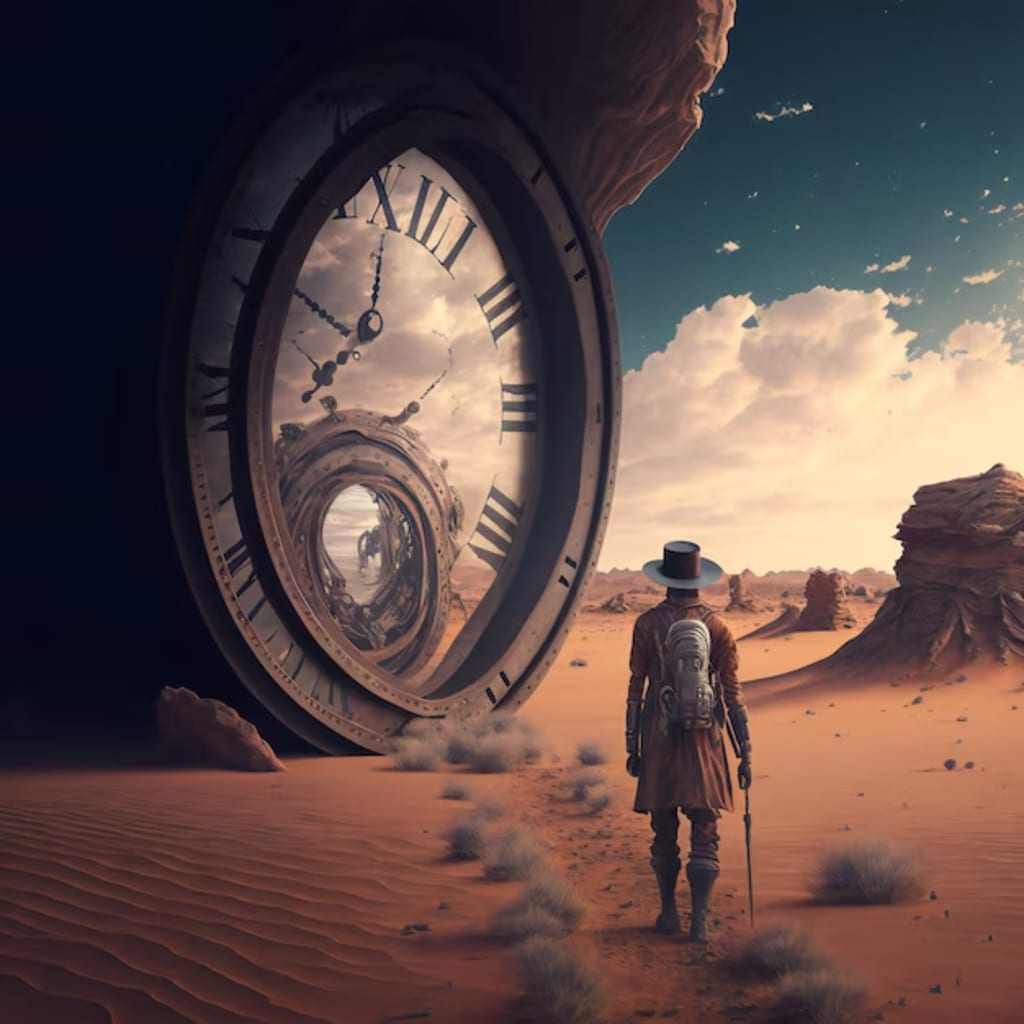
Okay, so you've watched the time travel movies and read the time travel novels.
The majority of them describe tales of entering futuristic boxes and instantly finding yourself in another Epic.
Although this is now science fiction, there are ways to hypothetically make time travel possible. Simply put, we haven't figured out the technology yet.
To begin with, 1)traveling at great speeds—but not only the kind of speed that would get you a ticket on the superhighway—could enable time travel to the future.
The good news is that scientists have already conducted tests to support this idea, which is based on Einstein's theory of special relativity and explains why time slows down for things moving at extremely high speeds.
The good news is that scientists have already tested this theory and it appears promising. They used two identical clocks, one of which was placed on a jet and the other remained on the ground. They discovered that the clock on the jet ticked slower than the one on the ground because of how quickly the jet was moving. The faster an object is moving, the more time will slow down for it. A specific class of particles called neutrinos, some of which may move at practically the speed of light, are currently the fastest speeds seen by human technology.
This theory is based on Einstein's findings, specifically his theory of general relativity, which explains that the 2) stronger gravity is, the slower time moves. This means that as you get closer to the center of the Earth, the strength of gravity increases a bit. Neutrinos, some of which can move at almost the speed of light at these speeds, one second for the protons is equal to 11 months for us now.
The same method was used to measure this effect, with two identical clocks placed on shelves at different heights and the rate of ticking monitored. The clock on the lower shelf ticked more slowly because it experienced a slightly stronger gravity, but there is a drawback to this approach: in order to travel to the far future, you'll need to find a location with extremely strong gravity, such as a black hole, which is a point in space where the gravity has reached its maximum strength. But because it's a one-way trip, traveling into a black hole is extremely risky. Here's a fascinating fact: In order for GPS systems that we use in our cars and on our phones to function effectively, time dilation effects must already be taken into consideration. Once you cross its edges, there is no turning back. This is due to the satellites' high speed and the gravity they experience on Earth. Your phone's GPS wouldn't be able to locate your location on Earth very precisely without these corrections. The third option, however, is more concerned with our own bodies than it is with the forces of the universe.
By accelerating bodily functions, researchers are looking for ways to travel through time. Although you wouldn't actually be traveling through time, if your body stays in one place for a very long time, you might finally awaken in the future. Some animals, such as bears and squirrels, have the ability to reduce their metabolism while hibernating, which allows them to subsist on less food and oxygen.
The ability for humans to fall into a brief slumber for a few hours is being researched by experts who want to know if it is possible.
In 2005, researchers at the hospital discovered a way to slow down mice's metabolism by exposing them to a tiny amount of a particular gas. However, it did not work as well when scientists attempted the same thing with larger creatures.
Our fourth method of time travel is quite unusual; it includes 4)wormholes, a specific class of shortcuts that may be present in our universe.
Now let's try to comprehend what they are before continuing. You must visualize a trampoline and two balls. The trampoline now remains flat in the absence of any pressure. Imagine the two balls are equally positioned on the trampoline; from this angle, there is no chance that they will ever touch.
However the cloth between the two balls can theoretically expand to the point where they touch if you apply enough pressure to the trampoline between them. The same effect occurs with stars and various star systems; they are large enough to bend space around them, which is why the majority of planets orbit stars. There would be a wormhole connecting those two locations. One could use these wormholes to travel over great distances—up to a billion light years—or even to visit distant eras. Nowadays, many scientists, including Stephen Hawking, believe that wormholes could exist and appear, but they would be extremely tiny—smaller than atoms. The issue is that we have no idea how to catch one and grow it such that humans may use it.
This would require a lot of energy, and we have no idea whether it is even feasible.
Even if humans managed to locate a wormhole and enter it, according to some astronomers, it would quickly collapse in on itself. The smallest amount of excess mass, such as that contained in human bodies, can cause the wormhole to close abruptly, much like a rubber band that has been overstretched.
Physicist Ron Malik of the United States offered the fifth approach to time travel. It 5)uses light, a resource that we can be certain is abundant in the universe.
He thinks that if something were thrown inside this whirling cylinder it could be moved in both space and time similar to how a bubble moves when you swirl it with a spoon in your coffee, just like the scientists' proposed idea regarding time travel that would use a rotating cylinder of light.
The correct cylinder shape, in Malik's opinion, might enable time travel to both the past and the future. To prove his theory, the physicist has been working to acquire funds for an experiment.
In this experiment, neutrons, which are extremely small particles, are dropped into a ring of rotating lasers.
Other experts, however, contend that further testing of Malik's theory is unnecessary because it is implausible. Would it be safe even if we eventually discovered a technique to go into the past or the future?
The paradox of time travel is a conundrum that scientists have been discussing for a very long time. What would happen if you traveled back in time and made a decision that altered the future is the central query.However, according to a recent study by experts from the University of Queensland, this issue may not actually exist after all. The researchers conducted some calculations and discovered that even if you modified something in the past, the timeline would still finish up the same way.
The Grandfather Paradox is a different version of this issue. Imagine travelling back in time and preventing the procreation of your own grandfather. Considering that. It necessarily implies that you shouldn't even be here. How could you possibly exist if your grandparents never had your parents?
The chronology that already exists has a method of correcting itself independent of where people are, so even if you did experience anything similar, you would still live in the present at the best.
About the Creator
Eliza
I love horror, mystery and sci-fi stories and has published few stories on these
Keep reading
More stories from writers in BookClub and other communities.
7 Books For A Relentless Mindset
In a world that constantly tests our patience, confidence, and resilience, cultivating a relentless mindset is no longer optional—it’s essential. Whether we’re building a career, pursuing financial freedom, training our bodies, or navigating personal challenges, success belongs to those who refuse to quit when progress feels slow or obstacles feel overwhelming.
By Diana Meresca day ago in BookClub



Comments
There are no comments for this story
Be the first to respond and start the conversation.