
Stephen King & the Ambiguously Gay Trope 3
A Look into One of Stephen King's Most Classic Writing Tropes: the Ambiguously Gay Duo

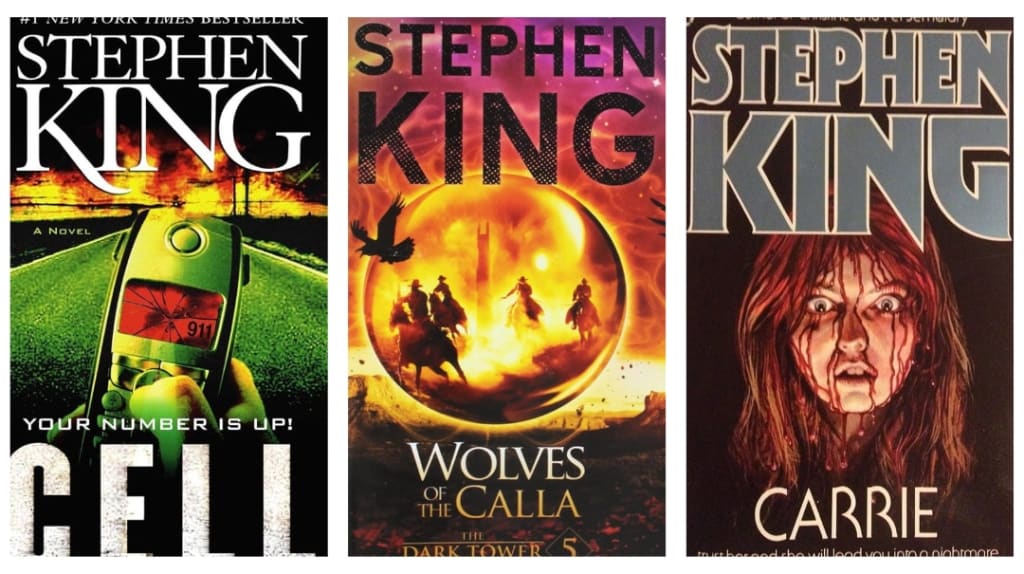
Stephen King is the author of sixty-plus novels and over two hundred short stories ranging from downright horror to thriller to the occasional Hard Case crime. Over the years the storyteller has developed a knack for specific tropes, enough to fill a bingo card if one is up to the game. As previously discussed on this profile in articles entitled, ‘Stephen King & The Ambiguously Gay Trope’ & ‘Stephen King & The Ambiguously Gay Trope: The Sequel’, one of the writers' most prominent motifs is the special bond shared between two significantly close friends who act as featured players in the story. King’s efforts to express just how close, familiar, or even just plain engrossed these characters are with the other always lead to a largely accidental, but phenomenal all the same, LGBTQIA+ lens to look through. Looking at a whole new set of characters from three King novels; ‘Cell’, ‘Wolves of the Calla’, and ‘Carrie’, it becomes clearer and clearer that said lens can be looked through for a crazy number of King’s books.
Hand-in-hand with the ambiguous gay trope for this pairing is the found family device which King also uses in a number of his novels. Clay Riddell and Tom McCourt are characters from King’s 2006 apocalyptic book, ‘Cell’, in which a mysterious signal is broadcast over cell phone networks causing people to turn into mindless animals. From the instant these two meet young Alice Maxwell, they become her parental team and act as almost well…husbands. “He looked across the lobby and saw Tom squatting beside Alice as she sat on the sofa. He was murmuring to her quietly, touching one of her loafers and looking up into her face. That was good. He was good. Clay was increasingly glad he run into Tom McCourt…or that Tom McCourt had run into him.” (King, Stephen. Cell, Pocket Star Books, p. 49). The two men act as a perfect team, extremely thankful for each other, so much so that Alice comes to rely on them both; “ ‘One of us could risk it. The other two could leave and wait until— ‘No,’ Clay said. ‘Please no,’ Alice said. She was almost crying again. ‘I want you both. I need you both.’ ” (King, Stephen. Cell, Pocket Star Books, p. 131). King writes Tom and Clay as a flawless pair to the extent that they joke about it in serious times; “ ‘No the worst that can happen is he can shoot you dead on his fucking welcome mat and leave me with a motherless teenage girl,’ ” (King, Stephen. Cell, Pocket Star Books, p. 107, 108), thus sounding like Clay is Alice’s Mother figure. How did they get that way? Tom and Clay can act as though they were husbands because of the special bond they develop throughout the novel.
In the duration of ‘Cell’, Clay and Tom become increasingly close and form a special bond in which Tom feels comfortable enough to be flirty; “Incredibly, Tom began to grin. ‘I tore your shirt, Batman.’ Clay felt like knocking his head off. Also like hugging and kissing him just because he was still alive.” (King, Stephen. Cell, Pocket Star Books, p. 235, 236). Not to mention Clay’s instinct to be openly affectionate which King often describes between two close friends. During the course of events, these two become exceedingly close, and when Clay decides to separate, it kills Tom. “ ‘Sorry I’m too tired to cheerlead,’... ‘And–may I be frank?--too heartsick at losing you.’ ” (King, Stephen. Cell, Pocket Star Books, p. 323). But it’s nothing compared to their reunion; “There’s a line that resonates in the current situation–‘Journeys end in lovers meeting.’ ” (King, Stephen. Cell, Pocket Star Books, p. 354). Tom openly calls them lovers. One could say he’s just using the quote to express happiness in seeing Clay again but it wasn’t necessary to use a quote that uses the term, lovers.
Stephen King’s magnum opus is often referred to as his infamous ‘Dark Tower’ series and hidden in the pages of ‘Wolves of the Calla’ is another ambiguous gay duo; Jake Chambers and Benny Slightman. To discuss these two, one must take a careful look at Jake’s severe disinterest in girls. Starting in ‘The Waste Lands’, this character has a profound connection to doors and finds himself drawn to the classroom closet. “Instead he walked back to his seat. Petra Jesserling looked at him with merry, dancing eyes. ‘Take me in there with you next time,’ she whispered. ‘Then you’ll have something to look at.’ Jake smiled in a distracted way and slipped into his seat.” (King, Stephen. The Waste Lands, Signet Fiction, p. 139). Not only does Jake not seem interested in the slightest in Petra, but the reader finds out in ‘Wolves of the Calla’ that a girl has a similar crush on him but Jake, once again, does not care. “ ‘Good evening, soh! Would you like your horoscope? This time of year is sometimes called Charyou Reap! You will see an old friend! A young lady thinks of you warmly!’ and so on. Jake had asked Roland again why he was spending so much time with Benny Slightman.” (King, Stephen. Wolves of The Calla, Hodder, p. 524). He instead ignores this information and asks about Benny.
Compared to the boy’s active disinterest in girls, Jake’s fascination with Benny and spending time with him seems noteworthy. “Jake lay looking at the sleeping boy, troubled. He liked Benny – his openness, his appetite for fun, his willingness to work hard when there were chores that needed doing. He liked Benny’s yodeling laugh when something struck him funny, and the way they were evenly matched in so many things…” (King, Stephen. Wolves of The Calla, Hodder, p. 624). Compared to the girls, Benny gets a whole paragraph written about why Jake likes him. When telling Roland that Benny asked him to stay with him, Jake blushes; “ ‘Do you want to go’ Roland asked. The boys cheeks flushed thin red.” (King, Stephen. Wolves of The Calla, Hodder, p. 220). During the novel, Jake finds out Benny’s dad is a troubling man and worries about the ramifications of sharing this information, “Jake looked at Benny for a long time, deeply troubled in ways he did not precisely understand…or want to.” (King, Stephen. Wolves of The Calla, Hodder, p. 598). Sounds like Jake had a lot of underlying feelings about Benny.
Lastly, from the author’s first published novel, the Carrie White + Sue/Tommy dynamic is one the most interesting King relationships. Both Tommy and Sue played their roles in Carrie's story as most teenagers would. Sue desperately wanted out of her romance, so as not to end up like Brenda & Eddie from Billy Joel's 'Scenes from an Italian Restaurant'. Her sending Tommy to prom with Carrie was not only Sue's attempt to feel like a better person but also to hope her boyfriend fell for the girl she thought deserved the happiness that she didn't want for herself. “And so I’m sorry and I hope it was good for her, that prom. Until the terror began, I hope it was good and fine and wonderful and magic…” (King, Stephen. Carrie, New English Library, p. 131). Sue is a flawed person, as we all are, so some of her intentions mirror that. Sue did want to help Carrie because she genuinely liked her once she realized her mistake in the locker room. They are three characters that could have easily fallen in love with either one between them. Be it, Tommy/Sue or Tommy/Carrie or Sue/Carrie which is perhaps the sweetest take on the story. Sue endeared herself to Carrie more and more as the book continued. There was a growing interest in the mysterious girl that Sue had lost for Tommy completely (basically from the beginning of the short novel). Sue didn't always understand Carrie but she fell into a deep fascination with her and most likely how Carrie could help her grow as a person.
Throughout the novel, Sue fears the impending doom of a heteronormative lifestyle with Tommy, to conform. She wishes not to settle down and marry the boy but does not know how to express this to him. After listing off her worst nightmare situations, she comes to this; “Carrie, it was that god damn Carrie. This was her fault. Perhaps before today, she heard the distant, circling foot-falls around their lighted place, but tonight, hearing her own sordid, crummy story, she saw the actual silhouettes of all these things, and yellow eyes that glowed like flashlights in the dark." (King, Stephen. Carrie, New English Library, p. 46). It was Carrie. Carrie made Sue leave the dark and realize the lifestyle was imminent. For Sue, it all comes back to Carrie. Like this scene in which Sue and Tommy have just finished having sex that Sue found unsatisfying; "In the aftermath she felt low and melancholy, and her thoughts turned to Carrie in this light." (King, Stephen. Carrie, New English Library, p.44 ). Sue's lament over the sex; “Tonight was only the second time she had begun to feel something like pleasure, and then it was over. Tommy had held out for as long as he could, but then it was just... over. It seemed like an awful lot of rubbing for a little warmth." (King, Stephen. Carrie, New English Library, p.44 ), being followed by thoughts of another woman is something to think about.
Part of the fun when it comes to reading Stephen King is collecting his tropes in that mental bingo card. The ambiguously gay trope is just one of many but there’s something to be said about it, especially because of the sheer number of times it comes up in his stories. Looking at these three examples is just a small analysis but it shows that interpreting King’s friendships romantically has a real basis. Next time you read a Stephen King book, be on the lookout because you never know when it might pop up. Don’t be afraid to look through the LGBTQIA+ lens that King may have set up for you, be it accidentally or on purpose. ‘Cell’, ‘Wolves of the Calla’, and ‘Carrie’ are not the only examples of this trope.
About the Creator
Jaime Burbatt
My name is Jaime, I'm 26 years old & my dream is to be an author
Keep reading
More stories from Jaime Burbatt and writers in BookClub and other communities.
7 Contemporary Romance Books Everyone Should Read In 2026
Love is timeless, but the stories we tell about it evolve with the world around us. Contemporary romance captures the pulse of modern relationships, blending passion, humor, and emotional depth with the realities of our everyday lives. Unlike classic romance, contemporary tales often tackle themes like career challenges, cultural differences, mental health, and personal growth—making them both relatable and inspiring. In a world where connection is increasingly digital, these books remind us of the beauty of vulnerability, the excitement of chemistry, and the transformative power of love.
By Diana Meresc6 days ago in BookClub



Comments
There are no comments for this story
Be the first to respond and start the conversation.