
Spiritualism
When the Living Sought Answers from the Dead

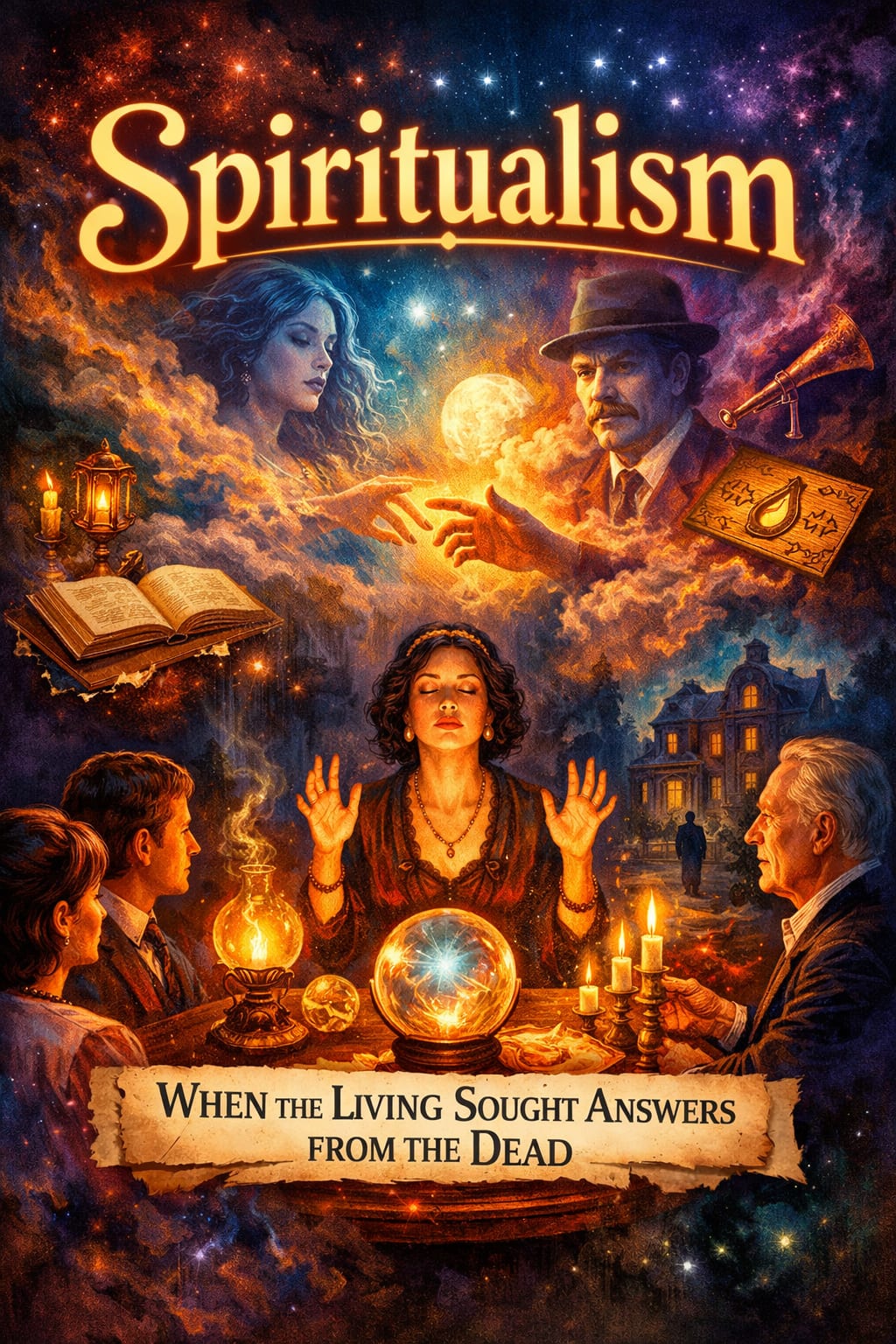
Listening for Voices Beyond Death
Spiritualism arose from a persistent human question that predates written history: does consciousness survive bodily death, and if survival is possible, can contact be made across that boundary. Across civilizations, burial rites, ancestor veneration, and funerary texts suggest that death was rarely understood as an absolute ending. Spiritualism gave this ancient intuition a distinct form during the nineteenth century, shaped by social upheaval, scientific confidence, and widespread personal loss.
The movement took recognizable shape in the mid 1800s, a period marked by rapid industrialization, expanding literacy, and shifting religious authority. Traditional churches no longer satisfied all seekers, while scientific progress encouraged the belief that unseen forces could be measured, tested, and explained. Telegraphy had already taught society that invisible signals could carry meaning across great distances. Against this backdrop, the idea that the dead might communicate through physical signs felt less impossible than it might have in earlier centuries.
Spiritualism offered both comfort and structure. Death was reframed not as silence but as transition. The deceased were imagined as active personalities who retained memory, emotion, and moral awareness. Communication was not reserved for prophets or saints but presented as accessible through ordinary individuals known as mediums. Séances, spirit messages, and trance communications became rituals through which grief, curiosity, and hope were given voice.
The appeal was not limited to belief alone. Spiritualism claimed alignment with reason and observation. Many adherents viewed spirit communication as a natural phenomenon governed by laws not yet fully understood. Investigations were conducted, experiments attempted, and testimonies recorded. Some participants sought proof of survival, while others found meaning in the ethical vision promoted by spirit teachings, which emphasized personal responsibility, moral growth, and the continuity of human identity beyond the grave.
At the same time, Spiritualism unsettled social norms. Women frequently occupied central roles as mediums and speakers, gaining authority in public spaces often denied elsewhere. Questions of authenticity, deception, and self-delusion followed closely behind spiritual claims. Critics challenged the validity of phenomena, while supporters defended personal experience as a legitimate form of knowledge. This tension between faith, evidence, and skepticism became one of the defining features of the movement.
Spiritualism endures not because certainty was achieved, but because the longing that fueled it never disappeared. The desire to believe that love, memory, and identity survive death continues to shape human thought. In that sense, Spiritualism stands as both a historical movement and a mirror, reflecting how each era grapples with mortality, meaning, and the unseen possibilities that may lie beyond the final breath.
What Spiritualism Is
Spiritualism is a religious and philosophical movement founded on the conviction that human consciousness continues after physical death and remains capable of interaction with the material world. Death, within this framework, represents a transition rather than an ending. Identity, memory, and moral awareness are believed to persist beyond the body, forming the basis for communication between the living and the deceased.
Central to Spiritualist belief is the role of the medium. A medium is understood as an individual possessing heightened sensitivity to nonphysical forms of consciousness. Through this sensitivity, communication is said to occur between spirit personalities and human participants. Mediumship has taken many forms, ranging from spoken messages delivered in altered states of awareness to written communications produced through automatic writing. Some traditions also describe physical manifestations, including audible sounds, table movement, or unexplained lights, interpreted as evidence of spirit presence.
Spiritualist cosmology describes the spirit world as structured yet progressive. Existence beyond death is often portrayed as a series of conditions or spheres reflecting moral and intellectual development. Advancement within this realm is associated with ethical growth, compassion, and self awareness rather than judgment or punishment. This view rejects static visions of heaven or hell in favor of continuous learning and refinement of character.
Communication with spirits serves purposes beyond curiosity about survival. Messages attributed to spirit communicators frequently emphasize moral responsibility, personal integrity, and the consequences of actions during embodied life. Guidance is presented not as prophecy or command but as counsel offered from a broader perspective shaped by experience beyond physical limitation.
Ritual practices within Spiritualism developed to support structured communication. Séances became formal gatherings designed to create focused conditions for spirit contact. Trance speaking involved altered states in which verbal messages were delivered without conscious control. Spirit rapping and other physical signs were interpreted as symbolic language, often requiring interpretation through agreed upon systems of response.
Spiritualism occupies a distinctive position among religious movements due to the emphasis on personal experience as a source of knowledge. Authority does not rest solely in scripture or hierarchy but emerges from direct encounters interpreted as meaningful evidence of survival. Belief is reinforced through perceived experience rather than doctrine alone, allowing Spiritualism to function simultaneously as faith, philosophy, and experiential inquiry into the nature of consciousness beyond death.
The Historical Arc of Spiritualism
Roots Before 1848
Belief in communication with the dead long predates the appearance of Spiritualism as a named movement. Ancient Mediterranean cultures recorded rituals intended to consult the departed, including practices described in Greek literature and philosophical texts. Oracles, dream incubation, and necromantic rites reflected a worldview in which the boundary between the living and the dead remained permeable. Jewish mystical traditions also preserved concepts of continued existence after death, with visions of spirits offering guidance or warning. These ideas did not form a unified doctrine but established a cultural foundation in which survival beyond death was widely assumed.
During the Enlightenment and early modern period, philosophical inquiry reframed older spiritual assumptions. Thinkers debated the nature of the soul, personal identity, and immaterial substance. Questions of consciousness and moral agency persisted even as religious authority weakened in some regions. By the early nineteenth century, belief in an immortal soul existed alongside emerging scientific confidence. Electricity, magnetism, and unseen forces suggested that invisible processes governed much of reality. Such intellectual conditions made spirit communication appear conceivable rather than purely mythical.
The Hydesville Spark
Modern Spiritualism is generally traced to events reported in 1848 in Hydesville, New York. In a modest farmhouse, two young sisters, Margaret and Kate Fox, described persistent knocking sounds that seemed to respond intelligently to questions. A system of coded responses was developed, allowing the sounds to indicate letters and numbers. The phenomenon was presented as communication from a deceased individual rather than natural noise.
Public demonstrations followed as neighbors, clergy, and curious observers gathered to witness the sounds. Reports spread quickly through newspapers and word of mouth. Séances soon appeared in nearby towns, where similar phenomena were claimed by other participants. Whether viewed as revelation, entertainment, or deception, the Hydesville events ignited widespread fascination. The idea that ordinary households could serve as sites of spirit contact transformed private belief into public spectacle.
Expansion and Organization
By the 1850s and 1860s, Spiritualism had grown into a recognizable movement across the United States and Britain. Public lectures, séance halls, and traveling mediums brought spirit communication to urban and rural audiences alike. Printed pamphlets and newspapers circulated accounts of spirit messages, moral teachings, and personal testimonies of survival after death.
Organizational structures gradually emerged. Churches, associations, and training programs for mediums were established to formalize practice and belief. In the United States, national coordination eventually led to the formation of the National Spiritualist Association of Churches in 1893. Spiritualism attracted participants from many social backgrounds, including reformers, abolitionists, scientists, and artists. Women often occupied prominent roles as mediums and speakers, gaining authority rarely available in other religious institutions.
Scientific interest accompanied popular enthusiasm. Researchers conducted investigations into trance states, automatic writing, and physical phenomena. Chemist William Crookes became one of the most prominent figures to examine mediumship under controlled conditions. Conclusions varied widely, and disagreements between investigators fueled controversy. Accusations of fraud coexisted with sincere attempts to document unknown forces.
Spiritualism also absorbed influences from related movements. Mesmerism, also known as magnetic healing, contributed ideas about altered consciousness and invisible energies. Hypnosis provided language for trance states and dissociation. These overlaps blurred distinctions between spiritual, psychological, and physiological explanations.
By the late nineteenth century, Spiritualism stood as a complex social phenomenon shaped by grief, curiosity, scientific ambition, and changing religious authority. The movement reflected both the hopes and anxieties of an age struggling to reconcile faith with modernity and death with meaning.
Beliefs and Practices
Survival of Consciousness
Spiritualist belief rests on the conviction that consciousness does not end with bodily death. Identity, memory, emotion, and intention are understood to persist beyond physical dissolution. Death is described as a passage into another condition of existence rather than extinction. Spirits are believed to retain individuality and awareness, maintaining relationships and interests formed during embodied life.
Interaction between the living and the deceased is considered possible through specific conditions and methods. Communication has been described in many forms, including spoken messages delivered during altered states of awareness, impressions received mentally or emotionally, and written messages produced without deliberate control. Physical manifestations have also been reported, such as unexplained sounds, movement of objects, or changes in temperature during séances. These phenomena are interpreted within Spiritualism as expressions of spirit agency rather than symbolic metaphor.
Moral and Ethical Dimensions
Spiritualism places significant emphasis on ethical development. Moral character during physical life is believed to influence conditions experienced after death. Progress in the spirit world is described as dependent on qualities such as compassion, honesty, and responsibility. Advancement is not determined by belief alone but by conduct and intention.
Teachings attributed to spirit communicators often emphasize accountability and self improvement. Messages commonly address themes of personal growth, reconciliation, and the consequences of harmful actions. Rather than focusing on judgment or punishment, Spiritualist ethics center on learning through experience. Mistakes are portrayed as opportunities for moral refinement rather than permanent condemnation.
This ethical framework appealed to individuals dissatisfied with rigid doctrines of salvation or damnation. Spiritualism presented moral law as continuous across life and death, reinforcing the idea that human responsibility extends beyond physical existence.
Spirit Guides
Within Spiritualist practice, certain spirits are believed to act as guides. These entities are described as having achieved a higher level of moral or intellectual development. Guidance is offered through inspiration, symbolic imagery, or direct communication during mediumistic sessions. Spirit guides are not worshiped and are not considered infallible authorities. Instead, guidance is framed as advisory rather than directive.
The concept of spirit guidance reinforced the belief that the spirit world is structured and purposeful. Relationships between guides and mediums were often described as ongoing and cooperative. Such relationships were believed to develop through trust, discipline, and ethical alignment rather than ritual alone.
Regional Variants and Related Movements
Spiritualism evolved differently across cultural and geographic contexts. One of the most influential related movements is Spiritism, developed in the mid nineteenth century by French educator Allan Kardec. Spiritism shares the belief in spirit communication but places stronger emphasis on reincarnation and progressive moral evolution across multiple lifetimes. Ethical responsibility is central, with repeated embodiment viewed as a mechanism for learning and correction.
Spiritism gained particular influence in Latin America, especially in Brazil, where organized communities, charitable institutions, and educational centers continue to operate. While Spiritualism and Spiritism share historical roots, doctrinal differences shaped distinct identities. Spiritualism generally emphasized communication with deceased individuals from a single lifetime, while Spiritism framed spiritual existence as part of a longer cycle of rebirth and ethical advancement.
Together these beliefs and practices reflect a shared attempt to understand consciousness as enduring, meaningful, and shaped by moral choice across visible and invisible states of existence.
Controversies and Criticisms
Spiritualism has been subject to persistent scrutiny, skepticism, and dispute throughout its history. From the earliest public séances, questions arose regarding the authenticity of spirit phenomena. Investigations revealed that some mediums employed deliberate deception, using hidden mechanisms, accomplices, or sleight of hand to simulate communication. Such exposures prompted both outrage and fascination, drawing attention from entertainers, scientists, and journalists seeking to distinguish genuine experience from trickery. Illusionists like Harry Houdini dedicated significant effort to revealing fraudulent practices, demonstrating how the senses could be manipulated and emphasizing the vulnerability of participants to suggestion. By the early twentieth century, formal inquiries and laboratory experiments found that many phenomena attributed to spirits could be replicated through natural or mechanical means.
Criticism extended beyond questions of authenticity. Religious authorities frequently condemned Spiritualism as heretical, morally dangerous, or a form of forbidden necromancy. Formal prohibitions were enacted in some regions, reflecting concerns about undermining established doctrine and social order. Ethical objections were also common, as skeptics argued that spiritual claims exploited grief, manipulated hope, or encouraged dependence on unverified sources for guidance.
From a sociological and psychological perspective, Spiritualism has been interpreted as a reflection of human needs and cultural conditions rather than as objective proof of life after death. It provided solace for those confronting mortality, grief, and uncertainty, offering structured rituals and moral narratives that addressed profound emotional experiences. The movement also intersected with shifting social norms, granting women a visible and authoritative role as communicators with the spirit world, a development viewed with both admiration and suspicion by contemporaries.
Debate over Spiritualism continues to highlight the tension between faith and evidence. Enthusiasm for spirit contact coexisted with public exposure of fraud, critical evaluation of methods, and philosophical questions about consciousness and morality. Controversy became an intrinsic aspect of the movement, shaping its reputation, influencing public perception, and contributing to the dynamic interplay between belief, skepticism, and human desire for connection beyond death.
Social and Cultural Significance of Spiritualism
Spiritualism played a profound role in shaping social and cultural life, particularly during the nineteenth century. The movement created spaces in which individuals marginalized by formal institutions could exercise influence and authority. Victorian-era women, often excluded from leadership roles in church, politics, and academia, found a unique platform as mediums, lecturers, and writers. Public séances allowed women to address audiences on spiritual, ethical, and philosophical matters, granting visibility and social authority rarely available elsewhere. Mediumship became both a spiritual vocation and a means of negotiating gendered limitations, contributing to broader conversations about women’s roles in public life.
Spiritualism also intersected with intellectual and scientific debates of the period. The publication of evolutionary theory, advances in physics, and growing confidence in empirical methods challenged traditional religious authority. In this context, Spiritualism offered a framework that combined faith, observation, and experimentation. Séances, spirit communications, and reports of phenomena were often interpreted as empirical investigations into unseen dimensions. Such practices blurred the line between religious experience and scientific inquiry, allowing exploration of existential questions while maintaining engagement with the rationalist discourse of the time.
Cultural influence extended beyond formal study or religious practice. Spiritist literature, periodicals, and pamphlets circulated widely, providing narratives that combined ethical instruction, personal testimony, and moral philosophy. Art, theater, and public lectures frequently incorporated Spiritualist themes, reflecting fascination with death, the afterlife, and unseen forces. These representations contributed to a shared cultural imagination in which the boundaries between life and death, reason and wonder, science and spirituality were actively explored.
Spiritualism also intersected with social reform movements. Abolitionists, suffragists, and advocates for temperance sometimes engaged with Spiritualist networks, using the movement’s moral and ethical framework to support broader efforts to reshape society. Spirit messages emphasizing justice, compassion, and ethical responsibility resonated with reform-minded individuals, reinforcing the perception of Spiritualism as both a personal and social ethic.
Through its engagement with gender, science, art, and social activism, Spiritualism became more than a set of beliefs. It functioned as a cultural force that challenged conventions, expanded opportunities for marginalized voices, and created a public arena in which the mysteries of life, death, and morality could be explored with seriousness, curiosity, and human attention.
Recommended Reading: #commissionearned
The History of Spiritualism by Arthur Conan Doyle
Arthur Conan Doyle produced one of the most influential historical accounts of Spiritualism, combining narrative history with personal conviction. The work traces the emergence of modern Spiritualism from early nineteenth century phenomena through organized movements and prominent figures. Detailed descriptions of séances, mediums, and investigative efforts reveal how belief and inquiry developed side by side. Historical context is carefully woven into the narrative, showing how social change, scientific optimism, and widespread grief shaped public interest in spirit communication. The text provides insight into internal debates within Spiritualist communities and the tension between faith and skepticism. The author’s perspective reflects both testimony and interpretation, offering a vivid portrait of a movement struggling to define itself. This book aligns closely with the themes of historical evolution and cultural meaning explored in the broader discussion of Spiritualism.
Spiritualism: Its History, Phenomena and Doctrine by J. Arthur Hill
J. Arthur Hill offers a comprehensive exploration of Spiritualism that balances historical narrative with philosophical reflection. The book examines reported phenomena with attention to detail, presenting accounts of trance states, physical manifestations, and mediumistic communication. Doctrinal ideas are explained in clear terms, including concepts of survival after death, moral progression, and spirit guidance. Historical development is connected to broader intellectual trends, including scientific inquiry and religious reform. Analytical commentary distinguishes between sincere belief and questionable practices without dismissing the emotional significance of spiritual experience. The text contributes depth to understanding how Spiritualism functioned as both belief system and social movement. This work complements discussions of Spiritualist practices and ethical frameworks by providing structured explanations of core ideas and historical continuity.
Talking to the Dead: Kate and Maggie Fox and the Rise of Spiritualism by Barbara Weisberg
Barbara Weisberg’s work offers a richly detailed and carefully researched account of the Fox sisters, whose experiences in a small New York farmhouse helped ignite the modern Spiritualist movement. Rather than treating the sisters as simple symbols of belief or deception, the book presents them as complex figures shaped by social pressure, fame, and the emotional climate of nineteenth century America. The narrative situates the famous spirit rappings within a culture already primed for supernatural explanations, scientific curiosity, and public spectacle. Attention is given to how newspapers, lecture circuits, and private séances transformed local events into an international phenomenon. Weisberg explores the emotional costs of notoriety, including internal conflict, public scrutiny, and the long shadow cast by later confessions and reversals. The book also examines how grief, gender expectations, and economic survival influenced the sisters’ choices and public performances. By blending biography with cultural history, this work complements broader discussions of Spiritualism by grounding the movement in lived experience rather than abstract belief, showing how personal lives and public fascination became inseparably intertwined.
Anne Kalvig investigates Spiritualism in modern contexts, connecting historical roots with contemporary practices. The book explores how spiritual communication has adapted to new social environments, technologies, and cultural expectations. Attention is given to debates surrounding authenticity, ethics, and authority within present-day Spiritualist communities. Sociological and anthropological perspectives illuminate how belief systems respond to modern skepticism and scientific discourse. Case studies demonstrate the persistence of spiritual practices despite changing intellectual climates. Analysis of controversy reveals how Spiritualism continues to provoke discussion about consciousness, identity, and evidence. This work aligns with broader themes of continuity and transformation within Spiritualism across different historical periods.
The Darkened Room: Women, Power and Spiritualism in Late Victorian England by Alex Owen
Alex Owen provides a detailed examination of the relationship between gender and Spiritualism in Victorian society. The book reveals how mediumship created opportunities for women to exercise authority in public and private spheres. Historical examples illustrate how séances became arenas for negotiating power, identity, and social roles. Analysis of personal narratives and public reactions exposes tensions between fascination and suspicion toward female mediums. The work connects Spiritualism with broader struggles for recognition and autonomy within patriarchal structures. Cultural and psychological dimensions are explored to show how spiritual practice intersected with social transformation. This study deepens understanding of Spiritualism as a force that reshaped social hierarchies and challenged traditional boundaries.
The Dangers of Spiritualism by John Godfrey Raupert
John Godfrey Raupert presents a critical perspective shaped by personal experience and theological concern. The book examines perceived risks associated with spirit communication, including moral, psychological, and spiritual consequences. Historical examples are used to illustrate cases in which Spiritualist practices led to conflict or deception. Religious interpretation frames Spiritualism as a phenomenon requiring caution rather than acceptance. The narrative reflects early twentieth century anxieties about modernity, faith, and unseen influences. By contrasting enthusiasm with warning, the work highlights tensions between belief and skepticism within public discourse. This perspective adds complexity to discussions of Spiritualism by demonstrating how fear and doubt shaped responses to spirit phenomena.
The Other World: Spiritualism and Psychical Research in England, 1850–1914 by Janet Oppenheim
Janet Oppenheim presents Spiritualism as a serious intellectual and social current rather than a fringe curiosity. The book examines how belief in spirit communication intersected with Victorian concerns about science, morality, religion, and the limits of human knowledge. Spiritualism is shown operating alongside early psychology and psychical research, attracting scientists, philosophers, clergy, and skeptics alike. Detailed attention is given to how séances, trance states, and mediumship were debated within educated society rather than confined to popular entertainment. The narrative reveals how questions about the survival of consciousness challenged both religious orthodoxy and materialist science. Cultural anxiety surrounding death, progress, and unseen forces emerges as a driving influence behind spiritual inquiry. This work fits seamlessly with a serious exploration of Spiritualism by demonstrating how the movement functioned as a genuine attempt to reconcile faith, reason, and experience during a period of rapid intellectual change.
Concluding Reflections
Spiritualism endures as a complex and often contested tradition shaped by belief, doubt, experience, and cultural change. The movement occupies a space where religion, philosophy, psychology, and social history intersect. Claims of spirit communication have never existed in isolation, but alongside skepticism, investigation, exposure, and reinterpretation. This tension has not diminished its significance. Instead, disagreement has become part of the tradition’s identity, revealing how deeply questions of death, survival, and meaning are woven into human thought.
Historical examination shows that Spiritualism attracted a remarkably diverse range of participants. Scientists explored altered states of consciousness. Philosophers debated the nature of mind and identity. Grieving families sought reassurance and continuity. Social critics examined power, gender, and belief. Each encounter left traces that continue to shape how Spiritualism is understood. No single explanation accounts for its persistence or its influence.
Understanding this subject benefits from patient and careful reading. Public libraries remain one of the most reliable gateways to balanced research, offering access to historical texts, academic studies, and critical perspectives without commercial pressure. Librarians often provide guidance toward reputable editions and contextual materials that deepen understanding. Physical books, archival collections, and peer reviewed studies allow sustained engagement beyond surface impressions.
Caution is advised when relying solely on free online material. Digital resources vary widely in accuracy, intent, and editorial oversight. Some platforms blur scholarship with speculation or present belief as fact without distinction. Critical evaluation of authorship, publication context, and historical grounding strengthens discernment. Cross checking claims across multiple formats and viewpoints supports a more grounded understanding.
Spiritualism resists simple conclusions. The tradition remains valuable not because certainty has been achieved, but because inquiry continues. Engaging with its history invites reflection on how human beings confront loss, search for meaning, and attempt to understand consciousness itself. Thoughtful research, careful reading, and informed skepticism create space for insight without surrendering reason. In that process, the past becomes a conversation rather than a verdict, offering perspective on enduring questions that remain unanswered yet deeply human.
About the Creator
Marcus Hedare
Hello, I am Marcus Hedare, host of The Metaphysical Emporium, a YouTube channel that talks about metaphysical, occult and esoteric topics.
https://linktr.ee/metaphysicalemporium
Keep reading
More stories from Marcus Hedare and writers in BookClub and other communities.
Mediumship in Theory and Practice
Opening the Study of Mediumship Mediumship refers to a broad set of practices centered on the claimed ability to facilitate communication between the physical world and non-physical intelligences commonly described as spirits. Across history, mediumship has appeared in religious, philosophical, and cultural contexts, often shaped by prevailing beliefs about the nature of consciousness, survival after death, and the relationship between the material and immaterial worlds. While frequently associated with nineteenth-century Spiritualism and Spiritist movements, mediumship predates these systems and continues to evolve within modern metaphysical, psychological, and paranormal discourse.
By Marcus Hedare2 days ago in BookClub
My New Book is Finally Here
My poetry collection Beautiful and Brutal Things is done. It's actually done and finally published over 270 pages. Over a year of my life went into this book. More than a year, really. Long days at my computer, sometimes seven days a week because I couldn't stop even when I probably should have. Then two months of editing that felt harder than the writing itself. But it's finished, and I'm still standing, and the book is real.
By Tim Carmichael7 days ago in BookClub
7 Fascinating Books You Need To Read In 2026
Books have an almost magical ability to expand our inner world. They sharpen our thinking, stretch our empathy, and quietly reshape how we see ourselves and society. In a time when attention is fragmented and information is fleeting, deep, meaningful reading remains one of the most powerful ways to grow intellectually and emotionally.
By Diana Meresc7 days ago in BookClub



Comments
There are no comments for this story
Be the first to respond and start the conversation.