
Solitary Witchcraft
The Path of Independent Witchcraft

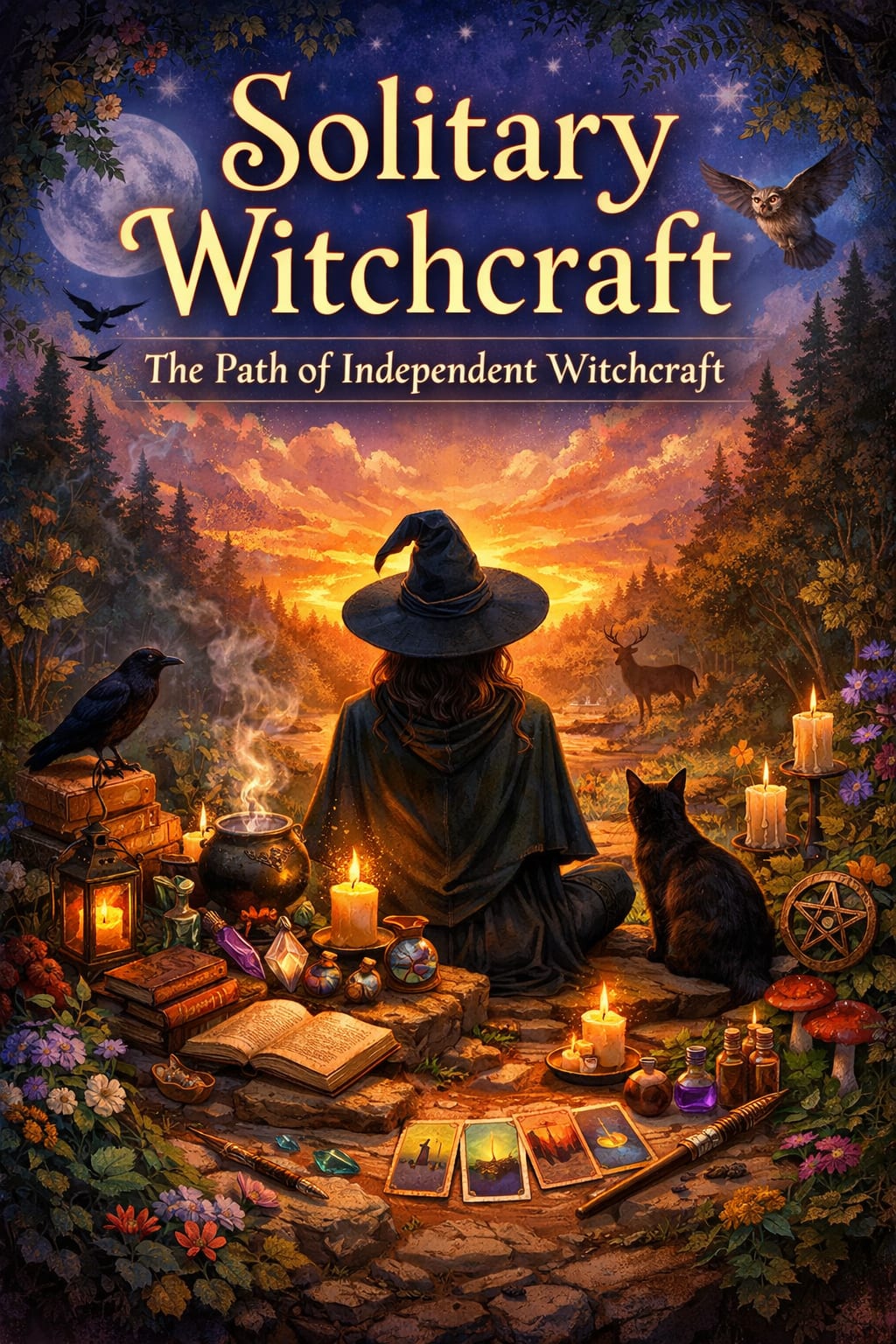
Foundations of the Solitary Witchcraft Tradition
Witchcraft is a spiritual and magical practice shaped by both inherited tradition and direct personal experience. Archaeological, historical, and folkloric records demonstrate that magical practice existed long before formal religious institutions, often carried out by individuals working outside centralized authority. Healers, cunning folk, seers, midwives, and charmers operated within local communities, relying on observational knowledge of nature, seasonal cycles, herbal lore, and spiritual symbolism. These practitioners frequently worked alone or within family lines rather than organized religious groups, establishing a historical precedent for independent magical practice.
The Solitary Witch emerges from this lineage of self-directed spirituality. Solitary witchcraft is defined not by isolation from knowledge or tradition, but by the absence of formal coven hierarchy and initiatory dependency. Authority within the practice is derived from study, experience, and personal accountability rather than rank or group validation. Historical witchcraft accusations from early modern Europe often centered on individuals rather than collectives, reinforcing the reality that magical practice has long been associated with solitary figures embedded within daily life rather than ceremonial assemblies.
Modern solitary witchcraft developed alongside the revival of Paganism and Wicca during the twentieth century. While early Wiccan traditions emphasized coven structure and lineage-based initiation, increasing access to published material allowed independent practitioners to engage deeply with ritual, theology, and magical technique. Authors such as Scott Cunningham documented solitary practice as a legitimate and complete spiritual path, grounded in ethics, ritual discipline, and reverence for nature. Scholarly studies of contemporary Paganism confirm that solitary practitioners represent a significant portion of modern witches, often motivated by geographic limitations, privacy concerns, spiritual autonomy, or philosophical preference.
Solitary witchcraft is sustained through rigorous self-education, experiential learning, and conscious relationship with the natural world. Seasonal observance, lunar cycles, planetary timing, and elemental symbolism form the backbone of many solitary practices, reflecting cosmological frameworks documented across European, Mediterranean, and Near Eastern magical traditions. Rather than diminishing depth, solitary practice often demands greater precision, reflection, and discernment, as progress depends entirely on personal integrity and consistency.
The enduring presence of solitary witchcraft across cultures and centuries demonstrates its resilience and legitimacy as a spiritual path. Rooted in history yet adaptable to contemporary life, solitary practice continues to serve as a means of spiritual exploration, magical discipline, and connection to ancestral modes of knowledge grounded in land, cycle, and conscious intent.
Defining the Solitary Witch
A Solitary Witch is a practitioner of witchcraft who conducts spiritual and magical work independently, without formal affiliation to a coven, lodge, or initiatory group. This mode of practice is characterized by self-directed study, individually constructed ritual, and direct accountability for ethical and spiritual development. Solitary witchcraft exists across multiple traditions, including Wiccan, Pagan, folk magical, and eclectic systems, and cannot be reduced to a single theological framework or ritual style.
Within modern Pagan and Wiccan discourse, the term “Solitary Witch” developed as a practical distinction rather than a hierarchical one. Organized Wiccan traditions often rely on coven structure, degree systems, and lineage-based initiation. Solitary practitioners, by contrast, engage with the same cosmological concepts and ritual technologies without reliance on group authority or inherited rank. Scholarly studies of contemporary Paganism confirm that solitary practitioners represent a substantial portion of modern witches, reflecting both historical precedent and modern accessibility to published magical knowledge.
Historically, solitary practice aligns closely with the role of the village wise person, cunning folk, or folk healer. Across Europe, the British Isles, and parts of the Mediterranean, magical specialists operated independently, offering charms, healing remedies, protective magic, and divinatory services. Knowledge transmission occurred through apprenticeship, family inheritance, or experiential observation rather than codified religious institutions. These practitioners often existed at the margins of accepted religion while remaining integral to community survival and spiritual life.
The modern solitary witch continues this tradition of independence while adapting to contemporary conditions. Geographic isolation, lack of access to established covens, concerns over privacy, and philosophical commitment to autonomy all contribute to the growth of solitary practice. Advances in publishing during the twentieth century, particularly within Pagan and occult literature, made structured magical instruction accessible outside closed initiatory systems. This shift allowed solitary practitioners to engage with ritual theory, seasonal observance, magical ethics, and deity work with a high degree of sophistication.
Solitary witchcraft is not defined by rejection of communal practice. Many solitary witches participate in broader Pagan communities through festivals, study groups, or online scholarship while maintaining an independent ritual life. The defining characteristic lies in the assumption of full responsibility for spiritual progression, magical competence, and ethical accountability. Rituals performed alone demand clarity of intention, disciplined focus, and sustained reflection, as collective energy and external validation are absent.
Direct engagement with magical tools, spiritual forces, and symbolic systems forms the core of solitary practice. Altars, ritual spaces, divinatory tools, and seasonal rites are shaped through personal research and lived experience. Deities, spirits, or natural forces are approached through individually established relationships grounded in study, respect, and consistency. This direct engagement fosters a deeply internalized spiritual discipline rooted in awareness, intentionality, and continuous refinement.
The solitary witch embodies a model of witchcraft that is historically grounded, intellectually rigorous, and adaptable across cultures and eras. Independent practice affirms that witchcraft does not require institutional authority to achieve depth, meaning, or legitimacy. Instead, it rests on dedication to learning, respect for tradition, and disciplined engagement with the unseen structures that have shaped magical practice for centuries.
Historical Foundations of Solitary Practice
The roots of solitary witchcraft extend deep into human history, long before the emergence of formal religious institutions or organized magical orders. Archaeological and historical evidence demonstrates that magical and spiritual practices were integral to early societies, often embedded within daily survival, agriculture, healing, and cosmological understanding. In pre-Christian Europe, the British Isles, and parts of the ancient Mediterranean world, magical knowledge was closely tied to land, season, and ancestry. Individuals skilled in herbal medicine, divination, spirit appeasement, and protective magic frequently operated outside centralized authority, serving communities through practical and spiritual expertise.
Pre-Christian folk traditions across Celtic, Germanic, Slavic, and Mediterranean cultures relied heavily on independent practitioners. These figures were often known as wise women, cunning folk, seiðr workers, or village healers, depending on region. Magical knowledge was transmitted orally, through observation, or via apprenticeship rather than through codified religious doctrine. This decentralized transmission fostered individualized methods while maintaining shared symbolic systems such as lunar timing, elemental forces, and sacred geography. Solitary practice was not considered unusual within these societies; it represented the dominant model of magical engagement.
During the medieval and early modern periods, solitary magical practitioners continued to exist despite increasing pressure from ecclesiastical and legal authorities. Trial records from Europe frequently reference individuals accused of witchcraft acting alone rather than within organized groups. Historical scholarship confirms that many accusations were directed toward healers, midwives, and herbalists whose knowledge operated outside sanctioned religious frameworks. These records further illustrate that solitary magical practice remained widespread, adaptive, and embedded within local culture rather than formalized institutions.
The Renaissance introduced new layers to solitary practice through the development of occult philosophy and ceremonial magic. Figures such as Marsilio Ficino, Heinrich Cornelius Agrippa, and later Paracelsus contributed written systems that combined astrology, Hermetic philosophy, Kabbalistic symbolism, and natural magic. Although some ceremonial traditions required lodges or orders, much of this work was conducted privately through study, ritual experimentation, and personal discipline. The solitary magician emerged as a scholar-practitioner, engaging deeply with cosmology and metaphysical structure through independent inquiry.
The nineteenth and early twentieth centuries saw the formation of esoteric societies such as the Hermetic Order of the Golden Dawn, which emphasized graded initiation and group ritual. While these organizations influenced modern magical thought, independent practice continued alongside them. Many practitioners studied published materials without formal membership, adapting techniques to personal spiritual frameworks. This period laid the groundwork for the modern revival of witchcraft by preserving ritual forms, symbolic systems, and magical theory accessible through written texts.
Modern Wicca, introduced publicly in the mid-twentieth century through the writings of Gerald Gardner, formalized a coven-based initiatory structure that emphasized lineage, degree progression, and shared ritual. While this system became influential, solitary practice never disappeared. Early Wiccan history itself contains evidence of practitioners working alone due to geographic limitations, secrecy, or personal preference. Solitary witchcraft existed concurrently, drawing from the same mythological and ritual foundations without dependence on formal initiation.
The latter half of the twentieth century marked a significant shift in accessibility. Authors such as Scott Cunningham articulated solitary witchcraft as a complete and legitimate spiritual path. Cunningham’s work emphasized ethical responsibility, seasonal observance, and personal devotion, presenting witchcraft as a living tradition adaptable to individual circumstances. Academic institutions and religious studies programs later documented the rise of solitary practitioners as a defining characteristic of contemporary Paganism, confirming the historical continuity of independent practice.
Solitary witchcraft stands as a convergence of ancient folk tradition, Renaissance occult scholarship, and modern spiritual autonomy. Its historical foundations demonstrate that independent magical practice is neither a modern deviation nor a secondary alternative. Instead, solitary practice represents one of the oldest and most enduring expressions of witchcraft, shaped by land, necessity, scholarship, and sustained personal dedication across centuries.
Core Principles of Solitary Witchcraft
Solitary witchcraft encompasses a wide spectrum of belief systems, ritual styles, and cosmological frameworks. Independent practitioners may align with Wiccan theology, folk magic traditions, animistic spirituality, ceremonial magic, or eclectic synthesis informed by multiple sources. Despite this diversity, solitary witchcraft is unified by a set of core principles that define its structure, discipline, and philosophical orientation. These principles are consistently documented within historical practice, modern Pagan scholarship, and practitioner accounts, forming the ethical and functional foundation of the solitary path.
Personal Responsibility and Accountability
Personal responsibility stands at the center of solitary witchcraft. Without the guidance of a coven hierarchy or initiatory oversight, every aspect of spiritual and magical development rests upon individual accountability. Study, ritual execution, ethical decision-making, and evaluation of magical outcomes must be conducted with intellectual honesty and discernment. This responsibility extends beyond spellwork into areas such as source evaluation, historical literacy, and ethical reflection.
Historically, independent magical practitioners were expected to maintain competence through observation, apprenticeship, and lived experience. That expectation persists within modern solitary practice. Progress is measured through consistency, discipline, and the ability to integrate knowledge into effective and ethical action. This principle cultivates a rigorous approach to learning that values depth over novelty and experience over imitation.
Autonomy of Practice and Ritual Design
Autonomy is a defining feature of solitary witchcraft. Rituals, devotional practices, and magical workings are designed according to personal research, spiritual alignment, and environmental context rather than standardized group liturgy. This freedom allows solitary practitioners to construct meaningful observances aligned with seasonal cycles, planetary timing, ancestral traditions, or personal symbolism.
Autonomous practice does not imply disorder or lack of structure. Many solitary witches adopt established ritual frameworks drawn from Wiccan, ceremonial, or folk traditions and adapt them through careful modification. The absence of enforced conformity encourages experimentation while reinforcing the need for methodical documentation and refinement. Over time, this process results in a highly personalized system grounded in lived practice rather than borrowed authority.
Intuition and Experiential Knowledge
Intuition plays a critical role within solitary witchcraft, functioning as both a spiritual compass and a method of interpretation. Without external validation from a group, intuitive perception becomes essential for assessing ritual effectiveness, spiritual communication, and symbolic resonance. This reliance on intuition aligns with historical magical traditions that emphasized direct experience and personal revelation.
Intuitive development within solitary practice is cultivated through meditation, divination, dreamwork, and close observation of natural cycles. These practices support the refinement of perception while maintaining balance with scholarly research and critical thinking. Intuition is treated not as infallible insight, but as a skill developed through discipline, reflection, and repeated engagement with symbolic systems.
Adaptability and Evolution of Practice
Solitary witchcraft is inherently adaptive. The absence of rigid doctrine or lineage-bound requirements allows independent practitioners to integrate multiple systems of magic and spirituality. Herbalism, astrology, spirit work, energy manipulation, and divination are often combined into cohesive practices shaped by ongoing study and lived results.
This adaptability reflects historical precedent. Folk magical traditions evolved continuously in response to environmental change, cultural exchange, and available resources. Modern solitary practice mirrors this dynamic process, allowing techniques and beliefs to evolve as understanding deepens. Adaptability ensures longevity within the practice, preventing stagnation and encouraging thoughtful innovation grounded in tradition.
Engagement with Nature and Cyclical Awareness
A sustained relationship with the natural world forms a cornerstone of solitary witchcraft. Seasonal transitions, lunar phases, weather patterns, and ecological rhythms inform both ritual timing and spiritual worldview. This engagement reflects ancient agricultural calendars and cosmological systems that recognized humanity as part of an interconnected natural order.
Solitary witches often observe seasonal festivals, lunar cycles, and elemental symbolism through ritual, meditation, and daily awareness. These practices foster alignment with natural rhythms while reinforcing attentiveness to change, growth, decay, and renewal. Nature is not approached as an abstract concept but as an active participant in magical and spiritual work.
The core principles of solitary witchcraft establish a framework rooted in responsibility, autonomy, intuition, adaptability, and ecological awareness. Together, these principles form a disciplined and historically grounded path that supports sustained spiritual development without reliance on institutional authority.
Key Terms and Concepts in Solitary Witchcraft
Solitary witchcraft draws on centuries of magical tradition, folklore, and modern Paganism, creating a rich vocabulary that supports study, ritual, and personal reflection. Understanding these terms strengthens comprehension of magical practice, ethical frameworks, and symbolic systems, allowing practitioners to engage more deeply with both theory and lived experience. Many concepts in solitary witchcraft originate from historical folk practices, pre-Christian European traditions, and contemporary adaptations, reflecting both continuity and innovation in magical work.
The concept of sacred space is central to independent practice. Altars serve as focal points for ritual, meditation, and spellwork, often incorporating tools, candles, offerings, or symbolic representations of deities and elemental forces. Circle casting is frequently used to create boundaries between ordinary awareness and ritual consciousness, establishing focus and protection during magical work. Practitioners often call the four cardinal directions or elemental energies to strengthen the ritual environment, aligning personal intention with universal forces.
Correspondences provide a symbolic framework that links physical objects, natural phenomena, and metaphysical concepts to magical intent. Herbs, stones, colors, planetary timing, and lunar phases are commonly employed to amplify focus and manifest desired outcomes. Similarly, spellcraft is grounded in intention, preparation, and ethical reflection. Spells address a variety of purposes, including protection, healing, clarity, and personal transformation, while careful attention to correspondences, timing, and outcomes enhances effectiveness. Keeping a Book of Shadows allows solitary witches to document rituals, spells, divination results, and personal reflections, creating a living record that supports growth, refinement, and continuity of practice.
Divination is another central practice in solitary witchcraft. Tools such as tarot cards, runes, pendulums, and scrying mirrors provide symbolic languages that facilitate insight, reflection, and decision-making. These methods are closely intertwined with inner work, meditation, dream journaling, and shadow exploration, all of which strengthen self-knowledge, intuition, and spiritual discernment. Ethical development is intertwined with these practices, as careful attention to intention, consequence, and personal responsibility underpins effective magical work.
Seasonal and cyclical awareness is foundational to many solitary witches. Observance of lunar phases and the Wheel of the Year supports attunement to natural rhythms, fostering alignment between personal practice and environmental cycles. Seasonal festivals, or Sabbats, mark transitions in agricultural and solar cycles, encouraging reflection, celebration, and ritual engagement. Elements such as Earth, Air, Fire, Water, and Spirit are understood as active forces within magical work, while grounding and centering techniques cultivate energetic stability, focus, and alignment during ritual or meditative practices.
Finally, solitary witchcraft emphasizes personal autonomy, self-directed learning, and integration of diverse magical systems. Concepts such as syncretism, animism, and intuitive development highlight the adaptability and experiential nature of independent practice. Familiars, whether physical or spiritual, are valued as guides or protectors, while sigils serve as symbolic tools for manifestation. Together, these concepts provide the vocabulary and framework necessary to approach solitary witchcraft with depth, clarity, and intentionality, supporting both ethical and effective magical work.
Common Practices in Solitary Witchcraft
Solitary witchcraft is expressed through a wide range of practices shaped by historical precedent, environmental context, and individual spiritual orientation. While no single method defines independent practice, certain activities appear consistently across traditions and time periods. These practices support ritual discipline, magical effectiveness, and sustained spiritual development, forming the practical foundation of solitary witchcraft.
Ritual Design and the Creation of Sacred Space
The establishment of sacred space is a fundamental practice within solitary witchcraft. Sacred space functions as a boundary between ordinary awareness and ritual consciousness, allowing focused engagement with spiritual and symbolic forces. This space may take the form of a permanent altar within a private residence, a temporary ritual setup, or an outdoor location aligned with seasonal or elemental significance.
Ritual design within solitary practice reflects a synthesis of study and personal symbolism. Candles, incense, ritual tools, offerings, and directional orientation are selected according to cosmological understanding and magical intent. Many solitary practitioners incorporate meditation, breath control, chanting, or visualization to establish altered states of awareness necessary for effective magical work.
Traditional Wiccan ritual frameworks, including circle casting, elemental invocation, and deity acknowledgment, are frequently adapted for individual use. These structures provide continuity with historical and contemporary Pagan practice while allowing flexibility in execution. Modifications often arise from spatial limitations, theological orientation, or ecological considerations, reinforcing the adaptive nature of solitary ritual design.
Spellwork and Applied Magic
Spellcraft represents one of the most recognizable aspects of solitary witchcraft. Spells are constructed as intentional acts of symbolic communication, combining focused will with material correspondences. Protection, healing, prosperity, clarity, and personal transformation are among the most commonly addressed objectives. Historical grimoires, folk traditions, and modern instructional texts provide frameworks for spell construction while emphasizing the importance of clarity and precision.
Correspondence systems form the backbone of effective spellwork. Herbs, stones, colors, planetary hours, lunar phases, and elemental associations are selected based on documented magical symbolism and experiential results. Solitary practitioners often maintain detailed records of spell components, timing, and outcomes. This documentation supports refinement of technique and development of deeper understanding of magical causality.
Ethical consideration is integral to solitary spellcraft. Without external oversight, careful evaluation of intention and potential consequence becomes essential. Many practitioners adopt ethical guidelines informed by Wiccan, folk, or philosophical principles, ensuring that magical practice remains aligned with responsibility and restraint.
Divination and Inner Work
Divination serves both predictive and reflective functions within solitary witchcraft. Tools such as tarot cards, runes, scrying mirrors, pendulums, and oracle systems provide structured symbolic languages through which insight is accessed. Historically, divination has been central to magical practice, offering guidance for decision-making, ritual timing, and spiritual development.
In solitary practice, divination is closely linked to inner work. Interpretation relies on intuitive perception supported by symbolic literacy rather than group consensus. Practices such as meditation, trance work, and dream journaling deepen self-awareness and enhance symbolic interpretation. These methods foster an ongoing dialogue between conscious intention and subconscious insight.
Inner work extends beyond divination into shadow exploration, emotional integration, and spiritual self-assessment. Solitary witches often engage in reflective practices that examine belief systems, personal limitations, and patterns of behavior. This internal focus strengthens magical efficacy by aligning intention with psychological and emotional clarity.
Seasonal Observance and Cyclical Alignment
Seasonal observance anchors solitary witchcraft within natural and cosmological cycles. Many practitioners follow the Wheel of the Year, a cycle of eight festivals that mark agricultural transitions and solar movement. These festivals, commonly referred to as Sabbats, originate from a blend of pre-Christian European seasonal observances and modern Pagan synthesis.
Solitary celebration of seasonal festivals emphasizes attunement to environmental change rather than elaborate ceremony. Rituals may include offerings, symbolic acts of renewal, meditation on seasonal themes, or practical engagement with land and weather. Lunar observance also plays a significant role, with full moons and new moons serving as focal points for magical work and reflection.
Through consistent engagement with seasonal and lunar cycles, solitary witchcraft fosters awareness of time as a living process rather than a linear abstraction. This cyclical alignment reinforces connection to land, body, and spiritual rhythm, grounding magical practice in observable natural reality.
Common practices within solitary witchcraft demonstrate a balance between tradition and innovation. Ritual, spellcraft, divination, and seasonal observance function as interconnected disciplines that support sustained spiritual growth, ethical awareness, and effective magical practice within an independent framework.
Challenges and Rewards of Solitary Practice
Solitary witchcraft offers a deeply independent spiritual framework, yet this independence carries distinct challenges alongside its benefits. Historical accounts, contemporary scholarship, and practitioner testimony consistently illustrate that the solitary path requires resilience, intellectual rigor, and sustained commitment. At the same time, it provides opportunities for profound growth and spiritual depth that are uniquely shaped by self-directed practice.
Challenges of Solitary Witchcraft
Self-discipline is one of the most significant demands placed upon solitary practitioners. Without scheduled coven meetings, external accountability, or formal mentorship, progress depends entirely on consistency and personal motivation. Study of magical theory, ritual practice, and historical context must be pursued independently, requiring careful evaluation of sources and sustained engagement over time.
Ethical navigation presents another challenge. Group traditions often provide shared ethical frameworks, ritual safeguards, and corrective feedback. In solitary practice, ethical decision-making rests solely on individual discernment. Practitioners must evaluate intention, consequence, and responsibility without external validation. This necessitates a strong foundation in critical thinking, philosophical reflection, and historical understanding of magical ethics.
Isolation can also emerge as a practical concern. Solitary practice does not inherently imply social withdrawal, yet the absence of regular communal ritual may limit opportunities for shared discussion or experiential comparison. Academic studies of modern Paganism note that many solitary witches seek balance through reading groups, conferences, or scholarly engagement while maintaining independent ritual work.
Debate regarding legitimacy has historically surrounded solitary practice, particularly within initiatory Wiccan traditions that emphasize lineage and degree structure. Some traditionalists argue that coven initiation confers authenticity through transmission of ritual knowledge. However, respected publishers, educators, and scholars within Pagan studies affirm that self-initiation and independent study represent valid spiritual expressions. Works published through established Pagan presses, including Llewellyn, document solitary witchcraft as a complete and functional path grounded in ethical practice and historical continuity.
Rewards of Solitary Witchcraft
The rewards of solitary practice are closely tied to its challenges. Independence fosters deep personal accountability, resulting in a strong sense of ownership over spiritual development. Progress achieved through self-study and experimentation often leads to confidence grounded in experience rather than external affirmation.
Spiritual autonomy allows for the creation of practices that are both meaningful and sustainable. Rituals, devotional activities, and magical workings can be adapted to life circumstances, environmental conditions, and evolving understanding. This flexibility supports long-term engagement without the constraints of fixed schedules or standardized liturgy.
Solitary witchcraft also encourages lifelong learning. Independent practitioners frequently engage with historical texts, academic research, folklore, and comparative religious studies to refine understanding. This ongoing inquiry deepens appreciation for the cultural and historical dimensions of witchcraft while strengthening practical competence.
Perhaps the most profound reward lies in the depth of spiritual connection cultivated through solitary practice. Direct engagement with ritual, symbolism, and natural cycles fosters an intimate relationship with magical processes and spiritual insight. This connection, developed through sustained attention and disciplined practice, affirms solitary witchcraft as a path of substance, resilience, and enduring relevance.
Recommended Reading: #commissionearned
Wicca: A Guide for the Solitary Practitioner by Scott Cunningham
First published in the late twentieth century, this book marked a turning point in how solitary witchcraft was understood within modern Paganism. The text presents Wicca as a complete spiritual system that does not require coven initiation to be meaningful or effective. Ritual structure, seasonal festivals, deity concepts, and ethical considerations are explained with clarity and respect for both tradition and personal experience. Nature-centered spirituality forms the backbone of the work, emphasizing observation of seasonal change and direct engagement with the natural world. Practical guidance is paired with philosophical grounding, encouraging thoughtful adaptation rather than strict replication. The book remains especially relevant to solitary practitioners seeking structure without hierarchy. Its themes of autonomy, responsibility, and ecological awareness closely reflect the foundations discussed throughout this blog.
Solitary Witch: The Ultimate Book of Shadows for the New Generation by Silver RavenWolf
Designed to function as both instructional manual and personal reference, this expansive volume mirrors the way many solitary witches organize their practice. The book blends spellwork, ritual outlines, magical correspondences, and ethical discussions into a format that encourages documentation and reflection. Emphasis is placed on personal safety, discernment, and accountability, addressing challenges commonly faced by independent practitioners. The eclectic approach reflects the adaptable nature of solitary witchcraft, drawing from multiple traditions while maintaining internal coherence. Practical sections are balanced with explanations of symbolism and intent, reinforcing disciplined practice over impulse. This book supports the blog’s exploration of adaptability, spellcraft, and self-directed learning. Its enduring popularity reflects its usefulness as a working resource rather than a purely theoretical text.
Wicca for One: The Path of Solitary Witchcraft by Raymond Buckland
This work approaches solitary witchcraft with a structured and methodical tone, appealing to readers who value clarity and discipline. Ritual design, divination, dreamwork, and seasonal observance are presented as interconnected practices requiring consistency and reflection. The text emphasizes study as a continuous process, encouraging careful evaluation of results rather than reliance on belief alone. Ethical responsibility is treated as foundational rather than optional, reinforcing the seriousness of independent magical work. The book aligns closely with the blog’s discussion of personal accountability and ritual precision. Its practical exercises support long-term development rather than short-term experimentation. This approach positions solitary practice as a mature and sustainable spiritual path.
Solitary Witchcraft: A Modern Guide to Walking the Witch’s Path Alone by Monique Joiner Siedlak
Contemporary concerns such as spiritual fatigue, isolation, and information overload are addressed thoughtfully within this guide. The book frames solitary witchcraft as an integrated part of daily life rather than an activity confined to formal ritual. Topics include altar creation, intuitive development, energy awareness, and elemental work, all presented in a practical and accessible manner. Reflection and mindfulness are emphasized as tools for maintaining balance and clarity. This perspective complements the blog’s focus on lived practice and experiential learning. The modern tone makes the book particularly relevant for solitary witches navigating present-day environments. Its emphasis on sustainability reinforces the long-term rewards of independent practice.
Witch Alone: The Essential Guide for the Solo Practitioner of the Magical Arts by Marian Green
A reflective and contemplative work, this book explores solitary witchcraft as a path of personal power developed through patience and self-awareness. Historical context is woven into practical exercises that emphasize symbolism, visualization, and relationship with place. The text encourages depth over speed, urging readers to cultivate understanding rather than accumulate techniques. Inner development is treated as central to magical effectiveness, aligning with long-standing traditions of solitary practice. This approach mirrors the blog’s discussion of intuition and inner work as foundational skills. The book speaks to practitioners seeking meaning through disciplined attention rather than external validation. Its tone reinforces the maturity and seriousness of solitary magical work.
Folk Witchcraft: A Guide to Lore, Land, & the Familiar Spirit by Roger J. Horne
Rooted in folklore and animistic worldview, this book situates solitary witchcraft within land-based tradition. Emphasis is placed on developing respectful relationships with spirits, landscape, and ancestral memory. Historical sources and ethnographic material provide context for practices that existed long before modern Pagan revival. The absence of rigid hierarchy reflects the decentralized nature of folk magic traditions. This perspective supports the blog’s examination of historical foundations and nature-centered practice. The book offers an alternative to standardized ritual systems, highlighting regional specificity and lived experience. Its focus on land and spirit reinforces the enduring relevance of solitary practice.
Solitary Wicca For Life: Complete Guide to Mastering the Craft on Your Own by Arin Murphy-Hiscock
This book frames solitary Wicca as a lifelong spiritual discipline rather than an introductory phase. Attention is given to long-term practice, ethical maturity, and emotional resilience. Daily devotion, energy management, and adaptable ritual habits are presented as essential components of sustained independent work. The text emphasizes balance between spiritual practice and personal well-being, addressing challenges often encountered over time. This approach complements the blog’s discussion of both challenges and rewards inherent to solitary practice. Focus on mastery reinforces the legitimacy of independent witchcraft as a complete path. The book speaks to practitioners committed to growth across all stages of life.
Lifelong Learning and Independent Exploration in Solitary Witchcraft
The practice of solitary witchcraft is inherently a path of ongoing study, experimentation, and personal refinement. Mastery is not achieved through a single text, ritual, or experience; it emerges from sustained engagement with both historical knowledge and lived practice. Understanding magical principles, ethical frameworks, seasonal observances, and symbolic systems requires consistent study and thoughtful reflection. Journaling rituals, tracking lunar and seasonal cycles, and documenting magical outcomes are essential methods for consolidating experience and deepening comprehension.
Independent research is equally vital. Exploring a broad range of sources, including historical grimoires, ethnographic studies, contemporary Pagan literature, and folklore collections, allows the practitioner to contextualize modern practice within centuries of magical tradition. Scholarly and practitioner-based works illuminate both the evolution of solitary witchcraft and the diversity of techniques and philosophies available to those working alone. Engaging critically with sources ensures that knowledge is interpreted thoughtfully and applied responsibly, rather than passively accepted.
Experiential practice provides another dimension of understanding. Ritual performance, divination exercises, energy work, and observation of natural cycles reinforce theoretical learning and cultivate intuitive skills. Reflecting on these experiences through journaling, meditation, and study promotes a continuous dialogue between observation, interpretation, and action. The combination of study, reflection, and practice forms the foundation for skillful, meaningful, and ethical magical work.
Participation in wider Pagan and magical communities, while maintaining an independent path, can also support growth. Workshops, lectures, seasonal gatherings, and mentorship opportunities provide exposure to diverse techniques and perspectives. Even brief interaction with other practitioners can introduce new methods, offer constructive feedback, and expand understanding of cultural and historical contexts. However, engagement with the broader community should complement rather than replace independent exploration and personal discernment.
Encouraging curiosity and personal initiative is central to the solitary path. Readers are urged to seek knowledge beyond this blog and the recommended texts. Comparing sources, testing techniques, and reflecting on personal experience allows solitary witches to cultivate practices that are authentic, adaptable, and deeply resonant. The journey of solitary witchcraft is one of both intellectual and spiritual development, rewarding sustained attention, reflection, and ethical engagement.
Ultimately, the study of solitary witchcraft is a lifelong endeavor. By combining rigorous research, reflective journaling, experiential practice, and critical evaluation, practitioners develop both proficiency and insight. This path fosters a deeply personal connection to magic, nature, and the unseen forces that shape spiritual life. Continued exploration and self-directed study ensure that each practitioner can navigate the complexities of solitary witchcraft with integrity, awareness, and enduring empowerment.
About the Creator
Marcus Hedare
Hello, I am Marcus Hedare, host of The Metaphysical Emporium, a YouTube channel that talks about metaphysical, occult and esoteric topics.
https://linktr.ee/metaphysicalemporium
Keep reading
More stories from Marcus Hedare and writers in BookClub and other communities.
The Eclectic Witch and Eclectic Witchcraft
A Living Tradition of Selection and Synthesis Witchcraft in the modern era exists as a living, adaptive spiritual current shaped by history, culture, and individual experience. Across the world, practitioners engage with systems that range from formally initiated traditions to solitary practices built through study and experimentation. Within this diverse landscape, Eclectic Witchcraft has emerged as a distinct and increasingly visible approach, defined not by lineage or dogma, but by intentional selection, adaptability, and personal responsibility.
By Marcus Hedare11 days ago in BookClub
7 Books Worth Carrying Into 2026
Not all books are meant to be finished and shelved. Some are meant to be carried forward—revisited, re-applied, and re-interpreted as we grow. These are the books that shape how we think, decide, lead, heal, and live. In a world overwhelmed by noise, fleeting trends, and surface-level advice, the books worth carrying into the future are those that offer timeless frameworks, deep insight, and practical wisdom we can return to again and again.
By Diana Meresc3 days ago in BookClub



Comments
There are no comments for this story
Be the first to respond and start the conversation.