

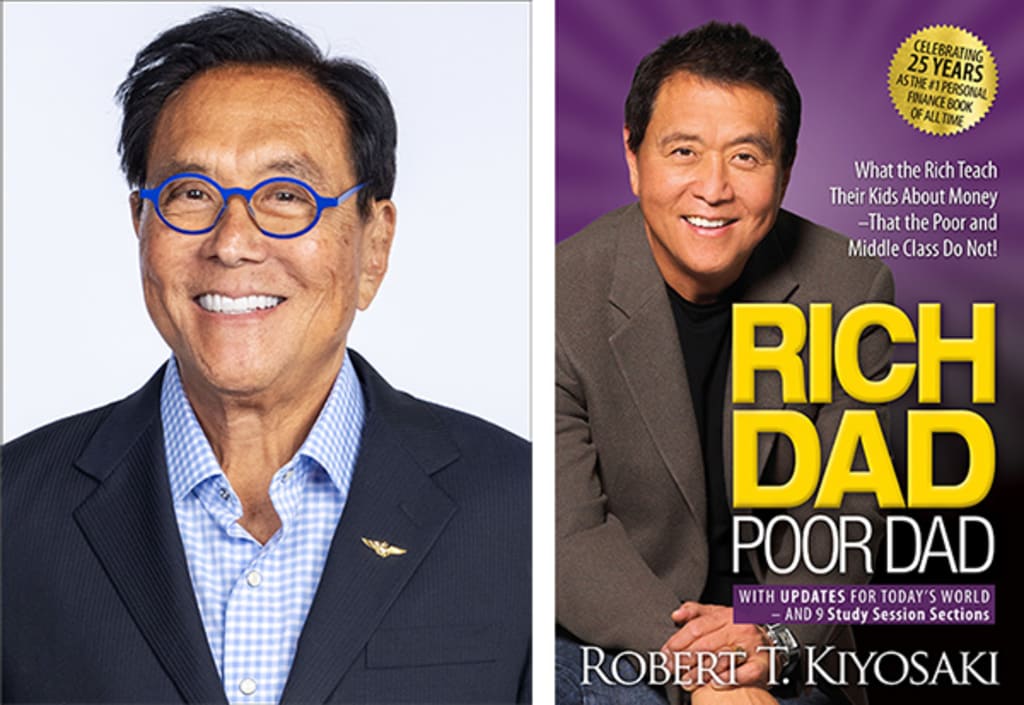
The personal finance classic "Rich Dad Poor Dad" by Robert Kiyosaki questions accepted ideas about money, wealth, and financial education. The book, which was first released in 1997, tells the story of Kiyosaki's two "dads": his best friend's father (referred to as "Rich Dad") and his biological father (referred to as "Poor Dad"). Kiyosaki teaches important lessons on how to achieve financial independence and accumulate wealth through their divergent philosophies and way of living.
Poor Dad vs. Rich Dad:
The first chapter of the book is an autobiographical reflection by Kiyosaki on his upbringing and the different financial outlooks of his two "dads."
- Poor Dad: Robert's biological father, also known as "Poor Dad," exemplifies the conventional way of thinking that emphasises working hard, obtaining a good education, and pursuing job security. He adheres to the conventional wisdom of going to school, doing well in school, landing a steady job, and saving for retirement using conventional strategies like a 401(k).
- Rich Dad: In contrast, "Rich Dad" (the father of his best friend) adopts a more unusual strategy for accumulating wealth. He places a strong emphasis on entrepreneurship, financial literacy, and the acquisition of passive income-producing assets. Rich Dad favours owning assets that put money in one's pocket over liabilities that take it out (like consumer debt), such as real estate, businesses, and investments.
Key Concepts and Lessons:
Kiyosaki introduces a number of crucial ideas and lessons that are crucial to his financial philosophy throughout the book:
- Financial Education: According to Kiyosaki, financial education is frequently overlooked in traditional education. In order to make wise financial decisions, he emphasises the value of learning about money, investing, and financial literacy.
- The Rat Race: The cycle of working for a paycheck, making ends meet, and trying to save for retirement is what Kiyosaki refers to as the "rat race". He exhorts readers to pursue financial independence in order to end this cycle.
- Assets vs. Liabilities: The distinction between assets and liabilities is Kiyosaki's main argument. He emphasises the significance of accumulating income-producing assets (like businesses or rental properties) while reducing liabilities (like credit card debt or pointless expenses).
- Entrepreneurship: Rich Dad advocates for it as a means of achieving financial success. He considers that owning and operating a business can give one more control over their financial future.
- Investing: Real estate, stocks, and starting or investing in businesses are just a few of the various investment vehicles covered in the book. Kiyosaki advises readers to educate themselves on these investment possibilities and look for opportunities that fit with their financial objectives.
- Mindset: The lessons of Rich Dad emphasise the value of developing a wealthy mindset and overcoming failure-related fears. He thinks that success in business requires taking calculated risks.
- Financial Independence: The idea of becoming financially independent, where your passive income exceeds your expenses and you can work only when you want to and not because you have to, is one that Kiyosaki emphasises.
Critiques and Controversies:
"Rich Dad Poor Dad" has received a lot of praise for its unconventional and inspirational financial advice, but it has also generated controversy and criticism. Some detractors claim that Kiyosaki's books lack specific, doable advice and that his emphasis on real estate and entrepreneurship may not be appropriate for all readers.
It has also been argued that "Rich Dad" and "Poor Dad" are composite characters or fictionalised representations rather than real people, which has led to questions about their identities.
Conclusion:
"Rich Dad Poor Dad" is a mindset-changing exploration of wealth-building principles rather than just a book about personal finance. Robert Kiyosaki urges readers to seek financial education, make wise investments, and embrace entrepreneurship. He challenges them to reevaluate their relationship with money. Although some people might find his theories controversial or unconventional, the book's enduring popularity is proof of its success in altering how people view money and wealth. "Rich Dad Poor Dad".
About the Creator
The Knowledge
Welcome to a virtual realm where the past, present, and future converge to unravel the mysteries of history, the wonders of science, and the treasure trove of general knowledge.
Reader insights
Good effort
You have potential. Keep practicing and don’t give up!
Top insight
Expert insights and opinions
Arguments were carefully researched and presented
Keep reading
More stories from The Knowledge and writers in BookClub and other communities.
1984
The dystopian novel "1984" by George Orwell examines the perverse effects of totalitarianism and the destruction of personal liberty in a desolate, authoritarian society. The story, which is set in the fictitious superstate of Oceania in the year 1984, centers on Winston Smith, a citizen who dared to revolt against the Party's repressive dictatorship under Big Brother.
By The Knowledge 2 years ago in BookClub
Rachel Reviews: Lakefront Wolves by Joseph Deegan
Meet Finn. He's an 18 year old kid who has potential. He's bright with great school scores and he's also an athlete, a footballer of some prowess. He has it all going for him, it would seem, and yet, he's determined to send what could be a well-planned, stable existence firmly off the rails. He drinks, he smokes, he takes drugs, he has violent tendencies and he's in danger of losing not only his mind but all that he holds dear.
By Rachel Deeming8 days ago in BookClub
Garrett Morgan
ORDER HERE In the long arc of American innovation, certain names blaze brightly across history, their ideas reshaping how entire societies operate. Yet among these extraordinary figures, few embodied creativity, courage, and practical foresight as completely as Garrett Augustus Morgan, an inventor whose work continues to influence daily life more than a century after he first began tinkering with his ideas. Known today for the gas mask precursor and the modern traffic signal, Morgan was much more than an inventor; he was a problem solver who possessed the rare ability to recognize trouble before it unfolded and build solutions that protected the public without fanfare or expectation.
By TREYTON SCOTT6 days ago in BookClub


Comments (1)
To be an entrepreneur is some feelings that come from inside and there are signs to recognize which often entrepreneurs bring with them. Start thinking creatively at night, with no sleep at night or light sleep. Listening to information and creating business out of what has been said or said establishes new income sources and businesses.