
Review: Jack Thorne’s Adaptation of Lord of the Flies Falls Short of the Original
The Guardian critiques the stage version, highlighting challenges in translating William Golding’s novel to modern performance


Introduction
Jack Thorne’s stage adaptation of Lord of the Flies has recently premiered, prompting literary and theatrical debate. William Golding’s 1954 novel is widely regarded as a classic, examining human nature, societal collapse, and the tension between civilization and savagery. Thorne, known for his adaptations and original work in theatre and television, sought to bring the story to contemporary audiences. However, critics argue that the stage version struggles to capture the novel’s psychological intensity and allegorical depth, leaving audiences with a version that is dramatically engaging but thematically muted.
Background: The Original Novel
Lord of the Flies tells the story of a group of boys stranded on an uninhabited island after a plane crash. As attempts to self-govern deteriorate, the boys descend into violence, revealing the darker aspects of human nature. Golding’s work is lauded for its exploration of morality, leadership, and the thin veneer of civilization.
Its status as a literary classic means that any adaptation faces the dual challenge of honoring the source material while making it accessible and compelling in a new medium.
Jack Thorne’s Adaptation
Thorne’s adaptation condenses Golding’s novel into a stage production intended for modern audiences. The play focuses on the plot’s external conflicts and group dynamics, highlighting dramatic moments such as confrontations between Ralph and Jack and the descent into chaos. Thorne has streamlined characters and scenes to fit stage constraints, emphasizing the visual and performative aspects of the story.
While these changes are necessary for stage performance, critics note that some of the psychological and philosophical nuance is lost in translation.
Strengths of the Stage Version
Several elements of Thorne’s adaptation have been praised. The staging uses minimalistic sets, lighting, and sound to evoke the isolation and tension of the island. These techniques create a sense of immediacy and atmosphere that engages the audience. Actors’ performances have also been highlighted for capturing the physicality and emotional volatility of the boys’ descent into disorder.
By focusing on tension, confrontation, and action, the adaptation delivers a compelling theatrical experience that can appeal to audiences unfamiliar with Golding’s novel.
Limitations in Conveying the Original Themes
Despite the visual and dramatic strengths, reviewers argue that Thorne’s adaptation struggles to convey the novel’s moral and philosophical depth. Golding’s exploration of inherent human savagery, the complexities of leadership, and the subtle social commentary on post-war England is difficult to replicate on stage.
Scenes that work well in a novel’s descriptive and reflective form often lose subtlety when reduced to dialogue and physical action.
Character Complexity and Development
In Golding’s novel, characters like Ralph, Jack, and Piggy are carefully constructed to represent broader social and psychological themes. Thorne’s adaptation condenses character arcs and, in some cases, simplifies motivations to maintain pacing and coherence.
As a result, characters sometimes feel more like archetypes than fully realized individuals, reducing the tension between personal choice and societal pressures that defines the original text.
Challenges of Adapting Literature to Stage
Adapting a novel as dense and thematically rich as Lord of the Flies presents inherent challenges. Stage adaptations must balance narrative clarity with dramatic engagement, often necessitating the omission or condensation of scenes. Symbolic and internalized elements, such as the boys’ psychological struggles, are difficult to convey visually and verbally without losing nuance.
The play’s focus on external conflict over internal reflection reflects this trade-off, illustrating a common difficulty in literary adaptation.
Comparisons With Previous Adaptations
Lord of the Flies has been adapted multiple times, including two feature films in 1963 and 1990. Comparisons with these versions indicate that each adaptation faces similar challenges in representing the novel’s psychological and allegorical content. Thorne’s stage version distinguishes itself with live performance elements, but critics note that the medium’s limitations prevent it from achieving the narrative depth found in film or literature.
Impact on Contemporary Audiences
While Thorne’s adaptation may not replicate the original novel’s power, it introduces Lord of the Flies to a new generation. For younger audiences or those unfamiliar with Golding’s work, the play provides a visual and emotional entry point into the story’s central ideas.
However, educators and literary purists caution that the stage version should be complemented with reading the novel to fully appreciate its themes.
Cultural and Educational Implications
Stage adaptations like Thorne’s serve an educational function by making classic literature more accessible. Schools and theatre programs may use the play to spark discussion about leadership, ethics, and human behavior. Even with thematic simplifications, the adaptation can encourage viewers to engage with difficult questions about morality and social order.
This approach aligns with broader goals of cultural education and public engagement with literature.
Critical Review From The Guardian
A review in The Guardian emphasizes the contrast between the adaptation and Golding’s original work. While acknowledging strong performances and production design, the review notes that the adaptation lacks the psychological intensity and symbolic weight that give the novel its enduring significance.
The critique suggests that while Thorne’s play is visually and theatrically engaging, it falls short of capturing the novel’s full literary impact.
Balancing Entertainment and Literary Fidelity
Thorne’s adaptation reflects the broader tension between entertainment and fidelity in literary adaptations. Maintaining narrative coherence, audience engagement, and stage feasibility often requires changes that affect thematic and philosophical content.
The Guardian review underscores this tension, highlighting how adaptation inevitably involves trade-offs between form and substance.
Conclusion and Bottom Line
Jack Thorne’s adaptation of Lord of the Flies offers a compelling theatrical experience, characterized by strong performances, dramatic staging, and engagement with conflict and tension. However, it falls short of capturing the original novel’s depth, moral complexity, and psychological intensity.
For audiences new to Golding, the play can serve as an introduction to the story’s basic narrative and themes. For those familiar with the novel, the adaptation may feel incomplete or simplified. Ultimately, the production highlights both the possibilities and limitations of adapting a literary classic for the stage, emphasizing that some elements of literature—particularly its internal reflection and moral ambiguity—are difficult to fully replicate in a live performance.
About the Creator
Saad
I’m Saad. I’m a passionate writer who loves exploring trending news topics, sharing insights, and keeping readers updated on what’s happening around the world.
Rachel Reviews: Lunch Tales: Teagan by Lucille Guarino
Well, I did enjoy this! Sometimes, all you need is just great storytelling and this is what Lucille Guarino delivers here. There's no big message to this book; it's just about folks and families, living their lives and coping with everything that's being thrown at them and finding their way. But when it's done well, like it is here, then you have characters to whom you can relate, tension which leaves you rooting for a better outcome, attraction which has your heart racing and an urge, as a reader, to see the characters happy with the people with whom they belong.
By Rachel Deeming9 days ago in BookClub
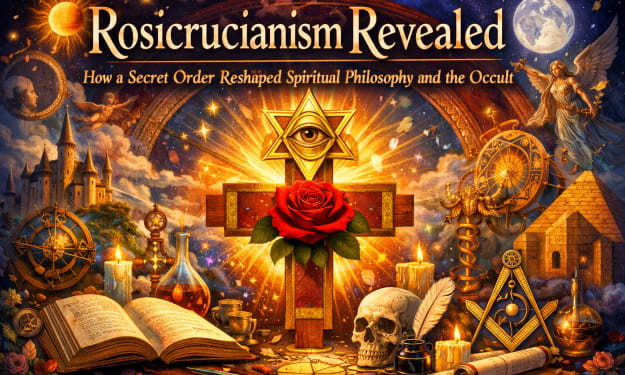
Rosicrucianism Revealed
The Enigmatic Rise of Rosicrucian Thought Rosicrucianism stands among the most compelling currents in Western esoteric history. The tradition occupies a distinctive position at the intersection of mysticism, philosophical speculation, symbolic language, and spiritual inquiry. Interest in Rosicrucianism has persisted for more than four centuries, fueled by cryptic manifestos, elaborate allegories, and a reputation for concealed wisdom transmitted through select circles of initiates. References to hidden brotherhoods, alchemical transformation, and spiritual illumination continue to attract scholars, historians of religion, and students of Western occult traditions.
By Marcus Hedare7 days ago in BookClub



Comments
There are no comments for this story
Be the first to respond and start the conversation.