
Review First Things First
Stephen R. Covey is an internationally respected leadership authority and founder of the Covey Leadership Center. He received his M.B.A. from Harvard and a doctorate from Brigham Young University, where he taught business management and organizational behaviour for 20 years. His book The 7 Habits of Highly Effective People has sold more than 10 million copies and has been translated into 30 languages.

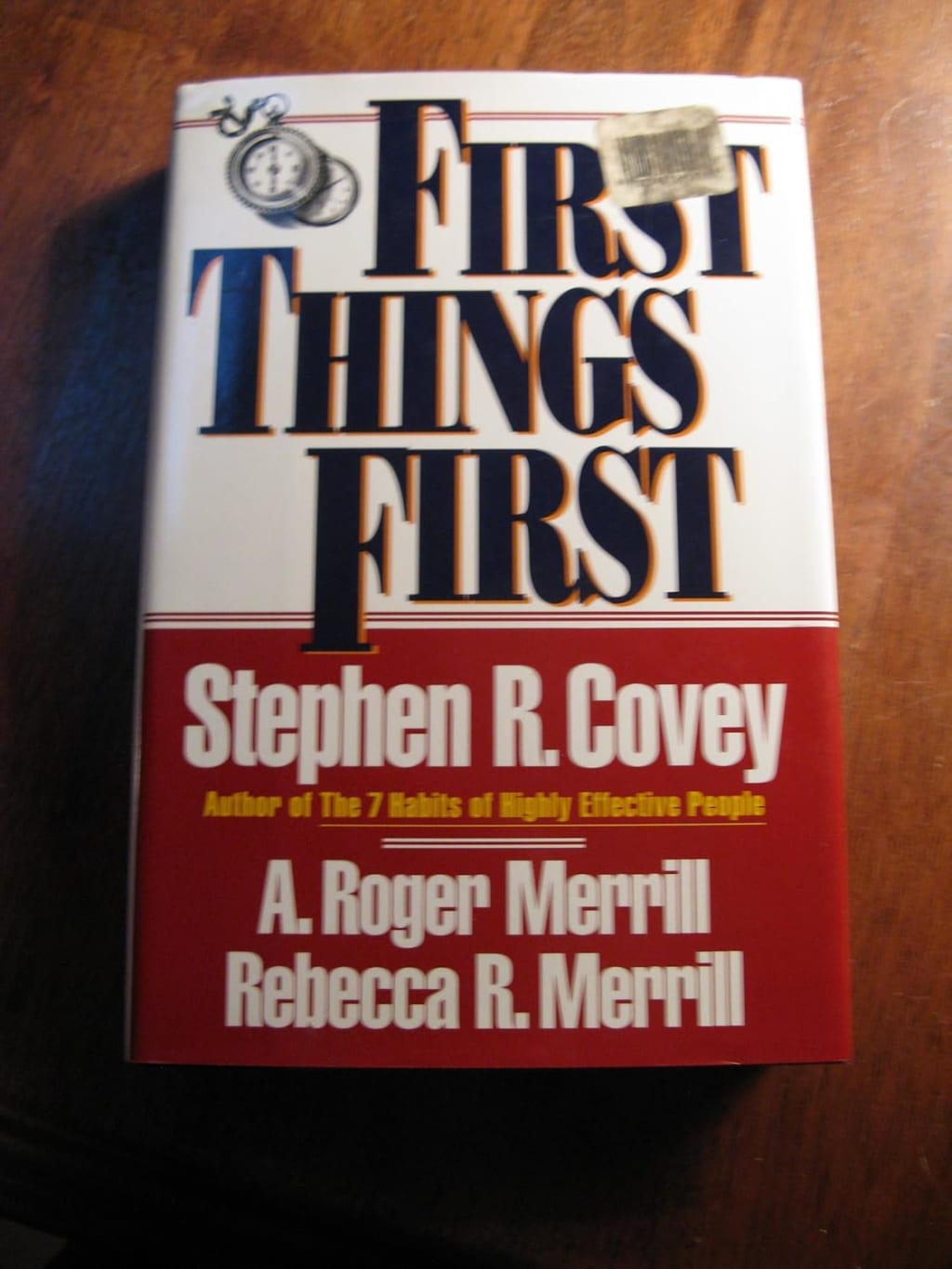
First Things First by Stephen R. Covey, with the assistance of A. Roger Merrill and Rebecca R. Merrill is a penetrating analysis of what it means to identify the things that should be done and do them, over and above merely identifying the things that need to be done and doing them. Developed from the principles laid down in The 7 Habits of Highly Effective People, this book turns the ladder from Urgency to Importance and guides individuals to make better choices in life – to manage their time, organize their goals and live their priorities.
Click here to read First Things First for free with a 30-day free trial.
Core Premise
The authors assert that the more popular approaches of TTMs disregard the essence of what one needs to achieve, in the overcrowding effort is to do more in less time. This introduces disparity between activities and goals, unhappiness and pressure.
Covey introduces the Time Management Matrix, dividing tasks into four quadrants based on urgency and importance:
Quadrant I: Important/Urgent: instances that are considered critical usually, severe problems in the organization.
Quadrant II: Can be Deferred but has to be done with high priority (e.g., creating a relationship, formal planning).
Quadrant III: High Priority Low Priority – Gets done when time permits ( interruptions, and non-critical activities).
Quadrant IV: It means it will never be urgent and it is not important in the least (e.g., distractions).
The path to success is found in spending as much time in Quadrant II as possible, which includes taking preventive actions, looking at the big picture and deciding what is really important in life.
Strengths of the Book
1. Transition From the Efficiency Model to the Effectiveness Model : The authors stress that life leads not from trying to pack more and more into the time but from making one’s activities consonant with his or her purpose. This philosophy has great applicability in a society that has come to celebrate busyness.
2. The Compass vs. the Clock : An appealing analogy, the compass looks at the goal and values as long-term goals, the clock is short-term focused on time management. The book that I am currently reading speaks a lot about aligning the two so that every step we take as a society counts towards the outcome of the vision.
3. Practical Tools : The book provides actionable steps, such as:
Creating a Personal Mission Statement: A resource for decision-making when facing choices in regard to a person s morality and belief system.
Weekly Planning: Replace the structural timetable with roles and objectives.
Win-Win Solutions: Introducing the notion and practice of cooperation and networking.
4. Holistic Perspective : It also discusses balance throughout the multiple aspects of life, physical, emotional, mental, spiritual and so forth, so it is useful for both personal and workplace development.
5. Stories and Case Studies : Information and examples from daily practice enable the audience to relate to the material and demonstrate its application in various fields.
Key Takeaways
Significance Over Urgency
Typically, what is most valuable is the work to which we are not automatically drawn and which in the short term is not likely to engage us but which will ultimately lead to greater success and satisfaction.
Delegation and Boundaries
The key priorities therefore require setting priorities to mean that one has to decline other less important calls on his time and abilities as well as delegate responsibilities.
Life Roles and Balance
The model of planning based on the roles assumed like parent, professional, and community member helps to focus on all the major aspects of life.
Integration of Family and Workplace
Such a realization of values creates harmony within the organization eliminating internal struggle and is truly satisfying.
What about you, is your lifestyle consistent with the core values?
Which thing for a person is most important and what is fleeting is the map that navigates actions, which leads to creating harmony within as well as the strength for handling trials.
Comparisons to Other Works
The 7 Habits of Highly Effective People
While Habit 3: Put First Things First explains where perspective and priority take place, it digs far deeper into the method for organizing one’s life and provides its stand-alone solution.
Getting Things Done by David Allen is the book we want to focus on in this case.
Covey’s strategy is centred around values and vision thus lacking the tactical aspect that Allen places ward working procedures.
Atomic Habits by James Clear
In both books, intentionality is proffered as the solution: Clear focuses on habit, Covet on values.
Essentialism by Greg McKeown
While First Things First adopts somewhat systematic planning, McKeown’s principle of working less but better merges well with First Things First but unlike the book, McKeown’s main emphasis is on eliminating distractions.
Potential Critiques
1. Abstract Concepts : The focus on values and mission statements, might be considered by some as theoretical and for that reason it doesn’t provide clear solutions for the instant needs of a business.
2. Repetition : It is possible for some readers to think of this as a repackaging of concepts brought out in The 7 Habits of Highly Effective People, although First Things First has a lot more details on certain ideas.
3. High-Level Focus : It is easy to derive profound and useful principles from them, though such principles may not contain detailed gasps on how to proceed when things get tough, which is not an issue with professional project management tools.
Personal Impact
Although the task of reading a passage does not usually evoke a change in paradigm, reading First Things First does. It provokes a reader into thinking whether he or she is in the middle of leading a meaningful life. The tools have a stabilizing effect, which works counter to the prevailing anxiety of a never-ending cycle of productivity.
Some observations on saying no and about managing boundaries are thought-provoking specifically for a person who might feel the impact of overload. By applying the principles, readers can get back the hours to do what brings the most joy in their lives.
Conclusion
First Things First is an introduction to a way of consciously taking command of our lives by organizing our lives around values rather than around emergencies. By reading this book, the readers are able to come up with a workable plan on how to take care of themself, the job, and their emotions.
Whether you want to be more productive, make it through the week without burning out, or live life on purpose, this book offers a map to do just that. It is the guide for those who want to leave the endless spinning hamster wheel of unfulfilling work and crowded schedules and turn their lives into a place where what matters is on top.
Click here to read First Things First for free with a 30-day free trial.
About the Creator
TAPHA
Hi! Whether you're looking for insightful answers or a fresh perspective on a topic,I'm here to provide engaging, accurate,and thought-provoking content tailored just for you. Stick around, and let's explore the world of knowledge together!
Rachel Reviews: Lakefront Wolves by Joseph Deegan
Meet Finn. He's an 18 year old kid who has potential. He's bright with great school scores and he's also an athlete, a footballer of some prowess. He has it all going for him, it would seem, and yet, he's determined to send what could be a well-planned, stable existence firmly off the rails. He drinks, he smokes, he takes drugs, he has violent tendencies and he's in danger of losing not only his mind but all that he holds dear.
By Rachel Deeming6 days ago in BookClub
7 Positive Thinking Books You Must Read In 2026
What if the way we think could fundamentally reshape the way we live? This question sits at the heart of positive thinking, a mindset that has transformed millions of lives across the world. From entrepreneurs and athletes to students and leaders, people who cultivate an optimistic outlook often demonstrate greater resilience, creativity, and success. The reason is simple: our thoughts influence our actions, our decisions, and ultimately our outcomes.
By Diana Meresca day ago in BookClub


Comments
There are no comments for this story
Be the first to respond and start the conversation.