
Reading Canada Reads: When The Pine Needles Fall
Canada Reads 2025


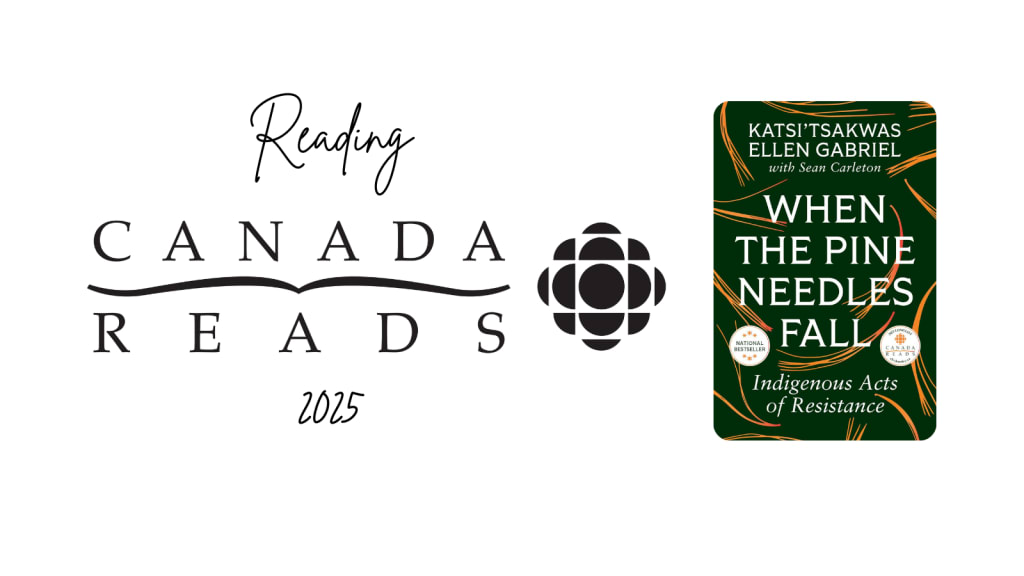
Welcome back to my Reading Canada Reads series, where I take you all along as I attempt to read as much of the Canada Reads longlist as I possibly can. This year’s theme: one book to change the narrative.
The third longlist book I finished was WhenThe Pine Needles fall, written by Katsi’tsakwas Ellen Gabriel with Sean Carleton.
“There have been many things written about Canada’s violent siege of Kanehsatà:ke and Kahnawà:ke in the summer of 1990, but When the Pine Needles Fall: Indigenous Acts of Resistance is the first book from the perspective of Katsi’tsakwas Ellen Gabriel, who was the Kanien’kehá:ka (Mohawk) spokesperson during the siege. When the Pine Needles Fall, written in a conversational style by Gabriel with historian Sean Carleton, offers an intimate look at Gabriel’s life leading up to the 1990 siege, her experiences as spokesperson for her community, and her work since then as an Indigenous land defender, human rights activist, and feminist leader.
More than just the memoir of an extraordinary individual, When the Pine Needles Fall offers insight into Indigenous language, history, and philosophy, reflections on our relationship with the land, and calls to action against both colonialism and capitalism as we face the climate crisis. Gabriel’s hopes for a decolonial future make clear why protecting Indigenous homelands is vital not only for the survival of Indigenous peoples, but for all who live on this planet.”
Rather than being structured in regular prose, this memoir is presented like the transcript of an interview between Carelton and Gabriel. Sean Carleton asks questions and provides context from academic sources relating to the Kanesatake Resistance and other moments in the Land Back movement while Katsi’tsakwas Ellen Gabriel responds with her memories of being a part of the movement. There were times when I personally found this format a little difficult to parse and I found it read a bit more like a textbook than a memoir, but I also appreciate that they were aiming to present the book as a conversation that is more reflective of the tradition of oral storytelling. Even when I was finding it a bit more of a slog to read, it was not so academic that I couldn’t grasp the information well. I read this one as an e-book and I think if I were to go back to it, I’d try to find an audiobook. I think it would work better for me if I heard the voices taking part in the conversation rather than reading a transcript.
Growing up in Canada and studying history and anthropology in university, I’ve heard quite a bit about the Kanesatake Resistance - or the “Oka Crisis”, as I more often heard it referred to. Like many events in history where settlers clash with indigenous communities, most of what I heard about it was from the government angle. While some of my professors in university did try to present more well rounded perspectives of the issue that centered the voices of the indigenous community, I think this account has provided me with a lot of details that I didn’t previously have. While my sympathies have long laid with the people defending their traditional territory, Gabriel’s memories of being part of the resistance added additional context to her people’s history, what led to the standoff, and her continued activism afterwards. In terms of the theme, “one book to change the narrative”, I think When The Pine Needles Fall is a nearly perfect embodiment of that. This book takes a well known event in Canadian history and reframes it from the other side, providing new insights and perspective on a story we’ve probably heard a hundred times. Because of this, I’m a little surprised this one didn’t make the shortlist. However, I will be reviewing a couple of shortlisted books next, so I’m excited to see how they stack up.
Rating: ⅘ Stars
Previous entries in this series:
About the Creator
Kelsey Clarey
She/Her/Fae/Faer. I live in Nova Scotia, Canada. I mostly write poetry and flash fiction currently, a lot of it fantasy/folklore/fairy tale inspired. I also like to do a lot of fiber arts and design TTRPGs.
https://linktr.ee/islanderscaper
Keep reading
More stories from Kelsey Clarey and writers in BookClub and other communities.
Rachel Reviews: Lakefront Wolves by Joseph Deegan
Meet Finn. He's an 18 year old kid who has potential. He's bright with great school scores and he's also an athlete, a footballer of some prowess. He has it all going for him, it would seem, and yet, he's determined to send what could be a well-planned, stable existence firmly off the rails. He drinks, he smokes, he takes drugs, he has violent tendencies and he's in danger of losing not only his mind but all that he holds dear.
By Rachel Deeming13 days ago in BookClub
7 Amazing Books to Read When You're Feeling Lazy
We all have those moments when life feels slow, energy is low, and the idea of tackling dense, heavy books feels impossible. Yet, even on our laziest days, reading can still be one of the most rewarding ways to spend time. The trick lies in choosing the right books—stories that are engaging without being exhausting, inspiring without being overwhelming, and comforting without feeling trivial.
By Diana Meresc4 days ago in BookClub


Comments (11)
Good work. It is strange to be Canadian, like books,...and not Cate for Canada Reads, but I applaud any effort to encourage other to read.
My impression is that Canada has a rich postmodern culture, with texts on identity, the environment, gender, and more. However, they still do not have a significant reach in countries like Brazil, partly due to the dominance of European and U.S. influence in the media and academia.
Thanks for this excellent review
Your review offers a thoughtful and well-rounded perspective on the book. Keep up the excellent work.
Nice!
Good work!
I will have to read some of the Canadian stories. Nice review.
Ok I definitely am adding this to my list!
This was a thoughtful and engaging review! Also, the audiobook idea? Genius—some stories just hit differently when spoken. Looking forward to your thoughts on the shortlisted books!
Nice review. I like that you are highlighting Canadian stories.
Nice work