
Marsilio Ficino
The Renaissance Philosopher Who Revived Plato

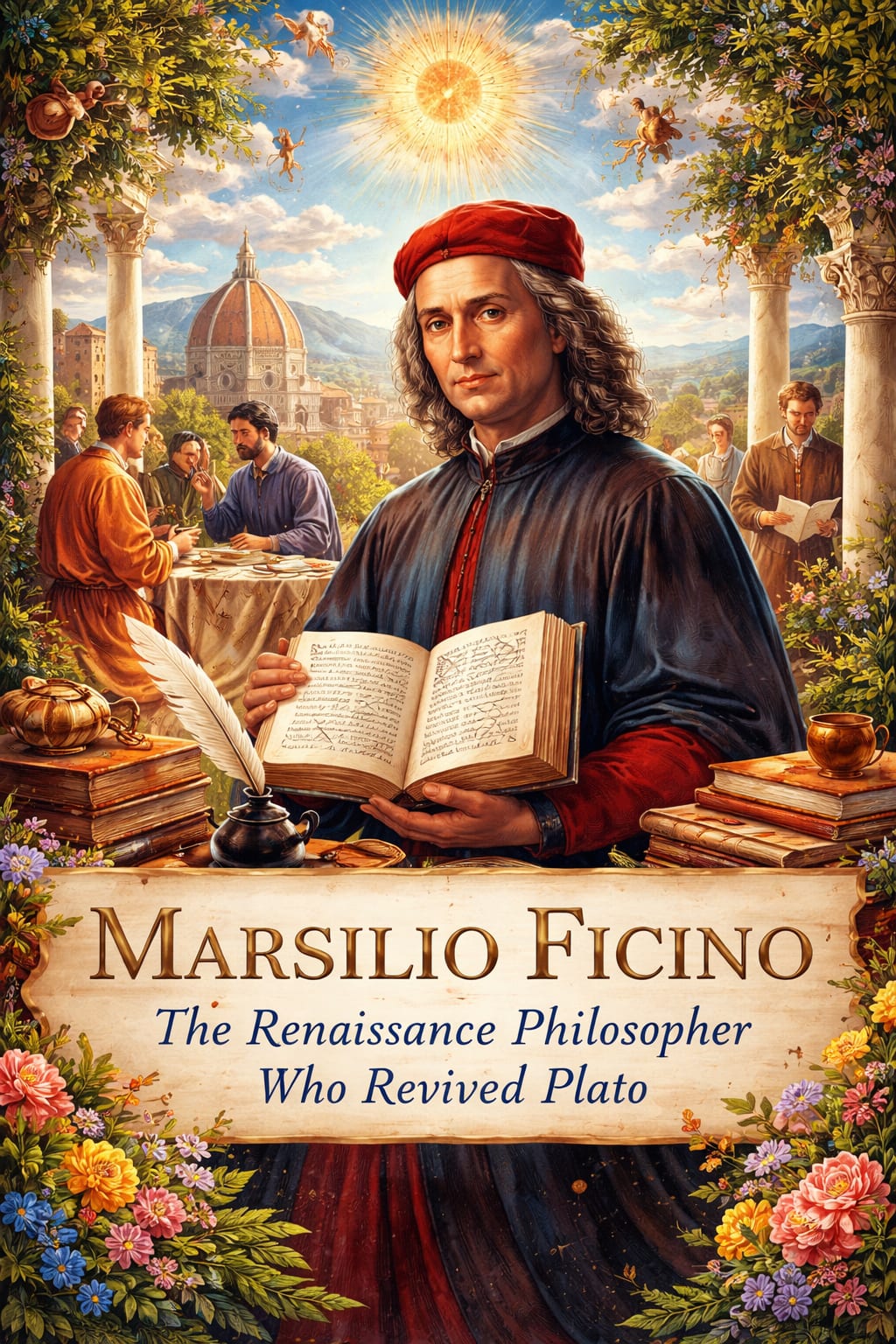
Marsilio Ficino and the Renaissance Revival of Plato
The Renaissance transformed the intellectual landscape of Europe through renewed engagement with classical antiquity. Greek and Roman manuscripts long absent from Western study returned to circulation through Byzantine scholars, monastic libraries, and new centers of learning in Italian city-states. Florence emerged as a leading center of cultural and philosophical renewal during the fifteenth century, where wealthy patrons supported scholarship, art, and literary production. Within such an atmosphere of rediscovery, the figure of Marsilio Ficino rose to prominence as one of the most influential interpreters of ancient philosophy.
Marsilio Ficino, born in Florence in 1433, received education in medicine, theology, and classical languages before entering the priesthood. Intellectual development unfolded under the patronage of Cosimo de’ Medici, a leading Florentine statesman and patron of learning. Cosimo encouraged translation of Greek philosophical texts into Latin, a task that placed Ficino at the forefront of Renaissance scholarship. Extensive translation work produced the first complete Latin edition of Plato’s dialogues in 1484, granting scholars across Europe access to Platonic philosophy for the first time since late antiquity. Additional translations included works attributed to Plotinus and other Neoplatonic writers, further expanding philosophical horizons within Western thought.
Ficino’s scholarship did not remain limited to translation. Original philosophical writings sought harmony between ancient Greek philosophy and Christian theology. The major work Theologia Platonica de immortalitate animorum, completed in the 1470s, presented a systematic defense of the immortality of the soul grounded in both Platonic philosophy and Christian doctrine. Another influential text, De Amore, offered a philosophical interpretation of Plato’s Symposium and explored the spiritual nature of love as an ascent from physical beauty toward divine reality. Through such works, Ficino articulated a vision in which beauty, intellect, and spiritual aspiration formed interconnected elements within the structure of the cosmos.
Florentine intellectual culture absorbed such ideas with enthusiasm. A circle of scholars and poets gathered around Ficino in gatherings often described as a Platonic academy, where philosophical discussion blended with literary creativity and music. Renaissance artists and writers found inspiration in concepts drawn from Platonic and Neoplatonic thought. Ideals of spiritual beauty and elevated love influenced artistic symbolism in Florentine painting and poetry, shaping the cultural language of the period. Names such as Sandro Botticelli and Michelangelo Buonarroti later reflected intellectual currents circulating within such philosophical environments.
Marsilio Ficino stands as a central architect of Renaissance humanism through the revival of Platonic philosophy within Christian Europe. Latin translations of Greek philosophical texts, combined with original theological reflection, created an intellectual bridge between classical antiquity and Renaissance spirituality. Florence became a focal point for philosophical renewal, while Ficino’s work helped establish enduring dialogue between ancient philosophy, religious tradition, and emerging currents of early modern thought.
Florence and the Renaissance Culture of Learning
Fifteenth century Florence stood as one of the most dynamic intellectual centers in Europe. Political ambition, economic prosperity, and cultural patronage created an environment in which art, literature, and philosophy flourished with extraordinary intensity. Merchant wealth generated through banking, textile production, and international trade allowed Florentine elites to sponsor architects, painters, sculptors, and scholars. Civic pride intertwined with intellectual ambition, transforming the city into a laboratory of cultural renewal.
Florence possessed a long tradition of learning that stretched back to the civic humanism of the fourteenth century. Scholars such as Leonardo Bruni and Coluccio Salutati had already begun promoting the study of classical Latin literature, rhetoric, and moral philosophy. Humanist education emphasized mastery of ancient texts, eloquence in language, and moral cultivation through historical example. Schools and private tutors trained young members of the Florentine elite in the works of Cicero, Virgil, Livy, and other classical authors whose writings shaped civic ideals and intellectual life.
The rise of the Medici family strengthened these developments. Banking success allowed the Medici to become one of the most powerful families in Florence, while cultural patronage helped establish lasting influence within the city’s intellectual and artistic communities. Cosimo de’ Medici in particular supported libraries, monasteries, and scholarly projects devoted to classical learning. The library of San Marco in Florence, expanded through Medici patronage, became one of the most important repositories of manuscripts in Renaissance Italy.
Several historical forces contributed to the growing interest in Greek philosophy and ancient intellectual traditions. The movement of Byzantine scholars into Italy introduced knowledge of the Greek language that had largely disappeared from Western Europe during the medieval period. Teachers such as Manuel Chrysoloras began instructing Italian students in Greek during the late fourteenth and early fifteenth centuries, opening access to philosophical works preserved in Byzantine manuscript collections. Greek manuscripts gradually entered Italian libraries through diplomatic exchanges, private collectors, and monastic archives.
The fall of Constantinople in 1453 intensified the migration of Greek scholars into Italian cultural centers. Manuscripts of Plato, Plotinus, Proclus, and other philosophical writers circulated more widely among scholars capable of reading the original language. Intellectual curiosity about ancient philosophy expanded rapidly as humanists sought to recover ideas that had shaped the classical world.
Translation became a major scholarly undertaking within this environment. Greek texts required careful linguistic interpretation before reaching a broader Latin reading audience. Wealthy patrons provided financial support for translators who could dedicate years to the study of philosophy, philology, and theology. Private study circles and scholarly gatherings offered places where new translations and interpretations could be discussed among scholars, poets, and educated members of Florentine society.
Within this vibrant intellectual climate, Marsilio Ficino developed a scholarly career that combined classical philosophy with Christian theological reflection. Access to Greek manuscripts, encouragement from influential patrons, and participation in Florentine humanist culture allowed Ficino to pursue the translation and interpretation of Plato’s works. Florence therefore became more than a geographic setting. Florence functioned as a meeting ground where classical wisdom, Christian scholarship, and Renaissance humanism converged to shape one of the most influential philosophical movements of the fifteenth century.
Formation of a Renaissance Philosopher
Marsilio Ficino entered the world on 19 October 1433 in Figline Valdarno, a small town located southeast of Florence in the Arno valley. Family roots lay within the professional class rather than the traditional nobility. Ficino’s father, Diotifeci Ficino, practiced medicine and maintained professional ties with the powerful Medici household of Florence. Service to the Medici court placed the Ficino family within reach of one of the most influential political and cultural networks in fifteenth century Italy. Early exposure to this environment introduced the young scholar to circles where scholarship, politics, and patronage intersected.
Florence during Ficino’s youth already possessed a reputation as a center of humanist learning. Education among ambitious families emphasized mastery of classical Latin authors, rhetorical training, and moral philosophy derived from ancient texts. Ficino received instruction in grammar, rhetoric, poetry, and philosophy, forming the intellectual foundation expected of Renaissance scholars. Latin language proficiency opened access to Roman writers such as Cicero, Seneca, and Virgil, whose works shaped the ethical ideals of humanist education.
Medical studies also formed part of Ficino’s early training. Instruction in medicine followed a curriculum grounded in the works of Hippocrates, Galen, and later Arabic commentators whose writings circulated widely in medieval universities. Knowledge of medicine encouraged interest in natural philosophy, astronomy, and the relationship between the human body and the broader structure of the cosmos. These interdisciplinary studies later influenced Ficino’s philosophical reflections on the harmony between the physical world, the human soul, and the divine order.
Despite the dominance of Aristotelian philosophy in university curricula, intellectual curiosity gradually drew Ficino toward a different philosophical tradition. Aristotle formed the backbone of medieval scholastic thought, particularly within theological institutions where logical analysis and systematic argument shaped academic study. Yet manuscripts of Plato and later Greek philosophers began appearing in Italian intellectual circles during the fifteenth century. Such texts offered an alternative vision of philosophy grounded in metaphysics, spiritual ascent, and contemplation of eternal truths.
A decisive moment in Ficino’s intellectual development arrived through contact with Cosimo de’ Medici, the influential Florentine statesman and patron of the arts. Cosimo recognized unusual scholarly ability in the young thinker and encouraged deeper study of Greek philosophy. Support from the Medici household provided access to manuscripts, financial security, and intellectual freedom necessary for long-term scholarly work. Encouragement from such a powerful patron transformed scholarly curiosity into a life devoted to philosophical translation and interpretation.
Cosimo de’ Medici also possessed a personal interest in Plato’s writings and believed that renewed study of Greek philosophy could enrich Christian intellectual life. Under Medici patronage, Ficino undertook systematic study of Greek language and philosophical texts. The project eventually expanded into the ambitious task of translating Plato’s dialogues into Latin. Such translations allowed educated readers across Western Europe to encounter Platonic philosophy without requiring knowledge of Greek.
Ficino’s intellectual activity gradually attracted a circle of scholars and poets interested in ancient philosophy. Gatherings often occurred at a Medici villa located in Careggi outside Florence. These meetings brought together diplomats, theologians, humanist scholars, and literary figures who shared fascination with classical wisdom. Conversations ranged across philosophy, theology, poetry, ethics, and metaphysics, creating a vibrant atmosphere of intellectual exchange.
Historians later described this circle as the Florentine Platonic Academy. The term refers to an informal intellectual community rather than a structured institution. No official membership lists, statutes, or administrative offices existed. Instead, the academy functioned as a gathering of minds united by admiration for Plato and interest in the philosophical heritage of antiquity.
Activities within this intellectual circle reflected both scholarly discipline and cultural celebration. Participants read and discussed Plato’s dialogues in translation, examined Neoplatonic commentaries, and debated the relationship between classical philosophy and Christian doctrine. Philosophical discussion often extended into poetry, music, and artistic symbolism inspired by Platonic ideas. Annual gatherings celebrated the traditional birthday of Plato, transforming philosophical study into a shared cultural ritual that linked Renaissance Florence with the intellectual traditions of ancient Athens.
The influence of these gatherings extended far beyond private discussion. Renaissance poets, artists, and thinkers absorbed Platonic ideas circulating within the Florentine intellectual community. Concepts concerning beauty, harmony, and spiritual ascent appeared in literature, painting, and philosophical writing throughout Italy and eventually across Europe. Within this environment of patronage, scholarship, and intellectual curiosity, Marsilio Ficino emerged as one of the most important interpreters of Platonic philosophy in the Western world.
Restoring Plato to Western Europe
The recovery of Plato’s philosophy in Western Europe stands among the most significant intellectual achievements of the Renaissance. Marsilio Ficino played the central role in this revival through the first complete translation of Plato’s writings into Latin. Such work opened an entire philosophical tradition to scholars who lacked knowledge of Greek and reshaped intellectual life across the continent.
Medieval universities had long favored Aristotle as the principal philosophical authority. Scholastic theologians built complex systems of logic and theology upon Aristotelian foundations, particularly through the influence of thinkers such as Thomas Aquinas and Albertus Magnus. Plato’s works, by contrast, remained largely inaccessible in the Latin West for centuries. Only fragments and partial references circulated through earlier translations or through later writers such as Augustine. Direct engagement with the Platonic dialogues rarely occurred because knowledge of the Greek language had nearly vanished in Western Europe after late antiquity.
The intellectual climate of fifteenth century Italy gradually changed this situation. Renewed interest in Greek learning encouraged scholars to recover original manuscripts preserved in Byzantine libraries. Instruction in the Greek language spread among Italian humanists through teachers who migrated westward from the eastern Mediterranean. Access to Greek texts created the possibility of translating philosophical works that had long remained outside the reach of Latin readers.
Within this environment of rediscovery, Cosimo de’ Medici entrusted Marsilio Ficino with a remarkable scholarly mission. Ficino undertook systematic translation of Plato’s dialogues from Greek into Latin, a task requiring mastery of language, philosophy, and careful textual interpretation. Years of labor produced a complete Latin edition of Plato’s works, published in Florence in 1484. This publication marked the first time that the entire Platonic corpus became available to Western scholars in a widely accessible form.
Latin functioned as the intellectual language of European scholarship during the Renaissance. Universities, monasteries, and humanist academies relied on Latin for teaching, correspondence, and publication. Ficino’s translations therefore traveled rapidly beyond Florence into the broader intellectual networks of Italy, France, Germany, and England. Philosophers, theologians, poets, and diplomats gained the ability to read Plato’s dialogues without specialized knowledge of Greek. Dialogue titles such as Phaedo, Symposium, Republic, and Timaeus entered the curriculum of Renaissance scholars through these translations.
The translation project extended beyond Plato himself. Ficino also translated important texts associated with the later philosophical tradition known as Neoplatonism. Among the most influential of these works were the writings of Plotinus, the third century philosopher whose treatises explored metaphysics, cosmology, and the nature of the soul. Ficino’s Latin translation of the Enneads appeared in 1492 and represented the first complete Western edition of Plotinus. Additional translations included works connected with philosophers such as Porphyry and Iamblichus, further expanding access to the spiritual and metaphysical dimensions of Greek philosophy.
Translation work alone did not define Ficino’s contribution to Renaissance thought. Detailed commentaries accompanied many of the translated texts, offering interpretation and philosophical guidance for readers unfamiliar with the complexities of ancient metaphysics. These commentaries explained key themes such as the immortality of the soul, the hierarchical structure of reality, and the relationship between human intellect and divine truth. Ficino also explored harmony between Platonic philosophy and Christian theology, presenting ancient wisdom as compatible with religious belief rather than as a rival tradition.
Through translation, interpretation, and philosophical synthesis, Ficino transformed the intellectual landscape of Renaissance Europe. Platonic dialogues returned to the center of philosophical discussion after centuries of neglect. Scholars across the continent encountered a vision of philosophy that emphasized contemplation, beauty, and the ascent of the soul toward divine reality. The revival of Plato’s voice within European scholarship owes much to the dedication, linguistic skill, and philosophical insight of Marsilio Ficino.
Christian Platonism and the Renaissance Cosmos
Marsilio Ficino developed one of the most ambitious philosophical syntheses of the Renaissance through the union of classical metaphysics and Christian theology. Ancient philosophical traditions did not appear as threats to religious doctrine within this framework. Greek philosophy represented an earlier stage in humanity’s search for divine truth. Plato and later philosophical writers therefore occupied an honored place within a broader spiritual history that culminated in Christian revelation.
This philosophical synthesis became known as Christian Platonism. The tradition sought harmony between Platonic metaphysics and Christian teachings concerning creation, the soul, and divine providence. Ficino regarded philosophy and theology as complementary paths directed toward the same ultimate goal. Intellectual contemplation, moral discipline, and spiritual devotion formed parts of a single pursuit aimed at understanding the nature of reality and the relationship between humanity and the divine source of existence.
The philosophical system presented in Ficino’s writings emerged most fully in Theologia Platonica de immortalitate animorum, completed during the 1470s and published in 1482. This extensive work combined metaphysical argument, theological reflection, and classical scholarship in defense of the spiritual nature of the human soul. The text sought to demonstrate that Platonic philosophy supported key Christian doctrines while also offering a philosophical framework capable of explaining the structure of the universe.
The Hierarchical Structure of Reality
Ficino described the universe as a carefully ordered hierarchy extending from the highest spiritual principle to the lowest material forms. The structure reflected both Platonic metaphysics and medieval Christian cosmology, presenting existence as an ordered chain linking all levels of reality.
At the summit of this hierarchy stands God, the infinite source of all being, intelligence, and goodness. Divine existence transcends all material limitations and provides the origin of every created thing. From this highest principle flows the entire structure of the cosmos.
Below the divine source exist angelic intelligences, spiritual beings responsible for maintaining cosmic order and transmitting divine influence throughout creation. Renaissance thinkers often associated these intelligences with celestial spheres and cosmic harmony, drawing upon both classical philosophy and medieval theological traditions.
The human soul occupies the central position within this hierarchy. Unlike purely spiritual beings, the human soul remains connected to the physical body while retaining intellectual capacity for spiritual contemplation. This intermediate status allows humanity to serve as a bridge between the visible world and the invisible realm of spirit.
Beneath the level of the soul lies the natural world, including living organisms, animals, and the forces governing physical nature. At the lowest level exists matter, the material foundation from which physical objects arise. Each level of this hierarchy reflects decreasing degrees of spiritual perfection and increasing involvement with material existence.
Such a vision of cosmic order reinforced Renaissance ideas concerning human dignity. Intellectual capacity and spiritual awareness elevated humanity above purely material life while still connecting human existence to the broader structure of creation.
The Immortality of the Human Soul
The immortality of the soul formed the central theme of Ficino’s philosophical work. Theologia Platonica presented numerous arguments intended to demonstrate that the human soul belongs to a spiritual order beyond the limitations of the physical body.
Human intellectual activity provided one of Ficino’s primary lines of reasoning. The mind possesses the ability to contemplate universal truths such as mathematical principles, moral ideals, and abstract concepts that cannot be reduced to material objects. Such intellectual activity suggests the presence of a spiritual faculty capable of transcending sensory experience.
Self reflection provided additional support for the spiritual nature of the soul. The human mind not only perceives external objects but also examines its own thoughts and intentions. This capacity for self awareness indicates a level of existence distinct from purely physical processes.
The human longing for eternal truth and perfect beauty offered another argument within Ficino’s philosophy. Desire for lasting wisdom, moral goodness, and spiritual fulfillment points toward a destiny beyond the temporary conditions of earthly life. If such aspirations originate within the soul, then the soul must possess a nature capable of surviving physical death.
Through such reasoning Ficino concluded that the soul continues beyond the dissolution of the body. Intellectual development and spiritual growth therefore form part of an ongoing journey directed toward union with divine truth.
Love as a Path Toward Divine Beauty
Love occupies a central place within Ficino’s philosophy and appears most vividly in De Amore, a commentary on Plato’s Symposium. This work explored the nature of beauty and the transformative power of love within the human experience.
According to Ficino, love begins with the perception of physical beauty. A harmonious face, graceful movement, or artistic creation awakens admiration within the human soul. Such attraction does not end with sensory appreciation. Visible beauty reflects a deeper spiritual principle present throughout the universe.
Contemplation gradually elevates the lover beyond physical appearance toward recognition of intellectual and moral beauty. Admiration for wisdom, virtue, and noble character represents a higher stage in the ascent of love. The final stage directs attention toward divine beauty, the ultimate source from which all lesser forms of beauty arise.
Love therefore functions as a spiritual force guiding the soul upward through successive levels of awareness. Physical attraction serves as the beginning of a philosophical and spiritual journey that ultimately seeks communion with divine perfection.
This interpretation profoundly influenced Renaissance literature and art. Poets and writers adopted the concept of Platonic love to describe relationships grounded in admiration for virtue, intellect, and spiritual beauty rather than purely physical desire.
The Idea of an Ancient Sacred Wisdom
Another important element within Ficino’s philosophy involved the belief in a primordial wisdom shared among ancient philosophers and sages. Renaissance scholars referred to this tradition as prisca theologia, meaning ancient theology.
According to this perspective, divine truth appeared throughout history in the teachings of inspired thinkers who lived long before the rise of Christianity. Ancient figures such as Hermes Trismegistus, Pythagoras, Orpheus, and Plato were believed to have preserved fragments of sacred knowledge concerning the nature of God and the structure of the cosmos.
Greek philosophy therefore represented part of a continuous spiritual heritage rather than a purely secular intellectual tradition. Christianity appeared within this framework as the culmination and fulfillment of insights that earlier sages had glimpsed through philosophical reflection.
This idea allowed Renaissance thinkers to engage deeply with classical philosophy while maintaining loyalty to Christian faith. Ancient texts became sources of wisdom capable of illuminating theological questions and enriching spiritual understanding.
Cosmic Harmony, Medicine, and the Influence of the Stars
Ficino also explored the relationship between the human body, the soul, and the wider universe. Renaissance natural philosophy often viewed the cosmos as an interconnected system in which celestial movements influenced earthly conditions. Astronomy, astrology, medicine, and philosophy frequently overlapped within such investigations.
Medical training influenced Ficino’s interest in the balance between physical health and intellectual activity. The work De vita libri tres, published in 1489, examined methods for preserving the health of scholars and contemplative individuals. Recommendations included balanced diet, exposure to sunlight, pleasant surroundings, and activities capable of uplifting the spirit.
Celestial influences occupied an important role within this work. Renaissance scholars widely believed that planetary movements could affect temperament, mood, and intellectual disposition. Ficino discussed ways to harmonize human life with beneficial celestial influences through music, herbal preparations, and carefully chosen environments.
Music held particular importance in this philosophy of cosmic harmony. Musical tones and rhythmic patterns were believed to reflect mathematical relationships present within the structure of the universe. Harmonious sound therefore possessed the ability to elevate the soul and restore psychological balance. Ficino himself practiced musical performance and often sang ancient hymns accompanied by the lyre, believing that sacred music could strengthen the connection between the human mind and the divine order of the cosmos.
Modern science does not support many of these astrological assumptions. Yet such ideas reveal a Renaissance effort to understand the universe as an integrated system in which physical nature, spiritual aspiration, and cosmic structure formed parts of a unified whole. Within this grand vision of harmony, Marsilio Ficino sought to place human life within a meaningful and spiritually ordered universe.
Philosophy in Art, Poetry, and Renaissance Culture
Marsilio Ficino’s philosophical ideas did not remain confined to scholarly manuscripts or academic discussion. Renaissance culture possessed a remarkable capacity to absorb philosophical concepts and translate them into visual art, poetry, music, and literature. Florentine intellectual life fostered constant interaction between philosophers, painters, poets, and patrons. Within such an environment, philosophical language concerning beauty, love, and spiritual ascent entered artistic expression and literary imagination.
The revival of Platonic philosophy transformed the meaning of beauty within Renaissance culture. Classical Greek thought described beauty as a reflection of divine order and harmony. Ficino’s interpretation of Plato reinforced this idea and gave renewed philosophical depth to artistic creation. Visible beauty represented more than physical elegance. Beauty functioned as a sign pointing toward spiritual perfection and divine intelligence.
Artists working in Florence absorbed these ideas and incorporated them into visual symbolism. Mythological scenes drawn from classical antiquity gained new philosophical significance when interpreted through Platonic concepts. Ancient gods and allegorical figures often appeared as representations of moral virtues, spiritual aspiration, or cosmic harmony. Painting and sculpture therefore became vehicles for expressing philosophical ideas concerning the relationship between physical beauty and spiritual truth.
The influence of Platonic thought can be observed in the artistic environment surrounding painters such as Sandro Botticelli, whose works frequently depicted mythological subjects drawn from classical literature. Images such as Venus emerging from the sea or graceful figures representing the Three Graces resonated with philosophical interpretations of beauty circulating within Florentine intellectual circles. Within such imagery, beauty symbolized the presence of divine harmony within the visible world.
Sculpture and architecture also reflected similar ideals. Renaissance artists pursued mathematical proportion, balanced composition, and harmonious form in order to embody philosophical concepts of order and perfection. Classical architectural principles returned to prominence during this period because ancient design seemed to reflect the rational structure of the cosmos itself.
Literary culture likewise absorbed Ficino’s philosophical vocabulary. Renaissance poets and writers explored themes of spiritual love, intellectual striving, and the ascent of the soul toward higher truth. Love poetry frequently portrayed admiration for beauty as the beginning of a spiritual journey rather than a purely physical attraction. The language of Platonic love entered Italian literature and gradually spread throughout Europe.
Poets such as Angelo Poliziano and other members of the Florentine humanist community participated in intellectual gatherings connected with Ficino’s philosophical circle. Poetry often blended classical mythology with philosophical symbolism, reflecting the influence of Platonic ideas circulating within Florence. Literary works portrayed love as a force capable of elevating the human spirit toward wisdom and virtue.
Through artistic workshops, literary circles, and humanist academies, Platonic philosophy traveled far beyond the immediate circle of Florentine scholars. Intellectual networks carried these ideas into other Italian courts and eventually into the cultural life of France, Germany, England, and Spain. Renaissance culture thus became a conduit through which philosophical ideas reached audiences far beyond university lecture halls.
Major Works of Marsilio Ficino
Marsilio Ficino produced an extensive body of philosophical writing that shaped intellectual debate throughout the late fifteenth century. Translations of ancient philosophical texts formed one part of this achievement, yet original writings established Ficino as one of the most important philosophical voices of the Renaissance.
Theologia Platonica de immortalitate animorum
This monumental work, often known in English as Platonic Theology, stands as Ficino’s most ambitious philosophical project. Written during the 1460s and 1470s and published in 1482, the work presents a systematic exploration of the nature of the soul and the structure of the universe. Drawing upon Plato, Plotinus, and Christian theology, Ficino argued that the human soul belongs to a spiritual order that transcends material existence. The text contains numerous philosophical arguments intended to demonstrate that intellectual activity, moral aspiration, and the pursuit of truth reveal the immortal character of the human mind.
Commentary on Plato’s Symposium (De Amore)
This influential work offered a detailed interpretation of Plato’s dialogue concerning love. Ficino presented love as a dynamic spiritual force that draws the human soul toward beauty and ultimately toward divine perfection. The commentary circulated widely among Renaissance scholars and played a major role in shaping the cultural idea of Platonic love. Philosophers, poets, and artists found inspiration in the idea that admiration for beauty could lead to intellectual and spiritual transformation.
De vita libri tres (Three Books on Life)
Published in 1489, this work blended philosophy, medicine, and reflections on the relationship between the human mind and the cosmos. Ficino addressed the challenges faced by scholars who devoted long hours to study and contemplation. Advice included dietary guidance, environmental influences on mental well being, and the possible effects of celestial forces upon human temperament. The work also discussed the role of music, herbs, and natural harmony in sustaining intellectual vitality.
De Christiana religione (On the Christian Religion)
This text presented a philosophical defense of Christianity grounded in both classical philosophy and theological reasoning. Ficino argued that ancient philosophical traditions contained insights that pointed toward Christian revelation. Greek philosophers therefore appeared not as rivals to Christian doctrine but as thinkers who anticipated elements of spiritual truth later expressed more fully within Christian teaching.
Together these writings reveal the breadth of Ficino’s intellectual ambition. Philosophy, theology, medicine, music, and natural science all entered the scope of inquiry. Through translation, interpretation, and original philosophical reflection, Marsilio Ficino helped shape the intellectual language of the Renaissance and guided the rediscovery of ancient wisdom within the cultural life of early modern Europe.
Recommended Reading: #commissionearned
Marsilio Ficino (Western Esoteric Masters) by Angela Voss
Renaissance philosophy often blended spiritual reflection, ancient metaphysics, and humanist scholarship, and few figures represent that fusion more clearly than Marsilio Ficino. This carefully edited volume gathers important writings and letters that illuminate the philosophical world Ficino inhabited. Selections reveal how Platonic metaphysics, Hermetic ideas, and Christian theology could coexist within a single intellectual framework during the fifteenth century. Readers encounter themes such as the immortality of the soul, divine beauty, cosmic harmony, and the ascent of the human intellect toward higher truth. Angela Voss provides historical context that situates these writings within the cultural revival of classical learning that reshaped Florence. Attention to primary texts allows modern readers to experience Ficino’s language and philosophical tone with clarity and depth. Study of these writings helps explain how Renaissance thinkers approached spirituality through philosophy, symbolism, and contemplation. Anyone interested in the ideas explored throughout this blog will gain valuable insight from these sources because the volume reflects the philosophical foundations behind Ficino’s influence on Renaissance culture.
Renaissance scholars often understood the human mind as part of a vast cosmic pattern shaped by planetary order and celestial rhythm. Thomas Moore explores that worldview through a thoughtful examination of Marsilio Ficino’s reflections on astrology, medicine, and psychology. Attention centers on Ficino’s work Three Books on Life, which offered guidance for scholars seeking intellectual vitality and emotional balance. Moore interprets Ficino’s astrological language as a symbolic psychology that reflects Renaissance attempts to understand the relationship between human character and cosmic structure. Discussion of planetary symbolism reveals how Renaissance thinkers associated temperament, imagination, and creativity with celestial patterns. Rather than presenting astrology as mere superstition, the study explains how such ideas formed part of a philosophical system that viewed the universe as an interconnected whole. Readers encounter a vivid portrait of Renaissance intellectual life in which music, environment, diet, and contemplation could influence the harmony between body and soul. The themes explored throughout this blog concerning cosmic order, intellectual life, and spiritual harmony become clearer through Moore’s exploration of Ficino’s imaginative cosmology.
Recovery of Plato’s writings during the Renaissance transformed European philosophy, and Marsilio Ficino played the central role in that intellectual revival. Denis J. J. Robichaud examines the scholarly methods through which Ficino translated and interpreted Plato’s dialogues for a new generation of readers. Careful analysis reveals that translation alone did not shape Renaissance Platonism. Interpretive commentary, rhetorical framing, and cultural adaptation allowed Plato to emerge as a philosophical authority compatible with Christian thought. Robichaud investigates how Renaissance humanists presented Plato as a figure whose wisdom aligned with spiritual and moral ideals valued in fifteenth century Florence. Manuscripts, early printed editions, and correspondence between scholars help reconstruct the networks that carried Platonic philosophy across Europe. Detailed attention to textual history reveals how Renaissance readers first encountered Plato through Ficino’s Latin translations. Readers interested in the intellectual revival described in this blog will find an especially rich exploration of the historical process through which Platonic philosophy returned to Western scholarship.
Friend to Mankind: Marsilio Ficino (1433 1499) by Michael Shepherd
Renaissance intellectual life depended as much on friendship, correspondence, and conversation as on formal philosophical writing. This collection of essays explores the human world surrounding Marsilio Ficino and reveals the personal relationships that shaped philosophical activity in Florence. Letters exchanged between scholars, poets, and political figures reveal a community deeply engaged with questions of beauty, truth, and spiritual wisdom. Essays within the volume explore Ficino’s role as priest, teacher, translator, and guide within the vibrant humanist culture of the Medici court. Attention to historical documents provides insight into daily life among Renaissance thinkers who gathered to read Plato, discuss theology, and exchange ideas about art and literature. The title reflects the admiration many contemporaries expressed for Ficino’s generosity of intellect and commitment to philosophical dialogue. Cultural context provided in these essays helps readers understand how philosophical ideas spread beyond academic circles into poetry, art, and civic life. Anyone interested in the Florentine intellectual environment described throughout this blog will find an illuminating portrait of the community that surrounded Ficino.
The Essential Plotinus (Hackett Classics) 2nd Edition by Plotinus
Neoplatonic philosophy formed the deeper foundation beneath much of Marsilio Ficino’s intellectual work. Plotinus, a third century philosopher of the Roman world, developed a profound metaphysical system describing reality as a series of emanations flowing from a supreme spiritual principle known as the One. Selections gathered in this edition introduce readers to ideas that later shaped Renaissance thought about the soul, beauty, and divine unity. Discussions of spiritual ascent describe how contemplation can elevate the human mind beyond the material world toward intellectual illumination. Reflections on beauty reveal why Renaissance thinkers connected artistic harmony with metaphysical truth. Plotinus also explored the nature of the soul and its capacity to return to a higher spiritual source through philosophical awareness. Renaissance scholars encountered many of these ideas through Latin translations produced by Marsilio Ficino. Reading Plotinus offers a deeper understanding of the philosophical heritage that informed Ficino’s vision of the cosmos described throughout this blog. Engagement with these writings allows modern readers to encounter the ancient roots behind Renaissance Platonism and the spiritual philosophy that shaped one of the most influential thinkers of the fifteenth century.
Controversy and Intellectual Debate
Philosophical innovation during the Renaissance rarely unfolded without debate. Marsilio Ficino’s effort to unite Platonic philosophy with Christian theology attracted admiration from many scholars yet also raised questions within religious and academic circles. Intellectual life in fifteenth century Europe remained deeply connected to theological authority, and any reinterpretation of ancient philosophy required careful examination.
Medieval scholasticism had long relied upon Aristotle as the primary philosophical authority within universities and theological institutions. Systems of logic, ethics, and metaphysics developed by medieval thinkers rested upon Aristotelian foundations. The growing revival of Plato therefore represented a shift in philosophical emphasis. Some scholars questioned whether Platonic metaphysics could be reconciled with established theological traditions that had developed through centuries of Aristotelian interpretation.
Concerns also emerged regarding the presence of pre Christian philosophical traditions within Renaissance scholarship. Greek philosophers such as Plato, Pythagoras, and Plotinus lived centuries before the rise of Christianity. Skeptical observers wondered whether admiration for ancient wisdom might encourage intellectual independence from Christian doctrine. Such concerns reflected broader tensions within Renaissance culture as scholars sought to recover classical learning without abandoning religious commitments.
Astrology provided another source of controversy. Renaissance natural philosophy often included belief in celestial influences upon earthly life. Planetary movements were widely thought to affect climate, health, and temperament. Ficino discussed these ideas in Three Books on Life, where celestial harmony appeared as part of a larger vision of cosmic order linking humanity with the structure of the universe. Some religious authorities worried that astrological explanations might conflict with Christian ideas concerning divine providence and human free will.
Criticism also arose from misunderstandings about mystical language present in Renaissance philosophy. Discussions of spiritual ascent, divine beauty, and cosmic harmony drew heavily from Platonic and Neoplatonic sources. Such language sometimes appeared unfamiliar to readers trained exclusively in scholastic theology. Debates therefore emerged over the proper interpretation of ancient philosophical texts and their relationship to Christian belief.
Despite such tensions, Ficino maintained a respected position within intellectual and religious communities. Ordination as a Catholic priest strengthened credibility among theologians and church authorities. Writings consistently emphasized harmony between philosophical reasoning and Christian doctrine. Classical philosophy appeared within this framework not as a rival to religious truth but as a preparation that guided thoughtful minds toward deeper understanding of divine reality.
Support from influential patrons also played a role in preserving Ficino’s reputation. The Medici family continued to encourage philosophical scholarship and cultural patronage throughout Florence. Intellectual circles connected with the Florentine humanist movement valued the revival of classical learning and welcomed attempts to integrate ancient philosophy with contemporary religious thought.
Debate surrounding Ficino’s work reflects a broader transformation occurring within Renaissance Europe. Recovery of ancient manuscripts, renewed study of Greek philosophy, and the rise of humanist education created new opportunities for intellectual exploration. Questions raised by critics therefore formed part of a larger cultural conversation concerning the relationship between faith, reason, and classical learning. Within that conversation Marsilio Ficino emerged as a leading figure who attempted to build a bridge between the spiritual traditions of antiquity and the religious life of the Renaissance world.
The Closing Years of a Renaissance Scholar
The final decades of Marsilio Ficino’s life unfolded during a period of profound cultural transformation in Florence and throughout Italy. Intellectual networks expanded as printed books circulated more widely across Europe, allowing philosophical ideas to travel beyond the local circles in which many Renaissance scholars had originally worked. Ficino remained an active participant in this evolving intellectual landscape through writing, translation, and an extensive exchange of letters with scholars, clergy, and political figures.
Correspondence formed an important part of Renaissance scholarly life. Letters functioned as vehicles for philosophical debate, spiritual reflection, and the exchange of manuscripts. Ficino maintained communication with humanists, theologians, and diplomats across Italy and beyond. Collections of these letters reveal discussions concerning theology, classical philosophy, ethics, and the challenges of intellectual life. Many correspondents sought philosophical guidance, while others shared reflections on Plato, Plotinus, and the broader revival of ancient learning.
During these later years Ficino continued to revise earlier writings and expand the philosophical system developed over decades of study. Translations of Greek philosophical texts remained central to this work. The translation of Plotinus, published in 1492, represented one of the final major scholarly achievements of Ficino’s career. Through that publication, Western readers gained access to one of the most important figures in the Neoplatonic tradition, a philosopher whose influence would shape Renaissance metaphysics and spirituality.
Florence itself experienced political and cultural upheaval during the closing years of the fifteenth century. The death of Lorenzo de’ Medici in 1492 weakened the stability of the political environment that had supported much of the city’s intellectual life. Religious reform movements gained influence, and debates concerning morality, politics, and religious devotion intensified. Despite these shifting circumstances, Ficino continued to pursue scholarship and spiritual reflection within the intellectual community that had formed around classical philosophy and Christian humanism.
Marsilio Ficino died on 1 October 1499 at Careggi, near Florence, not far from the villa where many philosophical gatherings had taken place during earlier decades. Nearly a lifetime of scholarship had passed within the orbit of Florentine intellectual culture. By the close of the fifteenth century, the philosophical revival initiated through translation and interpretation had already transformed the intellectual landscape of Europe.
A Legacy That Reshaped Renaissance Thought
The long term influence of Marsilio Ficino extends far beyond the lifetime of a single scholar. Work undertaken in Florence during the fifteenth century helped reshape the direction of European intellectual history. Latin translations of Plato’s dialogues restored a philosophical tradition that had remained largely inaccessible in Western Europe for centuries. Universities, courts, and humanist academies soon incorporated Platonic ideas into philosophical discussion, literary expression, and theological reflection.
Renaissance humanism gained additional philosophical depth through Ficino’s synthesis of classical thought and Christian theology. Humanist scholars had already emphasized education, rhetoric, and moral philosophy drawn from ancient sources. Ficino introduced a metaphysical dimension that explored the nature of the soul, the structure of the cosmos, and the spiritual significance of beauty and love. Such ideas expanded the intellectual framework through which Renaissance thinkers approached questions concerning human nature and divine reality.
Influence also appeared within literature and the visual arts. Concepts of spiritual beauty, Platonic love, and the ascent of the soul became recurring themes in Renaissance poetry and artistic symbolism. Mythological imagery drawn from classical sources acquired philosophical significance when interpreted through Platonic and Neoplatonic ideas circulating among scholars and artists. Cultural life in Florence and other Italian centers therefore reflected the philosophical transformation that accompanied the revival of ancient texts.
Later philosophical movements continued to engage with ideas associated with Ficino’s work. Renaissance Platonism influenced early modern thinkers who explored the relationship between mind, spirit, and the structure of the universe. Discussions of the dignity of the human soul and the intellectual capacity for truth helped shape broader philosophical debates concerning human nature during the transition from medieval to modern thought.
At the heart of this legacy lies a distinctive vision of humanity’s place within the cosmos. Ficino’s philosophy presented the human soul as a bridge between material existence and spiritual reality. Intellectual curiosity, moral reflection, and contemplation of beauty represented pathways toward deeper awareness of divine truth. Human life therefore possessed meaning within a universe ordered by harmony, intelligence, and spiritual purpose.
The Renaissance rediscovery of Plato and the revival of ancient metaphysical traditions remain inseparable from the scholarly dedication of Marsilio Ficino. Through translation, interpretation, and philosophical synthesis, a Florentine scholar helped reconnect Europe with a vast intellectual heritage that continues to shape philosophical reflection and cultural imagination today.
Rediscovering Marsilio Ficino
Renaissance intellectual history contains many remarkable figures, yet few scholars influenced European thought as profoundly as Marsilio Ficino. A life devoted to translation, philosophical reflection, and spiritual inquiry helped restore a vast body of ancient philosophy to Western scholarship. Latin translations of Plato opened intellectual pathways that had remained largely inaccessible for centuries. Engagement with Neoplatonic philosophy expanded conversations concerning the nature of the soul, the structure of the cosmos, and the meaning of beauty and love within human life.
Florence provided the setting for this transformation, yet the effects reached far beyond the walls of that city. Scholars throughout Europe encountered Platonic philosophy through the texts and commentaries produced during the second half of the fifteenth century. Philosophical discussions concerning the dignity of the human soul, the harmony of the universe, and the relationship between classical wisdom and Christian belief became central themes within Renaissance culture. Literature, painting, theology, and intellectual life absorbed ideas that had reentered European thought through the work of a Florentine translator and philosopher.
Despite such historical importance, many of Ficino’s writings remain unfamiliar outside specialized academic study. Philosophical texts produced during the Renaissance often require patience and curiosity from modern readers. Language shaped by classical philosophy and theological vocabulary can appear challenging at first encounter. Careful reading, however, reveals a remarkable intellectual landscape in which ancient metaphysics, spiritual reflection, and humanist learning converge. Within those writings appear enduring questions about the nature of consciousness, the search for truth, and the human desire for beauty and transcendence.
Independent exploration of Renaissance philosophy offers a rewarding path for readers interested in intellectual history. Public libraries provide an excellent starting point for such study. Many library systems maintain extensive collections of historical works, scholarly biographies, and modern translations of classical texts. Librarians often assist readers in locating reliable editions and reputable academic studies. Access to these resources allows careful engagement with historical sources while avoiding the limitations of fragmentary material found elsewhere.
Printed books and peer reviewed scholarship remain essential tools for understanding historical philosophy. Modern academic research includes careful translation, detailed commentary, and historical context that help clarify complex ideas from earlier centuries. Study through reputable sources strengthens critical thinking and encourages deeper appreciation of the intellectual traditions that shaped Western civilization.
Caution becomes especially important when consulting free online resources. Digital platforms contain an extraordinary range of information, yet reliability varies widely. Unsourced quotations, inaccurate summaries, and simplified interpretations often circulate without scholarly verification. Cross referencing information through academic publications, reputable historical institutions, and library collections helps protect against misunderstanding. Responsible research requires patience, curiosity, and a willingness to consult multiple sources before accepting any interpretation as authoritative.
Marsilio Ficino’s intellectual legacy invites readers to pursue that kind of thoughtful exploration. Philosophical questions concerning the nature of the soul, the meaning of beauty, and the structure of reality continue to inspire reflection centuries after the Renaissance. Engagement with historical philosophy also reveals how earlier generations confronted many of the same questions that still challenge modern thinkers.
A careful return to Renaissance scholarship reminds modern readers that ideas possess remarkable power. Manuscripts copied in ancient libraries, preserved through centuries of cultural change, and translated by dedicated scholars helped transform the intellectual direction of Europe. Curiosity about ancient wisdom opened new paths of thought during the Renaissance and continues to encourage inquiry today. Exploration of Marsilio Ficino’s work offers an opportunity to encounter one of the most important philosophical revivals in European history and to participate in the ongoing search for understanding that defines the human intellectual tradition.
About the Creator
Marcus Hedare
Hello, I am Marcus Hedare, host of The Metaphysical Emporium, a YouTube channel that talks about metaphysical, occult and esoteric topics.
https://linktr.ee/metaphysicalemporium
Keep reading
More stories from Marcus Hedare and writers in BookClub and other communities.
Peter J. Carroll
The Emergence of Chaos Magic and the Influence of Peter J. Carroll The closing decades of the twentieth century witnessed a notable transformation within Western occult thought. Ceremonial traditions rooted in nineteenth century esoteric orders continued to influence magical practice, yet growing dissatisfaction with rigid doctrine encouraged new approaches. Within experimental occult circles in Britain and Europe, discussion increasingly focused on results, psychology, and personal experience rather than inherited authority. From that environment emerged chaos magic, a current that challenged long established assumptions about ritual, belief, and the nature of magical practice.
By Marcus Hedare3 days ago in BookClub
Rachel Reviews: Lakefront Wolves by Joseph Deegan
Meet Finn. He's an 18 year old kid who has potential. He's bright with great school scores and he's also an athlete, a footballer of some prowess. He has it all going for him, it would seem, and yet, he's determined to send what could be a well-planned, stable existence firmly off the rails. He drinks, he smokes, he takes drugs, he has violent tendencies and he's in danger of losing not only his mind but all that he holds dear.
By Rachel Deeming10 days ago in BookClub



Comments
There are no comments for this story
Be the first to respond and start the conversation.