
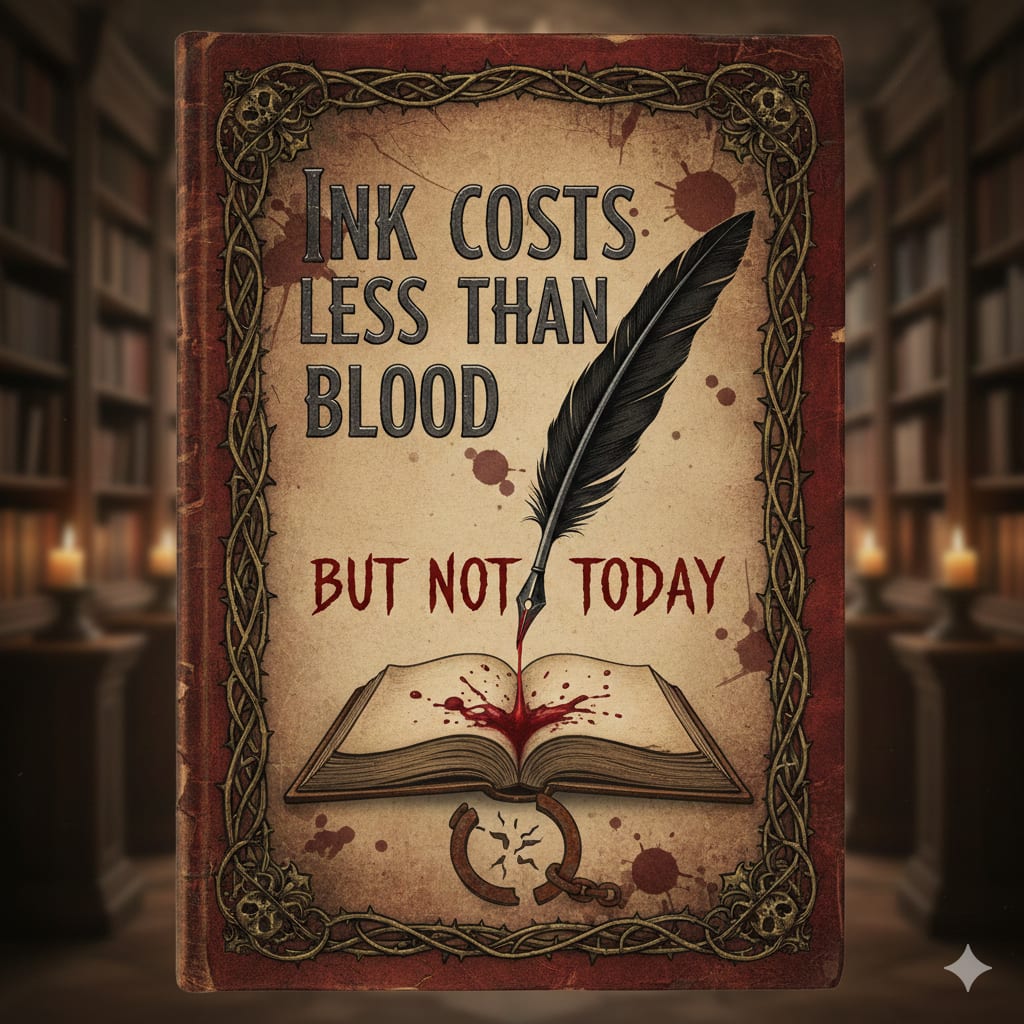
Ink Costs Less Than Blood, But Not Today
When truth demands a sacrifice no pen can afford.

Ink Costs Less Than Blood, But Not Today
The slogan was painted on the wall outside the newsroom in thick black letters: Ink Costs Less Than Blood. It had been there since before I joined, a reminder passed down like an heirloom. We said it to comfort ourselves when threats came in by phone, when anonymous notes slipped under the door, when our names appeared online with red circles drawn around them. We said it to believe that words—printed, published, preserved—could stop violence before it spilled.
Today, the paint was peeling.
By sunrise, the city already felt tight, like a clenched fist. Soldiers stood at corners they had never cared about before. Sirens threaded the air, and people moved quickly, eyes lowered, conversations unfinished. Inside the newsroom, the lights hummed. The coffee tasted burnt. Screens glowed with drafts no one had the courage to publish.
“Run it,” Malik said, standing by my desk. He was our editor, a man who believed deadlines were moral obligations. His beard was flecked with gray, and his voice had the calm of someone who had learned how to keep fear folded. “If we wait, the story dies.”
The story was simple, which made it dangerous. Documents showing how relief funds had been siphoned, how the shortages were engineered, how names we weren’t supposed to print had signed papers we weren’t supposed to see. Proof. Ink-ready proof.
I read the headline again. It felt heavy, like a blade balanced on a fingertip.
“They’re outside,” Sana said softly. She was at the window, peering through a crack in the blinds. “Not marching. Just… waiting.”
I remembered my father’s hands, stained with oil from the machines he fixed, the way he taught me to hold a pen properly when I was seven. Words last, he had said. Bruises don’t. He died believing that.
We had published worse before. We had survived. That was the lie we told ourselves: survival as precedent.
The first stone hit the glass at nine-forty. It didn’t shatter, just cracked, a white vein spreading across the pane. Phones buzzed at once—alerts, warnings, pleas. A message from my mother appeared and disappeared as I locked my screen. I could not read it. If I read it, I might stop.
Malik raised his hand. “Listen,” he said. “We’re journalists. Not heroes. But we don’t get to choose days that are easy. We choose truth. Or we choose silence.”
The servers were ready. The layout was clean. All that remained was the click.
I thought of the slogan on the wall, the certainty it once held. Ink costs less than blood—because words can save lives. Because exposure can prevent the next beating, the next empty shelf, the next coffin. Because light, we were taught, is antiseptic.
Another stone. Shouting now, closer. The waiting had ended.
“Publish,” Malik said.
My finger hovered.
The door downstairs buckled with a sound like thunder swallowing breath. Someone screamed. I clicked.
The story went live at nine-forty-three.
For a moment, nothing happened. The city did not pause. The sky did not fall. The words existed, which felt like a miracle in itself. Messages poured in—shares, screenshots, fragments flying faster than we could follow. The truth, uncontained.
Then the power died.
We moved by instinct. Backups. Mirrors. Phones held high to catch a signal that wavered like a dying pulse. Smoke crawled up the stairwell. Boots pounded. The newsroom, once a place of quiet urgency, became a room of noise and heat and decision.
I don’t remember who grabbed my arm. I remember falling, ink smearing across my sleeve from a spilled printer cartridge, the blackness blooming like a bruise. I remember Malik standing in the doorway, blocking it with his body, shouting names like a roll call of the living. I remember thinking, absurdly, that ink did stain.
Outside, the city roared. Inside, we scattered, carrying nothing but what we had already released into the world.
I hid in an alley until the afternoon, my phone buzzing itself to exhaustion. The story was everywhere. Translated. Quoted. Denied. Defended. The names were spoken aloud on channels that had never dared. Protests flared where apathy had lived. A minister resigned by evening. Another called us liars and promised consequences.
At dusk, I returned to the building. The wall was scorched. The slogan was half gone, the words broken by smoke. Ink Costs Less Than— and then nothing.
Malik was alive. Sana, too. Not everyone was unhurt. Blood had been paid today, a currency we pretended not to accept but always did. The ledger was honest in that way.
As night settled, I sat on the curb with my back against the blackened bricks and opened a fresh document. My hands shook. I typed anyway. Not because I believed words were cheap. Not because I believed they were safe.
I typed because ink costs less than blood—most days. And because on the days it doesn’t, the price we pay buys something that lasts.
About the Creator
Samaan Ahmad
I'm Samaan Ahmad born on October 28, 2001, in Rabat, a town in the Dir. He pursued his passion for technology a degree in Computer Science. Beyond his academic achievements dedicating much of his time to crafting stories and novels.
Keep reading
More stories from Samaan Ahmad and writers in BookClub and other communities.
A Heart Beyond Species
When a Touch Heals More Than Wounds The forest was still that morning, draped in a silver mist that softened the sharp edges of the world. Sunlight filtered through the tall trees, dappling the forest floor with golden flecks. In the quiet, a soft rustling broke the silence—a small figure moved carefully, watching the undergrowth with worried eyes.
By Samaan Ahmad10 months ago in BookClub
Rachel Reviews: Lunch Tales: Teagan by Lucille Guarino
Well, I did enjoy this! Sometimes, all you need is just great storytelling and this is what Lucille Guarino delivers here. There's no big message to this book; it's just about folks and families, living their lives and coping with everything that's being thrown at them and finding their way. But when it's done well, like it is here, then you have characters to whom you can relate, tension which leaves you rooting for a better outcome, attraction which has your heart racing and an urge, as a reader, to see the characters happy with the people with whom they belong.
By Rachel Deeminga day ago in BookClub
Sympathy For An Old Man
British citizens of the 1700s wanted to be known for their good morals and compassion as citizens and needed to have a standard to follow. Charlotte Temple, written in 1791 by Susanna Rowson, is a sentimental novel that delivers the framework the British populace needed. Two aspects of sentimental novels that are seen in Charlotte Temple are stereotypical good and bad characters and excessive emotion. Charlotte’s grandfather, Mr. Eldridge, is a good character who exemplifies the qualities a man of his time should possess. Mr. Eldridge is a sympathetic, good character and shows excessive emotion that is typical of sentimental novels.
By Stephanie J. Bradberry4 days ago in BookClub
Public Announcement Challenge Winners
For the Public Announcement Challenge, writers were asked to work inside voices built for control. These were notices, warnings, and updates meant to inform rather than confess. The strongest entries committed to that form and didn't break from it. Corporate memos, formal government alerts, and internal policy language were held consistently, allowing emotion, fear, grief, or humor to surface indirectly through pressure rather than declaration. The following poems recognize the voice of authority, and let human feeling slip through despite all its rules and restraint.
By Vocal Curation Team2 days ago in Resources


Comments
There are no comments for this story
Be the first to respond and start the conversation.