
I’ll treat Half of a Yellow Sun like the others we’ve done
“Love, War, and the Broken Dream of Biafra”
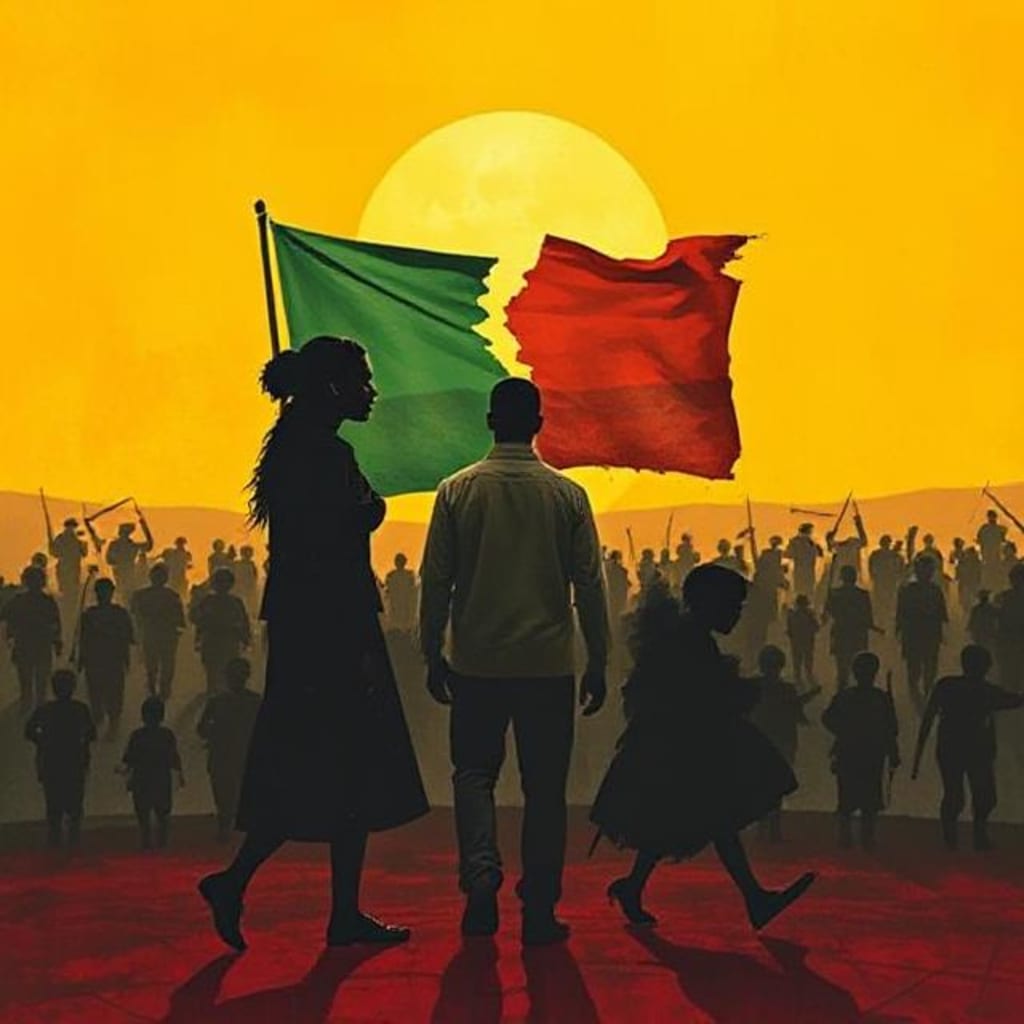
When Chimamanda Ngozi Adichie published Half of a Yellow Sun in 2006, she wasn’t simply writing a war novel. She was restoring memory. She was pulling back the curtain on a forgotten history—the Biafran War (1967–1970)—and asking the world to look again at the scars left on Nigeria, and the people caught in its violence.
This is not just the story of a war. It is the story of love during collapse, of family during famine, and of the fragile nature of dreams in a world governed by politics and power.
Part One: Before the Fire
The novel begins in the early 1960s, in a Nigeria still stitching together the wounds of colonialism. Britain had left, but the shadow of empire still lingered. New elites, educated in English schools, were rising, while ethnic divisions simmered beneath the surface.
We meet Ugwu, a 13-year-old boy from a poor village, who becomes the houseboy of Odenigbo, a radical university professor in Nsukka. Through Ugwu’s wide, curious eyes, we enter a household filled with intellectual debates, political arguments, and the heady optimism of a young nation.
Soon, Olanna enters the scene—the beautiful, educated daughter of a wealthy Igbo family, who abandons privilege to live with Odenigbo. She is gentle, compassionate, and deeply scarred by betrayal when she later learns of Odenigbo’s infidelity. Her twin sister, Kainene, could not be more different: sharp, sarcastic, and business-minded. She becomes the lover of Richard, an English writer who struggles to understand Nigeria but becomes deeply attached to Kainene and her people.
For a while, the novel feels like a story of lovers and dreamers. The conversations over palm wine, the laughter in university courtyards, the promises of independence. Yet, beneath this calm surface, cracks are forming. The old colonial boundaries had lumped together hundreds of ethnic groups into one fragile state. The Igbo, Yoruba, and Hausa were divided not just by language, but by politics.
The coup of 1966 changes everything. Nigeria fractures. The killings begin.
Part Two: The World Falls Apart
Adichie doesn’t flinch in showing how quickly neighbors can turn into enemies. Pogroms erupt in the north, where Igbo people are hunted and massacred. Trains carrying survivors arrive full of the mutilated, the starved, the traumatized. Olanna herself witnesses a massacre at a railway station—children’s bodies stuffed into baskets. That single moment, which Adichie writes with devastating restraint, marks the end of innocence.
In 1967, the southeastern region declares itself the Republic of Biafra, with its flag bearing half of a yellow sun. It is a symbol of hope, a promise of dignity and independence for a people who feel betrayed by Nigeria.
But hope is fragile. Nigeria declares war.
The world, too, turns its back. Britain, eager to protect its oil interests, supports Nigeria. Most of the international community follows. Biafra is blockaded, starved, and bombed into submission. The yellow sun that once promised a new dawn becomes instead a reminder of lost dreams.
Part Three: Life in the Ruins
For the characters, survival becomes the only goal.
Ugwu, once a shy village boy, is forced into the Biafran army. He experiences the brutality of war, both as a victim and as a participant—haunted by the atrocities he witnesses and commits.
Olanna struggles to hold her family together, caring for her daughter, Baby, amid air raids and hunger.
Kainene, the practical twin, becomes a war-time businesswoman, managing scarce resources, organizing refugee relief.
Richard, caught between his Englishness and his adopted Biafran identity, writes feverishly, desperate to capture the world’s neglect and the enormity of the suffering.
One of the most unforgettable aspects of the novel is its depiction of hunger. Biafra was starved into submission, and famine killed more than bullets. Adichie describes children with bloated bellies, their hair turning red from malnutrition, their eyes dull with resignation. Ugwu, Olanna, and the others scavenge for food, barter for scraps, watch loved ones wither.
And yet, within this darkness, there are flickers of humanity: stolen kisses, whispered laughter, moments of resistance against despair.
Part Four: Broken Bonds, Unbroken Spirit
War tests relationships as much as bodies. Olanna and Odenigbo’s love falters under betrayal, yet somehow endures. Kainene and Richard’s bond deepens, even as Richard struggles with the guilt of being a privileged outsider in someone else’s tragedy. Ugwu, once a servant, grows into a witness of history, carrying both shame and resilience.
The climax of the novel comes not with a battle, but with disappearance. Kainene, ever pragmatic and strong, goes on a trading mission during the famine and never returns. Her absence becomes a permanent wound, a reminder that not all losses are marked by graves.
When Biafra finally surrenders in 1970, the survivors emerge from the ruins carrying invisible scars. The dream of independence dies, but the memories of what was endured remain.
Part Five: What Adichie Really Wrote
On the surface, Half of a Yellow Sun is a historical novel about a war. But beneath that, it is a novel about memory and forgetting.
For decades, the Biafran war was something Nigeria refused to talk about. Official histories minimized it. International histories ignored it. Millions had died, and yet silence wrapped around their graves. Adichie breaks that silence, insisting that literature must do what politics failed to do: remember.
It is also a novel about the personal cost of war. Where history books might count deaths in numbers, Adichie counts them in names—Ugwu, Olanna, Kainene, Richard. She insists that war is not statistics, but shattered lives.
And finally, it is a novel about love in a time of collapse. Love does not vanish during war—it becomes sharper, more desperate, more necessary. Whether it is Olanna’s devotion to her daughter, Kainene’s fierce loyalty to refugees, or Ugwu’s quiet transformation into a man who can tell this story, love becomes the last form of resistance.
Conclusion: Half a Sun, Half a Memory
Half of a Yellow Sun is not a book that leaves you comfortable. It leaves you unsettled, mourning, reflecting. It forces you to ask: What does war take from us? What survives when nations fall?
Adichie shows us that the war for Biafra may have ended in defeat, but the stories of its people live on. Ugwu, in the novel’s closing moments, begins to write a book about the war—a book that is, in many ways, Half of a Yellow Sun itself.
The half sun on Biafra’s flag was meant to symbolize a rising dawn. But Adichie reminds us: it can also be seen as a half-light, a reminder of what was lost, and of the incomplete work of memory.
About the Creator
Keep reading
More stories from Hamza Habib and writers in BookClub and other communities.
The Handmaid’s Tale
When Margaret Atwood published The Handmaid’s Tale in 1985, it was intended as a dystopian cautionary tale. Forty years later, it feels eerily like a prophecy. It is not only a story about one woman’s survival under an authoritarian regime but also a mirror held up to the ways in which societies control bodies, especially women’s bodies, through religion, politics, and fear.
By Hamza Habib6 months ago in BookClub
Book Review: Atmosphere by Taylor Jenkins Reid
I flipped the book over in my hands in the centre of the small airport book shop. Although I had heard promising reviews of Atmosphere by Taylor Jenkins Reid, I hesitated. The synopsis didn’t compel me - I wasn’t much of a space girly. In high school it made me cringe when my peers would talk about the stars.
By sleepy drafts25 days ago in BookClub
Reading Orlam
Introduction For my birthday I got the Polly Jean Harvey book "Orlam". I was a little confused about it at first, but now it has revealed itself to me and I am enjoying exploring the worlds and magical mythical creatures and people that are described here.
By Mike Singleton 💜 Mikeydred 6 days ago in BookClub



Comments
There are no comments for this story
Be the first to respond and start the conversation.