
He discovered it, he did not create it.
Aristotle

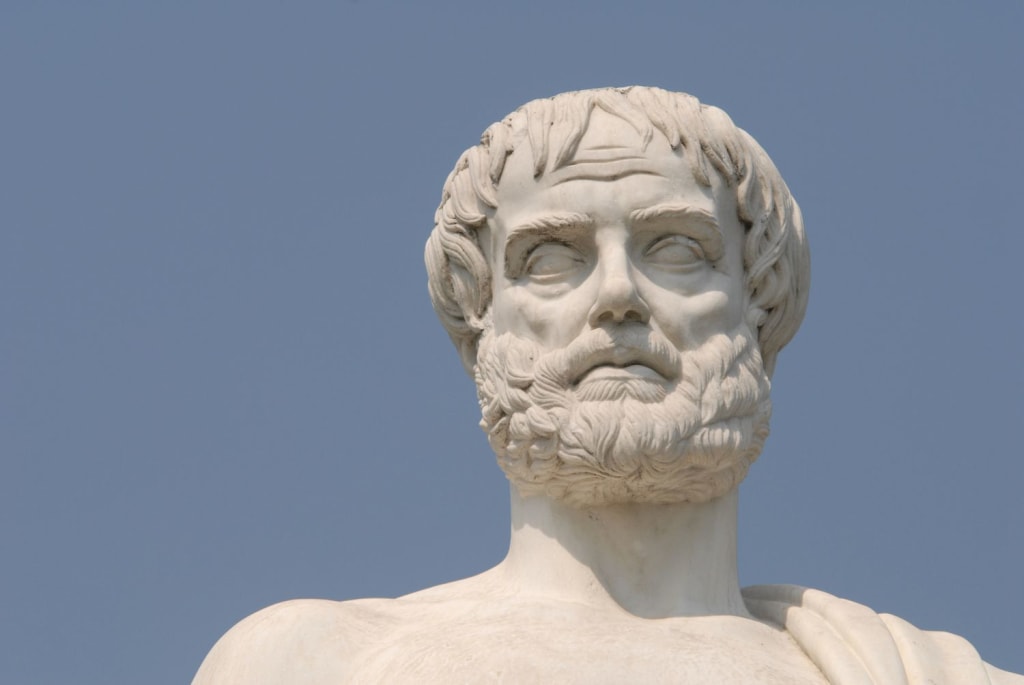
Humans are innately created to think. Or, to satisfy everyone, let us say: the human nature itself is inherently reflective. For those who do not believe in creation, it is evident that humans always distinguish between things—they recognize the difference between a horse and a human. A horse is a wild, irrational animal, whereas a human is rational and articulate. Humans also perceive that while a horse does not speak, humans do; indeed, this understanding extends to the entire animal kingdom.
They notice that smoke signifies fire, and sunlight entering through the window indicates the rising of the sun, and so forth. They also observe that certain things are opposites: fire opposes water, light opposes darkness, and life opposes death. They realize that opposing entities cannot coexist simultaneously: if fire meets water, either the fire is extinguished or the water evaporates. There cannot be a living and a dead being at the same time, nor can a place be both dark and illuminated simultaneously. In essence, one entity nullifies the other—or, more academically, cancels it.
These observations of relationships and distinctions were contemplated by ancient civilizations—from the Sumerians and Babylonians to the Indians, and finally the Greeks—who recognized that some principles are fixed and unchanging, becoming ingrained in the mind and self-evident, much like a person’s awareness of their own name.
From reading history, we see that humans have always been creative and curious. Unfortunately, much of their curiosity and intellectual pursuit was lost over time, like the wind scattering seeds. Then came the Greeks, and with them a man named Aristotle (or Thales of Miletus), whose era was one of scholarship and documentation. Fortunately, his ideas and questions were preserved, unlike many before him. Among his contributions was the science of logic—which, in another sense, is more of a discovery than a science—defined as a balance by which things are measured (here, “balance” refers to weighing the truth of statements against falsehood).
Aristotle expressed his ideas across several works:
- Categories
- On Interpretation
- Prior Analytics
- Posterior Analytics
- Topics
- On Sophistical Refutations
This collection is known as the Organon, a Greek term meaning “balance” or “instrument.” Within these treatises, he established rules including the classification of terms into simple and composite, divisions of indications, the purpose of poetry, the purpose of dialectic, and other studies, all sharing a single aim: the pursuit of knowledge through precise thought, asking the right questions, and finding the correct answers.
About the Creator
Ali Abdulkareem
born in 2007.
I try to present the results of my thinking based on what I read; sometimes I take pride in what I consider right, sometimes I critique, and sometimes I stand puzzled.
You may notice that I rarely provide sources.
Keep reading
More stories from writers in BookClub and other communities.
7 Amazing Books To Help Improve Your Critical Thinking
In a world overflowing with information, opinions, and half-truths, critical thinking is no longer a “nice-to-have” skill—it’s essential. Every day, we’re asked to evaluate news headlines, make financial decisions, assess workplace strategies, and navigate complex social issues. Without strong critical thinking skills, we risk accepting flawed arguments, falling for misinformation, or making decisions that don’t serve our long-term goals.
By Diana Meresca day ago in BookClub




Comments
There are no comments for this story
Be the first to respond and start the conversation.