
"Go Down Together" by Jeff Guinn - Book Club Discussion
Book club prompts

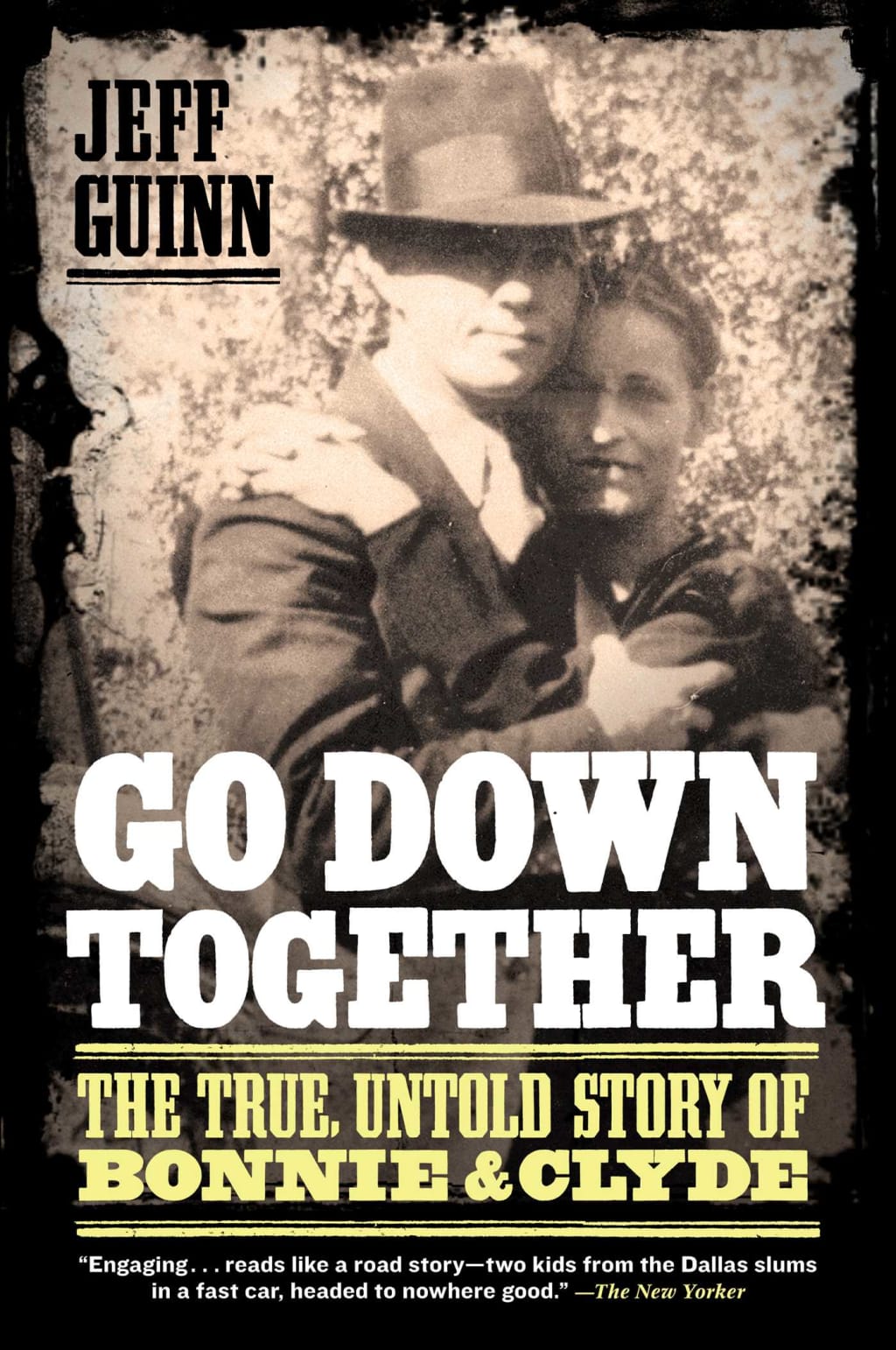
Forget everything you think you know about Clyde Barrow and Bonnie Parker. Previous books and films, including the brilliant 1967 movie starring Warren Beatty and Faye Dunaway, have emphasized the supposed glamour of America's most notorious criminal couple, thus contributing to ongoing mythology. The real story is completely different -- and far more fascinating.
Bonnie & Clyde: Bonnie Elizabeth Parker and Clyde Chestnut Barrow were an American criminal couple who traveled the Central United States with their gang during the Great Depression. The couple was known for their bank robberies, although they preferred to rob small stores or rural funeral homes.
About the Author:
- Jeff Guinn is the bestselling author of numerous books, including Go Down Together, The Last Gunfight, Manson, The Road to Jonestown, War on the Border, and Waco.
- He lives in Fort Worth, Texas, and is a member of the Texas Literary Hall of Fame.
- Jeff Guinn is the winner of the 2016 TCU Texas Book Award.
- The former books editor at the Fort Worth Star-Telegram and award-winning investigative journalist, he is a member of the Texas Institute of Letters.
- On Writing the Book:
- “Guinn’s “clear-eyed” account acquits the couple of some of the gang’s worst transgressions but never romanticizes them” (The Week)
- “if we examine their lives as a story, then it has everything: young kids rebelling against authority, there's the Romeo and Juliet thing, true love, and think they're really mostly interesting to us finally because of the way they die in this bloody, graphic, ambush when, essentially, they're blown, in the words of one of the deputies during the shooting, into a pile of wet rags. Would they have been as interesting to us if, let's say, they'd surrendered meekly that day, got long prison sentences, and came out sort of bent, worn-out old people? No, I don't think so. You had to have the great supposed tragedy and the drama of their deaths, and that's why, in various forms, the story's held us ever since. It's been 75 years, and yet thousands of people still troop out to look at their graves every month.” (NPR)
- “In a sense, all my books are about how our culture takes history and re-shapes it into whatever mythology suits our collective needs and interests at a given time. I wanted to answer two questions in Go Down Together. The first was, why would two young people willingly give up their lives for a very brief period of lawbreaking? Second, why would a nation find them fascinating and elevate them to the same sort of iconic heights enjoyed by Charles Lindbergh and Babe Ruth just a few years earlier? There had to be some sort of event-driven sociological chemistry at work. What was it?” (CBS News)
- “In a very real sense, Clyde Barrow and Bonnie Parker are less important for themselves than for what they represent. They reflect a time in our history when there was a huge chasm between a few very rich Americans and millions of poor ones. Young people born into poverty had no hope for improving their lives. Yet modern media - movies, newspapers, magazines - shoved into their faces images of fancy cars, fine clothes, glamour in every conceivable form - on a daily basis. When ambitious kids want things they can't have by following the rules, they break them. That's immutable fact. The parallels between the Barrow Gang era and modern-day America are staggering. Once again, many struggling people don't trust the government, think of the banking industry as the enemy, and feel helpless to save themselves and their families by doing what they are told to do (obey all the laws, trust the government). We can either learn from the past or, in some more modernized form, repeat it.” (CBS News)
Discussion Questions:
- Did you know the story of Bonnie & Clyde before reading “Go Down Together”?
- What did you learn from the book that you hadn’t known before?
- Why do you think Bonnie & Clyde are still glamorized in pop culture? What makes them more interesting than Blake Fitzgerald & Brittany Harper?
- In what ways are Bonnie and Clyde portrayed as heroes? What were some of their personality traits?
- Based on the book's cover, what were your expectations for the book? Were you right?
- The cover depicts an iconic, vintage photo of Bonnie Parker and Clyde Barrow. What do the photo and the rest of the cover suggest regarding the time period, the individuals pictured there, etc.?
- Thinking about how each of the characters grew up, how did that affect their lives?
- How did Clyde’s time in prison contribute to his criminal lifestyle? Would anything have deterred him?
- What do you make of the relationships between Blanche & Buck? Even after Blanche’s most prized possession, Snow Ball is lost to her, she continues to stay by Buck’s side while nagging him. Why?
- What do you make of the family dynamics between the Parkers and Barrows? Why did the family unwaveringly protect the criminals? What does this say about familial bonds?
- What legacy did Bonnie & Clyde leave behind? Is being infamous criminals a legacy?
- Do you think that Guinn got to the truth about Bonnie & Clyde? What truths did you discover that differ from the legend usually surrounding Bonnie & Clyde?
- Did you find yourself doing any research on topics brought up in the book? If so, on what?
- Did you read any of Bonnie’s poems? What did you think of them? Was she a good poet or simply glamorized for her escapades?
- Bonnie had big dreams for her life (a Broadway actress, a well-known poet, etc.). Why do you think she ‘settled’ for the criminal lifestyle of Clyde? Love? Popularity? Being seen?
- Was there an end to how far Bonnie & Clyde would’ve gone for each other? Why or why not? What bonded them together in such a way?
- Why do you think image was so important to Bonnie & Clyde? Bonnie is more upset with being thought of as a cigar smoker than being a criminal. Clyde makes all of the Barrow Gang members dress in suits.
- Do you think the deaths of Bonnie & Clyde were fair? Should they have been given the chance to surrender by Hamer and his posse? Would they have done so? Or was death the only way to stop Bonnie & Clyde?
About the Creator
Kristen Barenthaler
Curious adventurer. Crazed reader. Librarian. Archery instructor. True crime addict.
Instagram: @kristenbarenthaler
Facebook: @kbarenthaler
Keep reading
More stories from Kristen Barenthaler and writers in BookClub and other communities.
"Forensics" by Val McDermid - Book Club Discussion
Val McDermid is one of the finest crime writers we have, whose novels have captivated millions of readers worldwide with their riveting narratives of characters who solve complex crimes and confront unimaginable evil. In the course of researching her bestselling novels McDermid has become familiar with every branch of forensics, and now she uncovers the history of this science, real-world murders and the people who must solve them. The dead talk--to the right listener. They can tell us all about themselves: where they came from, how they lived, how they died, and, of course, who killed them. Forensic scientists can unlock the mysteries of the past and help serve justice using the messages left by a corpse, a crime scene, or the faintest of human traces. Forensics draws on interviews with some of these top-level professionals, ground-breaking research, and McDermid's own original interviews and firsthand experience on scene with top forensic scientists. Along the way, McDermid discovers how maggots collected from a corpse can help determine one's time of death; how a DNA trace a millionth the size of a grain of salt can be used to convict a killer; and how a team of young Argentine scientists led by a maverick American anthropologist were able to uncover the victims of a genocide. It's a journey that will take McDermid to war zones, fire scenes, and autopsy suites, and bring her into contact with both extraordinary bravery and wickedness, as she traces the history of forensics from its earliest beginnings to the cutting-edge science of the modern day.
By Kristen Barenthaler2 years ago in BookClub
My New Book is Finally Here
My poetry collection Beautiful and Brutal Things is done. It's actually done and finally published over 270 pages. Over a year of my life went into this book. More than a year, really. Long days at my computer, sometimes seven days a week because I couldn't stop even when I probably should have. Then two months of editing that felt harder than the writing itself. But it's finished, and I'm still standing, and the book is real.
By Tim Carmichaela day ago in BookClub
7 Books About Psychology That Are Impossible To Put Down
Psychology is not just an academic discipline—it’s a mirror held up to our inner world. It explains why we think the way we do, why we fall in love, why we sabotage ourselves, and why some habits cling to us like gravity. The best psychology books don’t feel like textbooks; they feel like conversations that change how we see ourselves and others.
By Diana Meresca day ago in BookClub



Comments
There are no comments for this story
Be the first to respond and start the conversation.