
Educational Philosophy by Frank Navarro’s "Trump, Hitler and Me"
This blog explores educational philosophy integrity, truth in education, and the philosophy of education revealed in a teacher’s journey.
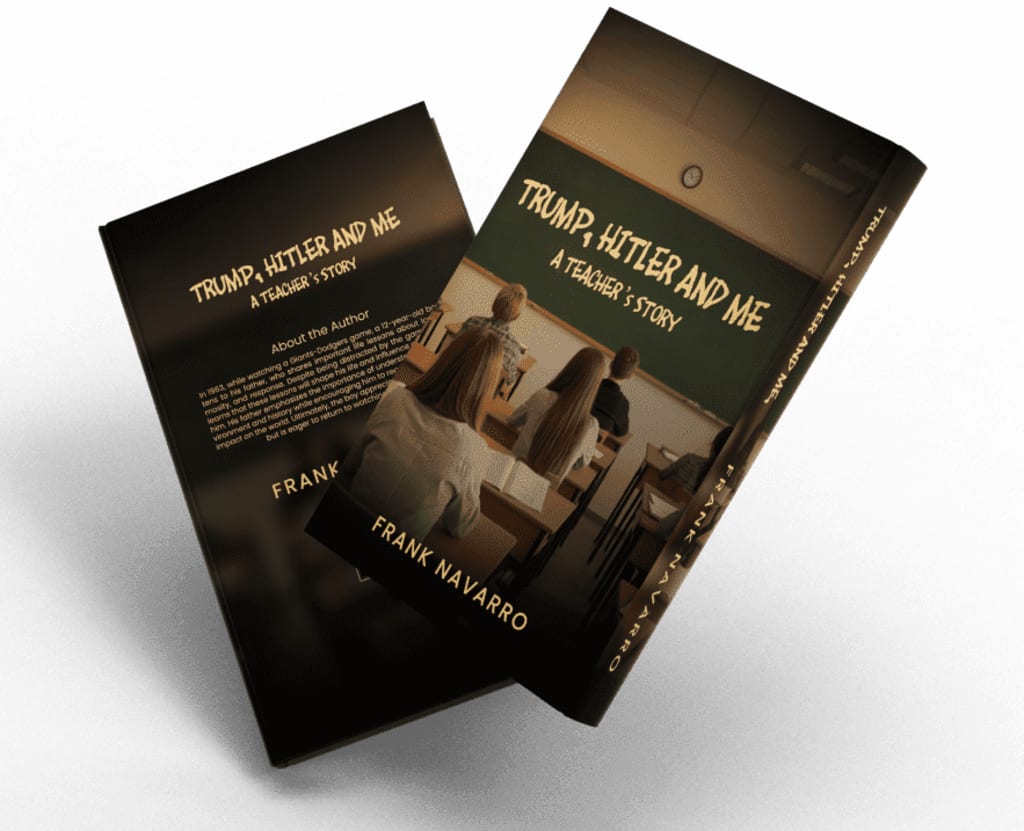
The heart of a very fascinating memoir by Frank Navarro, Trump, Hitler and Me is educational philosophy. He narrates about a teacher who is in the crossroad between truth and power and makes the philosophy of teaching come alive through personal memories, moral issues, and professional practices. He starts out with baseball and ends up with a strong defense of free thinking. Each page teaches lessons to students, teachers and citizens. His message is unpacked in this blog. It puts a focus on how history, identity, and truth meet in the classroom. Navarro speaks plainly. His message is immediate. His experience is characteristic of our era.
A Childhood Lesson That Shaped a Teacher’s Mind
Frank Navarro starts his narrative with a Giants Dodgers game. It’s 1963. He is a boy and is seated next to his father. A normal outing would be a serious lesson. His father explains to him about love, hatred and the ways people decide to react. These are not mere lessons in life. They form the basis of what a teacher value. They re-appear in Frank in his own classroom years later. And, finally, in a national discussion where he never thought himself involved.
He turns into a teacher who does not teach material and tells why it should matter. He makes parallels between the contemporary politics and the past and thinks that education is a reflector one that reflects the values of the society. That was to prove a costly belief to him.
When History and Politics Enter the Classroom
Following the U.S. election of 2016, Navarro provides a lesson in the rhetoric of Donald Trump as compared to that of Adolf Hitler. He does not come with an unruly accusation. Rather, he meticulously describes the process of political messaging. He employs facts. He describes similarities in speech and tactics. However, the following day, he is put on leave. The school claims it is to keep safe. Yet what was the truth? One of the parents did not agree with his statement in the classroom. A single complaint resulted in national attention.
That is not all about Navarro. He tells of the burden of silence. What it is like to be told to step back on your students. It was not a leave of absence to him. It was a breach of trust. Years had been spent carefully teaching, using evidence, challenging students to think. Suddenly, all that seemed to mattered no more.
This event drives him to write Trump, Hitler and Me. The memoir does not cover a single event. It is about what it is like to teach in politically fraught times and is a matter of courage. It is responsibility. And it shows a great educational philosophy instruction must be based on truth, even when there is danger in it.
Standing Firm in a Divided World
Navarro does not perceive the classroom as a distinct entity to the society. In his opinion, students should be ready to face the outside world. That involves appreciating history, injustice and propaganda. He does not shun controversy. He regards it as a chance to dig deeper. To educate not only what occurred but why it occurred. And above all what it means now.
His memoir also recollects his union origin. Having been raised in a union family, Navarro was taught the strength of defending the rights of the workers. However, this is not the case in his school. Teachers do not have to be unionized. Others find it unnecessary. Navarro asks honest questions: What is it to be a team player? When do you speak up? What do you do to defend one another when the system seems to be very hostile?
These are not simple questions. Yet they get to the heart of teaching. Once politics is introduced into the classroom which it always is teachers can decide. Be safe or tell the truth? Play it as neutral or make students think? Here, the educational philosophy of Navarro is evident. He is of the opinion that teaching is not neutral. It never was
In most instances’ neutrality is biased to the status quo. And where the status quo is unjust or dishonest, silence is complicity. Navarro does not want to keep it to himself. He desires his students to know the history. In order to find out how democracy can disintegrate. In order to identify threatening speech. To stand up when it counts the most.
Truth in Educational Philosophy
This is the truth in education itself. It is not about the promotion of a political agenda. It is a matter of honesty. Sincere of the past. Up front with power. Frank about what we remember and what we forget. Navarro does not write like a politician, but like a teacher. He demonstrates that a community can be shaken by a single lesson.
He also exposes the influence of fear on education. Firstly, educators are afraid of reprisal. Meanwhile, school’s dread controversy. At the same time, parents are scared of what they do not know. However, Navarro penetrates that fear. Moreover, he demonstrates that integrity in the classroom creates trust. Consequently, it opens minds. In fact, it does not make students absorb information but question.
We do not learn only at school or with books. We are able to learn whenever we encounter new experiences or issues. Learning can be painful. In a bid to learn, we have to go beyond our comfort zone. It is due to this that both the student and the teacher require courage. Unfortunately, schools that safeguard comfort instead of honesty fail. Yet, when the teachers talk clearly and responsibly, students learn. As a result, they acquire the power to think, question, and lead.
A Memoir That Turns into a Movement
The book is full of defining moments victories, mistakes, mentors, and lessons that Navarro shares throughout the book. He is not an ideal teacher. But he is a devoted one. In that commitment, the readers get to witness what education ought to be: daring, honest, and human. Trump, Hitler and Me is more than a memoir. It is the mirror to educational philosophy itself. Navarro helps us remember that the students come to the school as a whole person. Educators do not only influence knowledge, but lives. When Navarro was in controversy, people accused and defended him simultaneously. This was a good lesson to him: that people listen to what teachers teach, but they do not always know how teachers teach.
Conclusion
The book by Frank Navarro discloses a educational philosophy based on experience, challenge, and resilience. He educates that truth is important, particularly at the classroom. His story is very personal and very universal. His message is powerful as schools are under pressure. He demonstrates that education is not only about content. It is all about daring to go. It is a matter of posing tough questions and providing straight answers. Navarro model has integrity during political tension. He reminds the world that in education, truth needs more than knowledge it needs principle. His voice is an echo that we have to listen to, as teachers, parents, and students.
About the Creator
Keep reading
More stories from Lisa Hormyko and writers in BookClub and other communities.
Rodney Fenner’s Profound Contribution to Emotional Intelligence Books
Stories have the energy to reflect the emotions we regularly conceal. In Rodney Fenner’s work, storytelling will become a reflect, a way to study the emotional complexities that define our lives. With novels and short tale collections that dig deep into trauma, connection, and self-awareness, Rodney has earned his location among standout emotional intelligence books. His characters don’t simply circulate via life; they wrestle with it, research from it, and develop. His writing offers readers space to understand their very own struggles within the lives of fictional human beings. That is the form of storytelling that resonates. His books join now not just mind to web page however additionally heart to heart.
By Lisa Hormyko7 months ago in BookClub
Rachel Reviews: Lakefront Wolves by Joseph Deegan
Meet Finn. He's an 18 year old kid who has potential. He's bright with great school scores and he's also an athlete, a footballer of some prowess. He has it all going for him, it would seem, and yet, he's determined to send what could be a well-planned, stable existence firmly off the rails. He drinks, he smokes, he takes drugs, he has violent tendencies and he's in danger of losing not only his mind but all that he holds dear.
By Rachel Deeming15 days ago in BookClub
7 Must-Read Books for Those Looking to Start Reading Again
Rediscovering the joy of reading can feel a bit like returning to an old friend. Many of us once devoured books but gradually drifted away due to busy schedules, digital distractions, or simply losing the habit. The good news? It’s never too late to rebuild a reading routine—and the right books can make the journey exciting again.
By Diana Meresc3 days ago in BookClub



Comments
There are no comments for this story
Be the first to respond and start the conversation.