
"Books That Read You Back"
Genre: Literary essay / Reflection Every time you reread a book, it reveals something new — not because the words change, but because you do. The story explores how literature evolves alongside us, acting like a mirror to our growth. Why it fits: Philosophical yet accessible. This theme fits beautifully with the platform’s reflective tone.

Books That Read You Back
There are books that you read once and set aside, like postcards from a journey you’ll never repeat. And then there are others—those rare, breathing books—that seem to read you back. Their pages are the same, their words unmoving, but somehow, each time you open them, they feel alive in a different way.
I used to think books were static things—ink on paper, bound between covers. But now I know they are mirrors, and mirrors do not change; you do.
The first time I read The Little Prince, I was twelve and curious about why adults made such a fuss over a story that looked like a children’s book. I found it puzzling then—why the prince cared about a rose, why he left his tiny planet, why he asked so many questions. I read it the way one might read a fairy tale, looking for the moral at the end.
Years later, I picked it up again, accidentally, in a used bookstore with a coffee stain on the first page. The same sentences stared back at me, yet they felt rewritten. The rose, fragile and temperamental, reminded me of someone I had once loved and lost. The prince’s loneliness felt heavier. The fox’s whisper—“You become responsible, forever, for what you have tamed”—no longer sounded like advice for children, but a quiet truth about adulthood.
That day I realized: the story hadn’t changed. I had.
Every book is a time capsule, not of its story, but of the person you were when you first opened it. Rereading is like writing a letter to your past self and getting an unexpected reply. The same plotlines unfold, the same words march across the page, yet somehow, they reflect different meanings—meanings that only appear when you’ve lived enough to understand them.
When I first read To Kill a Mockingbird, I admired Atticus Finch’s courage. Years later, I began to see Scout as the real heart of the novel—the child who learns how unfairness is built into the world’s foundations. And years after that, I realized the story isn’t only about justice; it’s about empathy, and how fragile it is in a society that rewards blindness.
Each rereading was like meeting a friend under new light. The character I once admired became human. The villain I once despised became understandable. Books, it turns out, don’t just tell us stories—they hold up a mirror to the way we’ve learned to see.
There’s a kind of quiet magic in realizing that literature evolves with you. The copy of Jane Eyre on your shelf is not the same book it was ten years ago, even if every word remains identical. You are not the same reader. Your experiences have become part of the ink. Your heartbreaks, triumphs, and disappointments whisper between the lines.
That’s why people cry over books they once read without blinking. It’s not that the book became sadder—it’s that they’ve lived enough to recognize themselves in the sadness.
Sometimes, I imagine books as sentient beings, waiting patiently for us to catch up to them. They know things about us that we haven’t yet discovered. They sit on shelves, quietly observing our years pass, and when we return to them, they open their arms differently.
The words are the same, but the weight they carry shifts—like a melody played in a new key. A sentence that once felt ordinary suddenly cuts deep. A paragraph that used to bore you now feels profound. That’s not coincidence; it’s recognition.
We think we are the readers, but maybe the books are reading us—measuring who we are through what we notice, what we underline, what makes us pause.
The truest proof of this came when I reread a book I’d loved during a difficult year of my life—The Bell Jar. The first time, I read it for its voice: Sylvia Plath’s brilliant, biting honesty. The second time, I read it for survival. And the third, for forgiveness. Each read revealed a new version of both the book and myself—one struggling, one recovering, one quietly grateful to have made it through.
That’s the secret of great books: they become part of your memory, and your memory, in turn, rewrites them.
Maybe that’s why people keep books they no longer read. Not because they plan to open them again soon, but because those books hold versions of who they used to be. They are bookmarks in our own becoming.
So the next time you pick up a novel you’ve already finished, don’t expect it to be the same. It won’t be. You will find new truths in old paragraphs, new heartbreaks in familiar lines. You might even catch a glimpse of your younger self—naïve, hopeful, unscarred—reading beside you in the margins.
Books, after all, don’t just tell stories. They keep them. And sometimes, when you’re ready, they read you back
About the Creator
Rachel Reviews: Lakefront Wolves by Joseph Deegan
Meet Finn. He's an 18 year old kid who has potential. He's bright with great school scores and he's also an athlete, a footballer of some prowess. He has it all going for him, it would seem, and yet, he's determined to send what could be a well-planned, stable existence firmly off the rails. He drinks, he smokes, he takes drugs, he has violent tendencies and he's in danger of losing not only his mind but all that he holds dear.
By Rachel Deeming8 days ago in BookClub
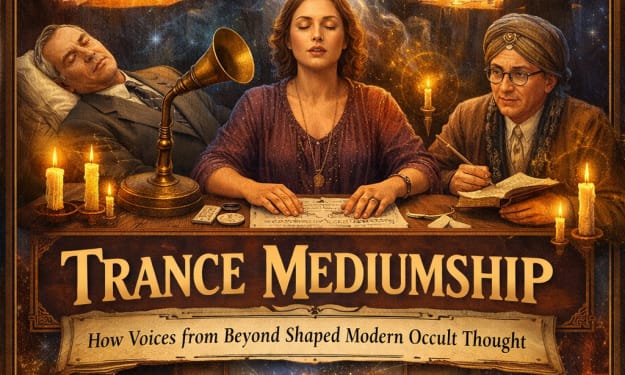
Trance Mediumship
The Living Voice in Altered States Trance mediumship holds a distinctive place within Western esoteric tradition. Unlike intuitive divination or clairvoyant perception, trance mediumship is defined by an altered state of consciousness in which speech, posture, facial expression, and temperament appear to shift under the influence of a perceived external intelligence. Observers have documented changes in tone, vocabulary, accent, and manner. Adherents interpret these manifestations as communication from discarnate beings. Psychical researchers have examined the same phenomena through frameworks of dissociation, subconscious cognition, and culturally conditioned religious experience. Occult practitioners have regarded trance as a disciplined method for accessing unseen dimensions of reality.
By Marcus Hedare5 days ago in BookClub



Comments
There are no comments for this story
Be the first to respond and start the conversation.