
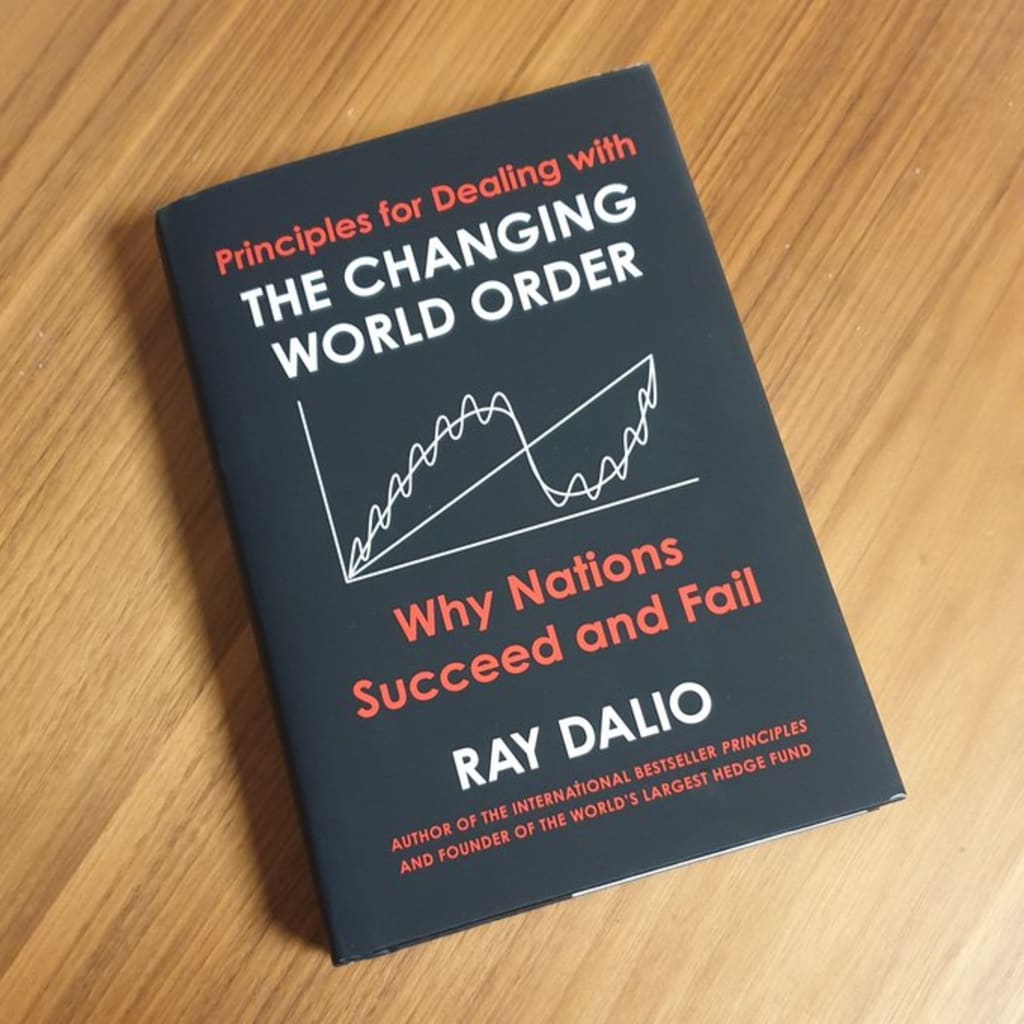
📘 Book Review: "Principles for Dealing with the Changing World Order: Why Nations Succeed or Fail" by Ray Dalio
“A provocative read ... There are few tomes that coherently map such broad economic histories as well as Mr. Dalio’s. Perhaps more unusually, Mr. Dalio has managed to identify metrics from that history that can be applied to understand today

🧠 Overview
Billionaire investor Ray Dalio extends his expertise with global economics through Principles for Dealing with the Changing World Order to reveal the enduring patterns that control national destinies. The book blends economic theory with historical information and predictive analytics as it explains the various factors that create empires and their life cycles while anticipating future world directions.
As Dalio explains, Big Cycle represents the unified analytical method through which internal forces combine with external variables to determine a nation's fate of rise or fall. While discussing power transitions, he uses the Dutch Empire and its British Empire successor, as well as the American Empire, together with the rising Chinese Empire, as examples.
🧩 Core Concepts
1. The Big Cycle
Throughout empire history Dalio recognizes a recurring pattern that consists of three evolutionary stages.
The Rise: Characterized by strong leadership, innovation, education, and productivity.
The top represents the time when a nation achieves its highest levels of wealth combined with peak power before becoming unproductively stable.
When empires start their decline, debt soars while disputes within the nation escalate alongside external threats.
His research covers a 500-year history through which he demonstrates the recurring nature of these cycles spanning approximately 250 years.
2. Determinants of National Success or Failure
His analysis of national strength involves 18 decisive indicators, which include:
-Debt levels
-Military strength
-Education and innovation
-Wealth gaps and internal conflict
-Reserve currency status
The indicators lead to the design of visual scorecards, which display national performance patterns.
3. The Role of Debt and Monetary Policy
Through extensive knowledge, Dalio has mastered the subject of monetary policy, together with central banking operations and credit cycle functions. The author explains that rising debt-funded expansion becomes problematic when it triggers increased inflation or reduced currency value, or societal disturbances.
Quantitative easing, along with currency debasement together with prolonged periods of zero or negative interest rates receive special focus from him.
📊 Data-Driven Insights
Dalio backs his claims with solid evidence that consists of large data visualizations and comprehensive graphs along with historical points of reference. For instance:
The author depicts America in a way that resembles the British and Dutch empires during their final stages.
He evaluates China through precisely eighteen measurements he applied previously to different historical powers.
The systematic explanation of methodology stands out as one of the essential features in this book. All conclusions made in the book become more apparent because the reader understands how the author reached those conclusions.
🌍 Geopolitical Implications
A major portion of the book focuses on American-Chinese relations alongside the changing dynamics from U.S. unipolarity to a global multipolar system. Dalio warns about:
The potential for military conflict
-Economic decoupling
-A looming global debt crisis
-Internal political polarization, particularly in the U.S.
In his analysis, Dalio evaluates how the U.S. dollar functions as the preeminent reserve currency, and he explores competition from both Chinese yuan and digital currencies to replace this position.
📘 Strengths of the Book
✅ Comprehensive Scope: Covers history, economics, politics, and psychology.
The book uses a great number of infographics alongside charts to enhance visual learning.
Through its practical approach, the book provides frameworks that help people recognize global occurrences and make wise choices.
Because of its neutral approach, the content only focuses on patterns in addition to data instead of demonstrating ideological bias.
The book explains economic ideas at a level all readers can understand from their background of economic knowledge.
⚠️ Critiques
The text repeats certain concepts several times by presenting them through different frames of reference.
Data depth presents a daunting problem for readers who approach the material casually.
The analysis reaches depth, but Dalio does not present specific plans for either policymakers or common readers.
🧭 Key Takeaways
History repeats—or at least rhymes. The analysis of the Big Cycle enables users to foresee upcoming events.
The end of imperial expansion occurs from domestic sources before external powers complete the downfall through debt levels and social division, together with warfare.
Using Dalio's model, both the United States show signs of decline, while China demonstrates growth, yet both nations encounter substantial domestic challenges.
The duration of nations depends heavily on their capability to adapt alongside their educational framework.
Nations require sound money and institution-based trust to maintain their national strength.
✍️ Best Quote
Worrying about something doesn't relieve you from that concern, but a lack of concern requires your attention to it. Being worry-free about something is in itself a reason to become worried.
From Dalio's perspective, the aware and attentive individuals become better equipped to handle revolutionary changes.
🔚 Conclusion
Every individual who shows interest in macroeconomics or investing, and geopolitical history should study Principles for Dealing with the Changing World Order. The book provides critical long-term analysis during a period when market behaviors and news cycles focus only on short-term perspectives.
Through timeless principles, Ray Dalio helps students learn ways to analyze current global changes, but avoids dictating his thoughts.
About the Creator
TAPHA
Hi! Whether you're looking for insightful answers or a fresh perspective on a topic,I'm here to provide engaging, accurate,and thought-provoking content tailored just for you. Stick around, and let's explore the world of knowledge together!
My New Book is Finally Here
My poetry collection Beautiful and Brutal Things is done. It's actually done and finally published over 270 pages. Over a year of my life went into this book. More than a year, really. Long days at my computer, sometimes seven days a week because I couldn't stop even when I probably should have. Then two months of editing that felt harder than the writing itself. But it's finished, and I'm still standing, and the book is real.
By Tim Carmichael2 days ago in BookClub
7 Dystopian Books You Must Read In 2026
In an era where society constantly wrestles with technological advances, political unrest, and environmental crises, dystopian literature offers a mirror to our present and a cautionary glimpse of the future. These books are more than just stories—they challenge our beliefs, provoke critical thinking, and explore the fragility of civilization. Below is a list of 7 dystopian books you must read in 2026.
By Diana Meresc6 days ago in BookClub




Comments
There are no comments for this story
Be the first to respond and start the conversation.