
Book Review: "Mortal Engines" by Philip Reeve
A wasteland full of wasted potential

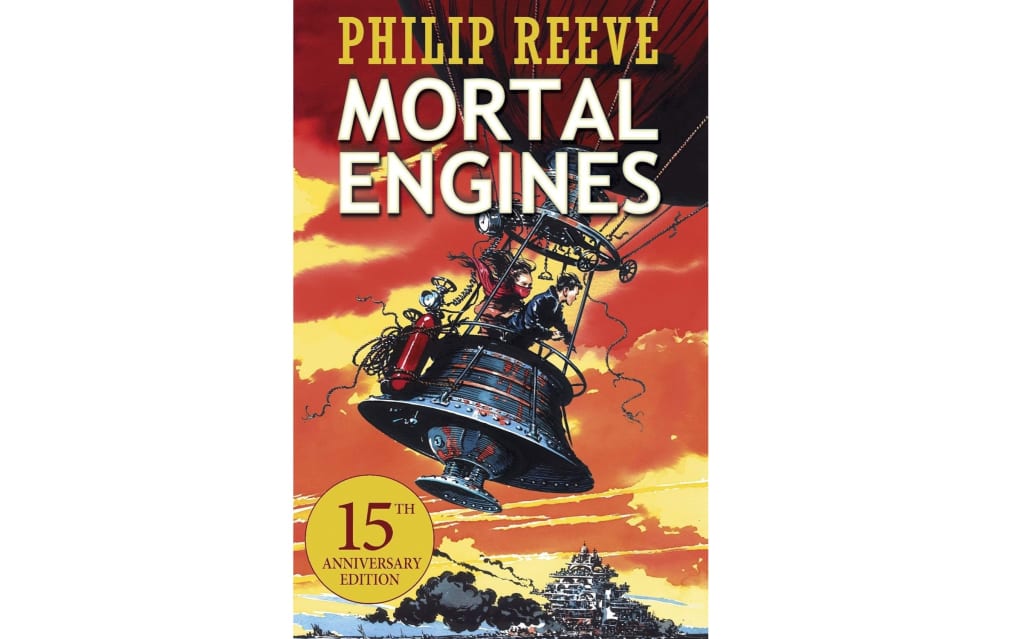
The beginning of this review is spoiler-free.
INTRODUCTION
In 2018, Mortal Engines first crossed my radar as a film adaptation produced by Peter Jackson.
I don't remember what movie I was seeing when the preview came on the screen, but I was immediately entranced by what I saw. In that darkened theater, the city-sized vehicles seemed to be hundreds of feet tall, emphasized by the sweeping scenery Jackson has been known for since his Lord of the Rings trilogy. The teaser couldn't have been more than thirty seconds long, but it made enough of an impact on me that I looked up the release date after I left the theater. Needless to say, I was excited.
Then the release date came, and the movie received a whopping 26% on Rotten Tomatoes.
Reviews aren't always accurate, but my enthusiasm certainly dimmed. I did more research and saw the movie was universally panned, and it was then that I realized it was based on a book.
Well, that made it all make sense! Clearly what we saw was a poor adaption of a beloved novel. I decided that I'd pick it up at some point and experience the real story.
I had that opportunity recently, when my office's book club picked Sci-Fi as the genre of the month. We usually try to recommend books we haven't read, so I suggested Mortal Engines. It was chosen, and I picked up my copy at the library and settled down to read.
I still have not seen the movie. But now that I have read the book, I no longer think the movie was a poor adaptation of a great book. Instead, to my immense disappointment, I suspect it was a faithful adaptation of a very mediocre novel.
PREMISE
Mortal Engines takes place thousands of years in the future in the Great Hunting Ground, a large landmass that encompasses most of modern-day Europe. Due to a cataclysmic event known as the Sixty Minute War, many communities became nomadic, preferring to travel around and look for resources rather than accumulating them in one place. This eventually culminated in the birth of Traction Cities: large, multi-tiered cities that are built on enormous treads, allowing them to travel at high speeds. Within the Great Hunting Ground, these cities practice Municipal Darwinism, which involves larger, more prosperous cities "eating" smaller cities and towns by capturing them and stripping the structures for parts. This practice is at odds with the Anti-Traction League, a coalition of "static" cities in Asia that built an enormous "shield wall" between themselves and the Great Hunting Ground to protect themselves from what they consider to be a barbaric tradition.
The story starts in the Traction City of London and centers on a fifteen-year-old orphan named Tom Natsworthy. After London eats a small town, Tom witnesses an assassination attempt of his hero - an explorer named Thaddeus Valentine - by a teenage girl named Hester, who was one of the denizens of the now-defunct village. After a brief chase, Hester tells Tom that Valentine murdered her parents and then she escapes to the Out Country. When Tom reveals this, Valentine pushes him out of the city in an attempt to kill him. Alone and without resources, Tom is forced to trek with Hester across the dangerous wasteland to return to his home and discover the truth of his hero's past.
SPOILER-FREE REVIEW
Verdict: 1.5/5
The greatest crime of Mortal Engines is that it sets up an epic, spellbinding world and then spends the majority of its words trudging through the least interesting parts of it. The book introduces the Traction City of London and then shoves the main characters away from it within the first thirty pages. There are some scenes in the city with other characters, but those are largely generic and could take place in almost any dystopian novel. In addition, the main characters' journey back to London is less of a fantastical quest than a series of disconnected episodes that add little to the overall plot. This makes the Great Hunting Ground feel more like an aesthetic then a living, breathing world, and most of the characters are not compelling enough to compensate. There is a single, well-written character arc that leads to emotional moments in the final pages, but sadly, I found myself struggling to finish the novel rather than enjoying the journey. For these reasons, I don't recommend this book, and I think someone looking for speculative young adult fiction would find more value in The Hunger Games, The Maze Runner, or the His Dark Materials series.

FULL SUMMARY
Tom and Hester have a series of dangerous adventures in their journey back to London, including nearly becoming slaves (twice), outrunning (and eventually killing) a cyborg made from a resurrected man, surviving the sinking of an aquatic town run by pirates, and becoming close with the citizens of a flying town called Airhaven. Eventually, they find themselves in the city along the Shield Wall and discover that Valentine murdered Hester's parents in order to recover part of a doomsday weapon, called the MEDUSA. They believe London plans to use the weapon to break through the Shield Wall and scavenge the cities in the land beyond. As if confirming this plan, Valentine sneaks into the city, destroys the Shield Wall's air defenses, and escapes. The leaders of the Anti-Traction League try to clean up the damage while Tom, angry at Valentine, decides to take action.
Tom and Hester take one of the few remaining airships back to London in an attempt to destroy the MEDUSA and seek revenge on Valentine. However, they don't know that Valentine's teenage daughter, Katherine, has been attempting to do the same. She began to suspect her father had darker motives after Hester's failed assassination and uncovered the truth about his involvement with the weapon, as well as his murder of Hester's family. Unwilling to be complicit in the deaths of millions, she confronts Valentine upon his return from the Shield Wall, asking him about Hester. He admits his involvement and reveals that he is likely Hester's father. Katherine realizes this makes Hester her half-sister and, enraged, storms off and contacts an engineer to create a bomb that will destroy the MEDUSA for good.
When Tom and Hester reach London, Hester exits the airship and Tom takes to the skies to do battle with the city's defenses, which he eventually dispatches. Katherine sneaks her improvised bomb towards the MEDUSA at the top of London. Meanwhile, Hester tries to find Valentine in an attempt to complete her revenge, but she is caught and brought before him. When Katherine witnesses her father about to kill Hester, she dives between them to block his sword.
Valentine does not stop in time and ends up stabbing Katherine instead of Hester. Katherine falls on the MEDUSA controls, causing the machine to malfunction and begin to misfire. Valentine and Hester work together to bring Katherine to Tom so she can be airlifted to safety, but Katherine dies before they reach the airship. Hester boards the airship instead while Valentine chooses to stay behind in London.
The MEDUSA finally misfires, destroying London and presumably killing everyone on board. Tom and Hester fly away from the explosion as the book comes to an end.
FULL REVIEW
As I alluded to above, the hardest thing for me to swallow about Mortal Engines is that there is real potential here. The building blocks for an amazing world exist within its pages. Right at the beginning of the novel, the reader is introduced to the tiered Traction City of London, a mobile metropolis capable of capturing entire towns and stripping them bare within a few hours. Reeve does fall a little bit into the dystopian trope of telling instead of showing; large portions of the premise are explained by a stream of consciousness in the protagonist's head, and I would have preferred to see them illustrated more organically. But so what? Early in the book and with such a promising concept, I was still excited to see what came next.
And then...
And then...
Oftentimes, stories can be generally categorized into two groups: character-driven and plot-driven. The former centers on the main character's thoughts, feelings, and decisions, while the latter refers to a story where the plot itself drives the character development forward. I would posit that another term for "plot-driven" is "world-driven," especially when discussing speculative fiction like Mortal Engines. For example, the movie Mad Max: Fury Road is a world-driven story. The characters do make decisions, but those decisions are shown through the set pieces and action sequences that define the film. Compare that to the A Song of Ice and Fire (Game of Thrones) series. Although it takes place in a fantastical world filled with dragons and magic, the main tension within most of the plot stems from decisions made by a colorful cast of characters and the way they interact.
The problem with Mortal Engines is that it wants to be a character-driven story, but the characters that Reeve created are simply not interesting enough to justify relegating the fantasy world to the back burner.
For example, the first major plot point of the book is the near-assassination of Valentine and the subsequent abandonment of Tom and Hester in the Great Hunting Ground. By then, some truly interesting things have been set up. We are introduced to a fascinating setting, a mysterious explorer within Valentine, and an exciting chase that kicks off the main story. And then we are left with Tom and Hester alone in the middle of the wasteland.
And believe me when I say that Tom in particular is someone I would not want to be alone in a wasteland with, because he might be the least interesting protagonist I have ever read.
I understand what Reeve tried to do. He wanted to create an everyman to serve as a lens through which the reader can absorb the story and the world. Stephanie Meyer used the same tactic in the Twilight series, which is also aimed at young adults. Bella, the protagonist, was written with vague, general feelings and descriptions so any preteen or teenage girl could slip into her shoes while reading the story.
The difference is that Twilight had a story. Each book had a distinct beginning, middle, and end, with noticeable changes to the characters or circumstances. But so much of Mortal Engines is dedicated to short, disconnected adventures that don't move the plot forward in any meaningful way. First, Tom and Hester are hiking through the wasteland. Then they are nearly sold as slaves. Then they end up in the flying city. Then they are being chased by a reanimated cyborg. Then they are captured by pirates. In nearly all of these cases, the other characters in those adventures are introduced, present for a few chapters, and never seen again once their story has concluded. It's episodic. And a story structured this way can work, but it needs one of two things to be successful.
First, the "episodes" need to be small parts of a greater whole. Think of nearly any Pixar movie. Most of those films have the characters go on a series of adventures, but each one of them adds something to the overarching rules of the world. Up, Coco, and Inside Out all use this formula spectacularly. However, the adventures in Mortal Engines don't improve each other. They all take the vague idea of steampunk in one extreme direction and then move on. Perhaps this would have worked if Reeve had spent time setting up the world in the beginning, but again, we have almost no time with the centerpiece of this novel before we explore other places, which made the setting feel ungrounded.
With all that in mind, you can still get away with an episodic story under the second condition: the characters the reader is spending all their time with are interesting or fun to be around. It's why procedural television shows like House and Castle had colorful, unique protagonists that were a joy to watch onscreen.
And Tom is not that kind of protagonist.
As a character, Tom comes off as a caricature of a loosely-defined teenage boy, and it is just not entertaining to join him on his journey. He spends a significant chunk of the book complaining about the travel conditions and having weird, off-putting thoughts, even for a teenager. He is extremely passive and mostly survives through luck and the actions of others. Admittedly, he does change over the course of the story, but it's less of an arc than a jagged, inorganic U-turn.
Throughout most of the book he is strongly in favor of the idea of Traction Cities and the city of London in particular. His reasons for this die-hard support aren't really made clear, especially since the novel states that his parents were killed in an accident that could only happen in a Traction City. However, this is forgivable since he lived there his entire life and the reader can pick up the pro-Traction propaganda that exists in London through context clues and other subtle hints. I can accept that even if it's not explicitly stated. I can even accept his staunch defense of the Traction Cities when he sits in on a meeting towards the end of the book, when the Anti-Traction League wants to bomb London to destroy the MEDUSA, and he balks at the idea of his home being destroyed.
However, shortly after that meeting, he sees Valentine and immediately flips the other way.
There is no conflict in his mind. There is no transition. Suddenly, Tom Natsworthy, full supporter of the Traction City of London, has zero qualms about doing everything he can to destroy it.
One could make the defense that he realizes the danger they are in and the sacrifices that need to be made. Or maybe he's so driven by his anger at Valentine that he no longer cares. He sees Valentine kill one of his companions at the Shield Wall, so that would make sense anyway. But if either of those are the case, it is not made clear to the reader. His reversal is both abrupt and complete. From that point on, he does do some interesting things, and I do like the Tom in the end better than the Tom in the beginning, but it takes over two hundred pages to get to that point and he is a different character in everything but name.
These shortcomings really make me think about what the book could have been if Reeve had chosen Katherine to be the protagonist.
I largely glossed over Katherine's story in the synopsis, mainly because Reeve writes her as a secondary character. She is introduced during the initial scenes with Tom and Valentine and at first, I thought she was just going to be a love interest. Tom had never met her before those scenes and spends a significant chunk of the book fantasizing daydreaming about how pretty she is. But within the first third of the book, we start to get scenes in London told from Katherine's point of view. We see her have some suspicion after Hester's attempted assassination. We watch her overhear her father discussing Hester with his boss, which raises her suspicion even more. We understand her as she conducts her own investigation and becomes ever more disgusted with the actions of her father. We empathize with her anger when she confronts him upon his return from the Shield Wall, even if the twist about Hester being her half-sister is poorly set up.
And we feel real, emotional pain when she sacrifices herself at the end of the book.
Katherine is truly the reason I gave this book a 1.5 instead of just a one. She is a well-written, understandable character with a great arc and is the one part of the book in which I was genuinely interested. She stays in London throughout the entire story, and the environments in her scenes lack distinct and unique elements that I had hoped to see in a Traction City. But her arc is compelling. Her arc makes me interested in the story and the mystery that surrounds her father. Her arc is the main reason that I kept reading the book to its conclusion.
And this is why I found the novel to be such a disappointment. If Katherine was the primary protagonist and her story was the main focus, it could have worked, and it could have been great. In this way, the entire first book could have taken place in London and spent time describing the Traction City, exploring the quirks and qualities that make it distinct within the realm of dystopian fiction. Besides cutting large swaths of Tom and Hester's story, the main plot could have stayed the same. Katherine could still investigate her father after the failed assassination, discover the MEDUSA, and attempt to destroy it. London could still get destroyed at the end and force the main characters into the Out Country, where they would now explore with high stakes and an audience that understands what this world is like in a "normal" era.
But as I said in my summarized review at the beginning of this piece, the greatest crime of Mortal Engines is it squandered the unlimited potential of its premise. What could have been an epic franchise is instead a collection of bland vignettes. And until another author uses it as inspiration to write a better story, it will be a short-lived memory in the minds of its readers.
AUTHOR'S NOTES
Mortal Engines is the start of a four-book series. I have not read the other three, so there may be some context I am missing. I have also seen many people defending this novel online. However, I maintain that each entry in a series - especially the first - should be able to stand on its own feet, and I wrote this review from that perspective. In addition, I wanted to like this book. I was excited to start reading the day I got it. The fact that I found it disappointing was...well, a disappointment.
I did not include direct quotes in this review because I wanted to focus on the overarching story and characters rather than the writing style. As a quick note, I felt Reeve's descriptions of objects in the world were clear and evocative, but his dialog left something to be desired.
About the Creator
Matt Spaziani
Robotics engineer by day and writer, musician, and gamer by night.
Keep reading
More stories from Matt Spaziani and writers in BookClub and other communities.
The Diary of Vernon Wright (Part 2)
This story is the script for Season 1 of the "This Machine Belongs To," a podcast produced by Halfwit Podcasts where Vernon Wright is voiced by Jonathan Swenson. Click the link below to listen to all episodes and visit halfwitpodcasts.com for other great content.
By Matt Spazianiabout a year ago in Fiction
7 Slow Burn Romance Books You Must Read In 2026
When it comes to romance, slow burn stories hold a special allure. Unlike instant love tales, these books let relationships simmer, evolve, and deepen over time, creating tension, emotional investment, and unforgettable payoff. We believe that the beauty of slow burn romance lies in its realism and the way it captures the messy, tender journey of human connection. Below is a list of 7 slow burn romance books you must read in 2026.
By Diana Meresc7 days ago in BookClub




Comments (2)
Thanks for sharing
Nice review