
Book Review: Butcher & Blackbird by Brynne Weaver
My honest review
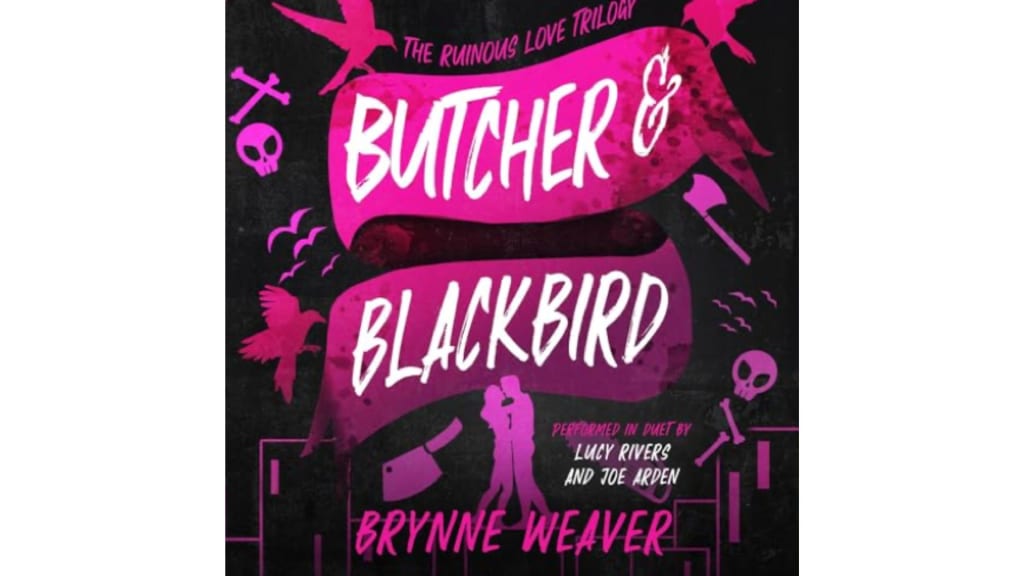
Brynne Weaver’s Butcher & Blackbird, the first installment in the Ruinous Love trilogy, is a book that dares to question: what happens when two serial killers fall dangerously in love? The answer, it turns out, is a deliciously twisted combination of dark romance, gory thrills, and unexpected humor that defies easy categorization. Marketed as a "dark romantic comedy," this novel takes readers on a wild experience through a world where love and murder intertwine with gleeful abandon. It’s not for the faint of heart—or stomach—but for those willing to embrace its macabre charm, Butcher & Blackbird is a standout debut that leaves a lasting impression.
The story centers on Sloane Sutherland, known in the underground as the "Orb Weaver," a serial killer with a job of targeting other murderers. Her grisly hobby takes a turn when she finds herself stuck in a cage with a rotting corpse, courtesy of her latest prey. Enter Rowan Kane, the "Boston Butcher," a charming chef with his own murderous streak and a fanboy-like admiration for Sloane’s work. What begins as a chance encounter blossoms into an unlikely friendship, drivin by a shared passion for eliminating society’s worst monsters. Rowan proposes an annual game: a competition to hunt down a designated serial killer, with the first to claim the kill declared victorius. Over the years, as they crisscross the U.S. from West Virginia to California, their bond deepens, evolving from camaraderie to something far more intimate.
Weaver’s premise is undeniably bold. The idea of two vigilante killers finding solace in each other’s darkness is a fresh twist on the romance genre, one that echoes the morally ambiguous allure of shows like Dexter or the chaotic energy of Bonnie and Clyde. Yet, Butcher & Blackbird distinguishes itself by leaning hard into its rom-com sensibilities. The banter between Sloane and Rowan crackles with wit, their chemistry plausible even amidst the blood and gore. Take, for instance, Sloane’s dry quip, “I didn’t gouge them out, Butcher. I plucked them. Delicately. Like a lady,” which encapsulates the book’s ability to find humor in the grotesque. Rowan, with his Irish charm and "he falls first" devotion, is the perfect foil to Sloane’s guarded, badass persona, creating a dynamic that’s as endearing as it is unhinged.
The duality structure enhances this interplay, offering readers a front-row seat to both characters’ minds. Rowan’s immediate obsession with Sloane—he’s smitten from the moment he frees her from that cage—contrasts with her slower, more reluctant journey toward vulnerability. This push-and-pull sustains the romantic tension across the book’s multi-year timeline, though the frequent time skips can occasionally disrupt the pacing. Chapters leap forward weeks, months, or even years, focusing on the annual murder games rather than the quieter moments of their lives. While this keeps the plot sleek and action-packed, it sometimes leaves the emotional beats feeling rushed or underdeveloped. I found myself craving more insight into how Sloane and Rowan navigate their day-to-day existences—her as a scientist, him as a chef—beyond their extracurricular killings.
That said, Weaver excels at balancing the novel’s darker elements with its lighter ones. The gore is vivid and unrelenting, with scenes of eyeball-plucking, cannibalism (accidental and otherwise), and decomposing bodies painted in unflinching detail. Yet, these moments are offset by the absurdity and levity of the characters’ reactions, turning what could have been pure horror into something oddly playful. It’s a tightrope walk that Weaver manages with surprising finesse, though readers sensitive to graphic content should heed the extensive trigger warnings. This isn’t a book that pulls punches—nor does it want to.
The romance, too, is a highlight, evolving from a slow burn to a full-on blaze. The "friends-to-lovers" arc is laced with classic tropes—he falls first, one-bed scenarios, hurt/comfort—that feel reimagined through the lens of their shared psychopathy. When the spice finally arrives (and it’s plentiful), it’s as intense as the violence, with a raw, unapologetic edge that suits the characters perfectly. Rowan’s possessive declarations—“She is mine”—and Sloane’s eventual surrender to her feelings are cathartic payoffs for their years-long dance. Still, some might find the leap from platonic murder buddies to passionate lovers a bit strange, given the truncated glimpses into their relationship’s growth.
Beyond the central duo, the supporting characters add flavor without overshadowing the main event. Rowan’s brothers, Lachlan and Fionn, hint at future stories in the trilogy, while Sloane’s best friend, Lark, brings a chaotic energy that promises more mayhem to come. The villains—other serial killers hunted by our protagonists—serve as grisly plot devices rather than fully fleshed-out characters, but they’re effective foils for showcasing Sloane and Rowan’s skills and teamwork.
Where Butcher & Blackbird stumbles slightly is in its depth. The concept of serial killers who only kill other serial killers raises fascinating moral questions—Are they monsters? Heroes? Something in between?—but Weaver doesn’t delve too far into this gray area. The focus remains squarely on the romance and the game, leaving the characters’ backstories and motivations somewhat surface-level. Sloane’s trauma from a boarding school incident and Rowan’s for shadowed past feel like sketches rather than portraits, which can make it harder to fully invest in their inner worlds. For a book so rich in visceral detail, this lack of emotional shading feels like a missed opportunity.
Yet, what it lacks in complexity, it makes up for in sheer entertainment. Butcher & Blackbird is indulgent, decadent, and unapologetically fun—a chocolate cake of a novel, as one reviewer aptly put it, albeit one spiked with blood and guts. The audiobook, narrated by Joe Arden and Lucy Rivers in a duet style, elevates the experience further, bringing Rowan’s Irish lilt and Sloane’s sardonic edge to life with infectious energy. It’s no wonder the book has garnered a cult following on platforms like TikTok, where its blend of spice, gore, and humor has struck a chord with readers craving something different.
In the end, Butcher & Blackbird isn’t a flawless novel, but it’s a wildly enjoyable one. It’s a love letter to those who revel in the weird and the wicked, a story that celebrates the idea that even monsters can find their match. Weaver has crafted a debut that’s equal parts shocking and delightful, setting the stage for what promises to be an equally unhinged trilogy. I’ll be eagerly awaiting Leather & Lark, if only to see how she tops the chaos of this bloody, brilliant romp. For now, I’ll give it a hearty 4.5 stars—deducting half a point for its lighter emotional heft, but wholeheartedly recommending it to anyone ready to embrace its twisted charm. Just don’t read it over dinner.
Read the book here
This review contains affiliate links.
About the Creator
Keep reading
More stories from writers in BookClub and other communities.
My New Book is Finally Here
My poetry collection Beautiful and Brutal Things is done. It's actually done and finally published over 270 pages. Over a year of my life went into this book. More than a year, really. Long days at my computer, sometimes seven days a week because I couldn't stop even when I probably should have. Then two months of editing that felt harder than the writing itself. But it's finished, and I'm still standing, and the book is real.
By Tim Carmichael13 days ago in BookClub
7 Books That Only a Few People Actually Understand
In a world flooded with bestselling novels and popular self-help guides, some books quietly exist in a rarefied space—texts that are intellectually demanding, thematically complex, or philosophically dense. These are books that only a few people actually understand, works that challenge conventional thinking and reward readers with profound insight when approached with patience and curiosity. Whether they delve into abstract philosophy, experimental narrative, or intricate social critique, these books are not just read—they are experienced. Below is a list of 7 books that only a few people actually understand.
By Diana Meresca day ago in BookClub
Instructions Included Challenge Winners
For the Instructions Included challenge, we asked writers to tell a story through instructions and to trust the form to carry what could not be said outright. Across the top entries, that trust paid off in many different ways.
By Vocal Curation Team2 days ago in Resources



Comments
There are no comments for this story
Be the first to respond and start the conversation.