
Atomic Habits vs The 7 Habits of Highly Effective People: Which Habit System Works Best?
Comparing Two Bestselling Habit Systems for Personal Growth

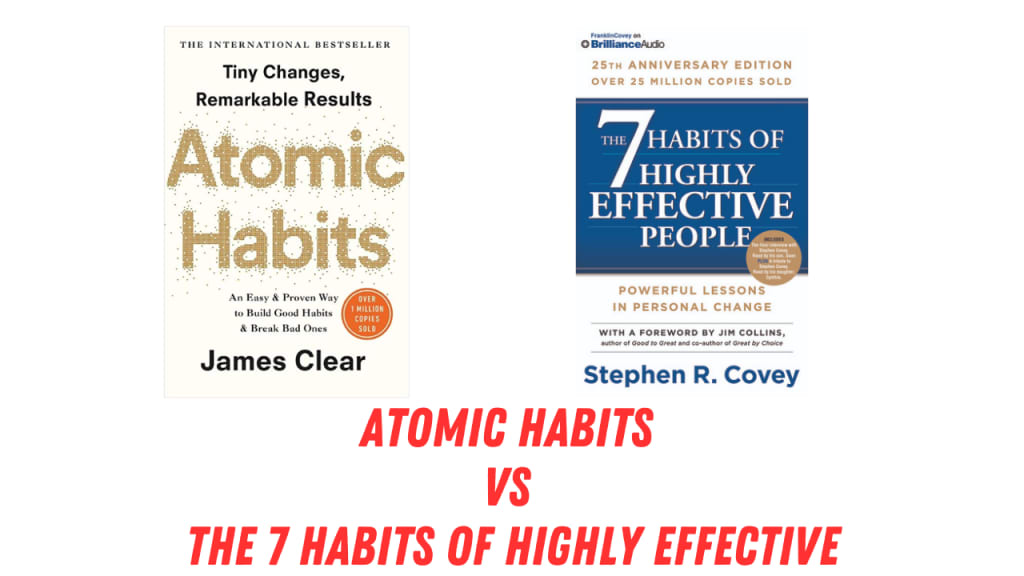
In the world of personal development, two books stand out as transformative guides for building better habits and achieving success: Atomic Habits by James Clear and The 7 Habits of Highly Effective People by Stephen R. Covey. Both offer frameworks to help people lead more productive, focused, and meaningful lives. But which one is better for your journey of growth?
In this in-depth comparison, we’ll explore the core principles of each book, how they differ, where they overlap, and which one is right for you based on your goals and personality.
What Is Atomic Habits?
Atomic Habits is a modern, science-based guide to building good habits and breaking bad ones. Written by James Clear in 2018, the book emphasizes small changes—called “atomic habits”—that compound over time to produce remarkable results.
Key Concepts:
- The 1% Rule: Small improvements every day lead to significant long-term growth.
- Habit Loop: Cue → Craving → Response → Reward.
- Four Laws of Behavior Change:
- Make it obvious.
- Make it attractive.
- Make it easy.
- Make it satisfying.
Focus: Behavior science, identity change, and consistency.
What Is The 7 Habits of Highly Effective People?
Stephen R. Covey’s The 7 Habits of Highly Effective People, first published in 1989, is a classic in leadership and personal development. It focuses on character ethics and long-term principles rather than quick fixes.
The 7 Habits:
- Be Proactive
- Begin with the End in Mind
- Put First Things First
- Think Win-Win
- Seek First to Understand, Then to Be Understood
- Synergize
- Sharpen the Saw
Focus: Character development, leadership, and personal effectiveness.
Key Differences Between Atomic Habits and 7 Habits

1. Tactical vs. Philosophical
Atomic Habits offers a tactical, step-by-step approach. It is rooted in neuroscience and behavioral psychology, perfect for people who want an action plan they can implement immediately.
The 7 Habits, on the other hand, is philosophical and values-driven. It focuses on fundamental principles that guide decision-making, relationships, and personal integrity.
2. Modern Science vs. Timeless Principles
James Clear’s book draws heavily on recent research in psychology, habit formation, and neuroscience. It’s full of studies, examples, and data.
Covey’s work relies on universal truths and moral philosophy. It doesn’t rely on recent science, but rather on timeless wisdom and practical life experience.
3. Identity vs. Character
Atomic Habits emphasizes identity-based habits. The idea is that the most effective way to change your behavior is to change your identity—see yourself as the kind of person who does X.
Covey’s book focuses on developing character and aligning with principles. It argues that effectiveness comes from living with integrity and balance.
4. Micro vs. Macro Focus
Clear focuses on the micro-level: daily habits, triggers, rewards, and systems.
Covey operates on a macro-level: mission, values, goals, and relationships.
Key Similarities Between the Two Books

Even with their differences, both books share some powerful similarities:
Both stress personal responsibility. Clear’s “you don’t rise to the level of your goals, you fall to the level of your systems” aligns with Covey’s “be proactive.”
They value consistency and integrity. Whether through repeated habits or living according to core values, both emphasize that long-term change comes from alignment between thoughts, actions, and beliefs.
They advocate growth through self-awareness. Understanding your triggers (Atomic Habits) or your paradigms (7 Habits) is key to improvement.
Which One Should You Read First?

Choose Atomic Habits if you:
- Struggle with sticking to routines or breaking bad habits.
- Want a highly practical, easy-to-follow guide.
- Prefer real-world tactics over deep philosophical thinking.
- Are trying to improve your health, productivity, or consistency.
Choose The 7 Habits if you:
- Want to transform your mindset and worldview.
- Are looking for a leadership or long-term life framework.
- Enjoy reflective thinking and values-based planning.
- Want to improve relationships, communication, and life vision.
Many readers find it helpful to start with Atomic Habits to build consistency and self-discipline, then move on to 7 Habits for long-term leadership and purpose.
Atomic Habits vs. 7 Habits: Which One is More Effective?

Effectiveness depends on what you're looking to achieve.
For short-term behavioral change and immediate impact, Atomic Habits is more effective. The methods are easy to apply, and you’ll see progress quickly—whether you're trying to exercise more, eat healthier, or be more organized.
For long-term life planning and personal transformation, The 7 Habits has a deeper impact. It forces you to think about your life as a whole, your values, and your relationships.
Ideal strategy: Combine both. Use Atomic Habits to build the daily behaviors that support the bigger life goals you define through The 7 Habits.
Real-World Application: Using Both Together
Here’s how you can apply both books together:
- Define your personal mission using Habit 2 (Begin with the End in Mind).
- Break your mission into smaller goals, guided by The 7 Habits.
- Use Atomic Habits to build daily systems that support those goals.
- Reflect and adjust regularly using Habit 7 (Sharpen the Saw).
- Create identity-based habits that align with the character traits Covey encourages (like integrity and proactivity).
Final Verdict
Both Atomic Habits and The 7 Habits of Highly Effective People are essential reads for personal growth, but they serve different purposes. If you're just starting out and want results fast, go with Atomic Habits. If you’re ready to reshape your character and long-term vision, The 7 Habits offers a profound roadmap.
In the end, the best habit system is the one you actually use. Success isn’t about choosing the perfect framework—it’s about applying it consistently.
About the Creator
pestosol
Hi.
I am Hmimda 30 years old From Algeria. I am a blogger. I like to share articles about decoration and designs
My New Book is Finally Here
My poetry collection Beautiful and Brutal Things is done. It's actually done and finally published over 270 pages. Over a year of my life went into this book. More than a year, really. Long days at my computer, sometimes seven days a week because I couldn't stop even when I probably should have. Then two months of editing that felt harder than the writing itself. But it's finished, and I'm still standing, and the book is real.
By Tim Carmichael2 days ago in BookClub
The 2025 Bibliophile Advent Calendar Special
There’s a moment every December when the world finally exhales. For me, it usually happens right after I pull out my favorite winter mug and I take that first deep breath of the season. The lights glow a little softer. The books on my shelves seem to lean toward me, waiting. And I remember why winter reading feels like a ritual.
By Kristen Barenthaler4 days ago in BookClub




Comments
There are no comments for this story
Be the first to respond and start the conversation.