
An Ugly Truth: Inside Facebook’s Battle for Domination
Book Review

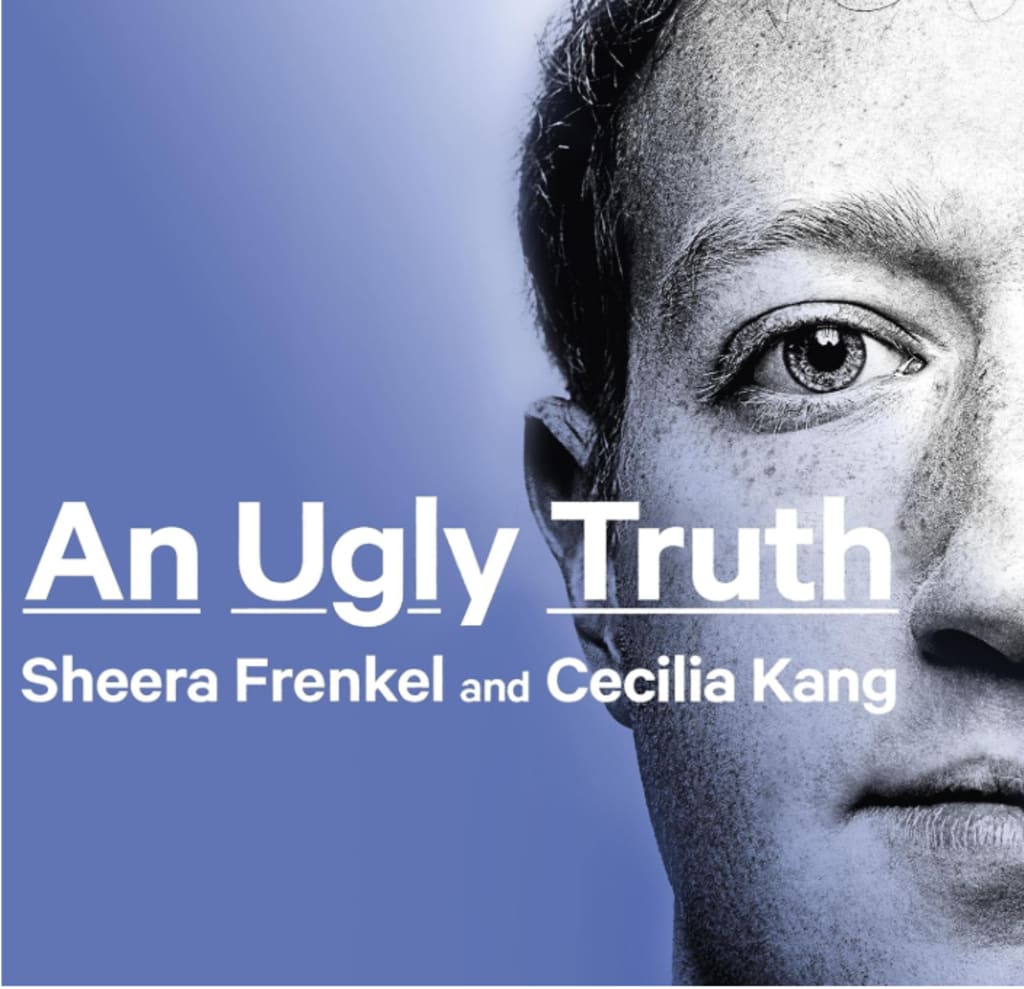
Summary
The book extends beyond common tech investigative works. The book presents an unyielding analysis of Facebook's complete transformation from its origins as a college social media to becoming a worldwide power that influences democracies and social movements alongside influencing the mental health of billions. Sheera Frenkel and Cecilia Kang who work for The New York Times penned this book which shifts its emphasis from Facebook technology toward examining its two top executives: Mark Zuckerberg and Sheryl Sandberg.
During the five years from the 2016 U.S. presidential marathon to the 2020 elections, the authors logged into Facebook to present their investigation into the inner struggles over decisions, failures and hidden actions within the platform. This study undertakes a specific ethical investigation of Facebook's actions instead of serving as a complete historical examination.
The book portrays Mark Zuckerberg as someone who maintains a single-minded focus on growth while showing blind neglect toward moral concerns. The book depicts Sandberg as a figure of trust while seeing her guard Facebook's reputation instead of caring for its user base. The unfolding drama greatly depends on Facebook executive personnel including Joel Kaplan who heads global policy and Alex Stamos as Chief Security Officer together with Monika Bickert who serves as Head of Global Policy Management.
The fundamental problem faces the platform operators who want connection services without causing manipulation or harmful effects to their users. The main unresolved issue in the book remained whether Facebook could get fixed beyond its fundamental problems.
The narrative does not depict a company which strayed from its path. This business operated with full awareness of its actions because power combined with profit and expansion remained their constant objectives.
Key Themes of the Book
1. Surveillance Capitalism
The book demonstrates that Facebook produces user information rather than functioning as a social platform. Under Sandberg's leadership, the company developed an ad model which performs mass personal data collection to harness profits at historically large scales. Users give up their life experiences including reading materials along with online activities and communicative choices as their payment exchange.
2. Loyalty Over Ethics
The entire book shows how the organization maintains silence and protects its principles. Employees expressing contradictions faced both disregard and dismissal from Facebook management. Muslim leadership chose Zuckerberg over his responsibility to protect his users. It seemed like employees at Facebook followed an unofficial rule that prioritized protecting Mark Zuckerberg above all else except user protection.
3. The Illusion of Neutrality
Facebook maintains claims to be an open platform service that does not publish content to users. The book disproves this notion through its presentation of Facebook executives who exercised selective intervention choices as illustrated by their decision to keep Donald Trump's inflammatory post despite conservative backlash in 2015. The many instances demonstrated that Facebook purposefully presented itself as neutral despite holding completely different values.
4. Unchecked Power
The authors Frenkel and Kang explicitly state that Zuckerberg faces no limitations to his actions. The majority owner position grants him complete business control over the company. Every time different executive members alerted him about privacy breaches and misinformation, the company made no modifications unless he gave the green light. And often, he did not.
Experience
Reading An Ugly Truth produced strong emotions of anger combined with frustration and serious shock within me. Suspecting Facebook operates unsafely with our personal information would be different from known proof. The reality of Facebook goes beyond suspicions because engineers track their ex-partners with internal tools while executives consider banning hate speech policies and executives provide advice to "not stir the bear" during Trump video deletion decisions.
At some moments I needed to set the book aside because of the content. The reading experience made me feel disturbed because it challenged my habit of giving Facebook complete access to my life without any pause for consideration.
The experience taught me significantly more than what I had originally anticipated. When Zuckerberg established a data access system for Facebook engineers to access user information it remained operational from 2004 until 2015. Sandberg who receives widespread recognition for her feminism and philanthropy activities chose image management instead of meaningful progress repeatedly.
The Facebook employee delivered a punch to me by saying "We expected this outcome even though we didn't know exactly when it would occur.' We just didn’t know when.” That sentiment—resignation to failure—echoes throughout the book. Despite internal awareness at Facebook staff members allowed the data intrusion to continue its course.
Emotionally, it was a rollercoaster. Shock turned into disbelief which later transformed into a strange state of emotional emptiness. My ultimate emotional response after reading the book involved a sense of responsibility. A sense of responsibility. Those who continue using these platforms after knowing about the damage they create become part of the story made by Facebook.
Strengths
The book stands out because of its exceptional access to information. The book's comprehensive research is evident because Frenkel and Kang interviewed over 400 sources mainly composed of workers from Facebook's past and present. The descriptions in this book create such lifelike scenes that you feel yourself present during management decisions. The authors don’t speculate. They deliver reliable information that comes with supporting evidence from documentation.
I appreciated the objectivity. The authors don’t grandstand. The authors just deliver the information while allowing it to convey maximum impact because they present the raw material without elaboration. One former security executive at Facebook revealed their organization lacked the ability to face their present-day adversaries. Our presence in the professional league demands serious work because we continue management operations using undergraduate dormitory practices. The sentence stayed in my thoughts for an extended period.
Another strength? The structure. The book progresses through successive chapters that limit their use of complex technical details. All audiences despite their technical knowledge background can easily understand this material. The essential understanding of the situation does not require knowledge about algorithm functions.
The true appeal of this book derives from the stories about human experiences. Zuckerberg along with Sandberg receive no villainous treatment in the narrative because the account proves them to be ambitious multifaceted characters who made distinct decisions. The subtle details about their actions make their decisions considerably more alarming to readers.
Weaknesses
As my primary criticism, I find the content insufficient to satisfy my desire for conclusion because the book reaches its maximum capacity yet fails to resolve its numerous questions. This text generates dozens of key questions while delivering minimal solutions. Not all of the responsibility for the lack of answers belongs to the authors. The nature of an ongoing story creates this particular outcome. Facebook continues to remain unfinished since the company has not succeeded in addressing all problems.
A minor yet noticeable relationship exists between the weight given to different aspects of the story. The book provides occasional shielding protection to Sandberg through its emphasis on her public relations skills although she bears primary responsibility for key disastrous choices. Some sections in the book appeared to offer gentleness toward Sandberg despite her equal accountability with Zuckerberg.
Although detailed throughout the text there is a limited discussion of specific technical Facebook elements particularly the platform's advertisement system and its programmed content selection. If the author had explained in detail how their systems operated it would provide a clearer picture of the consequences thus improving stakeholder comprehension.
All these points do not prevent this book from being an essential and engaging portrayal. Understanding the difficulty of complete truth-telling became more apparent because of the way the main subject repeatedly modified their story.
Final Thoughts
Reading this book provides the reader with insights into the internal workings of one of the most influential global companies. The book presents its challenging facts without hesitation. The book reflects both Facebook as well as human nature.
This book works well for individuals who operate in the tech field or social media realm along with those who value democratic functions. The intended readership includes policymakers as well as students and journalists together with activists. This material is essential for all of them. Your knowledge will increase because you will understand how to think more carefully about your posted content and the reasons behind it.
Although it lacks elements of thrilling entertainment it reads like one. Each chapter in the story reveals further secrets about the narrative that continue to develop. Facebook has not reached its apex which makes this situation the scariest aspect. Facebook shows no signs of slowing down since it continues to expand its operations.
Click here to listen to An Ugly Truth free with Audible.
My Recommendation
If An Ugly Truth got under your skin the way it did mine, here are a few books that will keep you thinking—and questioning.
Recommended Reads:
1. The Age of Surveillance Capitalism by Shoshana Zuboff
A deeper look into how companies like Facebook monetize your behaviour.
2. No Filter by Sarah Frier
The inside story of Instagram and how it became Facebook’s crown jewel.
3. Ten Arguments for Deleting Your Social Media Accounts Right Now by Jaron Lanier
Short, powerful, and persuasive—this book changed how I use social media.
4. Like, Comment, Subscribe by Mark Bergen
A fascinating, if frightening, account of YouTube’s influence and power.
So, what should you do next? Maybe check your privacy settings. Scrolling should be paused for now. Consider which type of internet you wish to join while developing strategies to make it happen.
An Ugly Truth altered my entire understanding of Facebook as an online platform. It might do the same for you.
Disclaimer
This article contains affiliate links. If you sign up for an Audible trial or make any purchases through these links, I may receive a small commission at no extra cost to you. Your support helps to keep this content free and accessible.
About the Creator
Sid Coulton
I have discovered a love for writing blogs, creating stories and writing articles. My book reviews do contain affiliate links as i am an Amazon Associate.
Keep reading
More stories from Sid Coulton and writers in BookClub and other communities.
Careless People: A Story of Where I Used to Work
Summary Journalist Sarah Wynn-Williams uses the book "Careless People: A Story of Where I Used to Work" to shine a clear dialogue with open truths upon Facebook's inner workings which present disturbing imagery of this modern tech powerhouse. My experience reading began on the very first page as if I had access to the inner workings that normally remain out of public view in the Silicon Valley hype machine.
By Sid Coulton10 months ago in BookClub
My New Book is Finally Here
My poetry collection Beautiful and Brutal Things is done. It's actually done and finally published over 270 pages. Over a year of my life went into this book. More than a year, really. Long days at my computer, sometimes seven days a week because I couldn't stop even when I probably should have. Then two months of editing that felt harder than the writing itself. But it's finished, and I'm still standing, and the book is real.
By Tim Carmichael9 days ago in BookClub
7 Books for People Who Feel Stuck but Don't Know Why
Feeling stuck in life is more common than most of us admit. We wake up, go through our routines, and yet a sense of unease, dissatisfaction, or inertia lingers. Sometimes it isn’t a specific event that holds us back — it’s an inner blockage, a mental fog, or a lack of clarity about our direction. When this happens, reading the right book can be like discovering a flashlight in a dark room: it illuminates your path, helps you understand the root of your stagnation, and offers actionable steps to move forward.
By Diana Meresc3 days ago in BookClub
The Blue Ridge Stalker
Tom had left the Ford down the way, its spark plugs finally exhausted and no mechanics for a dozen miles back through the foothills to Strossburg. No matter, he had worn his boots—almost as if he planned for this to happen. The puzzle he sought to solve emanated from the woods clinging to the slopes above; the valley behind held no mysteries.
By Stephen A. Roddewig4 days ago in Fiction



Comments