
Alchemy: The Ancient Art of Transformation
How a Millennia‑Old Tradition Shaped Science, Medicine, and Human Imagination

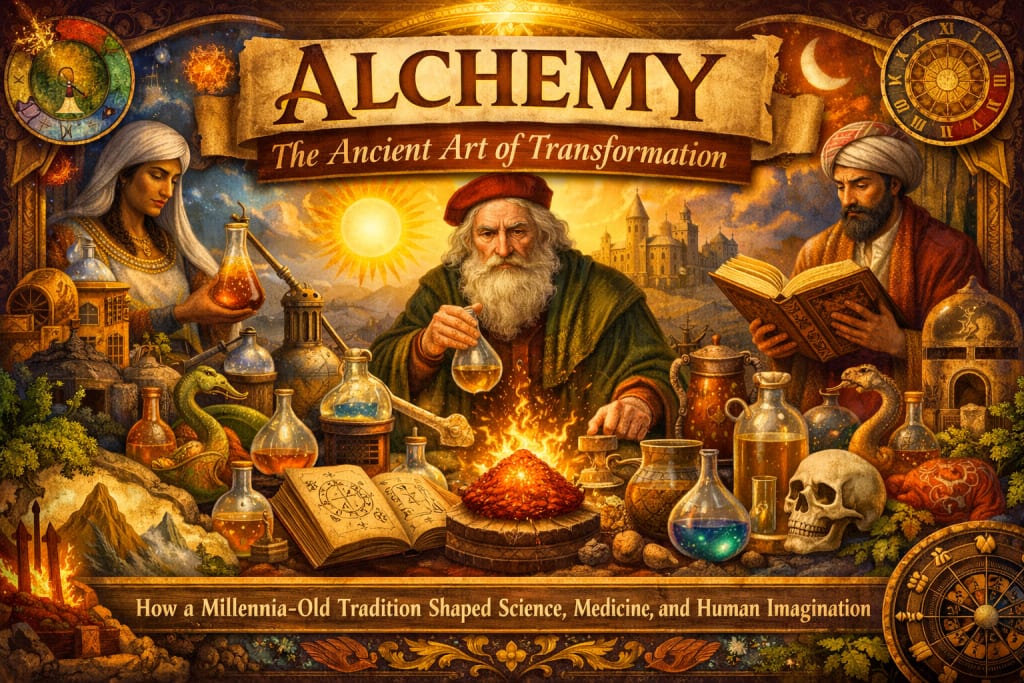
The Ancient Art of Transformation and Discovery
Alchemy is often remembered through the lens of myth: mysterious figures in shadowed laboratories, stirring powders and potions in search of gold or eternal life. These images, however, obscure the true nature of a discipline that was both rigorous and far-reaching. Alchemy was an intellectual and spiritual pursuit that spanned continents, centuries, and cultures, encompassing the study of nature, the human body, and the cosmos. Its aim was not simply the transmutation of metals, but the pursuit of knowledge, understanding, and transformation—both material and personal.
The origins of alchemy stretch back to ancient Egypt, where metallurgists combined practical knowledge with spiritual and symbolic interpretations of matter. From there, the tradition moved through the Hellenistic world, absorbing Greek philosophical thought, and later flourished in the Islamic Golden Age. Scholars like Jabir ibn Hayyan refined chemical processes, developed laboratory techniques, and wrote treatises that preserved centuries of accumulated knowledge. These texts would later be translated into Latin, spreading alchemical thought throughout medieval Europe.
In Europe, alchemy became intertwined with philosophy, medicine, and natural observation. Renaissance alchemists such as Paracelsus integrated chemical knowledge with medical practice, believing that the study of minerals and compounds could reveal remedies for illness and guide the purification of the human spirit. Alchemy was a comprehensive approach to the world, combining experimentation, observation, and reflection, often framed through symbolic language that conveyed deeper truths about the cosmos and the self.
Central to alchemical thought was the idea of transformation. The Philosopher’s Stone, the Elixir of Life, and the Great Work were more than fanciful goals; they symbolized the potential for change at every level—physical, mental, and spiritual. Alchemists believed that by studying and manipulating the natural world, they could harmonize human life with universal laws. Laboratory work, philosophical writing, and meditation were all part of the same endeavor: to understand and refine both matter and mind.
Alchemy’s influence is profound. It shaped early chemistry and pharmacology, informed medical practices, and inspired artists, poets, and philosophers. Its symbols and metaphors continue to appear in literature, art, and psychological theory, reflecting enduring human fascination with transformation and mastery over nature. To study alchemy is to enter a world where observation and imagination meet, where experimentation is inseparable from contemplation, and where the pursuit of knowledge is both a material and spiritual journey.
The Art of Transformation
Alchemy is one of history’s most enduring and complex intellectual traditions, a discipline that sought to understand the very principles of change in the natural and spiritual worlds. Far from being merely an attempt to turn base metals into gold, alchemy combined practical experimentation, philosophical inquiry, and spiritual practice into a unified approach to knowledge. Its goal was transformation in every sense—of matter, of the human body, and of consciousness itself.
The central aim of alchemy was often expressed through the pursuit of the Philosopher’s Stone, a substance believed capable of converting base metals into gold, and the Elixir of Life, a remedy thought to cure disease and grant longevity. These were not merely material ambitions. Alchemists understood them as symbols for personal and spiritual perfection, reflecting the belief that physical and inner transformation were inseparable. By engaging in the manipulation of substances, they also engaged in a process of self-cultivation and intellectual refinement.
Alchemy’s methods were as rigorous as they were symbolic. Laboratory practices such as distillation, calcination, sublimation, and fermentation were carefully observed and recorded. These processes were understood not only as chemical reactions but as stages in a broader framework of transformation, later codified in the concept of the Great Work, or Magnum Opus. This process was often described in four stages: nigredo (blackening), representing decay and dissolution; albedo (whitening), representing purification; citrinitas (yellowing), representing insight and illumination; and rubedo (reddening), representing completion and integration. Each stage symbolized both physical manipulation of matter and corresponding changes within the practitioner.
Underlying all alchemical practice was the principle of correspondence, the idea that the universe (macrocosm) and the human being (microcosm) reflect one another. This philosophy encouraged alchemists to view the natural world as a living system that mirrored human experience. Observing and experimenting with minerals, metals, and other substances was therefore also an exercise in understanding the self and the cosmos. Through this lens, laboratory work, meditation, and philosophical reflection were inseparable elements of the same transformative process.
Alchemical texts often used symbolic imagery and allegorical language. Dragons, phoenixes, and mystical compounds were not merely decorative; they encoded knowledge about substances, processes, and philosophical principles. These symbols guided practitioners in their experiments and reflections, offering a framework that combined observation, theory, and ethical instruction.
Historically, alchemy contributed significantly to the development of chemistry and medicine. Figures such as Jabir ibn Hayyan in the Islamic world developed sophisticated chemical apparatus and methods that influenced Europe, while Paracelsus in Renaissance Europe applied alchemical principles to medical practice, creating the foundation for pharmacology. Even early scientists such as Robert Boyle and Isaac Newton engaged deeply with alchemical texts, recognizing their insights into matter and transformation.
Ultimately, alchemy was a discipline of integration, combining careful observation, symbolic reasoning, and spiritual aspiration. It reminds us that the pursuit of knowledge can be both practical and philosophical, empirical and contemplative. By studying alchemy, we encounter a tradition that sought to unify the human experience with the natural order, leaving a legacy that resonates in science, philosophy, and culture.
Alchemy Across Time: A Global Journey of Transformation
Alchemy is one of humanity’s most enduring intellectual pursuits, a discipline that spans continents and millennia. It combined practical experimentation, philosophical reflection, and spiritual exploration, creating a unified approach to understanding the natural world. Its history reflects the human desire to transform matter, heal the body, and elevate the mind, leaving a legacy that continues to influence science, medicine, and philosophy.
Early Roots and Antiquity (c. 3000–1 BCE)
The earliest traces of alchemical thinking appear in ancient Egypt and Mesopotamia, where artisans developed the extraction and refinement of metals such as copper, gold, and lead. These early metallurgists were skilled in techniques such as smelting, annealing, and alloying, which later became the foundation of alchemy. Egyptian texts suggest that metals were viewed as living substances with spiritual qualities, and refining them was seen as a mirror of the purification of the soul.
In Greece, philosophers such as Democritus proposed that matter consisted of indivisible particles, anticipating the idea of transformation at a fundamental level. Greek thought emphasized the correspondence between the elements and the principles governing life and the cosmos, forming a conceptual basis for later Hellenistic alchemy.
By the 1st to 4th centuries CE, Alexandria had become a central hub of alchemical activity. Zosimus of Panopolis, an Egyptian alchemist, wrote extensive treatises combining practical experimentation with philosophical reflection. He described techniques such as distillation using early alembics, sublimation of minerals, and preparation of metallic compounds while embedding symbolic narratives about purification and transformation. Zosimus introduced glass vessels and furnaces designed for controlled heating, innovations that influenced Islamic and European alchemists for centuries.
Medieval Era and the Islamic World (8th–12th Century CE)
During the Islamic Golden Age, alchemy reached new heights in both theory and practice. Scholars translated Greek texts into Arabic, preserving knowledge that might have been lost. Jabir ibn Hayyan, known in the West as Geber, systematized chemical operations and created precise methods for distillation, crystallization, and the manipulation of acids. His experiments with sulfur, mercury, and various salts laid the groundwork for developments in metallurgy and medicine.
Al-Razi (Rhazes) made significant contributions by experimenting with compounds such as alcohol and arsenic, applying chemical principles in medical treatments. Islamic alchemists developed laboratory tools including retorts, alembics, and crucibles, which allowed experiments to be replicated accurately. Their meticulous documentation set standards for observation and methodology that would influence Europe centuries later.
European Middle Ages and Renaissance (1150–1600 CE)
By the 12th century, Latin translations of Arabic alchemical texts introduced these ideas to Europe. Monastic scholars and university-educated intellectuals studied the methods and theories of alchemy alongside philosophy, medicine, and theology.
The Renaissance saw the emergence of figures such as Paracelsus, who applied alchemical knowledge to medicine. He promoted the use of chemical substances such as mercury, antimony, and iron to treat illness. Paracelsus believed that disease resulted from imbalances in the body and that chemical remedies could restore harmony. His work bridged practical chemistry and medical theory, laying the foundations for modern pharmacology.
The Hermetic revival during the 16th century integrated alchemy with philosophy, astrology, and spiritual thought. Scholars such as Heinrich Cornelius Agrippa explored the spiritual dimensions of transformation, connecting the purification of metals with moral and intellectual refinement. Alchemical texts from this period featured rich symbolic imagery, including dragons, phoenixes, and allegorical representations of the stages of the Great Work.
Notable experiments included attempts to transmute metals into gold, preparation of aqua regia to dissolve gold, and distillation of herbal and mineral elixirs. Laboratory apparatus such as tripods, furnaces, bellows, and glass alembics reflected a sophisticated understanding of heat, pressure, and chemical interaction.
Early Modern Period (17th–18th Century)
The 17th century marked a transition in which alchemy intersected with emerging empirical science. Robert Boyle conducted experiments on gases and acids, emphasizing reproducibility and careful measurement while still engaging with alchemical principles. Boyle’s insistence on observation and documentation influenced the development of the scientific method.
Isaac Newton devoted thousands of pages to alchemical research, investigating metals, salts, and planetary influences on matter. He studied manuscripts on transmutation and the Philosopher’s Stone, conducting experiments with mercury and other substances. These studies reflect the era’s blending of empirical investigation with symbolic and philosophical approaches.
By the 18th century, alchemy’s material ambitions were increasingly dismissed as impractical. Modern chemistry emerged, emphasizing reproducible experiments, theoretical frameworks, and empirical observation. Despite this shift, alchemy’s techniques and vocabulary, such as distillation, sublimation, and the use of acids, continued to inform laboratory practice, demonstrating the enduring legacy of alchemical experimentation.
Alchemy’s history illustrates its global reach and intellectual breadth. From the metallurgists of ancient Egypt to Renaissance physicians and early modern scientists, alchemy integrated practical experimentation, symbolic reflection, and philosophical inquiry. Its methods and conceptual frameworks laid the foundations for modern chemistry, medicine, and laboratory science. Beyond its material contributions, alchemy tells a story of the human pursuit of knowledge, mastery, and transformation across centuries and cultures.
Core Concepts of Alchemy: Principles, Symbols, and Transformation
Alchemy rests upon an intricate philosophical structure that unites physical experimentation with metaphysical reflection. It is best understood not as a single goal or technique but as a worldview in which matter, mind, and spirit are bound by the same laws of transformation. Alchemists believed that by observing and participating in natural processes, one could gain insight into the deepest workings of existence. These ideas shaped how alchemists approached metals, plants, minerals, the human body, and even the soul.
At the center of alchemical thought stands the Philosopher’s Stone, a concept that has captured imagination for centuries. While later interpretations often reduced it to a fantastical object capable of producing gold, historical alchemical texts reveal a far more nuanced understanding. The Philosopher’s Stone represented the culmination of perfect balance and harmony within matter. Alchemists believed that all metals were engaged in a slow process of maturation beneath the earth, gradually moving toward the perfection embodied by gold. The Stone did not violate nature but accelerated a process already inherent within it. In this sense, the Stone symbolized mastery of natural law rather than domination over it. The associated Elixir of Life followed the same logic. Longevity and healing were seen as the result of restoring balance and purity within the body, mirroring the refinement of substances within the laboratory. Physical health, moral clarity, and spiritual insight were understood as interdependent outcomes of the same transformative process.
Underlying all alchemical work was the idea of Prima Materia, the original substance from which all forms arise. Alchemists inherited this concept from Greek philosophical traditions, particularly Aristotelian and Neoplatonic thought, which described matter as potential shaped by form. Prima Materia was described paradoxically as both worthless and sacred, base and divine. It was often depicted as dark, chaotic, or impure, not because it lacked value, but because it contained everything in an unrefined state. The alchemist’s task was not to impose something foreign upon it, but to reveal what was already latent within. This belief reinforced the idea that transformation required patience, discipline, and deep understanding rather than force. On a symbolic level, Prima Materia also represented the unexamined self, the raw state of consciousness before refinement through knowledge and experience.
The framework that guided this process of refinement was known as the Great Work, or Magnum Opus. This was not a single experiment but a sustained engagement with transformation over time. Alchemists described this work through a series of color stages that reflected observable changes in substances during experimentation. Nigredo marked the beginning, characterized by decay, dissolution, and the breaking down of form. This stage was often accompanied by blackening or putrefaction in laboratory materials, which alchemists saw as a necessary death preceding rebirth. Albedo followed as purification, where repeated distillation or washing produced clarity and separation of impurities. Citrinitas represented awakening and maturation, a stage associated with balance, illumination, and the emergence of insight. Rubedo concluded the work, marked by redness and completion, symbolizing unity, stability, and perfected form. These stages were never purely material. Alchemists consistently wrote of internal struggles, ethical refinement, and spiritual discipline as inseparable from laboratory success. Failure in character was believed to lead to failure in the work.
Hermetic philosophy provided the intellectual foundation that unified these ideas. Central to this worldview was the principle of correspondence, which asserted that the same patterns govern the cosmos and the individual. The movements of planets, the growth of metals, and the functions of the human body were all expressions of a single, ordered system. This belief shaped the alchemist’s approach to experimentation. Observing the behavior of substances was also a way of observing universal laws. Astrology, metallurgy, medicine, and theology were therefore not separate disciplines but interconnected fields of study. Alchemists often timed their experiments according to planetary cycles, believing that celestial influences shaped the behavior of matter. While modern science rejects these cosmological assumptions, they reflect a coherent and internally consistent attempt to understand nature as a unified whole.
Closely related to correspondence was the doctrine of the three principles, commonly known as mercury, sulfur, and salt. These were not substances in the modern chemical sense but conceptual principles used to describe the qualities present in all matter. Mercury represented volatility, movement, and the animating spirit. Sulfur symbolized combustion, energy, and individuality. Salt embodied solidity, structure, and preservation. Together, they explained why substances behaved as they did and how they could be transformed. A successful alchemical operation required balancing these principles, ensuring that none dominated to the detriment of the whole. This triadic model influenced later chemical and medical theories, particularly in Renaissance Europe, where it shaped early pharmacology.
The alchemical maxim Solve et Coagula, meaning to dissolve and recombine, expressed transformation as a continuous cycle rather than a linear progression. Substances were repeatedly broken down and reformed through processes such as dissolution, coagulation, sublimation, and fixation. Each cycle refined the material further, removing impurities and increasing coherence. This principle also carried philosophical weight. Alchemists believed that rigid structures, whether material or psychological, had to be dissolved before genuine growth could occur. Only through repeated cycles of breakdown and reintegration could true transformation be achieved.
Other important concepts emerged from this framework. Alchemists theorized the existence of the Alkahest, a universal solvent capable of dissolving any substance into its essential components. While never realized, it represented the ultimate tool for understanding matter at its most fundamental level. Tinctures, elixirs, and essences were practical expressions of this pursuit, produced through careful distillation and concentration. These preparations were believed to contain the vital essence of substances, making them powerful agents of change in both medicine and alchemy. The vessels used in these operations held symbolic importance as well. Sealed flasks and hermetically closed containers represented containment, discipline, and protection of the transformative process. Just as reactions had to occur in controlled conditions, the alchemist’s inner life required focus, restraint, and ethical clarity.
Taken together, these concepts reveal alchemy as a disciplined and coherent tradition rather than a collection of superstitions. It offered a model of transformation rooted in observation, symbolism, and philosophical reasoning. Alchemists sought to understand nature by participating in its processes, believing that knowledge emerged through engagement rather than abstraction alone. Their work laid essential groundwork for chemistry, medicine, and experimental methodology, while also offering enduring insights into the nature of change, balance, and human aspiration. Alchemy endures not because it promised easy miracles, but because it addressed the universal question of how raw potential becomes realized form, whether in metal, in medicine, or in the self.
Techniques and Tools of Alchemy
Alchemy was never solely an abstract philosophy. It was a hands-on discipline grounded in sustained experimentation, careful observation, and technical skill. Historical records, laboratory manuals, and surviving apparatus demonstrate that alchemists developed a sophisticated material practice that anticipated many principles of modern chemistry. Their workshops were places of intense study, where theory was tested through fire, glass, and metal, and where patience and precision were as important as intellectual insight.
Central to alchemical practice were techniques designed to break down substances into their essential components and recombine them in purified forms. Distillation was among the most important of these methods. By heating a substance and capturing its vapors, alchemists sought to separate volatile components from heavier residues. Distillation was used to produce alcohols, essential oils, mineral acids, and medicinal tinctures. It also carried symbolic significance, representing the elevation and refinement of spirit from matter. Alchemists developed increasingly complex distillation systems, including multi-chambered alembics and coiled condensers, allowing for greater control and efficiency.
Sublimation was another essential technique, involving the transformation of a solid directly into vapor and its subsequent re-solidification. This process was used with substances such as mercury compounds, sulfur, and salts. Sublimation fascinated alchemists because it appeared to bypass the liquid state, reinforcing the idea that matter could shift between forms under the right conditions. Symbolically, it represented the ascent of refined qualities and the separation of the subtle from the gross.
Calcination played a foundational role in the early stages of many alchemical operations. This technique involved heating a substance to high temperatures until it was reduced to ash or powder. Metals and minerals were calcined to remove impurities and weaken their structure, making them more receptive to further transformation. Calcination was associated with Nigredo, the stage of breakdown and dissolution, and was often described as a necessary ordeal through fire. Alchemists observed that substances subjected to repeated calcination behaved differently over time, demonstrating an early awareness of chemical change through heat and oxidation.
Fermentation introduced another dimension to alchemical work, particularly in the preparation of medicinal compounds and elixirs. Drawing inspiration from natural processes such as the fermentation of wine or the decay of organic matter, alchemists believed that fermentation activated hidden life forces within substances. This technique was used to transform plant materials, mineral mixtures, and even metallic preparations. Fermentation represented renewal and vitality, both in practical terms and within the symbolic language of the Great Work.
The success of these techniques depended heavily on specialized tools and carefully controlled environments. Glassware became a defining feature of alchemical laboratories, especially from the late antique period onward. Glass vessels allowed alchemists to observe changes in color, texture, and state during experiments. Alembics, retorts, flasks, and receivers were designed in various shapes to accommodate different processes. The development of clear, heat-resistant glass marked a significant advance, enabling more precise observation and repeatability.
Equally important were furnaces engineered for sustained and regulated heat. Alchemists understood that different operations required specific temperature ranges, and they designed furnaces with multiple chambers and adjustable airflow to achieve these conditions. Some furnaces were capable of maintaining low, steady heat for weeks or months, reflecting the long durations required for certain operations. The ability to control heat was seen as essential to unlocking the latent properties of matter, mirroring the slow processes of transformation believed to occur within the earth itself.
In terms of materials, alchemists relied heavily on mercury, sulfur, and salts, not merely as substances but as expressions of underlying principles. Mercury was prized for its volatility and ability to combine with metals, sulfur for its combustibility and transformative power, and salts for their stabilizing and preservative qualities. These substances appeared repeatedly in alchemical recipes and experiments, serving as agents of change and as symbols within a broader philosophical framework. Their manipulation required skill and caution, particularly given the toxic nature of many alchemical reagents.
Throughout their work, alchemists consistently drew parallels between the transformations occurring in their furnaces and those taking place in nature. They believed that metals matured beneath the earth through the influence of heat, moisture, and time, slowly progressing toward perfection. By recreating these conditions in the laboratory, the alchemist sought to accelerate natural processes rather than violate them. Fire, in particular, was viewed as both a physical and philosophical force, capable of revealing hidden qualities while demanding respect and restraint.
Taken together, the techniques and tools of alchemy demonstrate a discipline deeply engaged with the material world. Alchemists refined methods of heating, separating, combining, and observing substances with remarkable sophistication. While their interpretations of these processes were shaped by symbolic and spiritual frameworks, their practical innovations contributed directly to the development of laboratory science. Alchemy’s legacy in this regard lies not in its legendary promises, but in its disciplined approach to experimentation and its insistence that knowledge emerges through sustained interaction with matter itself.
Notable Alchemists and Contributors: Architects of a Transformative Tradition
Alchemy’s longevity and influence are inseparable from the individuals who practiced, preserved, and transformed it across cultures and centuries. These figures were not merely seekers of gold or longevity but thinkers, experimenters, physicians, philosophers, and mystics who shaped the intellectual foundations of both esoteric traditions and emerging scientific disciplines. Their contributions demonstrate that alchemy functioned as a serious and evolving body of knowledge rather than a marginal curiosity.
Among the earliest recorded alchemists is Cleopatra the Alchemist, an Egyptian practitioner active in Alexandria between the first and third centuries CE. She is one of the few women whose alchemical writings survive from antiquity. Cleopatra authored texts such as the Chrysopoeia of Cleopatra, which includes symbolic imagery depicting alchemical processes through circular diagrams and ouroboric symbolism. She is traditionally associated with advancements in distillation techniques and is often linked to the development or refinement of the alembic, a device essential for separating substances through vapor and condensation. Her work reflects the highly technical and symbolic character of Alexandrian alchemy, blending metallurgy, philosophy, and spiritual insight.
Another foundational figure from late antiquity is Zosimus of Panopolis, whose writings represent the earliest comprehensive alchemical corpus to survive. Zosimus described laboratory apparatus, furnaces, and methods in detail while also reflecting deeply on the moral and spiritual discipline required of the alchemist. He believed that successful transformation depended on the purification of the practitioner as much as the refinement of substances. His influence extended into the Islamic world and later medieval Europe through translations and commentaries.
The Islamic Golden Age produced some of the most significant contributors to alchemical practice and theory. Jabir ibn Hayyan, known in Latin as Geber, systematized chemical experimentation and emphasized reproducibility and classification. His writings introduced detailed descriptions of distillation, crystallization, and the preparation of acids such as nitric and sulfuric acid. Jabir’s corpus also articulated the theory of sulfur and mercury as fundamental principles underlying metallic composition, a concept that shaped alchemical and chemical thought for centuries.
Equally influential was Al-Razi, a physician and alchemist who applied chemical knowledge to medicine with exceptional rigor. He classified substances based on observable properties and used distillation to prepare alcohol and medicinal compounds. Al-Razi’s emphasis on empirical observation and practical application influenced both alchemy and early pharmacology.
In medieval Europe, alchemy became integrated with Christian theology and natural philosophy. Albertus Magnus, a Dominican friar and scholar, wrote extensively on minerals and metals, treating alchemy as a legitimate branch of natural science. He emphasized direct observation and experimentation, distancing himself from purely speculative interpretations. His student, Thomas Aquinas, although cautious about alchemical claims, acknowledged the possibility of artificial transformation within natural laws, reflecting the intellectual seriousness with which alchemy was treated in scholastic circles.
The Renaissance marked a profound shift in alchemical purpose through the work of Paracelsus, a Swiss physician and reformer. Paracelsus rejected the traditional fixation on gold-making and argued that the true aim of alchemy was healing. He introduced chemical remedies derived from minerals and metals, asserting that specific substances corresponded to specific ailments. His medical alchemy, later called iatrochemistry, challenged established Galenic medicine and laid the groundwork for modern pharmacology. Paracelsus also articulated the concept of the Tria Prima, mercury, sulfur, and salt, as explanatory principles governing matter and health.
During the early modern period, alchemical experimentation began yielding discoveries that would later be recognized as foundational to chemistry. Hennig Brand, a German alchemist, famously discovered phosphorus in the seventeenth century while attempting to isolate the Philosopher’s Stone from urine. Though accidental, this discovery demonstrated that alchemical methods could reveal previously unknown elements. Brand’s work highlighted the empirical potential embedded within alchemical practice, even when guided by symbolic goals.
Robert Boyle, often regarded as a founder of modern chemistry, maintained a complex relationship with alchemy. While critical of unsubstantiated claims, Boyle studied alchemical texts seriously and conducted extensive experiments on gases, acids, and combustion. His insistence on careful measurement, controlled experimentation, and transparency helped formalize the scientific method. Boyle did not reject alchemy outright but sought to reform it through empirical rigor.
Perhaps the most striking example of alchemy’s persistence within scientific thought is Isaac Newton. Although celebrated for his work in physics and mathematics, Newton devoted a significant portion of his life to alchemical study. He copied, translated, and annotated alchemical manuscripts, experimenting with metals and compounds in pursuit of fundamental principles governing matter. Newton viewed alchemy as a key to understanding the hidden forces of nature, integrating it with his theological and cosmological views.
In the twentieth century, alchemy continued to exert influence through esoteric and symbolic interpretations. Fulcanelli, a pseudonymous French author, published works such as The Mystery of the Cathedrals, which interpreted Gothic architecture as encoded alchemical symbolism. Fulcanelli claimed that true alchemy survived in hidden traditions and that transmutation was still possible. While his historical claims remain controversial and his identity unresolved, his writings revived interest in alchemy as a symbolic and philosophical system rather than a proto-science alone.
Together, these figures illustrate the breadth and depth of alchemy as a living tradition. They demonstrate that alchemy was shaped by practitioners who combined observation with imagination, discipline with speculation, and technical skill with philosophical inquiry. Their contributions influenced metallurgy, medicine, chemistry, spirituality, and experimental science, ensuring that alchemy remained a dynamic and evolving pursuit rather than a static relic of the past.
Controversies and Cultural Misunderstandings: Alchemy Between Science and Symbol
Alchemy has long occupied an uneasy position in cultural memory. Admired by some as a precursor to modern science and dismissed by others as a relic of superstition, it has often been misunderstood through the lens of later intellectual frameworks that did not exist when it was practiced. Many of the controversies surrounding alchemy arise not from its historical reality but from attempts to judge it by standards developed centuries after its decline as a dominant intellectual tradition.
One of the most persistent criticisms of alchemy is its classification as pseudoscience. From a modern scientific perspective, alchemy’s central ambition of transmuting base metals into gold appears fundamentally flawed. However, historians of science now widely recognize that this judgment oversimplifies alchemy’s role in intellectual history. Alchemy functioned during a period when distinctions between science, philosophy, medicine, and theology were not sharply defined. Alchemists worked within the best conceptual models available to them, drawing on classical philosophy, empirical observation, and symbolic reasoning to understand material change.
Importantly, alchemy contributed directly to the development of early chemistry through its methods and practices. Alchemists refined techniques such as distillation, sublimation, calcination, crystallization, and filtration. They developed laboratory apparatus including alembics, retorts, furnaces, and receivers that allowed for controlled experimentation. Substances such as sulfuric acid, nitric acid, and alcohol were prepared and studied by alchemists centuries before chemistry emerged as a formal discipline. While alchemists interpreted these processes through symbolic and philosophical frameworks, their hands-on experimentation laid essential groundwork for later scientific advances.
Another source of misunderstanding lies in alchemy’s close relationship with occult and mystical traditions, particularly during the Renaissance. Alchemical ideas became intertwined with Hermetic philosophy, astrology, Neoplatonism, and Christian mysticism. This synthesis reflected the Renaissance belief that all forms of knowledge were interconnected and that understanding nature required both intellectual and spiritual insight. For practitioners of the time, this integration was not irrational but coherent, reflecting a worldview in which the cosmos was ordered, meaningful, and intelligible through analogy and correspondence.
However, as scientific thought moved toward mechanistic explanations and mathematical description in the seventeenth century, alchemy’s symbolic language increasingly appeared opaque and untestable. Critics began to associate alchemy with magic, secrecy, and deception, particularly as fraudulent practitioners exploited its mystique to promise wealth or immortality. These abuses contributed to alchemy’s declining credibility and reinforced its association with superstition in the public imagination.
A major factor in alchemy’s misinterpretation is its symbolic mode of expression. Alchemical texts were deliberately written in allegorical language, filled with imagery of kings and queens, dragons and lions, deaths and rebirths. This symbolism served multiple purposes. It protected knowledge from misuse, reflected the philosophical belief that truth revealed itself gradually, and conveyed complex ideas that practitioners believed could not be expressed plainly. Without familiarity with this symbolic vocabulary, later readers often mistook metaphor for literal instruction, concluding that alchemy lacked empirical grounding.
Modern scholarship has shown that symbolism in alchemical texts often corresponded to observable laboratory phenomena. Color changes, phase transitions, and reactions were encoded in allegorical language that described both material processes and their philosophical significance. When stripped of this context, alchemy appears irrational, but when read within its historical and intellectual framework, it reveals a disciplined and methodical engagement with nature.
Religious opposition also played a role in shaping alchemy’s reputation. In medieval and early modern Europe, concerns arose that alchemical practices might challenge divine authority or promote material greed. While many alchemists framed their work as a study of God’s creation, others faced accusations of heresy or moral corruption. These tensions further complicated alchemy’s public image and contributed to its marginalization.
Today, historians approach alchemy as a transitional intellectual tradition, one that bridged ancient philosophy and modern science. Its failures and successes alike provide insight into how humans have sought to understand transformation, causality, and the structure of matter. Rather than dismissing alchemy as misguided, contemporary scholarship recognizes it as a serious and influential pursuit that shaped experimental practice, scientific language, and philosophical inquiry.
The controversies surrounding alchemy ultimately reveal more about shifting cultural values than about alchemy itself. By examining these misunderstandings, it becomes possible to appreciate alchemy not as a failed science, but as a complex system of thought that reflects humanity’s enduring desire to comprehend and participate in the processes of transformation that govern both the natural world and human experience.
Recommended Reading: #commissionearned
Alchemy: Science of the Cosmos, Science of the Soul by Titus Burckhardt
This work approaches alchemy as a traditional science rooted in metaphysical principles rather than as an early attempt at chemistry alone. Alchemical processes are framed as reflections of cosmic order and spiritual refinement, drawing heavily from Islamic, Hermetic, and medieval European sources. Symbolism is treated as a precise language developed to convey truths about both matter and consciousness. The text emphasizes the unity of cosmology, ethics, and natural philosophy within alchemical thought. Laboratory work is presented as an external counterpart to inner discipline and moral purification. This perspective reinforces the understanding of alchemy as a comprehensive worldview concerned with transformation at every level of existence.
The Forge and the Crucible: The Origins and Structure of Alchemy by Mircea Eliade
Historical metallurgy and mythological imagination form the foundation of this influential study. Alchemical symbolism is traced to ancient rituals surrounding metalworking, initiation, and sacred craft. Matter is presented as living and developmental, capable of maturation through human participation. The forge and crucible emerge as symbolic sites where natural time is compressed and perfected. Comparative analysis across cultures reveals recurring patterns in how transformation was understood. This framework deepens appreciation for alchemy as a universal response to humanity’s engagement with matter and meaning.
The Secrets of Alchemy by Lawrence M. Principe
A careful examination of primary sources challenges long standing assumptions about alchemy’s irrationality. Experimental records, laboratory notes, and technical recipes demonstrate that many alchemists operated with methodological rigor. Alchemical goals are explained within historical contexts rather than judged by modern standards alone. Substances such as acids, salts, and metallic compounds are discussed with attention to actual experimental outcomes. The work highlights continuity between alchemical practice and the emergence of early chemistry. This study is essential for understanding alchemy as a serious experimental tradition rather than a speculative curiosity.
The Chemical Choir: A History of Alchemy by P. G. Maxwell-Stuart
This sweeping historical survey presents alchemy as a collective intellectual effort shaped by many voices across centuries. Traditions from Hellenistic Egypt, the Islamic world, and medieval Europe are examined as interconnected rather than isolated developments. Attention is given to shifting aims, including metallurgy, medicine, philosophy, and spiritual renewal. Institutional contexts such as universities, courts, and monastic centers are woven into the narrative. Continuity and adaptation emerge as defining features of alchemical history. The book provides a strong foundation for understanding how alchemy evolved while retaining core principles.
Real Alchemy: A Primer of Practical Alchemy by Robert Allen Bartlett
Focus is placed squarely on laboratory practice as preserved in historical European sources. Step by step discussions of calcination, circulation, fermentation, and distillation ground alchemy in material process. Symbolic language is consistently linked to observable changes in matter. Apparatus, materials, and procedural discipline receive careful attention. The work avoids speculative interpretation in favor of reproducible practice. This approach reinforces alchemy’s identity as an experiential and technical discipline.
Alchemy & Mysticism by Alexander Roob
Visual culture serves as the primary lens for exploring alchemical knowledge in this richly illustrated volume. Emblematic imagery, engravings, and manuscript art are examined as structured systems of meaning rather than decorative elements. Symbols function as instructional tools designed to communicate layered philosophical and practical insights. The relationship between image, text, and laboratory work is explored in depth. Artistic expression is shown to be integral to the transmission of alchemical knowledge. This perspective helps correct modern misunderstandings of alchemical symbolism as purely abstract or fanciful.
A. E. Waite: Forgotten Writings by A. E. Waite
This collection reveals a lesser known dimension of early twentieth century esoteric scholarship. Alchemy is treated as a spiritual discipline grounded in historical texts rather than modern invention. Engagement with medieval sources demonstrates continuity between classical alchemy and later mystical interpretation. Themes of inner purification and divine order recur throughout the selected writings. Christian mysticism, Hermetic philosophy, and symbolic analysis intersect in a coherent intellectual framework. The volume illustrates how alchemical thought continued to shape esoteric discourse well beyond the early modern period.
Your Path Forward
Alchemy stands among the longest continuous traditions of inquiry in human history. From early metallurgical practice in the ancient world to the laboratories of early modern Europe, alchemical study shaped how matter, transformation, and causation were understood. Practitioners investigated metals, minerals, plants, and chemical processes through sustained observation and experiment. These efforts contributed directly to the development of laboratory technique, chemical theory, and medical practice. The historical record shows alchemy functioning as a serious and disciplined engagement with the natural world.
Beyond material experimentation, alchemy influenced broader intellectual culture. Medical reform movements adopted alchemical principles to rethink disease and treatment through chemical processes rather than purely humoral theory. Philosophical traditions drew on alchemical models of refinement and purification to explore moral and intellectual development. Artists, poets, and theologians employed alchemical imagery to express ideas of transformation, decay, and renewal. These intersections demonstrate how alchemy operated across practical, symbolic, and theoretical domains.
Serious study of alchemy requires careful attention to historical context. Alchemical texts rely on technical vocabulary, symbolic language, and philosophical assumptions that differ sharply from modern scientific writing. Without this context, misunderstanding is inevitable. Modern scholarship has clarified how allegory often encoded real laboratory procedures and how secrecy functioned to protect specialized knowledge. Reading primary sources alongside critical studies allows patterns of practice and thought to emerge with greater clarity.
Independent research remains essential. No single book or summary can convey the full scope of alchemical tradition. Engagement with multiple sources reveals disagreement, experimentation, revision, and intellectual debate within alchemy itself. Comparative reading across cultures further highlights shared concerns about matter and transformation while revealing distinct approaches shaped by language, religion, and philosophy.
Alchemy does not offer simple answers or universal conclusions. Instead, it presents a record of sustained human effort to understand change at both material and conceptual levels. Continued reading, questioning, and historical investigation allow that record to speak on its own terms. Through such study, alchemy becomes not a relic of error, but a testament to inquiry, discipline, and the enduring pursuit of knowledge.
About the Creator
Marcus Hedare
Hello, I am Marcus Hedare, host of The Metaphysical Emporium, a YouTube channel that talks about metaphysical, occult and esoteric topics.
https://linktr.ee/metaphysicalemporium
Keep reading
More stories from Marcus Hedare and writers in BookClub and other communities.
Imbolc: Celebrating the Return of Light and Life
Why Imbolc Matters Imbolc stands as one of the oldest and most enduring seasonal observances rooted in the Celtic tradition. Celebrated on February 1, it marks the halfway point between the winter solstice and the spring equinox, signaling the first turning of the wheel from deep winter toward the promise of rebirth and growth. Historically, this festival served as a marker for agrarian societies to acknowledge the beginning of key seasonal changes, including the onset of lambing, the appearance of fresh milk, and the gradual increase of daylight. The term Imbolc itself is believed to translate to “in the belly,” a reference to the pregnancy of ewes and, symbolically, the potential of new life waiting to break forth from winter’s hold.
By Marcus Hedare18 days ago in BookClub




Comments
There are no comments for this story
Be the first to respond and start the conversation.