
8 Best Artificial Intelligence Books in 2025
If you like artificial intelligence books, you should not miss these.


As technology continues to advance, understanding the inner workings, applications, and future of AI has never been more crucial. Below is a list of the 8 best artificial intelligence books. These books are essential reading for anyone who wants to better understand artificial intelligence and its impact on the future.
1. "Artificial Intelligence" by Stuart Russell and Peter Norvig
One of the most highly regarded books on AI, "Artificial Intelligence: A Modern Approach" by Stuart Russell and Peter Norvig is often considered the gold standard in AI textbooks. This comprehensive work provides an extensive overview of the entire field, from the theoretical foundations to real-world applications. Covering topics such as machine learning, robotics, and natural language processing, this book delves deep into the mathematical models and algorithms behind AI systems.
Perfect for both students and professionals, this book offers both breadth and depth, making it a valuable resource for anyone interested in understanding the full scope of AI.
2. "Superintelligence" by Nick Bostrom
Nick Bostrom’s "Superintelligence" explores the potential future of AI and the existential risks associated with the development of superintelligent machines. This book delves into the possible trajectories of AI advancement, highlighting the profound societal and ethical challenges that may arise as AI systems surpass human intelligence.
Bostrom outlines key strategies for managing the transition to superintelligence and examines the consequences for economic systems, political structures, and human civilization. It's a must-read for those looking to understand the long-term implications of AI development and the importance of safety measures in this rapidly evolving field.
3. "The Age of Em" by Robin Hanson
In "The Age of Em", Robin Hanson takes readers into a future where advanced AI systems, or "emulations", have the ability to replicate human minds and consciousness. The book examines how this technology could impact labor markets, relationships, and societal structures. It offers an intriguing exploration of the potential effects of mind uploading and how human identity could evolve in the age of AI-driven automation.
Hanson’s speculative yet deeply researched work provides a fascinating look at a possible future shaped by artificial minds, making it an essential read for those curious about the intersection of AI and humanity.
4. "The Master Switch: The Rise and Fall of Information Empires" by Tim Wu
Though not strictly an AI book, "The Master Switch" by Tim Wu explores how new communication technologies—such as radio, television, and the internet—have historically followed a pattern of open innovation followed by centralization of control by dominant players. The book provides a valuable context for understanding how AI may evolve within these frameworks.
Wu offers a historical perspective that allows readers to anticipate how AI might develop in terms of power structures, government regulation, and corporate influence. This book is crucial for anyone interested in the broader implications of AI on information and technology ecosystems.
5. "Rebooting AI" by Gary Marcus and Ernest Davis
One of the biggest concerns in AI development today is the trustworthiness and reliability of AI systems. In "Rebooting AI," Gary Marcus and Ernest Davis argue that current AI models, particularly deep learning-based systems, are far from achieving human-like intelligence. They critique the limitations of existing AI approaches and propose alternative methods to develop more robust, reasoning-based AI.
Marcus and Davis emphasize the importance of common sense reasoning, symbolic AI, and hybrid models that combine deep learning with structured logic. This book is essential for anyone looking to understand both the strengths and weaknesses of modern AI and the future direction of AI research.
6. "Competing in the Age of AI" by Marco Iansiti and Karim R. Lakhani
AI isn’t just transforming technology—it’s disrupting business models and changing the rules of competition. In "Competing in the Age of AI," Marco Iansiti and Karim R. Lakhani explore how AI-driven companies operate fundamentally differently from traditional businesses.
The book presents case studies of AI-powered organizations showing how they leverage AI to scale operations, optimize decision-making, and redefine competitive advantage. Readers will gain valuable insights into how AI can reshape industries, enhance productivity, and unlock new business opportunities.
This book is a must-read for executives, entrepreneurs, and business strategists who want to integrate AI into their organizations and stay competitive in a digital-first world.
7. "The Singularity Is Near: When Humans Transcend Biology" by Ray Kurzweil
Ray Kurzweil's "The Singularity Is Near" explores the concept of the singularity—a hypothetical point in time when artificial intelligence surpasses human intelligence, leading to profound changes in society. Kurzweil presents his predictions about the future of AI, biotechnology, and nanotechnology, offering a bold vision of a world in which humans and machines merge.
Kurzweil’s book is a thought-provoking read for those interested in the philosophical and technological implications of AI, as well as the ethical considerations surrounding the evolution of superintelligent machines.
8. "You Look Like a Thing and I Love You" by Janelle Shane
For a lighter yet deeply insightful take on AI, Janelle Shane’s "You Look Like a Thing and I Love You" is a fantastic read. Shane, an AI researcher and popular science communicator, uses humorous real-world examples to explain how AI works and why it often produces unexpected, bizarre, and even hilarious results.
This book explores machine learning models, AI training data, and algorithmic decision-making, demonstrating how AI systems can be surprisingly unintelligent despite their complexity. Readers will also learn about the limitations of AI models and why machines sometimes fail in unpredictable ways.
Conclusion
The rapid development of artificial intelligence is reshaping the world in profound ways. To truly understand AI and harness its power, it is essential to engage with the best minds in the field. The books listed here offer a comprehensive range of perspectives—technical, philosophical, practical, and ethical—that will help you stay ahead in the AI revolution.
About the Creator
Diana Meresc
“Diana Meresc“ bring honest, genuine and thoroughly researched ideas that can bring a difference in your life so that you can live a long healthy life.
Keep reading
More stories from Diana Meresc and writers in BookClub and other communities.
7 Fantasy Romance Books To Read In 2025
Fantasy romance books are an escape into magical realms, weaving together thrilling adventures with passionate love stories. These genres combine the allure of fantastical worlds with the emotional depth of romance, making them a perfect blend for readers who crave both escapism and heart-stirring tales. Whether you're a seasoned reader or just dipping your toes into this genre, there is a rich world of fantasy romance books waiting for you to explore. Below is a list of 7 fantasy romance books to read In 2025.
By Diana Meresc12 months ago in BookClub
Rachel Reviews: Lakefront Wolves by Joseph Deegan
Meet Finn. He's an 18 year old kid who has potential. He's bright with great school scores and he's also an athlete, a footballer of some prowess. He has it all going for him, it would seem, and yet, he's determined to send what could be a well-planned, stable existence firmly off the rails. He drinks, he smokes, he takes drugs, he has violent tendencies and he's in danger of losing not only his mind but all that he holds dear.
By Rachel Deeming9 days ago in BookClub
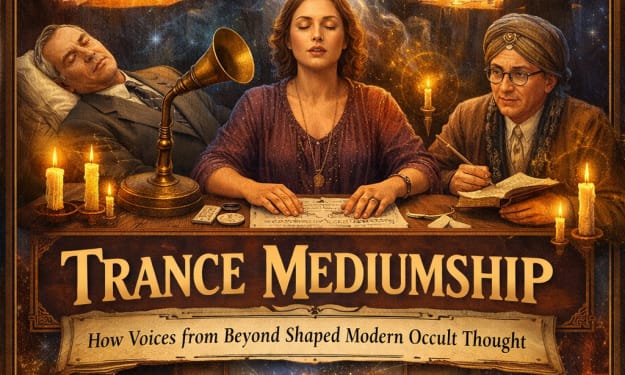
Trance Mediumship
The Living Voice in Altered States Trance mediumship holds a distinctive place within Western esoteric tradition. Unlike intuitive divination or clairvoyant perception, trance mediumship is defined by an altered state of consciousness in which speech, posture, facial expression, and temperament appear to shift under the influence of a perceived external intelligence. Observers have documented changes in tone, vocabulary, accent, and manner. Adherents interpret these manifestations as communication from discarnate beings. Psychical researchers have examined the same phenomena through frameworks of dissociation, subconscious cognition, and culturally conditioned religious experience. Occult practitioners have regarded trance as a disciplined method for accessing unseen dimensions of reality.
By Marcus Hedare6 days ago in BookClub



Comments
There are no comments for this story
Be the first to respond and start the conversation.