

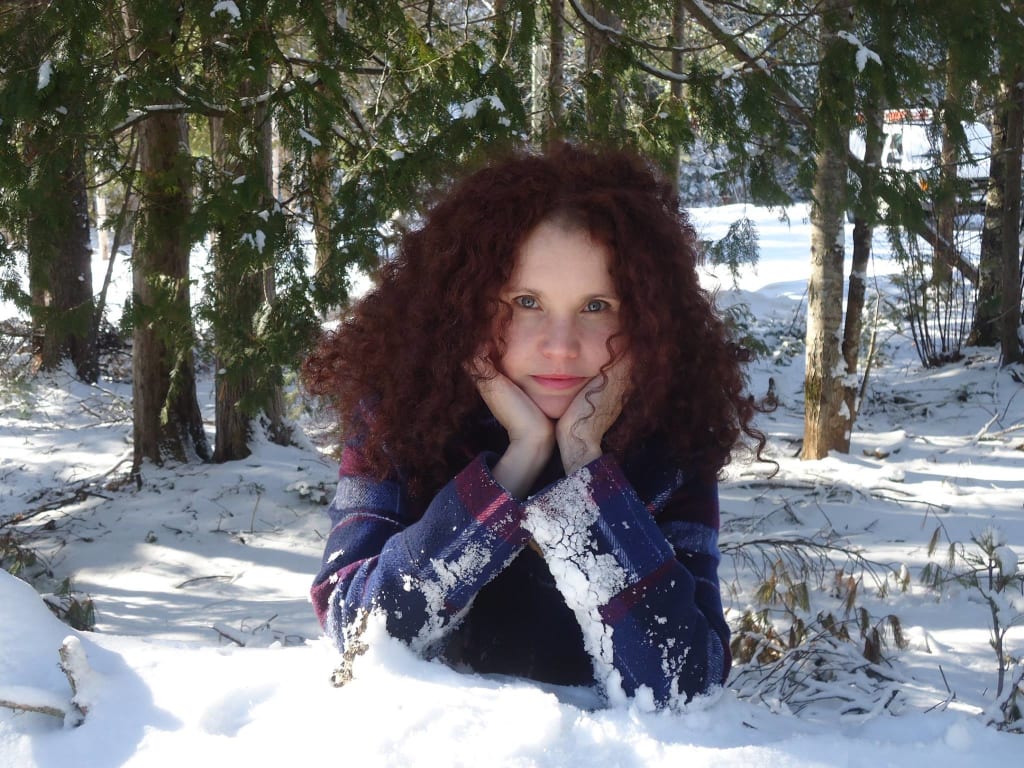
A friendly word of advice for anyone who happens to find themselves caring for a Black or Multiracial child; if you know nothing about curly hair, do find out. Ask your friends, watch some YouTube videos, something, anything. Trust me, it will save you, and your child a lot of grief in the long run.
I could write an entire book, perhaps a trilogy, on the frustration that my hair has given me over the years. I came into the world with a thick head of jet back, smooth straight hair. That hair was the pride of my parents when I was an infant with others often remarking at how, for a baby, it was so thick and full.
That ebony smoothness was not to remain, however. As I began to walk and talk, my hair began to change. It began to curl, softly at first, and to show tinges of red. My mother feared I would end up with red hair and later told me she prayed, actually prayed, every day during this time that I wouldn’t turn out to be a redhead. I didn’t. By the time I was 3, I had an enormous mop, well more like an afro, of frizzy, thick, wild brown curls. I was a little white-skinned girl with Black hair.
No one knew what to do with all this hair. It was too wild, too curly and there was simply too much of it. It overtook me and became the daily bane of my existence. You’d think that a Black couple would be ideally suited to deal with their adopted child’s Black hair, but no, not back then and not these parents. First, we’re talking about the ‘70’s and 80’s, products for Black hair weren’t available in smaller Canadian centres. Secondly, my parents weren’t exactly fashion conscious. They were simple people who weren’t overly concerned with running to the salon. My mother used to tell me all about the “hot combs” she and her sisters would use to manage their hair when they were younger, but also ruled out using any such thing on me as it was, in her opinion, too harsh for the hair of a child.
The solution was, at least in the early years, to focus on containing the beast by somehow tying it up to keep me look neat and tidy. My hair was perpetually put into braids or pigtails. But not two pigtails, three, one on each side and one in the back. I hated those pigtails! I was teased constantly about having the three of them. I saw other girls with cute little smooth ponytails, one in the back, or maybe one on each side, so sleek and shiny and nice. And then there was me, my hair divided into three sections, twisted into submissive finger-curls and secured tightly with elastics. Why three, you ask, the answer is simple, there wasn't yet an elastic on the market that would contain my hair in two equally sized ponytails without breaking under the strain,
Mornings became a battleground and the field was my head. My father took over the task of doing my hair because his hands were larger and stronger than my mother’s by the time I was 5. My mother simply couldn’t handle my hair; even divided into thirds, she couldn’t fit it all into her hand to secure it. My father would loudly proclaim, “gimmie her hair, I used to braid rope!”
I wasn’t rope; I was a little girl. The morning would start with wetting my tangled mess of a head and my father forcing a brush, then a comb through it. I’d cry because it hurt, anyone with hair like mine knows what I’m talking about. Curly hair gets knotted and getting those knots out hurts. My father didn’t start at the bottom and gently tease the knots out, he started at the top and just ripped through them. There was only so much time in the mornings. I had to get to school on time and he had to get to work. There was more hair than time.
Once my hair was sufficiently detangled; he’d take the end of the comb and part my hair into three equal parts and tightly secure each with an elastic. More crying. These weren’t loose comfy ponytails, these were tight, too tight, so tight, in fact, I could feel the skin on my face being drawn. I was always told to stop crying. Then each ponytail was tamed. He’d wet them and then twist them around his large index finger into submission, and then I’d be on my way.
I hated my hair. I longed to be like the other girls and that longing increased exponentially as I got older. Everywhere I looked, everyone had wonderfully smooth, tame, beautiful hair that lay flat and straight. Some had soft curls or, later, as the ‘80s came into full swing, feathers, and then there was me. I was filled with envy. All I wanted was to be able to wear my hair loose, to let it cascade down my shoulders, just like the other girls, to be able to go into the bathroom and comb it and fuss over it like them.
There were no Black people, where I grew up, aside from my family, for most of my time growing up, so I never saw anyone with hair like mine, aside from my mother, and that was little consolation to my young mind. I was teased with the mercilessness that only children can inflict on one another and was consoled by my parents with the standard line they used for everything, the other kids were just jealous. By the time I was 8 or 9, I wasn’t buying that, I was pretty sure there was nothing to be jealous of. I was the freak and if anyone was jealous, it was me of them.
I began to become defiant, at least as far as my hair went. I remember begging, when I was 9, to be allowed to do my own hair in the morning, just like the other girls. I mean, who, at 9 has their father as their hairdresser. My request was denied with the reason that I wasn’t old enough to handle the mess on my head properly. Picture day of grade 4 came and so did this first act of hair rebellion. I went to school with the standard three pigtails, and with the comb my mother had given me, to tame the few shorter fly-aways, I took the elastics out, combed it the best I could and let the beast loose!
I felt free! For the first time in I have no idea how long, I felt free. My face relaxed from the strain of the elastics being removed and for the first time, I could feel my hair on my shoulders. I got my picture taken. The other kids were in awe. They had never seen my hair out and I got more attention from my peers that day than I had ever gotten. Even the so-called cool girls (if one can be cool in grade 4) approached me and told me how cool and awesome my hair was and how I should “totally” leave it out all the time. I reveled in the attention and acceptance, but it was short lived.
I had to go home after school, and I knew I had to conceal my crime. There was really no concealing it, I couldn’t get my hair back into the pigtails they had been in. I was instantly found out and spanked by my mother accordingly. She didn’t seem to understand. I told her, I pleaded with her to understand that all I wanted was to be “normal”, to wear my hair out, like the other girls. She didn’t hear “normal”, she heard “white” and my head became our racial battleground for the next 35 years.
I fell into submission after that for a while, but that picture of me is still my favourite school picture. I wish I still had it. I felt pretty, it was one of the few times I did, in fact, only one of two times I felt pretty in my entire public-school career.
My next act of hair-defiance came right before I was to enter junior high. I was 12 and desperate for some level of emancipation to go along with what I felt was maturity. I took my money (my parents were always very generous with money; they didn’t have much, but they always made sure I had pocket money to buy burgers or records or whatever), and went to the mall, got my ears pierced, twice and got my waist long hair cut to just below my ears. Stylistically, a huge mistake, otherwise, a huge triumph.
First the triumph. The hairdresser was a nice lady, I can’t remember her name, but I remember she was probably in her fifties, chubby and very kind. She called all the other girls over to see the beast she was about to battle. They had never seen such a thing. Apparently, a hairdresser’s education didn’t include dealing with my kind of hair at that time (and didn’t, I was to learn, for decades afterward). She cut my hair as best she could, but she introduced me to a couple of new pals, conditioner and gel. She explained that my tangles could be easily dissolved if after I washed my hair, I put this magical serum in my hair, left it for a couple minutes and rinsed it out. And afterward, if I put some of this unsettled jello-looking substance in my hair, it would do what I wanted, more or less (turns out mostly less). I was sold! I got a haircut, two holes in each ear and shiny new bottles of conditioner and gel. A small, well maybe large piece of advice here, when taking your child to the salon, do make sure their stylist has some training and experience with Black hair.
My mother was LIVID! I mean seething, foaming at the mouth angry. Okay, granted, I did sneak off and get my hair cut and ears pierced without permission, but that wasn’t the issue. She hollered loudly about how I was not White and that I needed to accept it and never forget it. “You’re Black, don’t ever think you’re White,” was a phrase she’d repeat thousands of times over the years.
To me, it wasn’t an issue of race; it was an issue of hair and a pre-teen desire to fit in. My father smoothed things over, but my hair looked awful. I looked like I had a cotton ball on my head. I had a little brown afro.
To deal with the afro situation, I began to seek out creative ways to tame my thick curls. My favourite way at the time was to take a shower, brush my hair out straight and then take a nylon stocking and put it over my head. I’d cut the band so it didn’t choke me, and roll it up so my face was exposed, and go to bed like that. I’d awake to flat tamed curls. It wasn’t the straight hair that I wanted, but it was manageable, and I loved that my hair fell down close to my head and not out in some weird ever-expanding triangle. Of course, as the day went on, my hair expanded, curled back up and by noon, the afro would be back. After a few tries with the stocking, I gave up; hair 1: me 0.
Kids called me fuzzball and Q-Tip and I hated it! I did look like a Q-Tip, I was rail thin with a big old mess of curls on my head. My mother continued to alternate between encouragement, telling me the teasing was all jealousy and pointing out how White people got perms to have curly hair, and angrily admonishing me for what she saw as my wanting to be white.
Along with my newfound hair emancipation came another problem, the questions. Oh, man, the questions! The conversation went like this:
Well Meaning Person (WMP): You're such a pretty girl, but where did you get all THAT hair?
ME: Thank you, I take after my father.
WMP: But, what are you?
ME: (Confused look, thinking, well, I'm me, but I'm pretty sure that's not the answer you want.)
WMP: (Not content with silence, presses on) I mean, you must have "something" in you.
At the time, I was quite an indignant little thing and I really didn't feel obliged to outline my racial pedigree for every curious housewife that had never seen hair like mine before.
As I entered high school and beyond, I discovered curling irons and products and was able to sort of tame my hair. It took hours, but I could manage to get it to do a bit of what I wanted, and I did feel like I was blending in, which was nice. But, I remember even as an adult of about 40, I allowed a hairdresser to use a flatiron on my hair for the first time to straighten it, the thrill of the sleekness, the ease and sheer novelty of it was thrilling to me. I also remember still being admonished by my mother for even allowing the hairdresser to do such a thing and the anger that I was still rejecting being Black. I was over 40, I had become a lawyer, had 3 children of my own and my hair was still somehow an act of defiance. I wasn't rejecting anything, I was, and am extremely proud of my all of my roots, the Black the White the Jewish, all of it. I just wanted to know how straight, manageable hair felt. I wanted to know how it felt to get up in the morning and not have to embark on an hour long torturous journey of products, appliances and fussing.
Oddly enough, the answer was right in front of me all along and it was simple; leave it alone. That's right, shower, condition, a bit of product, a pic....and walk away from the hair. Do not touch, do not pass go, leave it alone! Let it do what it does because it's going to anyway.
I’ve learned to embrace my hair over the years. In fact, I’ve come to love it. It’s my power and my legacy. I learned how to control it and to let it be uncontrolled. I let my curls fall, I let the thickness show and I flip it around proudly. It’s become my trademark, it’s made me “me” and it's the perfect representation of what I am, a bit wild, hard to tame and with a mind of my own.
About the Creator
Misty Rae
Author of the best-selling novel, I Ran So You Could Fly (The Paris O'Ree Story), Chicken Soup For the Soul contributor, mom to 2 dogs & 3 humans. Nature lover. Chef. Recovering lawyer. Living my best life in the middle of nowhere.
Reader insights
Outstanding
Excellent work. Looking forward to reading more!
Top insights
Heartfelt and relatable
The story invoked strong personal emotions
Easy to read and follow
Well-structured & engaging content
Eye opening
Niche topic & fresh perspectives
Masterful proofreading
Zero grammar & spelling mistakes
Compelling and original writing
Creative use of language & vocab
On-point and relevant
Writing reflected the title & theme
Excellent storytelling
Original narrative & well developed characters
Expert insights and opinions
Arguments were carefully researched and presented
Is the Viral 10-Step Korean Skincare Routine Really Helpful?
The 10-step Korean skincare routine has been one of the most trending in the beauty world lately. It is claimed to provide us with glass-like skin. The beauty regimen is based on prevention and frequency, and it is geared towards using lightweight products to improve the skin barrier. But it is as good as it is and cannot be allowed in all cases.
By Good health to everyone7 days ago in Blush
The ultimate Ramadaan skincare guide for hydrated and radiant skin throughout the fast
The biggest skin concern during fasting periods is dehydration. There’s something quietly beautiful about the rhythm of Ramadaan. The stillness before dawn, the communal joy of breaking fast, the soft recalibration of body and spirit.
By Good health to everyonea day ago in Blush



Comments (2)
Thank you so much for opening up and writing about this, Misty. I remember in the university town I lived in for a while, my Black and multiracial friends struggled to find hairdressers. It's shocking to me that it isn't standard to teach how to correctly care for and handle different textures of hair in beauty school by now. Your hair is so beautiful! I am so glad you wear it out - it's perfect as is. 💓 Thank you so much again for writing and sharing this piece, Misty!!
As someone who's constantly being told that I'm not Mexican enough to be cast as the "ethnic" character they're looking for, but I'm not white enough to be cast as a "local" character either, I can relate to this in a personal level...! Thank you for sharing your story x