
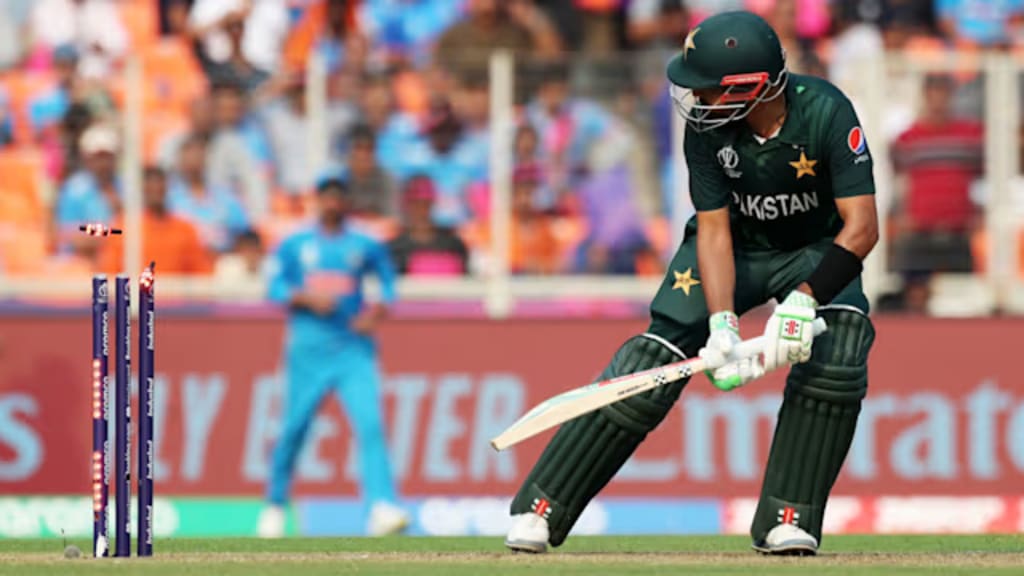
The basic rules are the same as for the longer versions, but innings are limited to 20 overs a side (an over comprises six balls delivered, or thrown, by a bowler to a batsman at the opposite wicket), with a maximum of four overs for each bowler and restrictions on the placement of fielders designed to encourage big hitting by the batters and high scores. In a short time, T20 became the most popular and lucrative form of cricket, particularly in India, where huge crowds attend matches in the Indian Premier League (IPL) and millions more watch on television. A shortened form of cricket known as Cricket Max was developed in New Zealand in the 1990s by the former Test batsman Martin Crowe, but the official rules for T20 were established by the England and Wales Cricket Board, and the first tournament was played by the English county teams, in 2003.
The format was quickly adopted by other countries, and two years later Australia and New Zealand played each other in a lighthearted T20 match in Auckland, the first official international T20 match. Both sides wore uniforms from the 1980s and wore (mostly fake) mustaches. It quickly became apparent, though, that T20 had the potential to attract a new, vibrant, young audience to cricket. The first T20 Men’s World Cup, organized by the International Cricket Council (ICC) and played in South Africa in 2007, was won by India, creating a huge market for T20 on the subcontinent that was quickly exploited by the IPL. Subsequent World Cups were played in various cricket-playing countries. Each major cricketing country developed its own domestic T20 tournaments, and a Champions League competition between the best club sides—like that contested in European football (soccer)—is held at the end of each T20 season. Starting with 12 competing teams in 2007, the 2014 World Cup went on to include 16 teams. The 2024 T20 Men’s World Cup saw further expansion, with 20 teams competing. Three teams made a T20 World Cup debut in 2024—USA, Canada, and Uganda. This was the first time a major ICC cricket tournament was held in the United States, the co-hosts for the event along with the West Indies.
Matches generally begin in late afternoon or evening so at least a portion of them are played under floodlights at night to maximize the television audience for worldwide broadcasts. Initially, league matches were played on a home-and-away basis between all teams, but, with the planned expansion to 10 clubs (divided into two groups of five) in 2011, that format changed so that matches between some teams would be limited to a single encounter. The top four teams contest three playoff matches, with one losing team being given a second chance to reach the final, a wrinkle aimed at maximizing potential television revenue. The playoff portion of the tournament involves the four teams that finished at the top of the tables in a series of knockout games that allow one team that lost its first-round game a second chance to advance to the final match.
With the advent of the IPL, almost overnight the world’s best cricketers—who had seldom made the kind of money earned by their counterparts in other professional sports—became millionaires. The owners of the IPL franchises—including major companies, Bollywood film stars, and media moguls—bid for the best players in auctions organized by the league. At the outset of the IPL, the well-financed Mumbai Indians had the league’s biggest payroll, more than $100 million. It cost the Chennai Super Kings $1.5 million to secure the services of Mahendra Dhoni in the initial auction for the 2008 season and the Kolkata Knight Riders $2.4 million to sign Gautam Gambhir, the opening batsman for the Indian national team, in the bidding for the 2011 season. Yuvraj Singh (2014 and 2015), Ben Stokes (2017 and 2018), Pat Cummins (2020), Chris Morris (2021), Sam Curran (2023), and Mitchell Starc (2024) are some other players who have been secured at the highest bids.
Cricket is played with a bat and ball and involves two competing sides (teams) of 11 players. The field is oval with a rectangular area in the middle, known as the pitch, that is 22 yards (20.12 metres) by 10 feet (3.04 metres) wide. Two sets of three sticks, called wickets, are set in the ground at each end of the pitch. Across the top of each wicket lie horizontal pieces called bails. The sides take turns at batting and bowling (pitching); each turn is called an “innings” (always plural). Sides have one or two innings each, depending on the prearranged duration of the match, the object being to score the most runs. The bowlers, delivering the ball with a straight arm, try to break (hit) the wicket with the ball so that the bails fall. This is one of several ways that the batsman is dismissed, or put out. A bowler delivers six balls at one wicket (thus completing an “over”), then a different player from his side bowls six balls to the opposite wicket. The batting side defends its wicket.
The eight founding franchises were the Mumbai Indians, the Chennai Super Kings, the Royal Challengers Bangalore, the Deccan Chargers (based in Hyderabad), the Delhi Daredevils (renamed to Delhi Capitals), the Punjab XI Kings (renamed to Punjab Kings) (Mohali), the Kolkata Knight Riders, and the Rajasthan Royals (Jaipur). In late 2010 two franchises, Rajasthan and Punjab, were expelled from the league by the BCCI for breaches of ownership policy, but they were later reinstated in time for the 2011 tournament. Two new franchises, the Pune Warriors India and the Kochi Tuskers Kerala, joined the IPL for the 2011 tournament. The Kochi club played just one year before the BCCI terminated its contract. In 2013 the Deccan Chargers were replaced in the IPL by the Sunrisers Hyderabad. The Gujarat Titans and the Lucknow Super Giants debuted in 2022.
IPL’s growth story
The first IPL tournament, held over 44 days in 2008, was won by the Rajasthan Royals, one of the smaller-market franchises, captained by Shane Warne, the great Australian bowler. The IPL has come a long way since its first season. According to a Forbes report in 2022, the average value of the IPL franchises shows an annualized growth rate of 24 percent, up from $67 million in 2009 (of 8 teams) to $1.04 billion in 2022 (of 10 teams). This growth in average team value, when compared with the past 13 years’ growth rate of 10 percent for National Football League (NFL) team values and 16 percent for National Basketball Association team values, is remarkable. Expectations about the 2023–27 media contract contributed to the team value in 2022. For the five-year cycle starting in 2023, streaming and TV rights were sold for a record total of $6 billion to Viacom18 and Star India (owned by Disney). This is more than double the amount at which media rights were sold for the previous cycle. Such has been the IPL’s success that the BCCI announced a new league for women’s cricket, the Women’s Premier League (WPL), which played its inaugural season in March 2023. In the wake of the IPL’s success, other cricketing countries scrambled to grab some of the riches by forming their own domestic T20 leagues. Major League Cricket (MLC), a U.S. T20 cricket league launched in 2023, also has its IPL connections: four of its six franchises have investments from IPL franchise owners, and many IPL cricketers feature in MLC.
There are two batsman up at a time, and the batsman being bowled to (the striker) tries to hit the ball away from the wicket. A hit may be defensive or offensive. A defensive hit may protect the wicket but leave the batsmen no time to run to the opposite wicket. In that case the batsmen need not run, and play will resume with another bowl. If the batsman can make an offensive hit, he and the second batsman (the nonstriker) at the other wicket change places. Each time both batsmen can reach the opposite wicket, one run is scored. Providing they have enough time without being caught out and dismissed, the batsmen may continue to cross back and forth between the wickets, earning an additional run for each time both reach the opposite side. There is an outside boundary around the cricket field. A ball hit to or beyond the boundary scores four points if it hits the ground and then reaches the boundary, six points if it reaches the boundary from the air (a fly ball). The team with the highest number of runs wins a match. Should both teams be unable to complete their number of innings before the time allotted, the match is declared a draw. Scores in the hundreds are common in cricket.
About the Creator
Keep reading
More stories from writers in Blush and other communities.
How to Use a Sugar Scrub the Right Way for Softer, Smoother Skin
In This Article ✅What Is a Sugar Scrub? ✅How to Properly Use a Sugar Scrub Your shower routine probably has all the basics covered: shampoo, conditioner, and sudsy body wash. But a fourth addition to this regimen—a good old fashioned sugar scrub—can make all the difference both in terms of your skin’s hydration and overall glow factor. With insights from a seasoned skincare pro, we’re diving into what sugar scrubs are and why they’re an absolute shower must, plus a quick rundown on how to properly use a sugar scrub.
By Good health to everyone6 days ago in Blush
How Independent Filmmakers Are Rethinking Film Financing
Over the past decade, the economics of filmmaking have been quietly transforming. For many years, large studios controlled most aspects of film production, from financing to distribution. Today, however, independent filmmakers are discovering new ways to bring projects to life without relying entirely on traditional studio systems.
By Andreas Szakacs4 days ago in Blush



Comments
There are no comments for this story
Be the first to respond and start the conversation.