
Crypto Lending vs. Staking: Key DeFi Investment Strategies
Discover the key differences between crypto lending and staking. Learn how these DeFi investment strategies work and boost your passive income today.

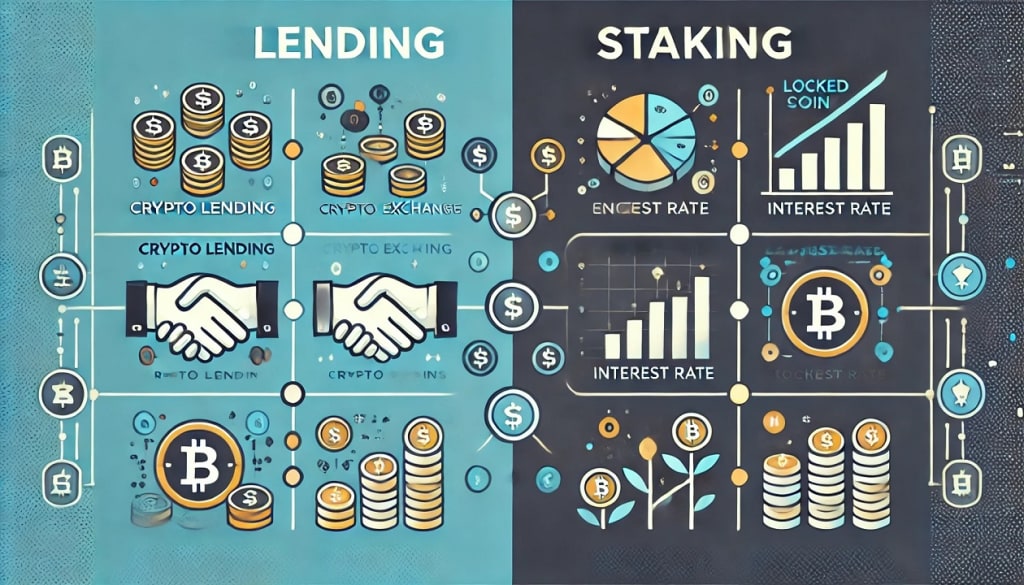
The rise of decentralized finance (DeFi) has created new ways to earn passive income through blockchain technology. Among the most popular methods are crypto lending and staking. These strategies allow investors to put their crypto assets to work while earning rewards. Understanding how each works can help investors choose the right approach based on their goals.
What Is Crypto Lending?
Crypto lending involves lending digital assets to borrowers through DeFi platforms in exchange for interest. It’s similar to traditional lending but operates without banks. Instead, smart contracts handle the entire process. Borrowers provide collateral, ensuring the lender’s funds are protected.
Crypto lending platforms offer various options, including fixed and flexible terms. Fixed-term lending locks assets for a specified period, while flexible lending allows withdrawal at any time. Lenders earn interest in cryptocurrencies, which can vary based on platform rates and demand.
How Crypto Lending Works
Depositing Funds: Users deposit their crypto assets into a lending platform.
Borrower Matching: The platform matches lenders with borrowers.
Interest Payments: Borrowers pay interest, which the lender receives as returns.
Collateral Management: Borrowers must maintain collateral to avoid liquidation.
Benefits of Crypto Lending
Passive Income: Earn interest on idle crypto holdings.
Asset Growth: Reinvest returns for compound growth.
Diversification: Spread investments across multiple platforms.
However, risks include platform hacks, market volatility, and potential borrower defaults.
What Is Crypto Staking?
Staking involves locking cryptocurrencies in a blockchain network to support its operations. This process secures the network while rewarding participants. Proof-of-Stake (PoS) and its variants like Delegated Proof-of-Stake (DPoS) are common mechanisms enabling staking.
When users stake their tokens, they validate transactions and create new blocks. In return, they receive rewards in the form of additional tokens. Staking is integral to many blockchain ecosystems, driving network security and decentralization.
How Crypto Staking Works
Choosing a Platform: Select a blockchain-supporting staking.
Locking Assets: Deposit tokens into the network.
Validation Role: Act as a validator or delegate tokens to a validator.
Earning Rewards: Receive token rewards to secure the network.
Benefits of Crypto Staking
Earn Rewards: Receive staking rewards regularly.
Network Support: Contribute to blockchain stability.
Lower Entry Barriers: Start with minimal technical knowledge.
Staking risks include asset lock-up periods, market volatility, and potential validator misbehaviour.
Crypto Lending vs. Staking: Key Differences
While both methods generate passive income, they differ in functionality, risk, and potential returns.
Earning Potential: Lending offers higher interest rates due to borrower demand while staking yields depend on network inflation rates.
Risk Levels: Lending carries counterparty risks, while staking involves network-specific risks.
Asset Control: Lending platforms hold assets, while staked tokens remain on the blockchain.
Flexibility: Lending terms vary while staking often requires lock-up periods.
Choosing the Right Strategy
Investors must consider risk tolerance, investment goals, and market conditions before deciding. Those seeking higher returns with manageable risks may prefer lending. Staking suits long-term holders supporting blockchain ecosystems.
The Role of Crypto Token Development in DeFi
Crypto token development has fueled the growth of DeFi platforms. Custom tokens power lending and staking ecosystems, enabling seamless transactions. A reputable crypto token development company can build tokens that integrate with lending and staking platforms, ensuring efficient DeFi operations.
Key Features of Tokens for Lending and Staking:
Smart Contract Integration: Automates lending and staking processes.
Security Protocols: Protects funds and prevents hacks.
Liquidity Provision: Supports market operations through decentralized exchanges.
Why Choose a Crypto Token Development Company?
Developing DeFi tokens requires technical expertise and blockchain experience. A reliable crypto token development company creates custom tokens with essential features, ensuring compatibility with DeFi protocols.
Partnering with a token development firm ensures scalable solutions, allowing platforms to expand and offer more services like lending, staking, and yield farming. This approach drives DeFi adoption and opens new revenue streams for investors.
Conclusion
Both crypto lending and staking are essential DeFi investment strategies. They offer unique ways to generate passive income while contributing to blockchain ecosystems. Understanding their differences helps investors make informed decisions based on risk tolerance and investment goals.
Additionally, crypto token development plays a vital role in shaping DeFi platforms. Partnering with an experienced crypto token development company ensures secure, scalable, and efficient tokens, driving innovation and financial growth in the decentralized world. With the right strategy and technological backing, investors can unlock significant returns in the ever-evolving DeFi landscape.
About the Creator
Sneha Ahlawat
I'm Sneha Ahlawat, Senior crypto marketing expert at Wisewaytec. Wisewaytec offers comprehensive crypto marketing services, expertly crafted to elevate your brand in the dynamic digital landscape.
Keep reading
More stories from Sneha Ahlawat and writers in Blush and other communities.
Exploring the Future of Crypto Marketing in Virtual Real Estate and NFTs
The world of crypto marketing is evolving at a rapid pace, and one of the most exciting areas is the growing intersection between virtual real estate, NFTs, and blockchain technology. As the popularity of virtual spaces continues to rise, crypto marketing agencies are increasingly stepping up to help businesses navigate these new realms. In 2025, virtual real estate and NFTs are expected to become even more central to crypto marketing strategies. The integration of blockchain-based assets into virtual environments is creating new marketing opportunities that businesses are just starting to explore.
By Sneha Ahlawatabout a year ago in Blush
Top 10 Hair Extension Brands to Consider in 2026
In the world of high-end beauty, hair extensions are more than just an accessory—they are a transformative tool for volume, length, and artistic expression. For salon owners and stylists, the brand you choose defines your reputation. For the consumer, it defines their confidence.
By Alex Morgan4 days ago in Blush
Mastering the Art of Men’s Hair Highlights: A Guide to Depth, Texture, and Style
In the modern world of men’s grooming, a great haircut is only half the battle. To truly stand out, many men are turning to color—specifically highlights—to add personality and sophistication to their look. According to the comprehensive guide by New Times Hair, A Complete Guide to Hair Highlights for Men, highlights are no longer just a trend; they are a powerful tool for adding dimension and life to otherwise flat hairstyles.
By Emma Smith7 days ago in Blush
Miss Persephone's Manual to a Seemingly Ordinary Life
Miss Persephone was found at the dining table, her blue eyes swollen, her tears arriving and retreating like the tides of the ocean. Earlier that day, her family had visited her in the retirement home where she had lived for eight years. It was her eightieth birthday.
By Imola Tótha day ago in Fiction




Comments
There are no comments for this story
Be the first to respond and start the conversation.