
A love beyond time
A 4800 years old proof of a mother’s eternal bond from Taiwan

---
A Love Beyond Time
A 4,800-Year-Old Proof of a Mother's Eternal Bond from Taiwan
In every civilization, religion, and culture across the globe, the word mother is a relationship too profound to be captured in words. Languages, nations, ideologies, and customs may evolve over time, but the essence of a mother’s love remains unchanged. A recent discovery in Taichung, Taiwan, has reminded the world of this very truth. More than just an archaeological milestone, this find is a timeless testament to the deepest of human emotions—a mother's love.
The Background of the Discovery
This incredible discovery emerged during a routine construction project. As the ground was excavated, archaeologists unearthed a site that would later be named “The Ruins of Anhe.” The site revealed 48 human skeletons, over 4,000 fragments of pottery, and nearly 200 shark teeth. But what truly stunned the world was the sight that lay at the heart of it all—an image so powerful that it transcended time itself.
A Mother’s Final Embrace
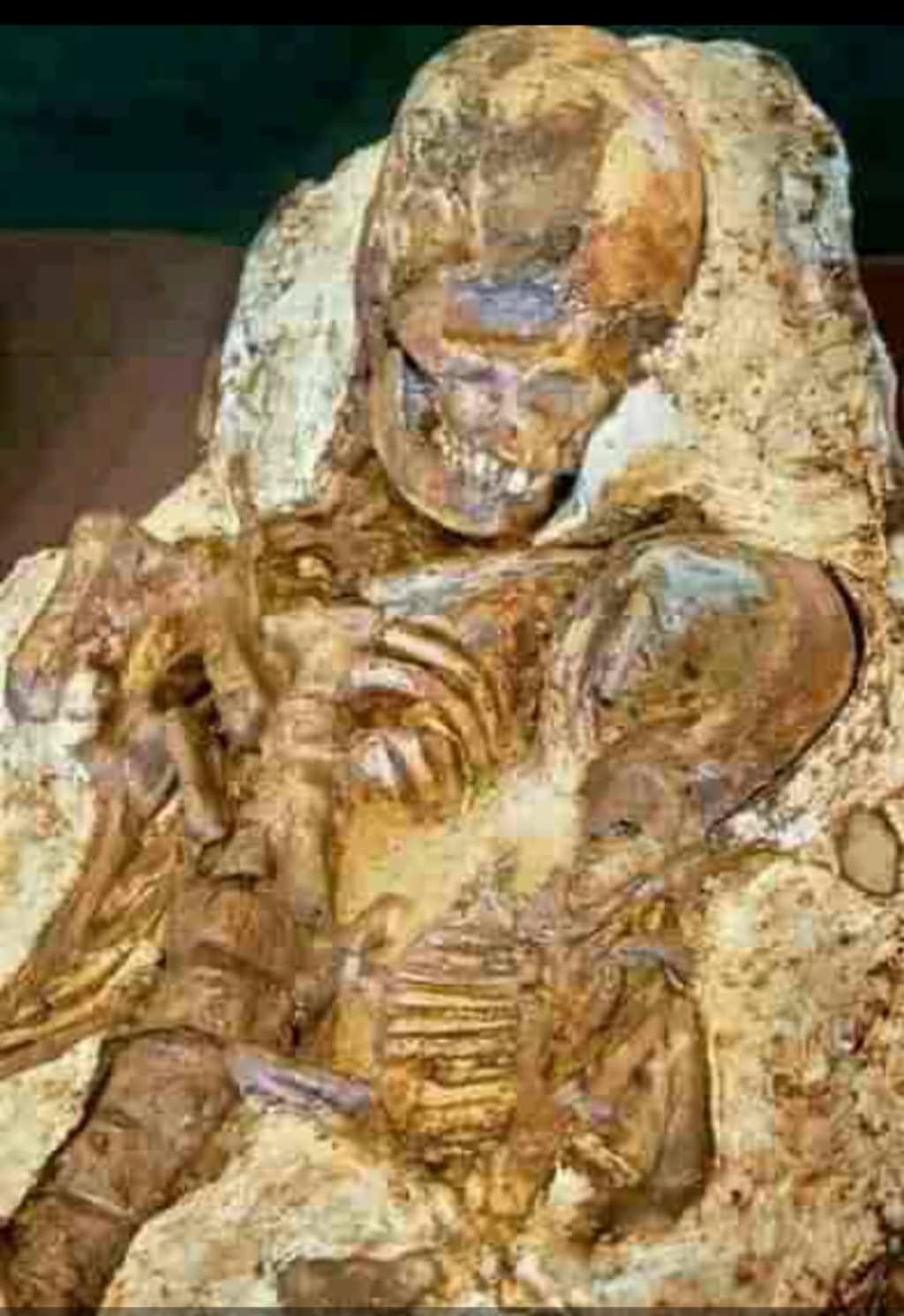
Archaeologists were left speechless when they uncovered the remains of a 20 to 25-year-old woman, lying in a position that showed she was cradling her six-month-old infant in her arms. Her head was bent down, as if gazing lovingly at her child, holding him close to her chest. It seemed as though, even in death, her only instinct was to protect and comfort her baby.
This was more than a skeleton—it was a frozen moment of unconditional love, preserved for nearly five millennia.
Dr. Chou Wei-Li of the National Museum of Natural Science in Taiwan reflected on the moment, saying:
> “When we discovered the scene, the entire team stood still in awe. We've excavated many skeletons before, but never have we seen something so emotionally powerful—a mother refusing to let go, even in death.”
Scientific Insights
Initially, it was assumed that the child might have died during childbirth and the mother soon after. However, further analysis revealed that the infant was approximately six months old at the time of death. Both mother and child likely perished together in a sudden natural disaster or tragic accident, their final moments forever captured in their embrace.
Carbon dating confirmed that these remains are approximately 4,800 years old, making this the oldest known evidence of human life in central Taiwan.
A Glimpse into an Ancient Civilization
Thousands of years ago, this area was located near the coastline. Archaeologists link this find to the Dapenkeng culture, part of the Neolithic period, and believe the people belonged to the Austronesian ancestral group.
In this society, men typically hunted or fished, while women engaged in agriculture, cooking, and childcare using tools made of stone. The recovered pottery, bone tools, and shark teeth provide a vivid glimpse into daily life during that era.
The discovery shows that, even nearly five millennia ago, the emotional bonds between a mother and her child were just as strong as they are today.
More Than Archaeology—A Window to the Human Heart
When we think of archaeology, we often picture dust-covered ruins, bones, and forgotten relics. But this discovery proves that history is not only a record of dates and empires—it’s also a reflection of love, grief, and humanity.
This ancient mother, who died holding her child close, speaks to us across time with a message louder than words:
Love is not bound by time.
A mother's bond never fades.
History is not just about kings and battles—it is about the stories of ordinary people, too.
A Lesson for the Modern World
In today’s high-tech world—where humans have set foot on the moon and artificial intelligence is reshaping society—we often forget the basics of compassion, selflessness, and emotional connection. This mother, who passed away nearly five thousand years ago, reminds us of what truly matters: the enduring, selfless love we often take for granted.
Her story offers us a message in this materialistic age:
> “No matter the era, location, or culture—a mother’s love remains unchanged.”
In Conclusion
The mother and child buried at The Ruins of Anhe may be long gone, their bodies returned to dust, but their love has defied time. That mother, who refused to let go of her child even in death, has now become a symbol of eternal motherhood.
Even after 4,800 years, she teaches us:
Motherhood is not just a relationship—it is a sacred vow.
A mother’s love needs no language, calendar, or validation.
And even when reduced to bones, a mother’s embrace continues to teach us the meaning of life.
---
About the Creator
New stAr writer
💌 If you love romantic stories, subscribe to my page and be part of a new story every day.
✨ Feel every shade of love — only here!
Keep reading
More stories from New stAr writer and writers in Blush and other communities.
: You Are Mine
--- You Are Mine — A Love That Defeated Destiny — The gentle drizzle tapped against the windowpane like a thousand tiny fingers, each drop singing a soft lullaby. Ali sat in the quiet corner of his small apartment, cradling a steaming cup of tea between his hands. The scent of cardamom rose with the steam, mixing with the fresh, earthy fragrance of rain drifting in through the half-open window. Lahore’s winter evenings always carried a bittersweet charm — cold enough to make you wrap yourself in a blanket, yet warm in the way they stirred old memories.
By New stAr writer 7 months ago in Writers
Safe & Hygienic Brows in Atlanta: What Clients Should Know
Getting permanent brows can be a life-changing beauty decision. Whether you choose combination brows, microblading, or ombré powder brows, safety and hygiene must be your priority. This is because these procedures that involve depositing pigment into the skin, genuine sanitation, and professional standards are needed to protect your health and achieve the best results.
By Milla Rosen7 days ago in Blush



Comments
There are no comments for this story
Be the first to respond and start the conversation.