
Various Cymbal Types: How to Choose
It’s easy to tell a cymbal when you see or hear it. But not all cymbals are made equal. When you start thinking of your drummer career,

It’s easy to tell a cymbal when you see or hear it. But not all cymbals are made equal. When you start thinking of your drummer career, cymbals need your attention. Do you need regular or low-volume cymbals? Are you ready to pay for an A-brand, or willing to save on using a Chinese copy? Here are the briefest answers.
The Most Popular Cymbal Types
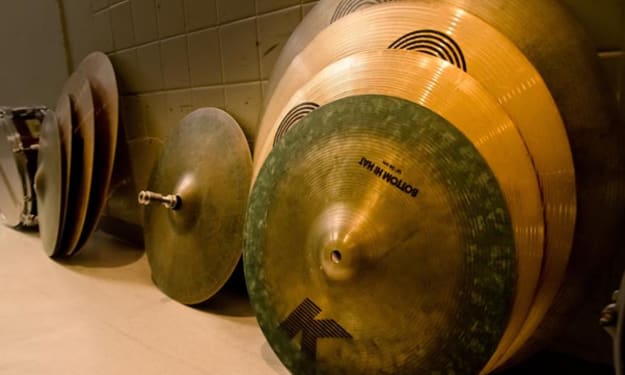
While the whole variety of cymbals available now is enormous, given exotic types, there are three most popular types that a modern drum kit has by default:
- Crash cymbal. Its sound is the most aggressive, accenting the highlights of the drum track. It’s played relatively rarely, though it’s always distinct, similar to Oriental gongs (the resemblance is not accidental).
- Ride cymbal. Less aggressive than a crash, it’s meant to be played throughout the song, contributing to the rhythm.
- Hi-hat. The finest sounds it produces are highly variable because it’s effectively a pair of cymbals that can be kept at some distance (open) or pressed against each other (closed) with a pedal. It’s also meant to be played throughout the song or its part, usually following a recurring pattern, though not always.
- Hi-hats are, in fact, irreplaceable. As for crash and ride cymbals, sometimes the pair is replaced with one cymbal that can be used as either, depending on the way you hit it. It’s easier to learn the basics with such a set, and some even play it seriously. It also makes sense if you introduce some exotic drums and, in this way, it helps reduce the default part of your drum set in favor of its extensions.
Regular vs. Low-Volume Cymbals
The regular cymbal sound is crisp and bright, mostly in the trebles, with a distinct echo that can be cut with special closing moves. Still, there is demand for low-volume cymbals. Mostly they are used for learning, as they deliver a similar physical feel but much less sound. Sometimes you may need that low volume mode at studios to record something specific that requires a more tender touch. So, which one are you to choose?
It seems logical to have a dedicated set for practicing to avoid wearing out the one you play at gigs or at studios. But when you need less practice (probably due to an intensive gig schedule), you may go with your basic one, just using silence pads on snares and toms and elastic rubber coverage on cymbals. It reduces the sound while preserving the same physical feel.
Vendors and Brands
There have been some established brands in the world of cymbals until recently. American-made Zildjian and Sabian, along with Meinl from Germany and Paiste from Switzerland, have been the Big Four and still remain so. Being quite expensive, their cymbals are always high-quality, and there is never a problem with service or accessories. Other manufacturers, many of them based in the Mediterranean countries (Turkey, Italy), exploit their centuries-long traditions to make distinct but not cheap cymbals.
And yes, many Chinese brands popped up recently, like Wuhan, Arborea, Zhangqiu Jin Sheng Yuan, and others. Will they ever compete with those above in terms of quality? Buddha knows. But if you need them just as expendables for hard practicing (so-called shredding), they are a good option.
Coda
It’s even less than a brief introduction to the world of cymbals. So you may continue our trip in the comments, no matter if you want to ask questions or to reply. It will be great if you share this on Facebook or Twitter to start a conversation with your friends. And we want it to be crisp, loud and clear.
About the Creator
Ali Akbar
Ali Akbar is a Brand and Marketing Strategist who partners with entrepreneurs to grow their personal and professional brands, human-to-human. After spending nearly 4 years, Ali's knows what truly drives conversions, sold-out launches.
Review of 'Man on the Run'
My wife and I saw Man on the Run, a nearly 2-hour documentary on Amazon Prime, about Wings, Paul McCartney's group that flew around the world from shortly after The Beatles broke up in early 1970 to shortly after John Lennon was murdered at the end of 1980, making a Beatles reunion forever impossible.
By Paul Levinson2 days ago in Beat
Trickle Them Down, But Not Out
The thing about smart people is that they should know better, but alas, intelligence is not the same as wisdom. Not only do the mistakes of experts too short on vision—when they are not corrected—have the potential to do great and far-reaching damage, but they also undermine public confidence in the very notion of expertise. This is particularly so when expertise is wielded in defence of the rich and powerful as a cudgel against those laid low. As an academic, this lack of faith in “so-called experts” is painful to see as it plays out in the spread of dis-/misinformation, conspiracy theories, and anti-intellectualism writ large. But it is also an understandable impulse given the catastrophic failure of an economic ideology pushed by certain economic experts. Supply-side economics has shaped a broken system for the last half-century and has arguably done more to undermine the fabric of the American Dream than any policy framework of the past century.
By Cory Wright-Maley6 days ago in Humans


Comments
There are no comments for this story
Be the first to respond and start the conversation.